Week 10 tight end is a pressure point—middle-field answers decide possessions while injury sheets harden and depth charts stop pretending. Buffalo keeps tilting its pass game inside; when tempo rises, Dalton Kincaid’s slot-seam menu turns hot reads into YAC and thickens the red-zone tree. Los Angeles has found a big-slot hammer in Oronde Gadsden II, with route rate in starter territory and RPO stick/seam punishing linebackers who bite the run fit. Berlin reframes the morning: Kyle Pitts gets Gus Bradley’s spot-drop world on a fast track, where motion and play-action can bend the hook/curl and open the seam before the post safety arrives. The other side bites hard. Baltimore’s quarters-match and robber tags choke the very window T.J. Hockenson needs—even with J.J. McCarthy back, Minnesota’s first-read flow skews boundary, not between the hashes. MetLife trims splash for David Njoku; the Jets win with four, live in match, and force tight ends into catch-and-tackle outcomes. Bye attrition steals a few brand names, so the levers matter more than the logos: route rate in the nineties, TPRR north of a quarter, first-read usage on money downs, and real end-zone involvement. Through that lens, we’ll press the seams that travel—and fade the rooms built to smother them.
Follow my handle @dansby_edits for more fantasy football advice, as well as plenty of NFL and college football betting goodies.
Start ‘Em
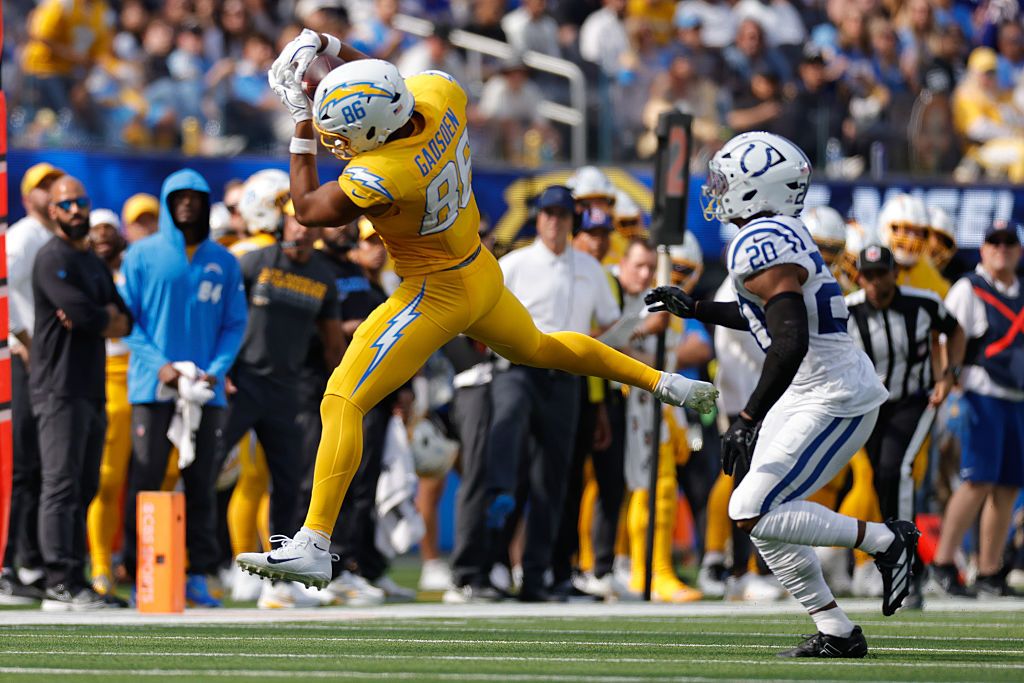
Oronde Gadsden, Los Angeles Chargers (vs. Pittsburgh Steelers)
SoFi’s Sunday night track flatters Oronde Gadsden II’s stride, and the usage now roars like a starter’s drum. The ramp tells the story: route participation has climbed from 29% to 94% over the past six games, with snaps pushing into the high-70s last week. He’s stacked four straight with at least five catches and sixty yards, and the season line sits at 32-453-2 with a 14.2 yards-per-catch clip. That’s not gadget noise; that’s a full-time seam merchant living in the teeth of the defense.
The opponent profile screams continuation. Pittsburgh has bled production to the position all year—fifty receptions, 581 yards, and six touchdowns allowed—which translates to the third-most PPR points per game to tight ends. Their identity layers heat and single-match rules: a top-three blitz rate with elevated man snaps that stress the flats and leave the hook/curl to scramble. That is exactly where Gadsden eats, settling into windows on glance and bending the seam when safeties pinch crossers.
Quarterback context is the tailwind. Justin Herbert sits top-two in passing yards and air yards, with time-to-throw near 2.75 seconds and an 18-touchdown ledger that keeps red-zone volume live. When blitz arrives, his hot path narrows inside: play-action glance, RPO stick, seam read. Gadsden’s catch radius widens those solves, and his recent 90%-plus route share means he’s on for every answer.
This is that lovely confluence point where usage meets geometry. Start him as a top-six option in full PPR and let the middle of the field pay. If Pittsburgh keeps sending five, the hot-read seam becomes a conveyor belt; if they soften to quarters, glance and choice routes turn into chain-moving volume with touchdown equity attached.
Dalton Kincaid, Buffalo Bills (at Miami Dolphins)
Buffalo’s quick-game cadence drops Dalton Kincaid right into the heartbeat of this script. The role is no longer emerging; it’s entrenched. Over his last four, route participation has hovered 88–92%, slot rate sits around 60%, and he’s cleared 75% of team dropbacks as a first-string runner every week. Volume follows structure: 22–24% target share across that stretch, 0.26 TPRR, and a rolling 1.95 YPRR that climbs past 2.2 against zone. The money downs are sticky—seven red-zone targets in four games—and the intermediate teeth bite at 8.5–9.0 aDOT, right where Buffalo layers dagger and glance off condensed splits.
The matchup? Ideal. Miami ranks bottom-five in PPR points allowed to tight ends, bottom-three in yards, and near the bottom in touchdowns conceded to the position. Their coverage palette tilts zone on early downs with simulated pressure pre-snap; hook/curl landmarks keep vacating when blitz and bluffs tug second-level eyes. That’s Kincaid’s office. On stick, seam, and glance, Josh Allen’s on-schedule throws (time-to-throw ≤2.6s) feed Kincaid’s catch-and-turn game; when Miami heats with five, the hot path drives inside and the ball arrives on time. Add a sturdy hands profile—<5% drop rate this month, >115 passer rating when targeted—and every possession carries chain-moving equity.
Environment tilts full. A total near 50 and a Bills team total in the mid-20s imply multiple red-zone trips, and Buffalo’s positive early-down PROE keeps Kincaid embedded as a first-read answer. If injuries compress the auxiliary target tree, his middle-field share consolidates further.
Kyle Pitts, Atlanta Falcons (at Indianapolis Colts [Berlin])
Pittsburgh’s middle lives in Pat Freiermuth’s hands—Y-iso, sit-and-whip, and pivot routes that punish linebackers who overstep. Over his last three, he’s logged routes on 82% of dropbacks with a 23% targets-per-route clip and a 27% first-read share—that’s feature usage, not a safety valve. The efficiency matches the workload: 1.78 yards per route run, 73.9% catch rate, and 0.29 EPA per target, with five red-zone looks in that stretch and four end-zone targets on the season. He’s also converting money downs; on third down he’s at 2.05 YPRR with a 52% first-down rate when targeted.
Green Bay invites tight-end damage. The Packers have allowed 8.6 yards per target to TEs (bottom-five), 65.1 yards per game to the position, and six touchdowns—a profile that bends between the hashes. Their coverage diet is zone-forward—quarters and Cover-3 rotations on roughly 72% of snaps—and Freiermuth thrives there: 76% catch rate vs zone, 2.03 YPRR, and a 115.8 rating when targeted. Pressure won’t erase him, either. Green Bay’s pressure rate sits at 31% (middle tier), and Pittsburgh’s quick-game counters—stick, spacing, and snag—place the tight end right in the hot window.
Game state leans his way. In the red area, Pittsburgh’s pass rate climbs above 55%, and Freiermuth owns 33% of the targets inside the ten. The scripted openers typically feature him on shovel threats and pivot settles; later, the call sheet layers dagger/seam once safeties start driving the slants. Sunday night spot, compressed possessions, and a defense that concedes the middle? That’s his lane.
Sit ‘Em
T.J. Hockenson, Minnesota Vikings (at Baltimore Ravens)
Sit T.J. Hockenson vs. Ravens, even with J.J. McCarthy back. The usage desert hasn’t budged: routes in the mid-80% look healthy, yet the volume has cratered—target share 12–14%, first-read share 11–13%, rolling efficiency ~0.90 YPRR, aDOT 5–6. Red-zone leverage is thin: one high-value look across the last three, with a per-route red-zone rate under five percent. McCarthy stabilizes play-action and keeper, but his first-read map skews boundary—Jefferson and Addison on glance, speed-out, and comeback—while Hockenson lives on sit routes that require clean timing.
Baltimore is a bad lab for that timing. The Ravens sit top-three by EPA/dropback allowed with a 40% success rate against passes, and they generate top-tier pressure without sending extra bodies. That four-man heat lets them live in quarters-match and robber, erasing glance, buzzing crossers, and choking the very window Hockenson needs to catch on the move. They’ve been stingy versus the position all year: bottom-five in TE PPR points, sub-40 yards per game allowed to TEs, and a low red-zone TD rate that forces perfect sequencing. Pressure-to-sack conversion is efficient, too, which pushes checkdowns to backs instead of middle-field sits.
A low-40s total and a modest implied team number mean fewer trips inside the ten and less need to spam middle-field answers. If Minnesota leans boots, the eyes fly to Jefferson’s boundary ISO or Addison on the over; if they chase quick game, the ball comes out before Hockenson clears the hook/curl.
Against Baltimore’s structure and with McCarthy targeting early reads outside, Hockenson profiles as a volume-starved TE2. Park him and chase routes that own first reads and red-zone equity.
David Njoku, Cleveland Browns (at New York Jets)
When the Jets crank the rush, that’s where Njoku’s profile starts to fray. The usage looks pretty on paper—route participation living in the mid-80s with plenty of in-line snaps—but the earning hasn’t matched the cardio: target share hovering in the teens, first-read share around the low teens, and a rolling YPRR stuck in the ~1.0–1.2 range the past month. The aDOT lives shallow at five to seven yards, and the red-zone diet has thinned to a trickle, with per-route red-zone looks sliding beneath the position’s TE1 cohort. When Cleveland pushes play-action, the ball has gravitated to perimeter digs and backs on leaks rather than the hook/curl sit where Njoku historically cashes.
The matchup is hostile. New York’s defense ranks top-tier by dropback efficiency and pressure rate, winning with four and letting quarters/three-match erase the easy seams. Tight ends have been forced into catch-and-tackle outcomes—bottom-eight YAC per reception allowed to the position, stingy red-zone conversion, and a low explosive rate through the middle. That geometry matters for Njoku’s profile: he needs on-the-move catches between the hashes to spike; instead he’ll see hip-to-hip match on crossers and a robber squatting under glance. Pressure-to-sack conversion climbs in this building, which shortens routes and steals second-reaction throws that sometimes save tight-end lines.
Game texture doesn’t bail him out. A total scraping the low 40s with Cleveland’s implied in the low 20s caps drive count and high-leverage snaps. Unless he lucks into a schemed low-red play, you’re banking on six targets of shallow air and hoping for a busted tackle.
Bench him. Let someone else chase the helmet; you chase first-read share, red-zone equity, and a defense that actually yields the middle.