Week 10 is a cold November crucible—install tweaks stick, injuries harden into plans, and coordinators trade sizzle for answers as playoff math sharpens. The rookie drum is loud in Chicago after Caleb Williams’ wild Week 9 finish, and the room believes it, with design runs and quick-game tempo now glued to the script. Berlin wakes first on Sunday with Falcons–Colts, a pace lever inside an international window that often juices early-down aggression and invites fourth-down conviction. Houston reshapes the map: C.J. Stroud is out, Davis Mills starts, and the Texans’ defense keeps charting top-tier by EPA, which drags Trevor Lawrence into longer downs and thinner explosives. Minnesota’s lens centers on J.J. McCarthy’s return arc while Baltimore manages Lamar Jackson’s hamstring through a week of spotlight questions, reshaping tempo and red-zone geometry in both windows. The bye cuts deep—Chiefs, Bengals, Cowboys, and Titans off the board—so usage levers matter more than logos; early-down PROE, first-read rate, and red-zone pass rate decide spikes. Washington’s coverage keeps bleeding explosives and passer rating, making that secondary a weekly tilt for rhythm throwers and a clean runway for layered overs and glance. The primetime bookends carry weight: Raiders–Broncos opens the week and Lambeau closes with Packers–Eagles amid fresh injury watch, but our pool lives in the Sunday crush. And inside that crush, two currents define the slate: Matthew Stafford’s heater—five in London, four against New Orleans, a metronome of motion-aided daggers—and Sam Darnold’s MVP surge, a clean-pocket clinic of timing, deep-intermediate accuracy, and mistake scarcity that keeps drives humming. With that context, Week 10 favors clean-pocket distributors and creators whose rushing equity converts first downs—and punishes big names walking into elite defensive geometry; we’ll ride the structure, fade the teeth, and press the matchups that travel. With that context, I’ve got three quarterbacks to start this week; two to sit.
Follow my handle @dansby_edits for more fantasy football advice, as well as plenty of NFL and college football betting goodies.
Start ‘Em
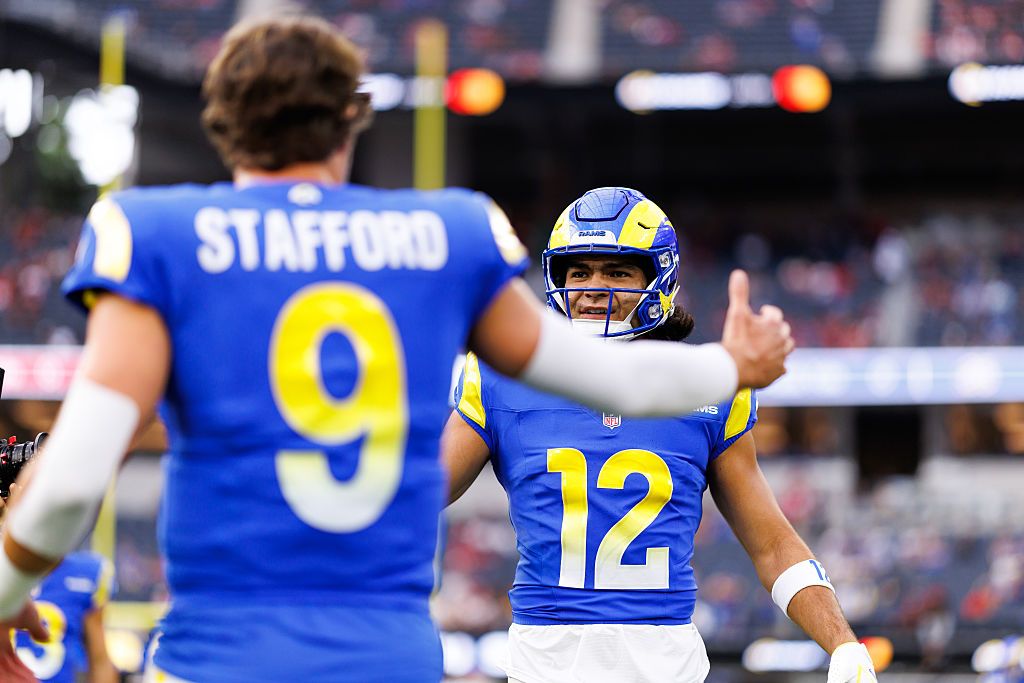
Matthew Stafford, Los Angeles Rams (at 49ers)
Matthew Ice (about whose stellar 2025 MVP-tear season I wax poetic here) walks in with the trigger hot and the plan crisp. He leads the league with twenty-one touchdowns against two interceptions and sits on a 66.5 QBR. That’s bankable efficiency for a veteran who’s seeing everything clean right now. He just thumped New Orleans 34–10 with 24-of-32 for 281 and four, inside a possession strangle. The heater is real, not noise.
San Francisco’s aura still sells fear, but the personnel losses matter on grass. Fred Warner is out for the season, and Nick Bosa is out, too. Rookie first-rounder Mykel Williams just joined them on the shelf. The pass rush has sagged to bottom-tier win rates, and the back seven has been stressed. That’s the exact ecosystem Stafford punishes.
The market agrees this tilts toward points; Rams-Niners carries Week 10’s highest projected total, with Los Angeles laying a field goal-plus. Stafford already hung 389 and three scores on San Francisco in Week 5’s overtime thriller, and the Rams have since stacked 35 and 34. The rematch brings similar leverage: clean pockets, layered crossers, and manufactured explosives off motion. Levi’s rarely forgives late rotations.
Under the hood, the signal is bright. Stafford’s at 8.2 YPA and sits top-ten in EPA per dropback, with a tight turnover-worthy rate. He’s pairing quick-game rhythm with timely deep shots, and the drive value keeps humming. Opposite him, the 49ers’ pass defense has allowed a 102.5 opponent rating and fifteen passing touchdowns. Pressure hasn’t landed consistently, and their depth defenders are getting isolated.
If San Francisco can’t heat him with four, Stafford will fillet their zones on glance, dagger, and rail. Pencil him as a Week 10 start with top-five upside. The matchup gives him runway, and the environment invites aggression. Expect McVay to spam motion, widen leverage, and keep Stafford in rhythm. The arm talent meets answers; the numbers say blast-off.
Jaxson Dart, New York Giants (at Chicago Bears)
the window is ripe for Jaxson Dart to fire. Chicago’s defense invites quarterback scoring, allowing the fourth-most fantasy points to the position at 25.4 per game. The market nods toward offense anyway: Bears −3.5 with a 48.5 total. That signals pace, short fields, and red-zone reps if the Giants keep script.
Dart’s early ledger travels. He’s sitting on 1,175 passing yards with ten touchdowns against three picks and a 60.8 QBR. He’s added 251 rushing yards and five rushing scores, which stabilizes floor when pockets muddy. he sacks are real—nineteen through eight games—but Chicago’s front hasn’t consistently won the first move. ESPN’s pass-rush win rate slots the Bears twenty-seventh, a crucial tell for a rookie who punishes clean edges with rhythm and keeper threats.
Dennis Allen’s coverage palette leans dime and more defensive backs in slot fits, which trades heft for disguise. That’s fine; Dart’s best weeks have leaned on quick game, RPO, and second-reaction sprints that make disguises pay late. Wan’Dale spacing, backs on arrows, and seam tags to the tight end should carve the underneath while Chicago protects its corners. If the Giants reach forty neutral-script dropbacks, Dart’s dual path to points—glance to run, dagger to scramble—stays live.
If Chicago can’t win with four, Dart will throttle their zones with glance, speed-outs, and keeper-boot explosives. The thesis is simple: bad QB defense, softened rush, and a live runner with red-zone equity. The floor sits near high-teens in full PPR scoring formats with realistic mid-twenties upside if New York trails and pushes tempo. The spread and total encourage aggression, and the matchup’s pressure math finally tilts toward him. Start Dart with confidence; the legs plus defined quick-game answers make this a green-light Week 10 play.
Jared Goff, Detroit Lions (at Washington Commanders)
Detroit’s pass game brings a steady burn. Goff has carved at 73% completions and 8.0 YPA, stacking 17–3 TD:INT with calm feet and ruthless tempo. Detroit’s early-down PROE sits positive the last month, and Ben Johnson keeps first reads clean near 65% of dropbacks. The engine is layered: play-action at a healthy clip, motion to tilt leverage, and glance/rail tags to punish single-high. That blend keeps windows honest and yards after catch alive.
Washington’s defense keeps breaking at stress points. Since Week 6, opponents have lived near +0.18 EPA/dropback with a 55% success rate through the air. Explosives arrive too easily: thirty-plus gains have stacked, and red-zone coverage hasn’t closed the vise. Pressure shows in flashes, not waves, and a middling pass-rush win rate leaves the back end exposed. Detroit doesn’t need chaos to score; routine concepts yield profit against loose zone landmarks.
The pocket math favors rhythm. Goff’s time-to-throw stays under 2.6 seconds, and his turnover-worthy rate remains low. On scripted downs, he’s north of 0.25 EPA/dropback, and the Lions’ play-action YPA spikes into the nines. Washington’s linebackers have struggled to midpoint crossers, which invites the deep over and dagger families. If safeties squeeze in-breakers, Johnson counters with rail and slot fades off motion.
I expect two to three scores, efficient yardage, and bonus explosives off play-action. Start him confidently; the scheme, environment, and math all point green.
Sit ‘Em
Justin Fields, New York Jets (vs. Cleveland Browns)
This matchup squeezes the things Justin Fields does best. Cleveland’s front ranks No. 1 in pass-rush win rate and top-tier in run-stop wins, a trench combo that closes launch points and escape lanes. Fields’ surface line tells the story of strain: 1,089 yards, five TD, zero 0 INT, 37.9 QBR, with 22 sacks already on the ledger. New York’s protection hasn’t carried him; the Jets have eaten multi-sack avalanches—nine one week, six the next—and the hits keep compounding.
Cleveland also erases quarterback rushing gravy. Opponents at the position have managed just 97 rushing yards and zero rushing touchdowns all season, the kind of cap that strips away Fields’ weekly bailout. Layer in a low-octane environment—spread flipping around a field goal and a total drifting 37.5–38.5—and you get fewer drives, tighter red-zone windows, and limited comeback volume. leans damp and chilly, not wind-wrecked but enough to make footing and timing fussy.
Even if the Jets keep the starter under wraps until inactives, the calculus doesn’t budge much for Fields’ fantasy ceiling. Cleveland’s edges win the first move; interior push muddies vision and compresses scramble paths; backside pursuit cleans up when the pocket breaks. When rushing equity gets taxed and the pocket keeps tilting, you’re leaning on precision dropback answers against a unit built to squeeze intermediate windows.
This is a sit in one-QB redraft. Not a referendum on talent—just matchup physics and context. The Browns throttle QB rushing, the pass rush arrives on time, and the game total slashes play volume. If you need upside, pivot to a cleaner pocket and a friendlier total; if you need floor, avoid the sack tax and the rain-slick third downs.
Trevor Lawrence, Jacksonville Jaguars (at Houston Texans)
This game grinds where Trevor Lawrence least enjoys it, with simulated pressure and late-rotating quarters squeezing the intermediate. Houston brings elite efficiency by EPA, especially against the pass, squeezing first reads and stretching progressions behind top-three pass-rush win rates and stingy explosive rates allowed. They sit at −0.20 EPA/dropback with a 38% success rate against passes, forcing longer answers and off-schedule throws. Third down isn’t an exit; the Texans rank third at 33.3% on defensive third downs, with tight man-match on money downs throttling first-read conversion. The first meeting told the truth: 40 attempts, 20 completions, 222 yards, zero touchdowns, one interception. That line produced six fantasy points.
Macro trends point the same direction. Houston has allowed the fewest fantasy points to quarterbacks, 15.2 per game across eight tilts, while keeping opponent YPA and explosive rate near league lows. The ledger: 1,548 passing yards, eight touchdowns, eight interceptions conceded, plus top-five red-zone TD rate against the position. They are brutal on play-action—EPA allowed plummets—an area Jacksonville leans on to manufacture explosives and lift YPA. Lawrence’s recent boxes rode legs, not arm: three rushing touchdowns across two weeks, only one passing score, with time-to-throw elongating under simulated pressure and scramble rate spiking. If those red-zone keepers vanish, the floor drops fast.
Environment compounds it. Books hang a tight spread with a 37.5 total, taxing dropbacks, explosives, and comeback volume as neutral pace trends slow. With C.J. Stroud sidelined and Davis Mills in, possessions shrink and urgency to chase fades, pushing Jacksonville’s early-down PROE negative. Jacksonville’s first-read success rate sits 43%, third-worst, and stacked fronts turn second-and-six into third-and-long while pressure-to-sack conversion climbs.
This week is geometry, not bravado. Four rushers and seven in coverage erase in-breakers, compress scrambles, and steal the cheap yards with quarters and robber tags. In one-QB redraft, the profitable line is benching Lawrence and buying cleaner pockets and friendlier totals elsewhere.