

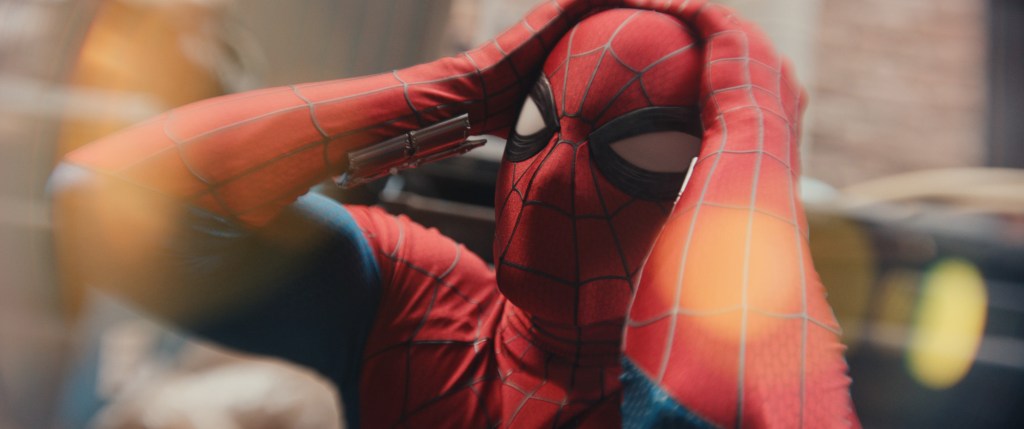
Spider-Man: Brand New Day is crushing it with critics, fans and at the box office. Tom Holland has amassed quite the catalogue, well surpassing Tobey Maguire’s run — never mind Andrew Garfield’s.
But, a Spider-Man movie being well-received isn’t something (brand) new, which begs the question: Where does Brand New Day rank among every live action Spider-Man movie ever made?
DraftKings Network’s staff broke down all nine live-action Spider-Man movies.
(NOTE: This list exclusively consists of live-action movies. The Spider-Verse movies were not considered.)
9. Spider-Man 3
For all of the memes it birthed, Spider-Man 3 is among the most derided comic book movies of all time for good reason. Featuring Venom, Sandman and New Goblin as villains led to none of getting the time and care they each deserved, which especially stood out after the Green Goblin and Dr. Octopus stole the spotlight in the first two films. Venom’s slim design and lack of violent nature were far from comic accurate, to say the least, plus the black suit saga was turned into a joke rather than the central dramatic focus of the story. So not only did we get evil Peter Parker dancing to music in his head — “evil” is a strong word, since he kind of just turned mean and emo for a few days — but the “will they, won’t they” between him and Mary Jane also went backwards for most of the movie.
The jokes feel like they were written by aliens, the performances are all over the place and the VFX waver between great and somehow worse than its predecessors. And despite being the franchise’s biggest box office hit prior to Holland’s sequels, Spider-Man 3 was such a creative failure that the Raimi-Maguire rendition of the character ended then and there. A “so bad it’s good” movie can be fun to look back on in hindsight, but that doesn’t change how bad the movie was and how disappointed audiences were in the original trilogy’s conclusion. —Sam Connon
8. The Amazing Spider-Man 2
While The Amazing Spider-Man was all too familiar in the ways that the film played it safe, The Amazing Spider-Man 2 was a reminder of everything that went wrong with Spider-Man 3 and its laundry list of bizarre choices. Studio interference, cinematic universe set-up and way too many villains tanked the movie, which was overstuffed and unbalanced on several levels. It failed at being a Green Goblin movie since Peter’s relationship with Harry was so rushed, all while failing at being an Electro movie due to Jamie Foxx’s uneven performance, corny dialogue and muddied motivations. That doesn’t even account for how wasted the Rhino and Black Cat were, either. The tone was all over the place, which is epitomized by comparing the Phillip Phillips-backed montage to Gwen Stacy’s heartbreaking death.
That being said, there is plenty of good to take away from The Amazing Spider-Man 2. The opening action scene — ignoring the eye-rollingly clunky flashback to Peter’s parents in a plane crash — features the best web-swinging in franchise history. The suit is arguably the best from any of the movies, too, and the Peter-Gwen relationship is overflowing with chemistry and charm. If The Amazing Spider-Man 2 wasn’t so preoccupied trying to set up sequels and speed run through iconic comic arcs, or if major scenes and characters hadn’t been chopped out of the final cut entirely, perhaps we would’ve gotten a movie that was good enough to actually warrant a third entry. —Sam Connon
7. The Amazing Spider-Man
The first live-action reboot of the Spider-Man franchise was a critical one. The campier Tobey Maguire era was over, with fans largely rejecting Spider-Man 3 even before Iron Man and The Dark Knight changed the superhero movie landscape forever. Coming out on the other end of that shift, The Amazing Spider-Man had to adapt and prove that it could belong in the new-look subgenre.
For the most part, director Marc Webb succeeded in differentiating The Amazing Spider-Man from Sam Raimi’s trilogy. Andrew Garfield’s Peter Parker felt like he was actually from the 21st century, rather than pulled straight out of a Silver Age comic book. The effects and swinging sequences were top-notch. Garfield’s quips were far superior to Maguire’s, even if his Peter Parker was a little too emo and cool at times. At the same time, though, there was a lot of familiarity that held the film back from truly redefining the character. While the Lizard was making his big-screen debut, the “scientist experiments on himself and goes mad” trope was tired. And of course, re-doing the spider bite origin story and Uncle Ben’s death was ultimately a slog. On its own, The Amazing Spider-Man was a solid flick, but it just doesn’t go above and beyond what came before or after it. —Sam Connon
6. Spider-Man
The one that started it all.
After Wesley Snipes’ Blade and 2000’s X-Men finally gave the superhero genre some real momentum on the big screen, 2002’s Spider-Man proved that the party was just getting started.
Featuring some big-time names, Tobey Maguire led the show alongside the ever-impressive Willem Dafoe, whose Norman Osborn/Green Goblin is still regarded as one of the best big-screen supervillains of all time. Maguire’s performance nailed the Peter Parker fans had become familiar with in other mediums (comics and television), while Cliff Robinson’s Uncle Ben set the stage for him to evolve into Spider-Man and change the movie industry forever.
Now, this one may not age quite as well as some of these other movies. But, that’s in part because it’s a victim of its own success. So many superhero origin stories that followed used this one’s structure as its foundation.
To put it succinctly: The superhero movie genre never would have reached its blockbuster heights without 2002’s Spider-Man. —Nick Friar
5. Spider-Man 2
This is my favorite of the Sam Raimi Spider-Man films. Like in Spider-Man: Brand New Day, Tobey Maguire’s Peter Parker is trying to strike a balance between the duality of Peter Parker and Spider-Man.
Peter is dealing with financial worries, the curdling resentment of his best friend Harry toward Spider-Man for killing his father and the fact that the newspaper he works for is constantly trying to paint him as a menace. Meanwhile, his mentor, Otto Octavius, becomes a deranged lunatic as a result of a project Peter helped work on. And like Holland’s Parker, Maguire’s also makes the choice to protect his love (Mary Jane) from his enemies by distancing himself.
Of course, Peter can’t have it all, nor run from his great power bringing great responsibility, so he has to embrace the hero within. The scene where Spider-Man stops the sabotaged train and the awed passengers (“he’s just a kid”) step up and try to protect him from Doc Ock still gives me chills. Ultimately, even though Spider-Man does great things, it’s Peter who saves the day. It’s Peter who convinces Harry to help him save Mary Jane. It’s Peter who, unmasked, reaches the Otto within Doc Ock and convinces him not to die a villain, but rather as a hero by using his tentacles to sink his machine, drowning himself with it.
The acting in this film was top notch, with Alfred Molina delivering a deliciously unhinged performance as Doc Ock, and Maguire and Kirsten Dunst displaying tremendous chemistry and yearning. The combination of acting, story and Raimi’s direction makes this movie the rare film to surpass its predecessor and one of the great examples of the superhero genre as a whole, especially given it came before the heights of the MCU. —Andy Silva
4. Spider-Man: Far From Home
Spider-Man: Far From Home existed in an interesting space in the MCU. The first movie to come out in the aftermath of Avengers: Endgame, it had to address the impact of millions returning from the Blip as well as the death of Tony Stark and the end of Steve Rogers’ time as Captain America. A lot to put on a kid’s shoulders, right? That’s exactly the point.
Far From Home managed to serve many masters, and it did so well. As Spider-Man: Homecoming was simultaneously a superhero and teen coming of age movie, Far From Home was simultaneously a teen road trip movie mixed with a superhero movie. Peter Parker has seen some stuff (as “Nick Fury” reminds him in a way that only he can, he’s been to space) and is just looking for a chill summer in which he can look to spend time with the girl he likes (MJ). But, with great power comes great responsibility — especially when your mentor just died saving millions of lives against Thanos and gifts to you a souped up weapons system.
Peter is feeling the pressure of his dual identity — he’s got teen angst in trying to make sure MJ doesn’t get too close to another classmate while at the same time he has to stop the Elementals and later Mysterio. The world is asking if he’s the next Iron Man, which is a lot to put on a high schooler’s shoulders. Which is paralleled by how the MCU put pressure on Far From Home to kick off the post-Endgame era of the MCU. Luckily, Spider-Man, on and off screen, was up to the task. —Andy Silva
3. Spider-Man: Brand New Day
After years away, Spider-Man — the film franchise and character — returned to the big screen. And as a result of the end of Spider-Man: No Way Home, both are changed.
On screen, Peter Parker has spent the past four years alone, throwing himself fully into his work. Even his NYPD contact worries he’s going to burn out. It seems, like the rest of the world, Spider-Man has forgotten about Peter Parker. At the same time, we’re also getting a more street-level Spider-Man. No more aliens or wizards. Peter Parker is back to being a friendly-neighborhood Spider-Man, listening to the modern equivalent of a police scanner to foil bank robberies rather than taking a trip to space.
Off screen, Destin Daniel Cretton took the reins behind the camera for Brand New Day after the first three MCU Spidey films were helmed by Jon Watts. Naturally, this film had a bit of a different feel as a result. Where the Watts films evoked things like the work of John Hughes, Brand New Day feels a bit more mature, a bit more gritty. It’s a natural evolution, given the characters have gone from high school students to adults. The best part is that while the film feels different, it doesn’t feel out of place. This still feels like the MCU version of Spider-Man, just in a new phase of his life. This film could have felt disjointed, a complete departure from what we’ve seen before. But credit to Cretton, Tom Holland, Zendaya and the writers for keeping the essence of what we’ve seen before while also allowing for organic growth.
This film, perhaps better than any other Spidey film (including the Raimi and Amazing films) explores the duality of Peter Parker and Spider-Man and how one side impacts the other. It brings Peter to the brink of erasing his own identity — out of loneliness, fear, perhaps even depression — and sees him find his way to the other side, accepting that he can be both Peter Parker and Spider-Man, which in turn helps him control his changing powers without resorting to unnatural, scientific means. In No Way Home, he chose not to give his letter to MJ in a bid to protect her. Now he realizes he doesn’t have to do that. He can be Spider-Man and still have friends and even love. Which leaves Spidey in a better place than where we found him at the start of Brand New Day. —Andy Silva
2. Spider-Man: No Way Home
The final chapter Tobey Maguire deserved. Redemption for Andrew Garfield. Confirmation that Tom Holland is the chosen one.
But even with all of that, every time this movie gets brought up, someone — without fail — will mention how No Way Home is fan-servicey.
First off, superhero comics do this kind of stuff all the time. Read a book.
Second, this is the best multiversal stuff the MCU has put out pre-Avengers Doomsday.
Last but not least: As much as this movie is heavily about the fun of having the three live-action Spider-Men on-screen, No Way Home is filled with heart. From Aunt May to the villains to Maguire, Garfield and Holland — everyone is working through something devastating in No Way Home.
There’s no denying that this movie is reliant on the seven live-action Spider-Man movies that preceded it. But that’s the fun in it, too! (To be fair: If you don’t like fun, I get why you don’t like this movie.)
There’s also an argument to be made that this one made all the other films better and more rewatchable — except for maybe Spider-Man 3. (Nothing could save that one.) —Nick Friar
1. Spider-Man: Homecoming
Spider-Man: Homecoming is Tom Holland’s first full-length installment in the Spider-Man franchise (after an enticing cameo in Captain America: Civil War left fans eager to see more of the new web-slinger), and in many ways it’s the finest encapsulation of the superhero we’ve ever seen on the big screen.
Holland has since refined his approach to playing Spider-Man, establishing himself as the greatest actor to take on the role. If you disagree with that take, especially after seeing Brand New Day, you are simply incorrect. However, there’s something so refreshing and relatable about this ground-level-yet-zany tale. It’s evident right away that Holland is Peter Parker. First off, he’s actually young-looking enough to play a realistic high schooler (sorry Tobey and Andrew), but Holland also perfectly captures the awkward, innocent and sarcastic nature that makes up the character.
Outside of Holland, the supporting cast in this film is incredibly strong. To no one’s surprise, Michael Keaton seamlessly toes the line between (relatable) villain and overprotective father, which weaves its way into the story delectably. Jacob Batalon and Zendaya are the perfect fit for Peter’s small band of misfits, Marisa Tomei nails it as Aunt May and Robert Downey Jr. picks up right where he left off in Civil War, further strengthening the relationship between Tony and Peter that eventually becomes one of the strongest connections in the entire MCU.
The story is remarkably smooth and well-paced for a superhero movie, featuring arguably the most effectively-executed plot twist in MCU history. It’s an incredibly strong product, and we likely wouldn’t have the rest of Holland’s story as Peter Parker without it, which is enough to earn the top spot in these rankings. —Jeff Pratt
More Spider-Man: Brand New Day Coverage
Check out all of DraftKings Network’s coverage of Spider-Man: Brand New Day:
- Spider-Man: Brand New Day Ratings: Rotten Tomatoes, IMDb, Metacritic & More
- Does Spider-Man: Brand New Day Have a Post-Credit Scene?
- Who is Sadie Sink in Spider-Man: Brand New Day?
- How Much Money Did Spider-Man: Brand New Day Make at the Box Office This Weekend?
Spider-Man: Brand New Day FAQ
Does Spider-Man: Brand New Day Have Mid-Credit and Post-Credit Scenes?
Spider-Man: Brand New Day does not have a mid-credit scene. But, it does have a post-credit scene.
What is the next movie in the Marvel Cinematic Universe?
The next MCU movie is Avengers: Doomsday, which is set to hit theaters on December 18, 2026. After that is Avengers: Secret Wars, which is coming on December 17, 2027.
Who plays Spider-Man?
The current iteration of Spider-Man in the MCU is played by Tom Holland, who made his debut in 2016’s Captain America: Civil War. He previously appeared in:
- Captain America: Civil War (2016)
- Spider-Man: Homecoming (2017)
- Avengers: Infinity War (2018)
- Avengers: Endgame (2019)
- Spider-Man: Far From Home (2019)
- Spider-Man: No Way Home (2021)
Who Does Sadie Sink play in Spider-Man: Brand New Day?
Sadie Sink has been cast as Jean Grey in Spider-Man: Brand-New Day and the MCU.