Week 7 arrives with velocity and quirks: an early 9:30 a.m. ET London curtain-raiser at Wembley—Rams–Jaguars—that compresses routines and expands fantasy windows, especially with Puka Nacua and Rob Havenstein ruled out, funneling first reads toward Davante Adams in a condensed script. The slate breathes differently stateside, too: Chiefs–Raiders carries a double-digit spread (KC -12.5, total 45.5), a signal that Kansas City’s passing volume and red-zone cycles should swell, keeping ancillary Chiefs in play. Byes thin the pool—Ravens and Bills sit—so managers must mine matchups and usage trends with sharper intent. Weather adds its own fingerprint: London lists rain and a steady breeze, while Browns–Dolphins points to showers and mid-teens winds—conditions that tilt snaps toward ground games, screens, and tight-end volume. Marquee absences stack beyond Los Angeles—Garrett Wilson trends doubtful for the Jets—so contingency plans matter. The flip side brings juice: Rashee Rice returns from suspension to rejoin Patrick Mahomes with Xavier Worthy and Marquise Brown flanking; CeeDee Lamb declares himself ready after a high-ankle sprain; and George Kittle signals a Week 7 comeback for San Francisco. In short, chase condensed targets overseas, lean into trustworthy workloads at home, and let the elements nudge your flex calls rather than scare you off ceiling. Let’s get right to my Five Lists of Five: Week 7 edition, here, and rummage ourselves some stashes, dart throws, breakouts, and, probably most importantly, as always, running back sleepers for fantasy football Week 7.
The refrain remains the same—All I want is for you to be better than your friends. You’re going to be surrounded by them on Sunday, probably. How sweet would it be if you could be sure you’ve checked every box possible that might guarantee you a resounding victory this week? Some kick-your-feet-up insights? I’ve got some. And I know my audience. The smoke-break audience. The quick-scan-of-the-phone-on-the-way-to-the-fridge audience. The I-ain’t-reading-all-that-but-good-luck folk. I’m a man of the people.
And so: the Five Lists of Five series. Think of these as byte-sized, two-minutes-to-yourself lists to scan during your weekend as you foam at the mouth for any competitive fantasy edge. As much relevant analysis as I can fit into, like, ~250 words per player.
Below: Top five breakout wide receivers for Week 7. These are guys that FantasyPros ECR has ranked in the mid-to-late WR2-or-worse range whose matchups I think warrant fringe RB1 consideration. Sometimes they’ll indeed be running backs who aren’t just breaking out of the prison of their rankings, but are indeed breaking onto the scene. But not always. There are only so many names that have scaleable and sustainable relevance in fantasy football!
Here are the other offerings from my 2025 Fantasy Football Five Lists of Five: Week 6 edition:
- Top five must-start players for Week 7 of 2025 fantasy football
- Top five WR/CB matchups to target for Week 7 fantasy football
- Top five breakout running backs for Week 7 of 2025 fantasy football
- Top five fantasy football trade targets as of NFL Week 7 of 2025
Follow my handle @dansby_edits for all of my fantasy football content—as well as plenty of NFL and College Football betting goodies—all season long.
Top five breakout WRs for 2025 fantasy football Week 7
Rashid Shaheed, New Orleans Saints
New Orleans wants speed in the first window, and Rashid Shaheed supplies it with economy and bite. He’s banked 26 catches on 36 targets (72.2%) for 316 yards and two scores, with a 10.9 aDOT, 1.63 yards per route run across 194 routes, and seven explosive gains of 15+ yards (26.9%)—a profile built for motion, RPO glances, and quick-turn over routes. With Spencer Rattler now steering the offense and coming off his sharpest outing—20-of-26 for 227 yards (76.9%) in Week 6—New Orleans gains a quicker trigger for those first-window throws that feed Shaheed’s rhythm.
Chicago’s coverage shell invites that exact tempo. Opponents complete 73.6% of passes against the Bears at 7.8 YPA with a 103.2 passer rating, and Chicago has generated just eight sacks to date—numbers that gift on-time throws and after-catch yards to true separators. The season total sits at 1,097 passing yards allowed in five games (~219.4 per), squarely in the exploitable band for a usage bump.
The usage breadcrumbs point toward volume. Fantasy tracking places Shaheed at WR35 in points per game, with top-24 deep targets and top-21 red-zone targets, plus a 17.4% target share and ~52.7 receiving yards per game this year. Against two-high shells (a Bears staple early—62.6% through Weeks 1–4), he’s still held ~1.76 YPRR, and his role as a motioned slot/field-stretcher gives Rattler clean leverage reads.
The shape of Sunday should look familiar: the Saints will stack and reduce splits to manufacture free access, then layer the deep-over once linebackers widen. Expect 6–9 targets, most inside 12–15 yards, plus one schemed shot off play-action when Chicago squeezes underneath. With the Bears’ high opponent completion rate and modest pressure, those scheduled touches tend to become drives—and drives become points. In full PPR, you bank the separation; in half-PPR, you ride the explosives that follow it.
Christian Kirk, Houston Texans
Houston needs a tempo valve against a front that accelerates pockets, and Christian Kirk answers on schedule. His 2025 line sits modest—10 catches on 16 targets for 109 yards—but the usage whispers expansion: a 10.1 aDOT, 1.47 yards per route on 74 routes, and 4.6 yards after the catch per reception. When pressure pinches, the ball seeks pivots, speed digs, and option routes—and Kirk wins those steps with economy. The matchup sharpens the plan. Seattle just walked into Week 7 with a pass rush humming at 3.33 sacks per game and fresh off seven sacks and 17 QB hits in Jacksonville, a reminder that timing evaporates if you hold the ball a beat too long. Yet this defense still concedes air yards: 257.8 opponent passing yards per game leave space between the rush and rally for hot reads and layered crossers.
C.J. Stroud supplies the distributor’s poise. He enters Monday with 1,076 passing yards, eight touchdowns, three interceptions, and a 64.8 QBR, numbers that pair cleanly with a spread, first-window plan built to punish width. Expect Houston to flood seams and stress landmarks, then spring a layered crosser when linebackers jump the sticks. Seattle’s edge wins are real, but their profile invites quick rhythm—on-time throws that leverage spacing, not hero ball.
Project 7–10 targets for Kirk, most inside 12–15 yards, plus one schemed finisher in the low red when Seattle squeezes underneath. The floor looks PPR-solid because Stroud processes and the Seahawks invite volume; the ceiling lives in a single second-level dagger when safeties overreact to tempo. Ride the metronome against the rush, and let Kirk’s precision turn scheduled touches into drives—and drives into points.
Jordan Whittington, Los Angeles Rams
Opportunity travels, and Jordan Whittington boards with an escalated role. His 2025 line leans efficient—10 receptions on 13 targets (76.9%) for 112 yards, 4.7 YAC per catch, 62.5% target success, and a clean 1/1 in the red—stacked atop a 2024 usage map that toggled outside, slot, and specialty tags without tipping intent. With Puka Nacua ruled out and Rob Havenstein sidelined, Los Angeles redistributes the interior stitching—motion, condensed splits, and glance routes that keep Matthew Stafford on schedule—and Whittington already runs those answers.
The Wembley stage adds its own tempo. A 9:30 a.m. ET kickoff compresses bodies and rewards scripted rhythm; McVay’s openers usually ride timing and formation stress. Expect stack releases, jet motion, and quick play-action to move eyes fast and protect the edge replacement.
Jacksonville shapes the coverage math with volatility. The Jaguars have 10 interceptions already, but they also bled explosives last week—295 passing yards allowed, including chunk strikes to Seattle’s receivers—and produced just one sack on Sam Darnold. That profile punishes late throws yet concedes steady protein to on-time targets. Whittington’s palette—crossers, whips, option routes—fits that calculus.
So the script writes itself. Los Angeles leans into 11 personnel, mirrors concepts, and funnels first-window throws to keep drives ahead of the sticks. Adams will command the headline isolations outside; Whittington fattens the drive beneath them, where PPR points accrue. Map it forward: 6–8 targets, two early touches off motion (screen and whip), then a third-quarter seam glance when linebackers widen to the run fake. In London, with Nacua down and the pass rush inconsistent, you ride the efficient connector who turns schedule into sustenance—and let the yards after the catch carry you across the river.
Luke McCaffrey, Washington Commanders
Washington’s target tree tightens, and Luke McCaffrey steps into the light. He has turned 10 targets into eight catches for 179 yards (22.4 per) and three touchdowns, with five receptions of 15+ yards and a 17.1 aDOT that screams vertical precision rather than reckless moonshots. That profile now meets a vacuum: Terry McLaurin is ruled out again, while Deebo Samuel (heel) is truly questionable, which concentrates first reads and high-leverage designs.
The quarterback surge matters. Jayden Daniels arrives efficient and decisive—875 yards, seven TD, one INT in four starts, plus 176 rushing yards, the kind of control that keeps timing alive against disguises and heat. He has played with a 98.7 passer rating and has avoided negative plays, which keeps Washington in structure and lets shot concepts breathe.
Dallas supplies oxygen. The Cowboys have allowed 1,719 passing yards through six games—that’s 286.5 per game—and now lose their top ball-hawk: Trevon Diggs is out (concussion). Without Diggs, Dallas leans on inexperienced corners, and the coverage menu has bled explosives while the pass rush yo-yos week to week. Expect Washington to lean into reduced splits and play-action, then hit crossers and boundary posts once safeties overreact to Daniels’ keeper threat.
The usage projection writes itself. With McLaurin sidelined and Samuel a game-time decision, McCaffrey inherits the shot plays that finish drives, not just extend them. Forecast 6–9 targets, one schemed red-zone look off motion, and at least one midrange dagger that flips field position. The math supports the mood: a vertical route artist with 22.4 yards per catch faces a defense conceding ~286.5 passing yards per game and missing its premier corner. That’s spike-week scaffolding. Start him where you chase ceiling and let Daniels’ calm delivery light the fuse.
Matthew Golden, Green Bay Packers
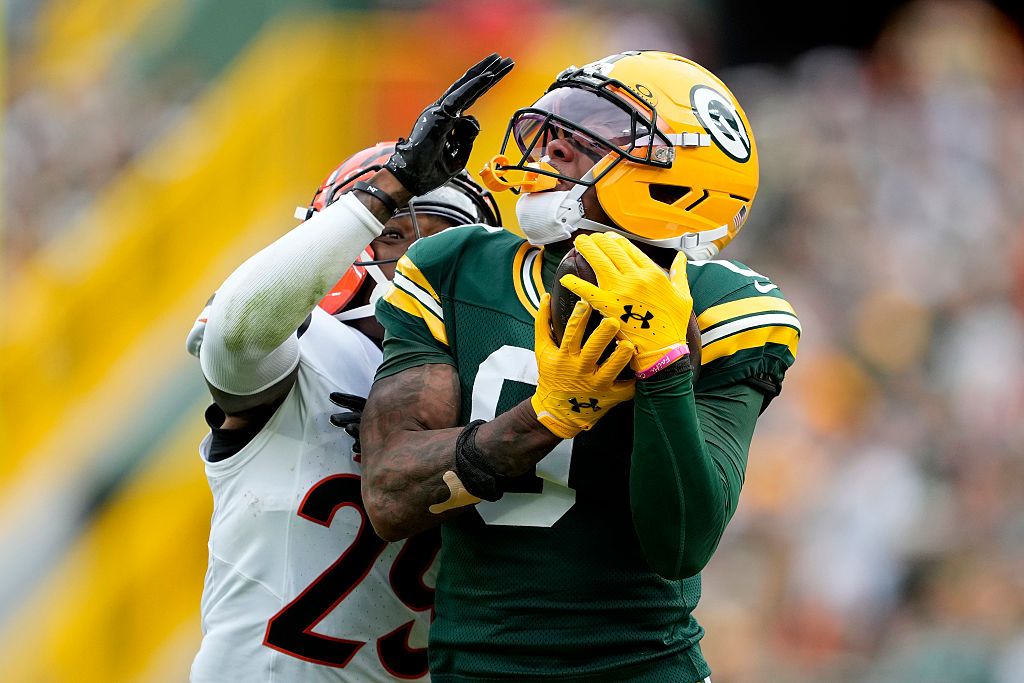
The rookie has started to stretch the field, and Green Bay has noticed. Matthew Golden just posted 3/86 on five targets with 102 scrimmage yards against Cincinnati, including third-down daggers of 35 and 31 yards; all five touches moved the chains. On the season he sits at 14 receptions on 19 targets (73.7%) for 212 yards (15.1 per) with a 14.6 aDOT and a 35.7% explosive-catch rate—numbers that broadcast intent, not empty cardio. Arizona obliges that intent. The Cardinals rank bottom-six in opponent passing yards (~246 per game), a structure you split with posts, drift, and deep-over layers once the linebackers widen.
Jordan Love supplies the throttle. He arrives with 1,259 yards, nine TD, two INT, 69.4 QBR through Week 6, and he just flirted with 10.0 YPA in the Bengals win (technically 9.96, rounding up). Green Bay’s pace can suppress counting stats, but when they uncork shots off play-action, Love’s ball flight finds the window. That marries perfectly with Golden’s route profile: reduced splits to launch crossers, boundary isolations when a safety hesitates, and the occasional jet or orbit to seed eye candy.
The runway widens with Christian Watson ruled out. Snap share and schemed touches consolidate toward Golden, Romeo Doubs, and Tucker Kraft, keeping Golden on the field for the very concepts that produced last week’s explosions. Expect LaFleur to spam condensed formations, stack releases, and glance off RPO—then tag a deep-over when Arizona rotates late.
Projection: 5–8 targets, one to two explosives, and live red-zone equity via mirrored looks off his early-down picture. If you’re chasing upside without reckless variance, Golden is sensible speed in a matchup that prizes it—backed by a quarterback operating efficiently and a defense that bleeds yardage through the air.