Week 7 arrives with velocity and quirks: an early 9:30 a.m. ET London curtain-raiser at Wembley—Rams–Jaguars—that compresses routines and expands fantasy windows, especially with Puka Nacua and Rob Havenstein ruled out, funneling first reads toward Davante Adams in a condensed script. The slate breathes differently stateside, too: Chiefs–Raiders carries a double-digit spread (KC -12.5, total 45.5), a signal that Kansas City’s passing volume and red-zone cycles should swell, keeping ancillary Chiefs in play. Byes thin the pool—Ravens and Bills sit—so managers must mine matchups and usage trends with sharper intent. Weather adds its own fingerprint: London lists rain and a steady breeze, while Browns–Dolphins points to showers and mid-teens winds—conditions that tilt snaps toward ground games, screens, and tight-end volume. Marquee absences stack beyond Los Angeles—Garrett Wilson trends doubtful for the Jets—so contingency plans matter. The flip side brings juice: Rashee Rice returns from suspension to rejoin Patrick Mahomes with Xavier Worthy and Marquise Brown flanking; CeeDee Lamb declares himself ready after a high-ankle sprain; and George Kittle signals a Week 7 comeback for San Francisco. In short, chase condensed targets overseas, lean into trustworthy workloads at home, and let the elements nudge your flex calls rather than scare you off ceiling. Let’s get right to my Five Lists of Five: Week 7 edition, here, and rummage ourselves some stashes, dart throws, breakouts, and, probably most importantly, as always, running back sleepers for fantasy football Week 7.
The refrain remains the same—All I want is for you to be better than your friends. You’re going to be surrounded by them on Sunday, probably. How sweet would it be if you could be sure you’ve checked every box possible that might guarantee you a resounding victory this week? Some kick-your-feet-up insights? I’ve got some. And I know my audience. The smoke-break audience. The quick-scan-of-the-phone-on-the-way-to-the-fridge audience. The I-ain’t-reading-all-that-but-good-luck folk. I’m a man of the people.
And so: the Five Lists of Five series. Think of these as byte-sized, two-minutes-to-yourself lists to scan during your weekend as you foam at the mouth for any competitive fantasy edge. As much relevant analysis as I can fit into, like, ~250 words per player.
Below: Top five WR/CB matchups to target for Week 7. Must-start WR consideration based on matchup specifically between receiver and cornerback.
Here are the other offerings from my 2025 Fantasy Football Five Lists of Five: Week 7 edition:
- Top five breakout wide receivers for 2025 fantasy football Week 7
- Top five must-start players for Week 7 of 2025 fantasy football
- Top five breakout running backs for Week 7 of 2025 fantasy football
- Top five fantasy football trade targets as of NFL Week 7 of 2025
Follow my handle @dansby_edits for all of my fantasy football content—as well as plenty of NFL and College Football betting goodies—all season long.
Top five WR/CB matchups to target in 2025 fantasy football Week 7
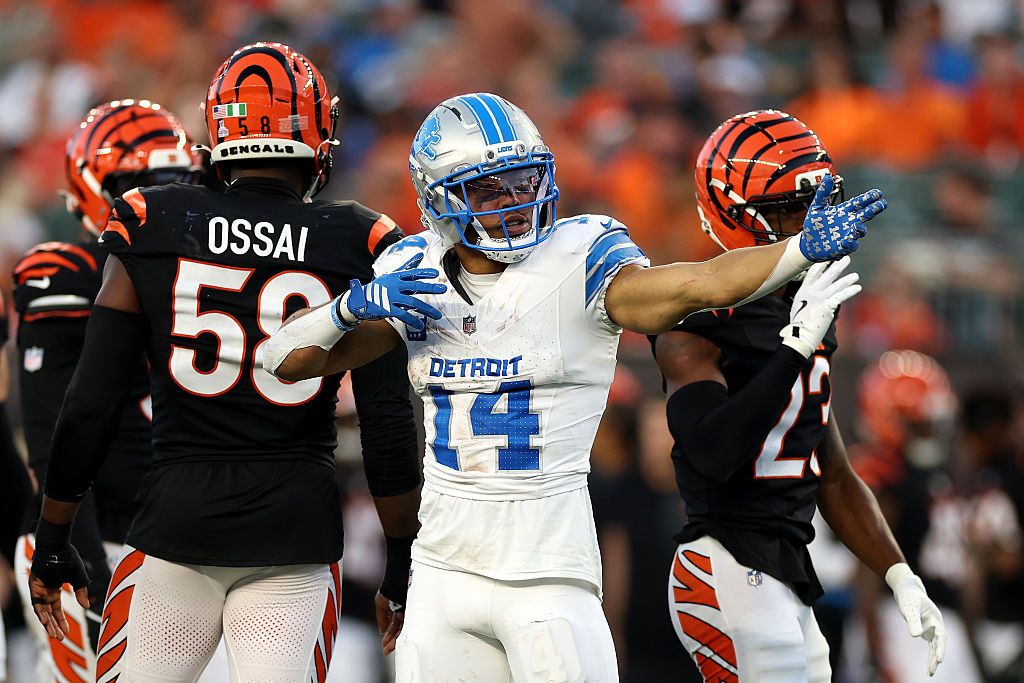
Amon-Ra St. Brown, Detroit Lions (vs. Buccaneers)
St. Brown remains Detroit’s metronome and blade. He’s sitting at 44 catches, 452 yards, and six touchdowns through six games, with 51 targets and a PFF receiving grade of 86.9—top-five among wideouts. He soaks volume, then carves leverage: nine red-zone targets already, and Detroit gladly toggles him inside and out to find the soft spot before the snap.
Tampa’s defense tightens the screws but leaves timing windows if you keep the ball on schedule. The Bucs are permitting ~253.3 passing yards per game and, early on, allowed 64.7% completions at 6.88 YPA—numbers that reward option routes and quick-hitting digs when the rush doesn’t land instantly. They also bring heat: ~34% blitz rate with a 53.1% pressure rate on blitzes, which dares you to beat the fire with sight adjustments and pre-snap motion. That is St. Brown’s wheelhouse.
The individual matchup carries bite because Jamel Dean is red-hot—NFC Defensive Player of the Week and, per Next Gen Stats, a 20.8 passer rating when targeted with a 42.1% completion rate allowed. But Detroit rarely leaves St. Brown parked on a boundary island. Expect stacks, bunch, and cross-formation motion to pry him off Dean and into the nickel’s jurisdiction, where whip/choice, pivot, and dagger concepts flourish against blitz or spot-drop. The Lions will sell run, slide him into a short split, and let Jared Goff fire on the plant foot before the rush blooms.
The plan writes itself: flood underneath landmarks early, force linebackers to widen, then uncork the middle-of-field dagger when Tampa rotates late. Pencil in 10–12 targets, heavy third-down usage, and at least one red-zone option mirrored off an earlier look. Tampa can win isolated snaps; Detroit wins by moving the chessboard. When a WR with six TDs and premium usage meets a pressure-heavy shell that still yields 253 air yards, you lean into the technician who never wastes a step.
Chris Olave, New Orleans Saints (vs. Chicago Bears)
New Orleans built this passing game to hit the first window, and Chris Olave keeps prying it open. He enters Week 7 with 39 receptions for 342 yards and a touchdown, volume that still threatens downfield even as the per-catch average dips while the offense retools. Last week crystallized the workload: 10 targets, six catches, 98 yards in a game where Spencer Rattler delivered on time. That’s the rhythm this matchup invites.
Chicago’s coverage shell has leaked efficiency all month. Opponents complete 73.6% of passes against the Bears at 7.8 YPA with a 103.2 passer rating, and Chicago has produced just eight sacks so far—pressure that rarely arrives fast enough to erase first reads. Translate the ledger: 1,097 passing yards allowed in five games (~219.4/gm), the kind of steady yield that rewards option routes, digs, and deep-overs—Olave’s bread and butter when New Orleans stacks or motions him free.
Rattler’s recent form accelerates the script. He just went 20-of-26 for 227 yards (76.9%) in Week 6, operating decisively and keeping the ball out on time. When the quarterback’s trigger matches the receiver’s separation, the Saints can spam glance and pivot early, then layer the intermediate shot once the linebackers widen. Expect New Orleans to dress Olave in bunch, slide him into short splits, and force the nickel to choose wrong; when the Bears spin late, the dig arrives behind rotation.
Projection: 9–12 targets, majority inside 12–15 yards, plus one schemed intermediate or vertical shot off mirrored looks. The Bears concede accuracy and live with rallies; Olave punishes that math by stacking on-time catches into drives. In full PPR, that’s a bankable floor; in half-PPR and standard, the single explosive rep—set up by all that precision—carries you across the line.
Romeo Doubs, Green Bay Packers (vs. Arizona Cardinals)
Second week in a row for Doubs. The Packers passing game has to hit eventually. And they keep getting these juicy matchups. Someone besides Tucker Kraft will eat soon, and Doubs has the best matchup with which to do it out of the receiving core in Green Bay.
While Christian Watson sits, Romeo Doubs keeps the passing game on tempo. He’s logged 18 receptions for 234 yards and four touchdowns—lean volume, loud impact—and now walks into a secondary that bleeds air yards. Arizona is allowing 257.5 passing yards per game with opponents completing 63.3% at 6.5 YPA, and they just placed starting CB Garrett Williams on IR, pushing more perimeter snaps to Kei’Trel Clark and depth options. That’s the exact canvas for Green Bay’s reduced splits, glance, and boundary comebacks that turn off-leverage corners into first downs.
Context sharpens the edge. Jordan Love hits this game with 1,259 yards, nine TDs, two INT and an 8.6 YPA—efficiency that rewards on-time throws and play-action daggers. The Packers have already ruled Watson out, consolidating receiver reads toward Doubs, Matthew Golden, and Romeo’s boundary toolkit. Expect LaFleur to stack and condense, steal free access with motion, and spam the stop/comeback until the corner drives, then tag curl-and-go for the explosive.
Projection: 6–8 targets, one or two deep-curl/vertical explosives, and end-zone equity off mirrored concepts in the low red. Arizona’s pass defense invites calculated aggression, and Doubs’ early-season scoring form—four TDs in five games—pairs cleanly with a defense conceding 257.5 passing yards and shuffling its outside corners. If you’re chasing startable ceiling with stable usage, pick the boundary hammer and let Love’s rhythm do the rest.
Michael Pittman, Indianapolis Colts (vs. Chargers)
Downs is out, the target tree tightens, and Pittman becomes the clean first read. The Colts ruled Josh Downs (concussion) and Ashton Dulin (chest) out for Week 7, which funnels snaps and high-leverage looks toward Pittman and rookie Adonai Mitchell, with Alec Pierce practicing fully to handle the field-stretcher work.
The matchup is a dare to volume. The Chargers’ pass defense has been stingy by the ledger—177.5 opponent pass YPG (sixth) with a 60.4% completion rate allowed and 6.2 YPA, buoyed by disciplined structure and an opportunistic back end. That profile can still be beaten by alpha usage and slant/dig sequencing, especially when Indy pares down its read tree and pairs Pittman with an ascending red-zone foil in TE Tyler Warren.
Pittman’s 2025 line isn’t cosmetic—28 receptions, 293 yards, four TD—and his red-zone conversion has resurfaced. With Downs sidelined, expect the Colts to stack condensed sets, motion for leverage, and hammer quick-game answers that feed Pittman on-time from Daniel Jones, who’s stabilized the operation (71.7% completion, 1,502 yards, 79.7 QBR) and keeps drives on schedule. The Chargers have also been nicked by attrition week to week even as the aggregate numbers pop, leaving Indy comfortable leaning into its WR1 when it needs a bucket.
Projection: 9–12 targets, heavy first-window volume (slants, speed-outs, digs), plus two schemed red-zone looks mirrored off early-down pictures. The defense wins the efficiency battle most weeks, but the Downs/Dulin absences tilt raw opportunity. In PPR, that’s bankable floor with a live touchdown kicker, buoyed by Pierce’s vertical gravity and Warren’s seams siphoning safety help.
Quentin Johnston, Los Angeles Chargers (vs. Indianapolis Colts)
Pick the boundary hammer, dinged up though it may be. Johnston’s 2025 arc hums upward—26 catches, 377 yards (14.5 per), four touchdowns—and the tape shows cleaner stems, sharper curls, and a quarterback who trusts him on timing. Add the context: he’s done it on 41 targets, while Justin Herbert steers a top-10 aerial output with 1,493 yards, 10 TD and a 65.7 QBR through six games. That synergy lands in a pass-first ecosystem: the Chargers sit top-10 in passing yards per game, a weekly nudge to keep Johnston’s route tree loaded with glance, comeback, and deep-curl answers.
The matchup tilts outside. Jaylon Jones is on IR, which forces Indianapolis to shuffle boundary snaps while Kenny Moore II anchors the slot. That rotation naturally steers Keenan Allen and Ladd McConkey into Moore’s orbit and leaves Johnston to work one-on-ones against the perimeter. When L.A. condenses formations and stacks releases, Johnston can force off-leverage turns, then punish with the deep curl once a corner opens his hips.
Indy’s defense wins on structure more than star power. They’re allowing 232.8 passing yards per game, and the ledger points to 6.8 yards per attempt and roughly 66% completions allowed with 10.3 yards per completion—stout but far from prohibitive—and they’ll rally to cap explosives if you hold the ball. The antidote is Herbert’s rhythm plus Johnston’s leverage wins: hit early glance and comeback, then tag a curl-and-go when the corner starts driving downhill.
Context helps the consolidation. McConkey is fresh off 7-100-1 in Week 6, commanding attention on motion and crossers; that gravity buys Johnston clean isolation outside. And Herbert’s current form is live—29-of-38 for 264-2 in Miami—so the Chargers can keep the perimeter volume flowing if Indy’s front settles into split-safety looks. Either way, Johnston holds the boundary key that unlocks the red zone—where his size and catch radius turn condensed splits into fade or slant-flat choices.
Projection: 7–9 targets, one vertical or deep-curl explosive, and one red-zone ISO mirrored off the early-down picture. The Chargers’ air volume plus Indy’s perimeter shuffle equals a green light for Johnston’s boundary toolkit.