Week 7 arrives with velocity and quirks: an early 9:30 a.m. ET London curtain-raiser at Wembley—Rams–Jaguars—that compresses routines and expands fantasy windows, especially with Puka Nacua and Rob Havenstein ruled out, funneling first reads toward Davante Adams in a condensed script. The slate breathes differently stateside, too: Chiefs–Raiders carries a double-digit spread (KC -12.5, total 45.5), a signal that Kansas City’s passing volume and red-zone cycles should swell, keeping ancillary Chiefs in play. Byes thin the pool—Ravens and Bills sit—so managers must mine matchups and usage trends with sharper intent. Weather adds its own fingerprint: London lists rain and a steady breeze, while Browns–Dolphins points to showers and mid-teens winds—conditions that tilt snaps toward ground games, screens, and tight-end volume. Marquee absences stack beyond Los Angeles—Garrett Wilson trends doubtful for the Jets—so contingency plans matter. The flip side brings juice: Rashee Rice returns from suspension to rejoin Patrick Mahomes with Xavier Worthy and Marquise Brown flanking; CeeDee Lamb declares himself ready after a high-ankle sprain; and George Kittle signals a Week 7 comeback for San Francisco. In short, chase condensed targets overseas, lean into trustworthy workloads at home, and let the elements nudge your flex calls rather than scare you off ceiling. Let’s get right to my Five Lists of Five: Week 7 edition, here, and rummage ourselves some stashes, dart throws, breakouts, and, probably most importantly, as always, running back sleepers for fantasy football Week 7.
The refrain remains the same—All I want is for you to be better than your friends. You’re going to be surrounded by them on Sunday, probably. How sweet would it be if you could be sure you’ve checked every box possible that might guarantee you a resounding victory this week? Some kick-your-feet-up insights? I’ve got some. And I know my audience. The smoke-break audience. The quick-scan-of-the-phone-on-the-way-to-the-fridge audience. The I-ain’t-reading-all-that-but-good-luck folk. I’m a man of the people.
And so: the Five Lists of Five series. Think of these as byte-sized, two-minutes-to-yourself lists to scan during your weekend as you foam at the mouth for any competitive fantasy edge. As much relevant analysis as I can fit into, like, ~250 words per player.
Below: Top five buy-low players for Week 6 of 2025 fantasy football. A new list this season, and one to which we’ll return quite on-and-off until the fantasy football trade deadline. Simple enough, here: these are players whose performances have been underwhelming given their name value and/or draft capitol, but whose opportunity metrics and intangibles signal an uptick on the rise.
Here are the other offerings from my 2025 Fantasy Football Five Lists of Five: Week 6 edition:
- Top five must-start players for Week 7 of 2025 fantasy football
- Top five WR/CB matchups to target for Week 7 fantasy football
- Top five breakout wide receivers for 2025 fantasy football Week 7
- Top five breakout running backs for Week 7 of 2025 fantasy football
Follow my handle @dansby_edits for all preseason and fantasy draft kit content—as well as plenty of NFL betting goodies—all summer long. All my other fantasy football draft kit content is at the bottom of this list!
Top five fantasy football trade targets as of NFL Week 7 of 2025
Breece Hall, RB, New York Jets
You buy the profile, not the panic. Breece Hall sits at 88 carries for 410 yards (4.7 YPC) with zero rushing touchdowns through six games, plus 17 receptions for 150 yards on 24 targets (8.8 per catch)—usable yardage wrapped in unlucky scoring. The underlying signals still flash neon: he ranks first in explosive run rate, ninth in missed tackles forced per attempt, eighth in weighted opportunities, and 15th in opportunity share, yet he’s just 44th in red-zone touches (five). That mismatch doesn’t last once the Jets actually reach the paint.
Context explains the lull. New York has been starved for short fields and easy scores, sitting 31st in red-zone trips per game (2.2). They’re 0–6, living in negative scripts, inconsistent quarterback play from Fields, etc. Luckily, the line isn’t the culprit; an eighth-best 74% run-block win rate keeps lanes available when the offense stays on schedule. Even the split stats hold up when volume arrives—he’s been effective early and late, converting first downs and carrying the ground game when the Jets aren’t chasing. That’s portable run value waiting for field position to improve.
The calendar gives you a path to profit. After Week 7 vs. Carolina, the Jets draw the Bengals (Week 8), Browns, Patriots, Ravens, Falcons (Week 13) and Dolphins (Week 14), a stretch with several run defenses that can be leaned on for efficiency or volume spikes. One or two more red-zone snaps per game pushes him toward mean reversion on touchdowns, and the peripherals already say he’s creating on his own.
His receiving work preserves the weekly floor while the touchdowns normalize. Hall’s 24 targets place him on a pace that threatens 60 looks if checkdowns rise with game-management tweaks, and that passing involvement pairs with a top-10 explosive profile and top-10 weighted opportunity share. That’s the definition of a buy-low: bankable usage, depressed TDs, a friendlier runway ahead, and line metrics that predict lift rather than drag. Move now, before the scores catch up to the film and the role.
Zay Flowers, WR, Baltimore Ravens
ay Flowers sits at 34 receptions for 423 yards and one touchdown, a box score that reads fine yet undersells the true footprint. The underlying profile tells the real story: a ~29% target share, 2.30 yards per route run, 9.13 aDOT, 73.9% catch rate, and 204 yards after the catch—metrics that signal a featured option operating with efficiency and intent rather than a bit player catching scraps. That cocktail travels to every game script and sustains across defensive looks.
Volume arrives in the places that actually decide drives. Flowers owns a 31.8% first-read share, sits 13th in deep targets, and—crucially—has seen little red-zone involvement so far, which is exactly why you buy before the touchdowns normalize. When the player you want already earns early-down and downfield opportunities, the six-point plays tend to show up later as offense and field position stabilize.
Context should tilt in his favor soon. Baltimore expects Lamar Jackson back after the Week 7 bye, and the offense’s rhythm typically reappears the moment he returns to the huddle. If the Ravens’ red-zone trips and sustained possessions bounce with their quarterback, Flowers’ scoring log follows his usage rather than fighting it. That’s the classic buy-low arc: strong per-route efficiency already on the page, with the touchdown column lagging behind the process.
Rest-of-season, you’re betting on sticky volume paired with quarterback gravity. Keep the math simple: a top-tier target share plus top-tier YPRR, wrapped in a scheme that feeds him first, usually matures into WR1/2 production over the back half. Acquire now, while one touchdown keeps the price human and the underlying signals glow.
Travis Etienne, RB, Jacksonville Jaguars
Bet on the workload and let the touchdowns catch up. Travis Etienne sits at 89 carries for 470 yards (5.3 YPC) and 2 rushing TDs, with receiving juice layered in week to week. That’s top-10 rushing yardage on a per-season pace that looks sturdier than the recent box scores suggest.
The peripherals keep the arrow green. Inside the 20, he’s handled 14 red-zone rushes and turned four red-zone targets into four catches, 24 yards and a TD—usage that usually pays off over time. Even with a clunker in Week 6 (12 for 27 rushing; 4-28 receiving), the season signal still reads feature-back stability, not committee noise.
His ceiling isn’t theoretical. In Week 1, Etienne posted the single-game high in Rushing Yards Over Expected (+69) per Next Gen Stats, a reminder that his burst can flip a script in one afternoon. And the blocking is quietly cooperative: tackle Walker Little ranks third among OTs in run-block win rate (84%), a helpful tailwind for the stretch run.
Context adds the buy window. Jacksonville hits London vs. the Rams in Week 7, then a bye, then a back half with beatable run defenses sprinkled in (Raiders, Texans, Chargers, Cardinals, Titans, Colts, Jets). That’s a string of scripts where a 18–22 touch back with pass-game usage can stack points without perfect efficiency.
Bottom line: you’re purchasing a feature workload attached to explosive traits and sticky red-zone involvement, at a moment when one down week and modest TD totals have tamped the price. If the Jaguars’ offense sustains drives even a tick more, Etienne’s volume translates cleanly into December production. Acquire now; let the role and regression do the rest.
Nico Collins, WR, Houston Texans
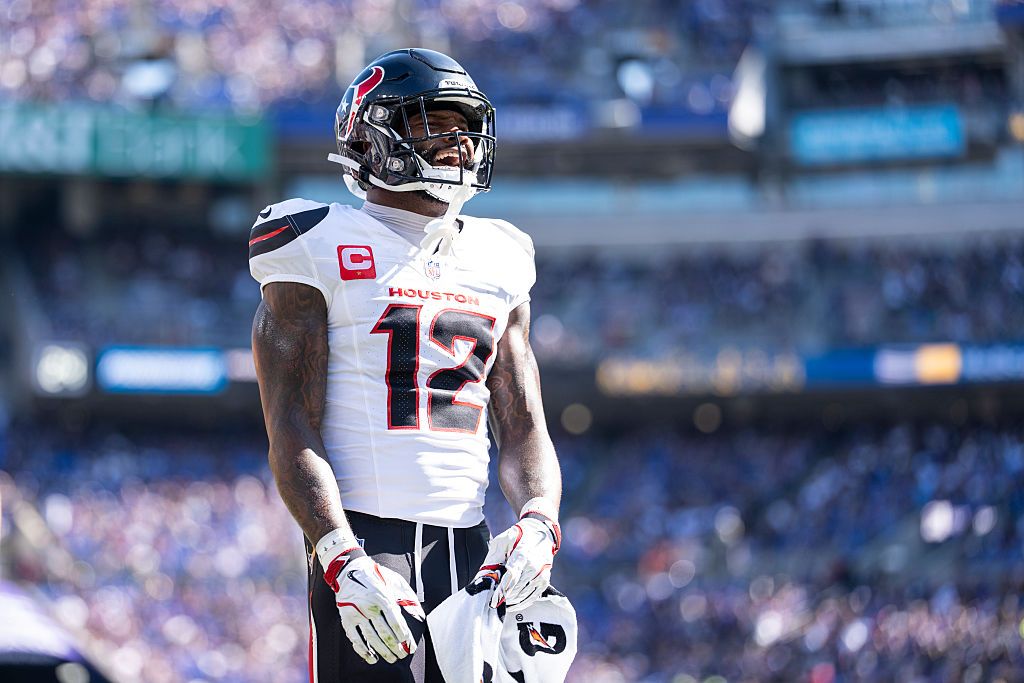
Nico Collins sits at 22 receptions on 36 targets (61%) for 312 yards (14.2 per) and three TDs, with an 11.03 aDOT and ~25% target share—a usage core that travels and sustains. His early spike reminded everyone of the ceiling (8/104/1 in Week 3), and even the “quiet” weeks still showed function (4/79 in Week 4; 4/52/1 in Week 5). That’s not a disappearing act; that’s volatility normalizing inside a featured footprint.
The slump chatter misses the context. Local analysis flagged a narrower route map and less work to the right side, which trimmed some of the explosive angles early. Yet the offense just recalibrated. Houston spent the bye self-scouting, then erupted for 70 points across the Titans and Ravens, with C.J. Stroud distributing decisively and reconnecting with multiple targets. When the quarterback rhythm returns and the structure tilts back to layered throws, the wideout who already commands intermediate volume benefits first.
Collins’ profile still screams stickiness. He owns the intermediate windows Stroud attacks on time, pairs a double-digit aDOT with after-catch utility, and keeps scoring access active via red-zone usage (three TDs already). The box score lag simply reflects opponent rotations and a couple of condensed game plans, not erosion in role. Expect Houston to lean back into their bread-and-butter: play-action to widen landmarks, glance and dig to feed the first window, then the deep-over once linebackers cheat. That sequencing funnels high-value targets to Collins—exactly the structure that pushed him over 1,000 yards last season and put him on a top-10 per-game trajectory.
Bottom line: buy before the second half prices him like the player he remains—a weekly WR2 with WR1 spikes anchored by target share, depth, and a quarterback trending up.
Chris Olave, WR, New Orleans Saints
Olave’s raw line still looks light—39 catches, 342 yards, one TD on 64 targets—but the usage remains alpha, and the quarterback play is sturdier than the record suggests. Spencer Rattler has been quietly efficient: 68.5% completion, 1,217 yards, six TDs, just one INT, 91.9 passer rating, 60.3 QBR (16th) through six games.
If you want sentiment backed by tape and numbers, it’s there. Marques Colston publicly praised Rattler’s efficiency and decision-making amid the 1–5 start, and Week 6 gave the on-field receipt: 20-of-26, 227 yards, 76.9% completion, with a team-best PFF grade and four big-time throws in a narrow loss where a late Juwan Johnson fumble and an Olave drop short-circuited scoring chances. That’s box-score drag, not quarterback instability, and it reinforces the thesis that drive quality is improving even if touchdowns lag.
Olave continues to own prime real estate: 64 total targets, a 29.5% target share, 38.5% air-yard share, and a 34.7% first-read share, while ranking second among WRs in total targets, sixth in routes run, and fifth in red-zone targets. That’s alpha volume with premium field position, not a role player’s trickle.
Bottom line: Olave’s opportunity remains sticky—heavy targets, premium air yards, high first-read rate—and the quarterback is playing well enough to cash it. Buy the dip caused by one lonely touchdown, anchor to Rattler’s efficiency and low turnover profile, and ride WR1/2 production as the Saints’ red-zone variance evens out.