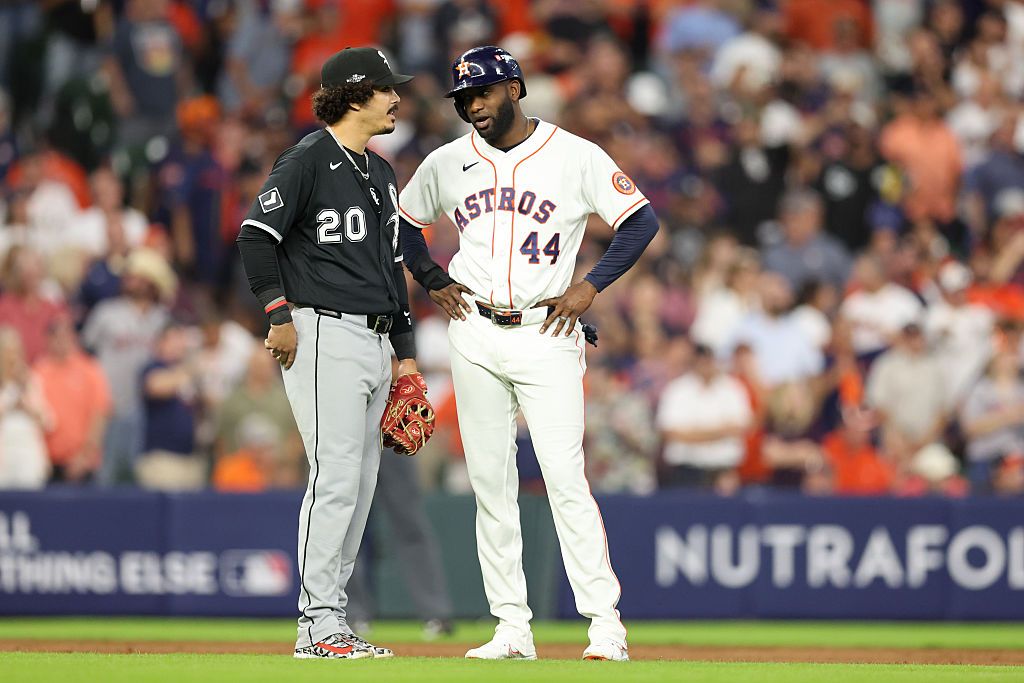
The Chicago White Sox already made history, becoming the first team to lose 100 games in a season and then make the playoffs in the following campaign. Tonight, they could become the first team to lose 100 games in a season then win a playoff series in the following campaign.
After a 6-3 win last night in Game 1 against the No. 3 Houston Astros, the No. 6 White Sox could close out the series tonight and give themselves an extra day of rest before a Division Series against the No. 2 Cleveland Guardians begins on Saturday.
Tonight’s clash is set to begin at 5 p.m. ET. Sean Burke is set to take the mound for Chicago, and Hunter Brown will start for Houston.
Let’s break down this pivotal clash with some odds and lines at DraftKings Sportsbook.
Chicago White Sox at Houston Astros Game 2 Best Bets
- Chicago White Sox Moneyline (+122): The Astros became only the second team in MLB history to make the playoffs in a full 162-game season with a losing record at home, and while the White Sox weren’t great on the road, I just trust them a little bit more overall, especially with their ace on the mound.
- Hunter Brown 7+ Strikeouts (+107): Brown has recorded seven or more strikeouts in five of his last six starts and 10 of his 20 overall, which would make this prop good value against a team that struck out at even an average rate. The White Sox aren’t that; they were fanned the fifth-most times this season.
Chicago White Sox at Houston Astros Game 2 prediction, preview
The White Sox could hardly have gotten their first postseason since 2021 off to a hotter start, as they scored three runs in the first two innings of the game behind a gritty pitching performance from rookie Hagen Smith. Entering the postseason, Chicago was in strong form, as it won six of its last eight games while posting the league’s eighth-highest OPS over the last 15 days. The White Sox had a strong infield power trio during the regular season in Munetaka Murakami, Colson Montgomery, and Miguel Vargas, and while Vargas had a poor game (zero-for-four), Murakami and Montgomery each drove in a run, with Montgomery taking Miguel Ullola deep in the fourth inning. Additionally, although Chicago’s starters pitched poorly to end the season, putting up an atrocious 5.04 ERA after the All-Star break, Will Venable decided to eschew starters entirely and pitch a bullpen game in Game 1. The strategy worked; although the normally steady Sean Newcomb gave up a two-run homer, Smith, Jordan Hicks, David Sandlin, and Grant Taylor all supplied more than an inning of work without allowing an earned run. At a minimum, Smith and Taylor will be unavailable tonight, but Huascar Brazobán, Bryan Hudson, Erick Fedde, and likely one of David Martin and Noah Schultz could relieve Burke.
The Astros also entered the postseason strong, winning on the final day against the Athletics to ensure that they wouldn’t be the first division winner with a losing record (though they did become the first .500 team to make the playoffs). Houston won four of its final six games and posted by far the league’s highest OPS over the final 11 games of the regular season, buoyed by its two dominant results against the long-eliminated Athletics. However, the Astros will only go as far as likely MVP Yordan Álvarez can take them, and Álvarez went just one-for-four. Basically Houston’s only offense in Game 1 instead came from an unlikely source in Nelson Velázquez, who hit .111 in 18 games after joining from the St. Louis Cardinals but took Newcomb deep. The Astros’ pitching staff, an issue for much of the campaign, settled down towards the end of the season, as their starters pitched to a 3.06 ERA in September and their bullpen a 4.15 mark. However, Joe Espada evidently called on the wrong relievers in Game 1; in retrospect, it can’t be too surprising that Bryan King (5.19 ERA this season), Bennett Sousa (6.00), and Josh Hendrickson (two career appearances before yesterday and a 4.75 mark in Triple-A) imploded. Houston could still have Logan VanWey, Sousa, Bryan Abreu, and Josh Hader available again tonight in addition to Tatsuya Imai, the lone primary reliever who didn’t feature in Game 1.
Burke should give the White Sox a good chance of winning. He was their best starter throughout the season, registering a 3.34 ERA in 32 appearances (27 starts), and while he had one blow-up outing in the second half of the season (1.1 innings and seven earned runs against the Pittsburgh Pirates on September 8), he allowed two or fewer earned runs in all but three starts in the second half. Advanced numbers back up his strong basic profile; Burke ranks in the 65th percentile in xERA and the 67th in xBA, and thanks to his volume, he also sports a 77th-percentile pitching run value. Burke has also done a solid job generating chases, whiffs and strikeouts, exacerbating three of the Astros’ relative weaknesses. Houston can get to him if it can get the ball in the air, as he owns a bottom-quartile ground ball rate, but his propensity to allow hard hits shouldn’t be much of an issue against the Astros, who have one of the softest-hitting lineups in baseball aside from Álvarez. The 26-year-old has pitched to an impressive 2.68 ERA on the road this season, and Houston’s offense has been worse at home; in fact, Burke just recorded 5.2 innings of one-hit, shutout ball at Daikin Park on September 1.
Brown is no slouch, either. He finished third in AL Cy Young Award voting last season after finishing with a 2.43 ERA across 31 starts, and although injuries have limited him to 20 outings so far in 2026, he’s made the most of them, pitching to a 3.19 ERA. In fact, since blowing up in his first start after the All-Star break, Brown has allowed more than three earned runs in a start just once, recording a 2.67 ERA across 12 appearances. Advanced numbers unequivocally prefer him to Burke; he sports both a top-quintile xERA and xBA, with the latter a 90th-percentile figure. In fairness, Chicago is well-suited to take advantage of his biggest weaknesses, as he ranks in the bottom quintile in both chase and walk rate and the White Sox have employed an extremely patient plate approach, with Murakami finishing second league-wide in walk rate. However, Brown has also done a good job limiting hard contact while inducing ground balls at a 97th-percentile rate, so his sinker should be an extremely effective counter against Chicago’s raw power. He’s pitched similarly well whether at home or on the road, and the White Sox finished the season with a barely-above-average road offense. The last time these teams faced off here, Brown pitched six innings of two-run ball.
Chicago White Sox at Houston Astros Game 2 pick, best bet
Best Bet: Chicago White Sox Moneyline (+122)
Both of these teams can be pretty inconsistent, and to be fair, Chicago was nine games below .500 at home, but the starting pitching matchup is pretty close, and I trust the depth of the White Sox’s offense just a little bit more.
Strong Lean: Hunter Brown 7+ Strikeouts (+107)
Brown sports a top-sextile strikeout rate, and Montgomery just set the MLB single-season strikeout record, with Murakami on pace to challenge it if he’d played a full season. The Astros might have to keep Brown in pretty deep into the game, given how much their bullpen was taxed last night.