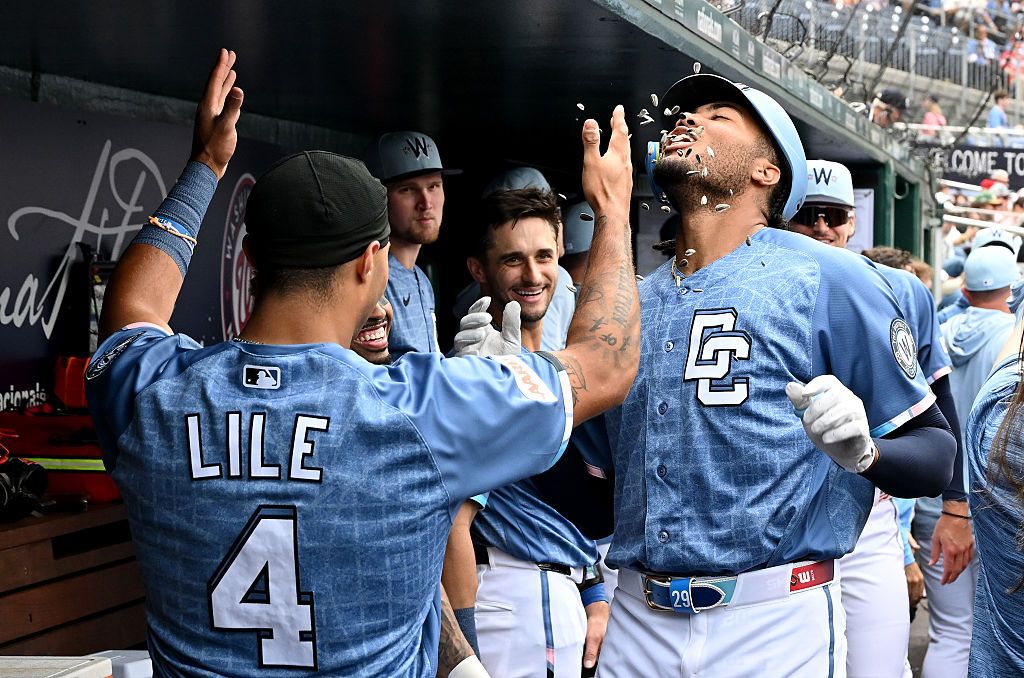
Sunday afternoon settles into that early-season sweet spot where the board looks full, but the environments split it in half. You’ve got cold air sitting over the Northeast and Midwest—upper 40s, damp pockets, heavy carry—while Denver warms into the low 70s and Houston holds steady in mid-70s air. We’re looking for lift and barreled-ball events. Bat speed, too. Let’s go hunting out west, then, shall we?
Below are my three favorite picks from the early slate of games to swat one out.
Top MLB Home Run Props
Shohei Ohtani to hit a home run (+195)
As I see it, the board’s cleanest bomb case. Ohtani’s 2026 Statcast profile is, unsurprisingly, MVP-caliber: 94.0 mph average exit velocity, 51.9% hard-hit rate, 22.2% barrel rate, and .411 xwOBA, all top-tier indicators of lift plus authority. His launch-angle band lives in the 15–25° window on a heavy share of batted balls, the range that converts barrels into home runs at Coors more than any other park. Against right-handed pitching this season, he’s already produced three homers with an .850+ OPS while maintaining a sub-25% chase rate and consistent pull-side damage. To boot, against right-handed pitching this season, he owns an .851 OPS with three home runs in 65 plate appearances.
Michael Lorenzen has opened the year allowing four home runs in 16.2 innings, paired with a .412 opponent average, 17.3 H/9, and a hard-hit rate allowed pushing into the mid-40% range. His four-seam velocity has sat in the low-90s, and opponents are lifting it—his early batted-ball mix shows elevated fly-ball contact with imperfect command. That combination feeds directly into Coors’ run environment, which historically inflates home run output by 25–30% above league average. Ohtani’s barrel rate means roughly one in every five optimal contacts leaves the yard in neutral conditions; altitude raises that conversion. One mistake in the middle third with traffic on base is enough for the swing to matter immediately.
Yordan Alvarez to hit a home run (+285)
Alvarez brings the most stable power metrics on the board. His 2026 profile sits at 94.3 mph average exit velocity, 50.0% hard-hit rate, 22.7% barrel rate, .524 wOBA, and .554 xwOBA, all signaling sustained, repeatable damage. His contact distribution stays tight—high line-drive plus fly-ball share with minimal weak contact—while his average launch angle continues to sit in a productive home-run band. Against left-handed pitching, he’s opened 12-for-23 with four homers, a .600 OBP, and a 1.730 OPS, with multiple extra-base hits driven to left-center and pull-side.
Matthew Liberatore has already allowed five home runs, carrying a contact profile around 44% hard-hit allowed with a .370+ expected wOBA against. His fastball-change mix has not limited lift; opposing hitters are getting the ball in the air with authority, and his in-zone contact rate has stayed elevated. Alvarez’s swing path handles that mix cleanly—he’s producing a barrel roughly once every five batted balls, and his average exit velocity against lefties remains above 94 mph. Houston’s conditions sit in the mid-70s, keeping ball flight neutral-to-positive without the cold suppression seen elsewhere. A single elevated fastball or changeup that leaks back toward the plate aligns directly with Alvarez’s most productive contact zone.
James Wood to hit a home run (+600)
This dude’s a laser show, and I say that as someone proudly hanging a Pedroia jersey in my closet. Wood’s profile jumps off the page immediately. He’s running a 96.0 mph average exit velocity, 64.7% hard-hit rate, and 27.5% barrel rate, which places him among the league leaders in pure contact force. His batted-ball distribution shows frequent lift—fly-ball and line-drive contact combined with exit velocities that consistently clear 100 mph on optimal swings. Against left-handed pitching, he’s logged two home runs with a .954 OPS, showing early comfort staying through breaking pitches while still generating pull-side loft.
Robbie Ray has allowed four home runs in 22.1 innings, with a pitch mix that still leans heavily on a high-usage fastball and slider. When the fastball leaks into the upper-middle part of the zone, it has been lifted; opposing hitters are producing elevated contact with enough exit velocity to reach the gaps and beyond. Wood’s barrel rate means nearly three of every ten well-struck balls reach optimal launch and velocity thresholds, and his average exit velocity ensures those contacts travel. Nationals Park temperatures in the low-60s remove the colder-air penalty present in several other games, keeping carry intact. At this price, the probability is tied directly to one swing—Wood’s contact quality puts that swing firmly in play.