Selection Sunday always sells itself as a clean act of revelation, as if the bracket is merely uncovering what the season already settled months ago. In reality, it is half coronation, half erasure. The official 2026 field is here, with Duke, Arizona, Michigan, and Florida on the one-line, but the loudest men’s-bracket arguments immediately shifted to the negative space—to the teams whose pedigrees were good enough to start a fight, but not sturdy enough to survive the room. Auburn, San Diego State, Indiana, Oklahoma, and, in a more tragic than prosecutable sense, Yale became the names hanging over the bracket like smoke.
This was a particularly modern kind of bubble year because the argument kept changing depending on which language you trusted most. Predictive systems were kinder to some of these teams than the committee was. Program history made a few omissions feel larger than their actual sheets. Conference-tournament endings scrambled the emotional memory of the whole picture. By Sunday night, the snub discourse had become the same old March argument in five different disguises: what matters more, the team a profile suggests in theory, or the one that actually did enough before the page ran out of space?
For the record, here’s the official ranking of 1-68 from the selection committee.
Biggest bracket snubs of March Madness 2026
Auburn Tigers
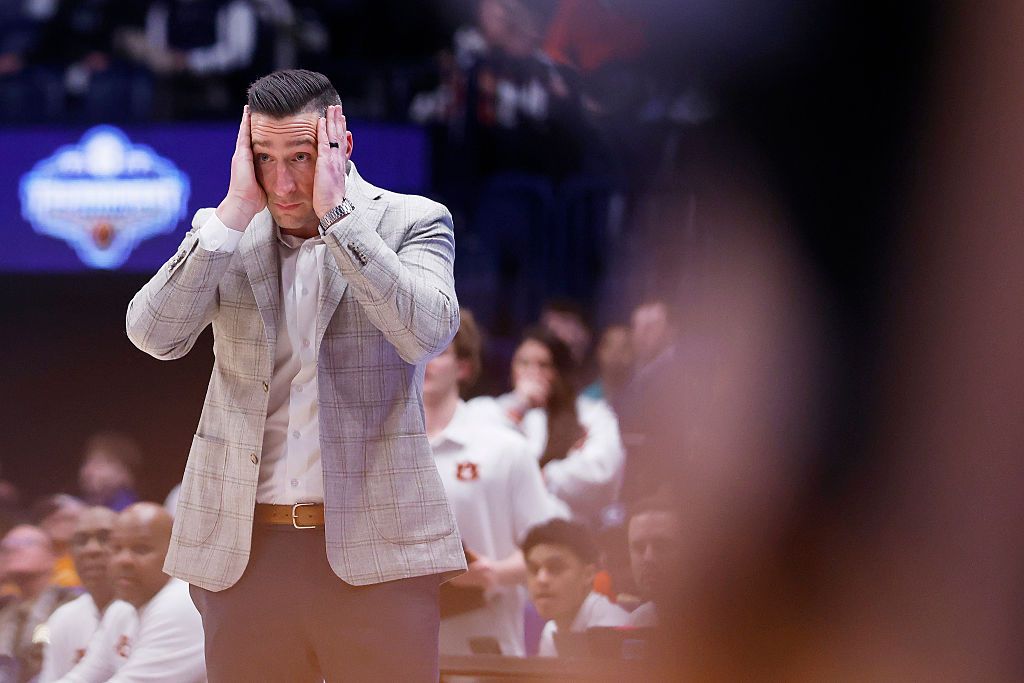
For all those who enjoyed seeing Bruce Pearl struggle to keep it together on the CBS despite being on the Selection Sunday desk.
Auburn is the cleanest true-snub argument because the pedigree has the kind of violent scheduling profile that usually buys a little grace. The Tigers finished 17-16 with a NET of 38, the No. 3 NET strength of schedule, a No. 15 nonconference NET SOS, and predictive numbers that still looked tournament-adjacent—BPI 28, KenPom 38, Torvik 41. The win stack had real shape to it too, with a road win at Florida and a neutral-floor win over St. John’s. And this is no longer some novelty program parachuting into the national conversation: Auburn had already made 14 NCAA tournaments and just came off its second Final Four. The reason it was left home is sitting in colder type just a few rows down. Auburn went 4-13 in Quad 1, only 2-8 on the road, and posted result-based marks of KPI 46, SOR 43, and WAB 44. The Tigers scheduled like a team begging to be taken seriously and finished like a team that kept paying retail for every mistake.
San Diego State Aztecs
San Diego State is the snub that feels most like the committee looking directly at a modern March brand and deciding not to be seduced by its recent aura. The Aztecs were 21-11 with a NET of 47, KPI 40, WAB 47, a 3-8 Quad 1 mark, a sturdier 6-2 in Quad 2, and a respectable 5-5 road record. The predictive profile sat right on the tournament fault line—BPI 56, KenPom 47, Torvik 44—which is another way of saying the numbers saw a field-worthy team, just not one that forced the committee’s hand. That omission lands louder because San Diego State has spent the last few years turning itself into a recurring March character; the program made its 17th NCAA appearance in 2025 and, two seasons earlier, played into the national title game. But the 2026 sheet never delivered the one screaming sentence bubble teams need. SOR was just 56, the nonconference record was 5-4, and the loss to Utah State in the Mountain West title game left SDSU without the kind of final, camera-ready evidence that converts a good case into an unavoidable one.
Indiana Hoosiers
Indiana is the brand-name omission, the one that sounds huge before the paperwork starts talking. The Hoosiers finished 18-14, went 9-11 in the Big Ten, carried an RPI of 81, and were only 3-8 on the road. The quadrant breakdown is where the whole thing curdles: 3-9 in Quad 1, 0-2 in Quad 2, and 4-3 in Quad 3. That is a sheet with an alibi problem. Indiana’s history still arrives dressed for a larger room—five national championships, eight Final Fours, and 40 NCAA tournament appearances in official program materials—but none of that could rescue this particular version of the Hoosiers. The committee did not reject the myth of Indiana basketball. It rejected an 18-14 team that never built enough second-tier stability to make the logo matter.
Oklahoma Sooners
Oklahoma is what bubble anxiety looks like when a late surge crashes into a full-season ledger that has already made up its mind. The Sooners did make a real push—Reuters had them at eight wins in 10 games after the SEC tournament win over Texas A&M—and the final sheet still had a few respectable bones: 19-15 overall, 7-2 in Quad 2, and that late neutral-floor A&M win. The history is substantial enough to give the omission extra dramatic weight too. Oklahoma’s official NCAA history credits the program with 34 tournament appearances, 11 Sweet 16s, nine Elite Eights, and five Final Fours. But selection-room mercy usually ends where 1-10 in Quad 1 begins. Oklahoma’s RPI was 97, the road record was 4-7, and three Quad 3 losses kept the résumé from ever feeling clean enough to trust. The Sooners made themselves discussable. They never quite made themselves safe.
Yale Bulldogs
Yale belongs in a different drawer—the heartbreak file. The Bulldogs finished 22-6 with a NET of 65, KPI 54, SOR 58, WAB 60, and a sharp 9-3 road record. They also arrived with recent March credibility that made them feel larger than a typical Ivy bubble case: under James Jones, Yale has earned five NCAA bids in the last 10 seasons and delivered the first two tournament wins in school history, including the 2024 upset of Auburn. But the at-large case itself was always thinner than the mood around it. Yale was 0-1 in Quad 1, 1-0 in Quad 2, carried a NET SOS of 223, and lived too much of its pedigree in the Ivy’s softer middle. Then Penn turned the whole thing into theater, stealing the automatic bid behind TJ Power’s 44-point, 14-rebound detonation in the Ivy final. Yale did not really get ignored by the committee. Yale got mugged by the calendar.