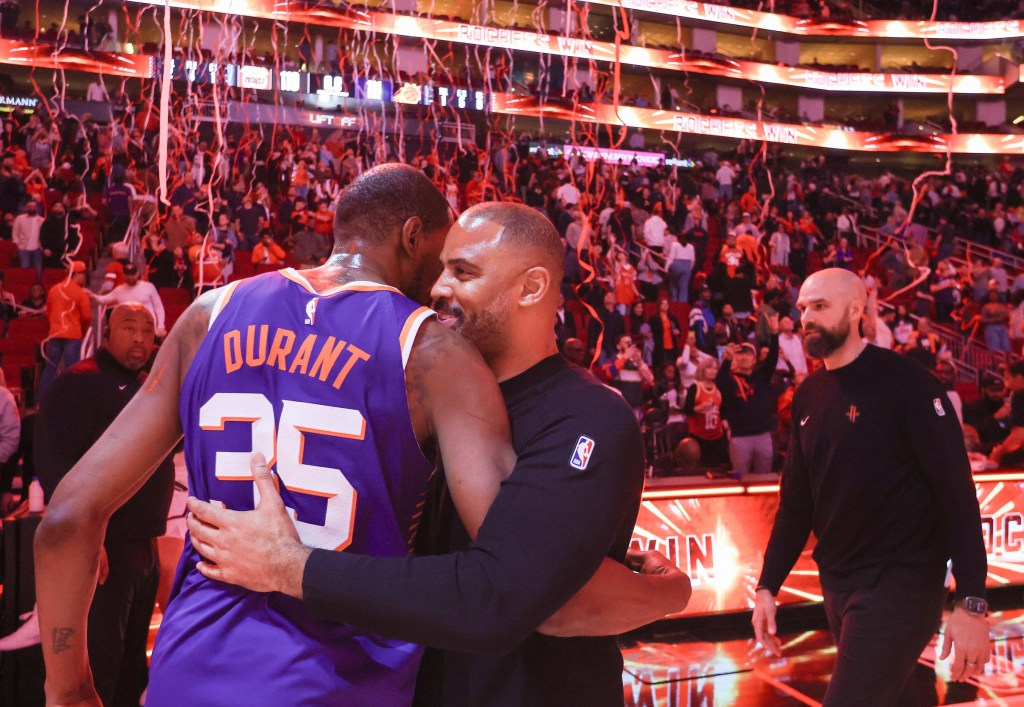
The landscape of the NBA shifted dramatically when the Houston Rockets pulled off a shocker: acquiring Kevin Durant from the Phoenix Suns in a summer blockbuster. Almost overnight, a team that had been carefully stockpiling assets to grow organically decided to cash in its chips and make a bold push into title contention. This wasn’t just one of those routine star-for-prospects swaps—the deal was intricate, layered, and driven by very different goals for each team. To understand who “won,” you need to appreciate what each side gave up, what they received, and why they moved the pieces at this particular moment.
The trade in focus
In the final agreement, Houston sent former No. 2 pick Jalen Green (22.7 PPG last season on 41.9% shooting and 33.2% from deep), three-and-D wing Dillon Brooks (10.7 PPG, 3.7 RPG with a 37.0% clip from three), the rights to the 2025 No. 10 overall pick (which originally belonged to Phoenix), and a small arsenal of second-rounders back to the Suns. In exchange, they added the aging-but-still-elite Durant, who is owed $51.2 million next season and $54.7 million in 2026—a salary that accounts for nearly 34% of Houston’s $151 million projected cap.
That return may seem light for someone of Durant’s pedigree—27.1 PPG last season on 52% shooting and 41.3% from three, top-10 in scoring despite turning 36—especially when you recall what Phoenix sacrificed to get him just one year earlier. But context is everything. Durant is under contract for just one more guaranteed season before a player option, and carries an injury history that can’t be ignored (he’s averaged only 51 games played per year since 2019). Phoenix was also up against brutal new tax aprons after topping $180 million in payroll last season, leaving them with zero flexibility under the second apron to improve their top-heavy roster that went 41-41 and missed the playoffs despite max-salary trio of Durant, Booker ($49.4M), and Beal ($46.7M).
That’s why the Suns prioritized regaining their 2025 first-rounder—a pick that could easily become lottery gold if this retooled roster struggles—while also reclaiming future second-rounders to rebuild their asset base. They also get back a player with Green’s explosive scoring chops, someone who can grow alongside Devin Booker, and a proven perimeter defender in Brooks who fits Frank Vogel’s defensive vision. Throw in the extra draft picks for flexibility and you can see Phoenix’s long-game: reset the roster and regain some control over their future after years of mortgaging draft capital.
Houston’s perspective
From Houston’s side, this was a calculated strike at just the right time. The Rockets leapt into the West’s top-10 defenses last year under Ime Udoka (110.8 DEFRTG, eighth in the NBA), but stalled in the postseason play-in due to their bottom-10 half-court offense (19th in offensive rating). Adding Durant—one of the most efficient isolation scorers in history (1.17 points per iso possession last season, per Synergy)—instantly raises their ceiling. Even at this stage of his career, he commands double teams and can punish elite defenses, which this roster desperately needed.
And critically, Houston managed to add him without gutting its youth. Jabari Smith Jr. (18.8 PPG, 8.2 RPG), Alperen Şengün (21.1 PPG, 9.3 RPG, 5.0 APG), and Amen Thompson remain in place as franchise cornerstones. They also kept all of their own future first-rounders after years of acquiring Brooklyn’s and others—allowing them to make this splash without leaving the cupboard bare.
Financially, they can absorb Durant’s salary ($51.2M) thanks to aggressive cap management—they had $61M in projected practical cap space heading into July after moving off Brooks and Green—and they’ll remain under the first tax apron (~$179M) next season. Even more strategically, they maintain max flexibility going into 2027 when Durant’s money is off the books and their rookie extensions will kick in.
That’s the kind of win-now move that still preserves long-term options.
Phoenix’s perspective
Phoenix’s calculus in moving Kevin Durant was stark and strategic. After two years swinging for the fences—emptying their asset chest to pair KD with Devin Booker and Bradley Beal—they were staring down an unsustainable roster. Last season they finished 41-41 despite a $182.5 million payroll, the third-highest in the NBA, and had zero flexibility under the second tax apron. That left them stuck: Beal on a no-trade clause, Durant making $51.2 million at age 35 with a declining games-played rate (averaging 50.7 games per season since joining), and virtually no path to upgrade the bench or add real two-way depth.
That’s why this trade is more about control than winning the box score next week. They reacquired their 2025 first-round pick—a vital asset given they owe unprotected firsts to Brooklyn and Milwaukee all the way into 2030—while peeling off $54.7 million in future salary commitments. Green is an intriguing, cost-controlled scorer who erupted post–All-Star (24.1 PPG on 45.2% shooting after the break), and Brooks gives Frank Vogel a proven switchable wing who held opponents to 42.7% shooting as a primary defender last year. Both fit a need for more youth, more athleticism, and more on-ball pressure than Durant provided on defense.
More important, this move finally breaks them out of cap jail. Even after absorbing Green’s $9.89M and Brooks’ $22.6M, Phoenix sits around $152.6M in committed salary—comfortably below the first tax apron ($8.5M). That means they can use their full mid-level exception (~$12.9M) for the first time since 2021 to chase a three-and-D wing or a combo guard to ease the burden on Booker and Beal.
Longer term, they can now actually pivot around Booker and Beal, with Green as a potential future piece rather than simply a throw-in. If Green blossoms into a 20-point-per-game player and their 2025 pick stays in the lottery, they’ll have restocked the cupboard in one deft stroke. Even if this roster doesn’t vault into the top four in the West immediately, the Suns have gone from rigid and top-heavy to agile and malleable—a small victory after years of all-or-nothing swings.
Immediate impact and longer view
On the floor, the fit is obvious. Houston already had top-10 defense and an emerging identity under Udoka. Adding Durant’s 7-foot shot-making alongside Fred VanVleet’s orchestrating (8.1 APG last season) and Şengün’s interior gravity should help unlock their offense. Role players like Tari Eason and Amen Thompson will slide into more specialized duties—on-ball defense, slashing, crashing the glass—and Udoka can lean on Durant as the closer that last year’s team never had.
For Phoenix, this trade signals a clear philosophical reset. Gone is the aggressive all-in push; they’re now prioritizing flexibility and a more balanced roster. Jalen Green will get a long look as a lead scorer alongside Booker—and if the 2025 No. 10 pick turns into an impact player like a Cody Williams-type wing or center prospect, this could set them up better for a sustainable future. Freed from $108 million tied up between Durant and Beal, the Suns can also leverage smaller trade exceptions (~$8.5M) to target mid-level role players that fit around Booker.
That doesn’t mean they’ll contend for a title next season—most models still, just after the trade, net them around a 10-15% shot of reaching the conference finals, by my survey—but they’ll be better equipped to navigate future draft capital and take advantage of a more balanced salary structure. Their total payroll now projects at $152.6M, allowing them to slip just under the first tax apron and potentially use the full mid-level exception (~$12.9M) for the first time since 2021.
A quick note on advanced stats
From an advanced-stats lens, Durant was still elite last year—his true shooting percentage (TS%) hit 62.4%, and his usage rate hovered at 28.7%, all while posting a 4.1 box plus-minus (BPM). Yet his defense showed slippage; his defensive EPM dropped to +0.7, the lowest mark of his career.
Jalen Green brings youth and upside with a 26.3% usage rate, but inefficiency persisted—a 53.2% TS% and -1.2 BPM highlight that he’s still a high-variance scorer who struggles to impact winning plays.
Dillon Brooks is the opposite: his offense rates negatively (52.7% TS%), but his gritty perimeter defense shines with a 40.8% opponent FG% as primary defender.
Finally, Phoenix’s reclaimed first-rounder is an unknown variable, though its projected draft value sits in the top 10% of all future assets per historical lottery odds. Combined, these metrics underscore a trade balancing star power against youth, defense, and flexibility.
Who comes out ahead?
Early returns say Houston is the big, big winner, here. They snagged one of the most gifted offensive talents in history at a modest price and instantly became a serious threat to come out of the West—all without hamstringing their long-term flexibility.
The Rockets’ odds to shifted dramatically after the trade on DraftKings Sportsbook with regards to their futures markets. You can take a look at the precise breakdown on the odds shift here.
Phoenix didn’t get a haul of unprotected firsts, but they stopped the bleeding, protected Booker’s prime years, and clawed back some long-term flexibility they sorely needed after going 41-41 with the NBA’s fourth-highest payroll.
If Houston is hosting a trophy parade next June, this will look like one of the most lopsided deals in memory. But if Durant’s body breaks down or the Rockets struggle to mesh star power with youth, Phoenix could look very smart for having taken its medicine early—getting back their pick and flipping a 35-year-old star with a max salary into a promising lead scorer and an elite wing stopper. Either way, this move reshaped the Western Conference power dynamic overnight—and the ripple effects will be felt for years to come.