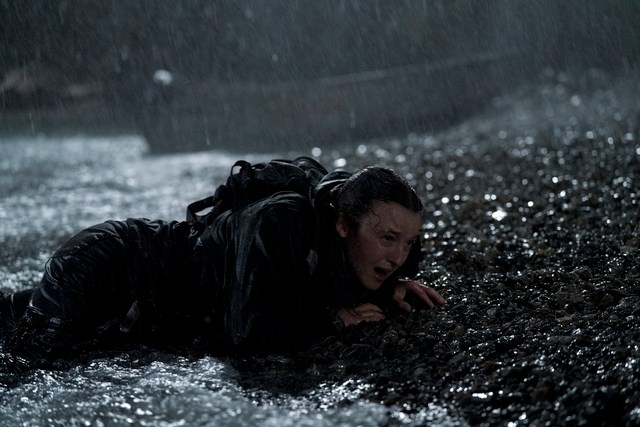
That last episode was so moving, it transcends any desire I have to point back to advising you all to prepare for “feature-length devastation” and feeling like I cashed a bet. This is DraftKings Network, after all; the winner’s impulse is always there. Readers of this column know just how dear, how fiercely-close I hold this story. And I’m not feeling like much of a winner six episodes into HBO’s The Last of Us season two.
I fear, more than anything, “The Price” registered, for me, as an example as to how this seven-episode run of the story—barring a finale that somehow sticks the landing altogether—got tangled between the separate and violently distinct hearts of both The Last of Us: Part I and The Last of Us: Part II, but failed to honor either/both in a way that would succeed in keeping a prestige-television audience rapt.
I’ve been resistant—in this column and in my broader conversations about the series—to admit that a writing team led by both the creative director of Naughty Dog (Neil Druckmann) and the creative mind behind Chernobyl (Craig Mazin) might somehow flub a story with such fixed and intimately-familiar source material. It honestly seemed beyond comprehension, but it’s now almost fully articulated itself. For me to admit it and reflect, this had to funnel itself down to its most granular frustrations: first it was just week by week and episode by episode, then it became beat by beat, writer’s decision by writer’s decision. And, with regards to the show’s structure, focus, and narrative flourishes, I can’t help but feel a little bit baffled and a great lot exasperated by some decisions we’ve seen play out on screen this spring.
As far as notes on when to tune in for this final installment: HBO releases episodes of The Last of Us on Sundays at 9:00pm ET/6:00pm PT.
For story notes and some general musings on the entire season as we prepare to wrap up, read on.
The Last of Us story notes
I’ve lost a little faith in the writers
See above, if that wasn’t clear. It’s important to me that I don’t articulate these criticisms in a way that betrays potential future story developments of which I’m aware based on my experience playing the games. Not everyone else is. So let’s just go with a list of some big-picture narrative decisions with which I now officially disagree:
Introducing Abby (Kaitlyn Dever) to so much ballyhoo, only to have her disappear altogether for the last four episodes (that’s, ballpark, 57.1% of the season’s total runtime without her, provided she’s in most of tonight’s story; if we don’t see her tonight, it creeps up to ~70%) before the finale.
There was the Entertainment Weekly cover reveal. Her overwritten monologue in the show (much better written in the game), which suggested to me they were caricaturing her villainy so as to provide more fertile ground for a moving season-long character arc. But nope. She’s gone. Been gone! Straight dust. Any hope of a narrative that was intricately-and-tightly braided like Devers’ hair in episode two went out the window. And how can we possibly do anything besides superficially loathe Abby to the point where the next time we see her, we hope it’s with a bullet in her head? What reason have you given anyone to preserve any sympathy for Abby?
Instead of fleshing her out any more, let’s do this, okay? Let’s go ahead and hit hard—I’m talking best-guest-actor nominee type stuff, here; get some real marquee names—the flashback episode that totally humanizes the impossible conflict Joel and Ellie faced based on Joel’s decisions in season one. And, again, let’s make sure to stamp that on the docket firmly before we give audiences literally any more empathetic screentime to Joel’s brutal, eager, and verbose executioner.
We might have forgotten what she looked like if not for Pedro Pascal’s Instagram posts—seriously.
Apologies for being glib. The flashback is one of my favorite sequences in the entire story. But it’s hard for me to feel like it’s not just a crutch for an otherwise underwhelming season in which Bella Ramsey and Isabela Merced are acting their absolute tails off, and somehow manage to transcend the woolly delivery of this holding-pattern of a story on screen week-after-week. They do it to no celebration at all, mind you. It’s just a bad blizzard of memes out there. Hyenas.
This whole Abby absence was a major structural decision—like, a foundational one—that, after episode six, seems an absolute sandbag of a dud. And it feels like they’re asking us to prepare for a third season of the show that’s all Abby. That’s an arrogant expectation, and not one the show earned from television viewers in the way it should have. Seeing a flashback of Joel before seeing Abby again in present-day (or, heck, a flashback with her father—you know, the guy who Joel shot so dismissively, and whose murder is really the entire catalyst for this story, now) just frustrated viewers more, made them long for Joel’s steady presence instead of intrigued as to how we’re going to find a way to root for Abby at all.
Whiff.
Following the structure of the video game narrative by having Joel die in, basically, the end of the first chapter of this story. Especially after the show played coy during its two-year absence about how they’d structure Part II, with showrunners and writers often hinting they’d be making some “changes.”
Shame on us, I suppose, for thinking this might mean the series would look to establish itself as a little more linear than the games. Instead of opening five years later, it was feasible that the changes Druckmann and Mazin might have been instituting for season two would give us more time with Joel and Ellie during those five years in Jackson, prior to Abby’s arrival. How could we not assume as much? The thought of a writing room electing to amputate itself of Pedro Pascal’s character in 2023-2025 seemed folly. Implosion.
And it was: the viewership ratings for each episode of The Last of Us season two have gone down, steadily and definitively, each week. Which, if you remember, is the exact opposite viewership trajectory of season one. 2023’s The Last of Us famously snowballed episode-by-episode into a global hit.
The choice to honor the source material so obdurately makes me wonder if there might never have been any story for HBO’s Joel and Ellie plotted out that bested what Naughty Dog put on paper for Part II (game). Surely they must have floated around ideas, no? I mean, the Gail/Eugene of it all is absolutely different from the video game’s story, and Joe Pantoliano can sure steal an entire hour with five minutes of screen time, but that was merely a beat or two. Not a story. Not Bill and Frank, not by any stretch of the imagination. And it was a revision/edit that took us to the same place without being a beautiful-enough detour.
To that end, I think the intent, regardless of Pascal’s bloated schedule this summer, might always have been to kill Joel in the early-goings.
Many of us expected, as Druckmann and Mazin bandied them about whenever they were harassed by interviewers about the plot of season two, that these changes would be far more tectonic. Turns out, according to Mazin, this big change was that, rather than Ellie and Dina chasing Tommy and Jesse to Seattle, it was vice versa. In the video game, Tommy and Jesse take off before Ellie and Dina are allowed to. Or, rather, before they sneak out.
Apparently, this change will be important enough to tonight’s finale that Craig Mazin is extremely relieved we’re all aware, now, of this arrangement on the PNW chessboard.
But let’s go back to those separate and distinct hearts of The Last of Us: Part I (or, here, season one) and The Last of Us: Part II (or, here, whatever gumbo of episodes comprises Part II‘s story across several television seasons and calendar years off between filming):
It’ll become clear by the end of HBO’s adaptation of Part II that the story’s message is a lot different than Part I‘s. Without revealing too much: Part II is far more bone-deep violent. Bleak. It’s more about human-against-human atrocities as opposed to humanity-against-extinction redemption quests. It’s, of course, about articulating and protecting what humanity means to its characters in a world that’s mutated the entire species—both the infected and the un-.
And it’s about personal loss in almost the precisely equal-and-opposite way that The Last of Us: Part I was about healing, and allowing beauty to flood in once more after suffering and resigning yourself to a life of unimaginable, brutal absence. Quite simply, Part II is about characters whose lives become/are defined by nonsensical barrages of loss. Part I was about Joel breaking the pattern. Both Parts are about rage as an agent of love. But, again, Part II is more about rage as a method for coping with loss. And that’s an important distinction, because one must cope before they love again, as we saw with Joel. In that way, seeing Ellie now might be our only window into how Joel may have been in those early days as a smuggler. Berserk with abandon.
The Last of Us could have ended after season one, just as it could have ended after the first game. No more powerful moment will exist between Joel and Ellie than when Joel says, “I swear,” (lie), and Eliie says, “Okay,” (lie). It was, in dialogue, an encapsulation of all they were willing to shirk, forego, kill off, jettison—whatever—in service of the love they found for each other. It was the most powerful moment in the video game, and, even though season one of the HBO adaptation gave us Bill and Frank, it was still the most powerful moment in any episode during the show’s initial run.
And so, after last week’s episode, which transported us so far back to the heart of the first season, it’s even easier to be frustrated and confused with regards to the direction of season two. What I mean by that is: the show didn’t deserve to have Pedro Pascal come in and deliver one of his top-three most pitch-perfect performances as Troy Baker’s Joel just to save the season.
The flashback episode is utterly necessary, don’t get me wrong. But it pointed to something else that’s equally crucial, and at risk of going missing for the entire season: the need for the show to challenge itself by leaning deeper into the Abby/WLF/Isaac/Seraphites side of things in Seattle, continue to establish a tone for this story instead of directing our focus away from it. And “The Price” didn’t just pull us away from Part II, really. It yanked us back. It displaced us into a reminder of what we miss most about the story—Joel and Ellie’s dynamic in season one—as a television audience unfamiliar with the source material and where it’s headed. That’s an unearned gut punch, in my opinion. A sucker punch.
It’s worth noting: an eight- or even nine-episode season would have allowed for a lot more flexibility and earned tonal pivoting. But we went with seven, I guess. That helped no one.
The entire Seattle storyline is still in its expositional phase—what’s been done there, really, is only superficial with regards to the WLF and the Seraphites, almost just the most sidebar groundwork. And why would they introduce Jeffrey Wright’s Isaac so theatrically two episodes ago just to, I don’t know, pull the camera away from him?
It all feels like a rather unstable and shaky bridge to get us to the meat of The Last of Us: Part II‘s storyline. And, for the record, I’m nervous with how they deliver whatever’s to come this evening. I’ve seen the advanced photos! And now, so have you. Ellie’s crawling on a beach. She does not look hopeful. One might say she looks a bit nervous, too.
Real quick: My theory on why Joel’s death in the video game worked within a narrative structure like this, but didn’t on the television screen
My honest theory is: time. Time we don’t get in a seven-episode season. After gamers dropped their controllers when Abby stopped Joel’s heart in The Last of Us: Part II, there were eight-plus hours in which they were controlling Ellie and Abby and forging their way through this world despite Joel’s absence. Gamers were still enmeshed in the story, even if they were frustrated with it. They had to exist in the world. So they hardened into the narrative as they controlled both protagonists, took in so much external stimuli authentic to exploring and stalking around a hostile Seattle.
Television viewers didn’t have the luxury of that for this story. A bloodied Joel died and the second episode basically faded to black. After that, we’re in Seattle, and we make our way to the movie theater. And, where I was able to literally control how Ellie moved through the world for hours and hours as we both grieved Joel’s absence—it was indeed strange not to control him at all for so much of the early goings in Part II—audiences are being ushered by rushed pacing within a seven-episode arc to shift their emotional understanding of the show entirely.
As far as a season of a television show: it’s a lot to ask of viewers in too little screentime. And, if it’s executed poorly—as in HBO’s The Last of Us season two—it becomes too much to ask of your audience. It feels like this is where we’re at.
Speaking of time: a note on tonight’s runtime
Let’s hope the gambler in me balances out: I was right about last week. Let me be very wrong about how disappointed I expect to be tonight. Please!
One way I was thinking they might shove it in my face was by dropping a 90-minute episode. But, alas, I hear tonight’s runtime is expected to be between 40-50 minutes. Just your regular, run-of-the-mill episode time. For the finale of what was possibly this year’s most-anticipated show not named The White Lotus.
Alright then. See you on the other side.