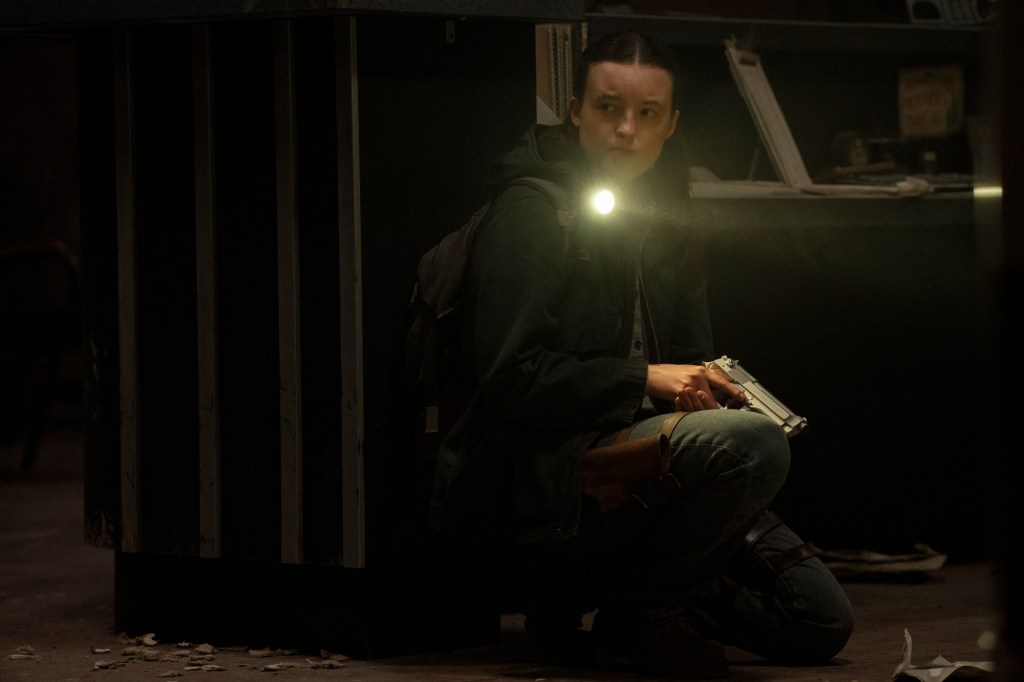
Can we all just take a beat, please? There’s a lot of understandable chatter about how The Last of Us‘s fourth installment was too video-gamey. There were, indeed, extended sequences in which Ellie and Dina were basically platforming their way through a television-set level of Seattle, in which the stakes were, really, stakes to be stakes. There wasn’t much narrative nor character development until after the platforming was done, and Ellie had a guitar in her hands, and Dina had an armload of positive pregnancy tests.
I’d like to recognize that it’s easy to understand frustration with sequences like that. I’d also like to say I believe a lot of the, ahem, sour-and-salted-grapes attitude many viewers have with regards to this season of The Last of Us is a *tad* less tolerant of the writing now that Joel’s gone, don’t you think? Folks even seemed unimpressed with Jeffrey Wright’s Isaac bits—come on, now.
Again, I’m just encouraging the most frustrated of us to take a beat. Last week’s episode wasn’t one of the series’ best by any means. But there was so much beauty, and so much necessary absolute growth and clarity that blossomed between Ellie, Dina, and their once-dynamic-now-situationship. More on all this below.
As far as notes on when to tune in for the second installment: HBO will release episodes of The Last of Us on Sundays at 9:00pm ET/6:00pm PT.
For story notes, read on.
The Last of Us story notes
What we know is this: out in the distance from the theater in which Dina and Ellie holed themselves up, a noose is tightening in Seattle. There are unexplained explosions, frantic comms, desperate calls for assists from names Ellie recognizes as her bounties.
Somehow, this all has to do with Isaac (Jeffrey Wright), to whom we were officially and spectacularly introduced last episode. He’s a stoic and powerful speaker, whose grisly charisma seems to have catapulted him to one of the primary leadership roles in the WLF (remember, that’s the military group of which Abby and her entourage are a part). And we know the WLF and Jeffrey are in some war with the fish cult and their Prophet, who seems to be a female.
And nowhere in all this is Abby. Yet. And I think it’s intentional. Hear me out:
I think The Last of Us realized they might run into a Walking Dead problem. What I mean is: it’s a lot to ask of viewers when you go from investing all your emotional engagement in a tight ensemble of characters only to have the writers zoom out the narrative world and start to focus on other stories within it. We saw this with the Game of Thrones book series, when George R. R. Martin released A Feast for Crows, which lacked perspectives from favorite characters like Jon Snow, Tyrion Lannister, and Arya Stark. It can be overwhelming, and the shift can feel more like a fracture than a branching. That’s an intimidating prospect for a television show that just saw its famous duo fractured in every literal and figurative way you can imagine. I understand that, to a small degree, this season is very much so a test in patience (find whatever poignancy you wish between being patient with narrative and being patient with grief, which Ellie must be if she’s to survive this endeavor).
So I wonder if the show is simply pacing itself, here. Episode three established an expositional premise for the state of things and the conflict therein re. Seattle’s factions. Episode four zoomed all the way back in on Ellie and Dina, and it felt like we only made very little narrative progress. I feel the same, too. I was a bit surprised that we ended at the moment when Ellie and Dina decide to split up or forge out together, now that the baby of it all is out in the open.
I ended last week’s notes by reminding everyone to trust the writers. I’ll do it once more this week, but that’s the last I’ll do so this season. We only get so many episodes; if they stick the landing from hereon out, no one will even remember the platforming, video-gamey bits in a month. We’ll see the video of Ellie playing “Take on Me” and Dina tearing up and understand that, really, this was Ellie’s way of telling Dina that she is heartbroken, that she is untethered. That perhaps what’s most important to understand about Ellie is that her beauty is indelibly linked with her rage and her hatred, for Ellie rages and hates with—always, only—love. And that entire sequence was about getting Dina to that clearing, where she saw Ellie in that light. And where she felt she could finally be honest, too.
However! If they keep downshifting the pace? And if they can’t find a good balance between the inter-faction conflict, the Eliie/Abby conflict, as well as, hopefully, both Ellie’s and Abby’s individual conflicts?
Well.