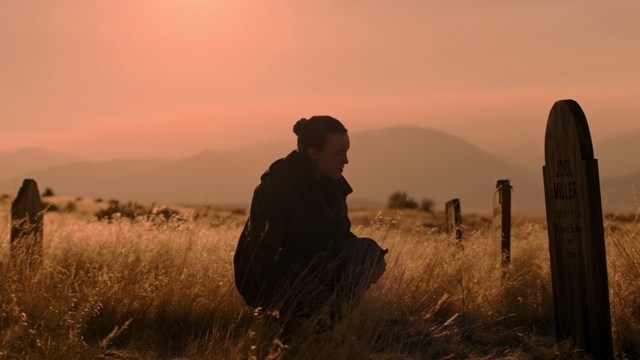
I’d like to begin here: Joel got up. Joel always got up, he went down getting up, and we’ll forever remember him as someone who—even when he was bludgeoned to a pulp—got up for those he loved. Urgently, and without question. Brimming with complicated love. Always bruised, and often bruising in his physically and spiritually violent frame, but a warrior of heart who seized his purpose once he found it once more. It is, of course, devastating knowing that Joel died likely believing Tommy and all of Jackson had perished in a fire, and that the danger Ellie was in had become fatal. But, to be fair, they told us from the get-go: Every path has its price. And the central tragedy to Ellie’s immunity and continued existence is that she was offered no choice in her own path; Joel decided that for her. And so: the golf club.
Joel and Ellie forever was never the promise nor prize of the choice Joel made in Salt Lake. That’s not how this universe works. And kudos to the writers’ room for having the courage to be as swift with this plot development in the adaptation as in the source material, and not hanging onto Joel just because Pedro Pascal’s surly representation was borderline pharmaceutical for world in need of his type of warrior. So! While we all struggle to grieve the loss of Joel—specifically with regards to the spectatorship experience; it was as brutally delivered in the television series as it was in the game—there is much damage to control, much blood to hunt.
Expect episode three to focus on the “What now?” of it all. As far as notes on when to tune in for the second installment: HBO will release episodes of The Last of Us, beginning with the premiere on this Sunday evening, April 13th, on Sundays at 9:00pm ET/6:00pm PT.
For story notes, read on.
The Last of Us story notes
I do so hate to be succinct in story notes for a narrative that deserves so much microscopic attention. But, to be honest, we watched the brutal undoing and the in-no-uncertain-terms tearing down of all season one built toward. The expansion and industrialization of Jackson Hole, Wyoming—(mostly) burned to the ground. Joel and Ellie’s relationship—materially over with no closure, but plenty of flashback context. And, perhaps a bit lost in the shuffle of the conflict in last episodes: gone, too, are the Fireflies.
So let’s just get a game reset. Don’t you love a good game reset after a media timeout? I sure do. I believe this episode might give us some space to breathe, knowing how the first two really felt like a pressure-cooker feature-length chapter that ended with Joel’s death. We’ll see where it takes us. Here’s where we are.
- The infected are getting smarter, and are somehow using cordycep filaments to communicate with or signal to each other, and it seems like the primary use of this is to draw a horde. This is in addition to the little tidbit that infected are using ice and other dead bodies as insulation between them and the freezing surface such that when they feel vibrations above them, they break through and form a horde, etc.
- The Fireflies are no more. Abby and her crew are evidently a part of something called the W.L.F., which we can assume is in Seattle. Why? Abby expressly told Joel not to go there before she played 18 holes with his face and shotgun-obliterated legs. Dina will have seen/heard this, and, assuming she actually wakes up and wasn’t fatally poisoned, will likely give this to Ellie as her only lead.
- Abby’s killing of Joel, in The Last of Us universe, was absolutely justified. It’s hard to accept, but didn’t you even see the acceptance set in on Joel’s face once he realized who it was? He knew there was always a chance the other shoe would drop. And indeed it did. Just to be clear: Abby’s father was the surgeon who Joel shot without a glance in the finale of season one. Ellie will never accept it, even though I’m starting to believe she has put enough together to understand why people might be hunting Joel.
- Tommy is alive, and does not know Joel is dead.
The title of last episode was “Through the Valley,” a song which Ashley Johnson—the voice actress who played Ellie in the video games—covered as the episode montaged to black. I have listened to it many times.
It’s a reminder that The Last of Us is a universe in which we are rooting for those who think themselves damned to grasp with fierce and fiercely ardent hearts onto what’s left of their humanity. The last line of the episode’s titular song is:
But I know, when I die /
my soul is damned.
While we grieve for Ellie, we must fear for her, too: what does humanity look like to her, now? What does she want it to look like?