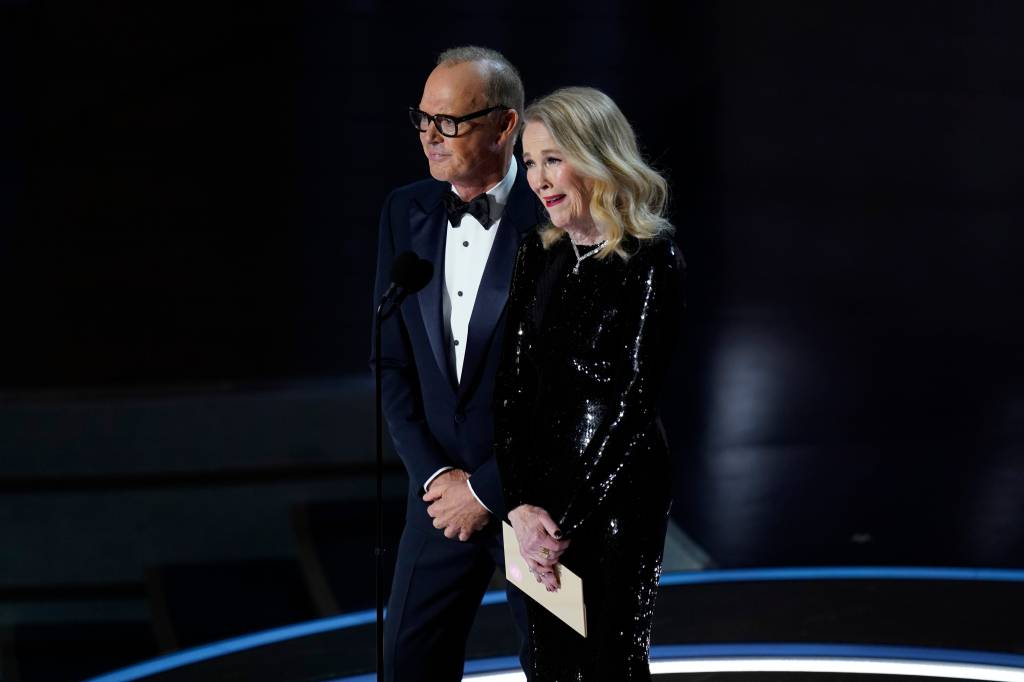
I was never going to begin this article with: “It’s showtime!” But, in fairness, we’re pretty close to it.
Beetlejuice Beetlejuice, the legacy sequel to the 1988 Tim Burton cult darling, Beetlejuice, releases in theaters tomorrow. Just a tidy 36 years after the original!
Many Beetlejuice diehards are as circumspect as they are excited. Sure, they’re stoked to see both Michael Keaton as Betelgeuse and Winona Ryder as Lydia again. It’s fun to encounter your favorite characters again in a completely different story almost forty years after you first found them to be so beloved. We always want to see what happens when the people we love—fictional and non—are given opportunity to do more.
On the other hand, fans are, understandably, worried this might be another Ghostbusters revival situation. Some have gone so far as to call it utterly unnecessary, and are concerned that Burton’s forcing the franchise into a position where it’s overstayed its canonical welcome.
Which is to say: In a world where we’re already so far down the rabbit hole of mistaking volume of content for quality of content, sequels like Beetlejuice Beetlejuice run the risk of flubbing. Especially because the entertainment industry, particularly cinema, is stuck in an oversaturated marketplace of IP-based storytelling. Unoriginal ideas stack upon unoriginal ideas like so much refuse in landfill.
Really, you might almost hope your favorite legacy franchises don’t get picked for the reboot treatment. It’s become a little like a short straw situation. Burton, Keaton, Ryder et. al will look to transcend this trap.
Let’s see what shakes loose as we engage with a few burning questions headed into the release tomorrow. It’s been about six-hundred years, after all.
Where are we going; where have we been? Why are we going there?
(S/o Joyce Carol Oates!) The biggest question, so often, with legacy sequels and their narratives is: Why?
We’ll get to that in a moment. What we know of the premise for the second film is that a family tragedy—presumably the death of Jeffrey Jones’s Charles Deetz—brings Ryder’s Lydia Deetz, Jenna Ortega’s Astrid Deetz (Lydia’s daughter), and Catherine O’Hara’s Delia Deetz back to the old Maitland/Deetz farmstead. Note, here, that neither Alec Baldwin nor Geena Davis are returning as the Maitland ghosts.
New in town
Here’s where things start to get unpleasantly scattershot.
Obviously, Keaton’s Betelgeuse comes back, still oozing with as much repulsive passion for his dear Lydia as he was in the first film. But then we have Monica Belluci as the film’s primary antagonist; she plays Betelgeuse’s jealous-and-imaginatively-violent ex-lover.
Enter Justin Theroux, also, as Lydia’s new boyfriend, who seems to be a self-help author of some sort. He also seems to be a wildly over-enthusiastic supporter of Lydia’s television series, Ghost House. His whole character seems a play on men who champion the creative success of their female partner, how that doting behavior is so often seen as effete instead of supportive.
And then, somehow, Willem Dafoe factors in as vigilante ghost hunter operating at the perimeter of this already-disorganized premise. Folks might call it a bit of a side quest narrative. This part, particularly, smacks to me of a typical Burton mistake we’ve seen in recent years.
Burton tends to trip over himself when he overstuffs his stories. More on that below, but this concerns me a bit for a sequel that already seems so extraneous.
I’m most interested, of course, in the growing dynamic between Betelgeuse, Lydia, and Ortega’s Astrid. Burton himself has said he wanted to focus more on the intergenerational dynamics between those three women as opposed to, say, the Maitlands. But, tell me: How are we going to get decent character studies of any individual, especially as these characters grapple with very real grief, if we’re off fedora shopping with a dusky Willem Dafoe? The movie is only 92 minutes long.
Of course, I’m burying the lede a bit here: we all came to watch Keaton. So many of us will forgive slapdash subplots and superficial characters for Beetlejuice Beetlejuice specifically if Keaton brings it.
Even more so if someone else rises to his level.
Will anyone match Keaton’s freak?
It’s abundantly clear from trailers and early reviews that Keaton’s, again, is the outstanding performance among the ensemble in the Beetlejuice universe. No surprise here.
Keaton’s made a bit of a late-career run, especially recently, as a fantastic and full-tilt supporting character actor. His roles in films like The Other Guys, The Flash, Documentary Now!, etc., have shown that he has comedic range beyond his Birdman-drama chops. And his performances always seem to suggest he’s fully bought in, no matter the gimmick.
And so he boomerangs back to Beetlejuice. You don’t have to give Keaton much runway to get a commanding performance off the ground. So, for him, this must be a dream: Tim Burton is having him suit up as the character for which he’s likely had the most artistic freedom in his career, at a time in his career when he might be feeling particularly energized.
With regards to who can saddle up on a giant hell-kept sandworm with Keaton and hang in the Inferno Room, so to speak, I don’t think anyone has a better shot to do it here than Ryder. If it ain’t broke, etc. Some say Delia’s wacko fashion was the second-best part of the original film, only bested by Keaton’s hijinks. I’m of the mind that it was Ryder’s performance as Lydia that elevated Keaton’s crazy as Betelgeuse, and am betting on her to similarly elevate this ensemble.
Because, to be clear, Burton & co. bloated the cast. I’m a bit concerned that the performances by Theroux, Ortega, Dafoe, and Belluci won’t feel cohesive. I, too, am a bit concerned they may prove arbitrary.
Which leads me to my last question:
Which Tim Burton are we going to get?
Maybe our concern should be more about Burton himself. We have reason to be dubious of his ability to once more nail the narrative approach for such an idiosyncratic story. And now we’ve got all these new characters, and the next generation of Deetzes. Having seen some of Burton’s less-impressive work (regrettably, here, I am speaking about his adaptations of Carroll’s hallucinogenic classic Alice’s Adventures in Wonderland, which we all so wanted to be excellent), I fear there’s often a binary with his work.
It’s either: a fantastic ensemble cast of macabre and absurd characters who have plenty a sense of humor surrounding the human condition, but they get smushed within a listless, abstract narrative that doesn’t quite fit all their individual stories. It’s fractured. Just as Red Queen, White Queen, Alice, the Mad Hatter, the various Tweedles, etc. in Through the Looking Glass felt more like an unedited, kaleidoscopic tilt-a-whirl through a wartime Wonderland.
Or: Of course, you have the gems: Edward Scissorhands, The Nightmare Before Christmas, Coraline, to name a few of my personal favorites. What these did was narrow the character focus to smaller ensembles of protagonists such that we shadowed Coraline, Jack, Sally, Edward, et. al.
We lingered with these characters. We did so long enough that we saw that their feverish and silly and sometimes-manic restlessness with the human condition was something with which we, the audience, could empathize. Then, it was deeper: we identified. We, too, have a Spiral Hill in our heart from which we pine at the great big harvest moon. We, too, want to tear a hole in the walls of our house and step through.
There’s worthwhile, endearing dark humor. And then there’s dark humor for the sake of itself, in celebration of itself—a sort of gothic, masturbatorial circus.
Burton’s worst stories suffer from the latter pitfall, and what could be space for narrative is instead occupied by a recursive cycle of bizarro tableaus that amount only to parts, never a sum. The comedy bludgeons itself flat.
Bottom line
Beetlejuice, as a franchise, is certainly a different, more demonic animal than the above listed. Keaton, at his best in this role, is terrifically glib about death, trauma, identity—all things O’Hara’s, Ryder’s, and Ortega’s characters will likely earnestly grapple with, in spite of Betelgeuse’s chicanery.
Burton, at his best, allows both characters and narrative to breathe, even in his darkest works. Glib for glibness’s sake is, anymore, exasperating. Burton, as a storyteller, needs to have learned that for him to regain our trust. For example, it’s probably pretty key that the Deetz patriarch’s death has, at some point, some emotional weight. Otherwise, it’s a transparent plot device to reunite the collective of otherwise-distributed individuals just so they could raise a nefarious Keaton back from the dead.
Just look to Jack, Sally, Edward, Coraline, and so many more. They’ve become timeless staples for unabashed weirdos everywhere. Young Lydia from the the first film in 1988, too! The way Burton wielded the malaise of these characters had a jua de vivre. Their darkness, like all of our darknesses, has a heart.
Beetlejuice Beetlejuice, especially with Burton’s focus on the story being about three generations of women coming together after a family tragedy, will demand a storyteller who can imbue it with a narrative heart—albeit a pickled, blackened, skulduggerous, ghoulish, maggoty one—to be a worthwhile addition to the franchise.
The Crown Is Yours: Sign up for DraftKings and experience the ultimate host for games and betting experiences!
All odds provided by DraftKings Sportsbook and all odds subject to change.
I am a promoter at DraftKings and am also an avid fan and user (my username is thegreatdansby9) and may sometimes play on my personal account in the games that I offer advice on. Although I have expressed my personal view on the games and strategies above, they do not necessarily reflect the view(s) of DraftKings and do not constitute a representation that any particular strategy will guarantee success. All customers should use their own skill and judgment in building lineups. I may also deploy different players and strategies than what I recommend above. I am not an employee of DraftKings and do not have access to any non-public information.