

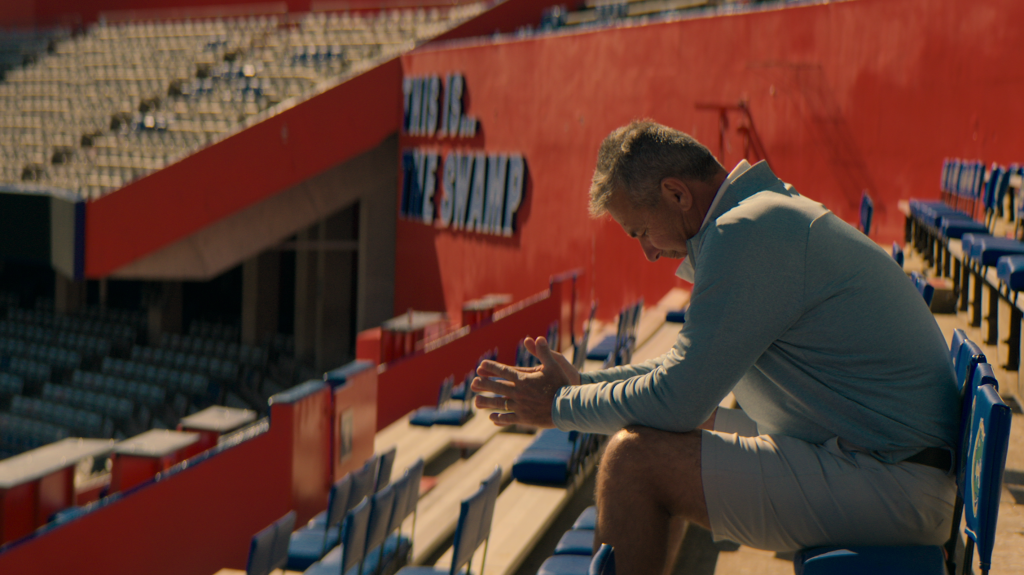
The third season of Netflix’s Untold has taken us through the eccentric and disruptive nature of Jake Paul’s boxing career, the rise and fall of Johnny Football, and the complicated deceits of the BALCO steroid trial. But everything has been building up to the finale, the four-part Florida Gators expose, Swamp Kings. After the success of The Last Dance, we’ve seen an abundance of sports documentaries that look to dive into a particular period in time within a franchise. Swamp Kings might be an essential watch for college football fans and lend an introductory overview for non-fans into what this exciting and turbulent period meant to certain players. Other than that, the documentary often pulls back from getting into the thorny periods and doesn’t provide too much new information from what sports fans already know.
The audience gets a look at the 2005-2008 Urban Meyer era at The Swamp. Before Meyer took the head coaching job with the Gators, he was the spread offense frontman of the Utah Utes, leading them to a perfect 12-0 season and Fiesta Bowl win in 2004. But as his account and ESPN’s Paul Finebaum both say – playing in the SEC is a different animal. The Florida program had been in a slump coming off the Steve Spurrier era, and quite frankly, the program needed a spark. This is where Meyer’s military upbringing comes into play as he forged ahead to put together what he called “the hardest program in the country.”
Winning two national championships in four years is an incredible feat (as some former players say, they should have won it in 2008), but it wasn’t always easy. Even though Meyer’s team experienced some success in 2005, they got knocked down to earth because of the talent gap in playing other schools like Alabama.
Besides following Meyer and his former offensive coordinator Dan Mullen speaking out their thought processes, Swamp Kings is most rewarding by briefly peering into former Gators’ lives like Brandon Siler, Brandon Spikes, and Chris Rainey. Looking into their background, you see why they bought into this program with the tenaciousness it needed to succeed. Sometimes, Meyer’s methods turned some people off (former guard Carl Johnson states he wants to forget the person he was then), but it drew them closer together in a quintessential sports manner.
:format(webp):no_upscale()/cdn.vox-cdn.com/uploads/chorus_asset/file/24866456/Untold_Swamp_Kings_E1_00_01_20_15.png)
Of course, the documentary builds up to the legend of Tim Tebow, and it’s not hard to see that his focus paired with Meyer’s competitiveness was a perfect match. When Tebow speaks about his time as quarterback, you can still feel the fire inside him. With success comes difficulty, and Meyer talks about his stress levels elevating. The expectations and weight felt unimaginable as those Florida Gator teams became more successful. Swamp Kings briefly touches on the many legal troubles players faced under Meyer’s tenure (no Aaron Hernandez), the tension between players due to the emphasis on Tebow’s praise in the media, and the culture that divided players into a “champions table.” by treating “stars as stars and sh*t as sh*t” as quoted by a player.
Meyer himself touches on his health issues which are one of the main reasons he stepped down a second time after the 2010 season – and that’s pretty much the tone to the end of the dynasty. If anything, Swamp Kings gives a first-hand account of how it was playing for legacy and what that cost. There are many highlights surrounding the big games through four seasons that you’ll get a kick out of either reliving or learning about for the first time. Besides that, this is a pretty standard documentary where you’ll recognize the conventional ebbs and flows from others before this one.
