

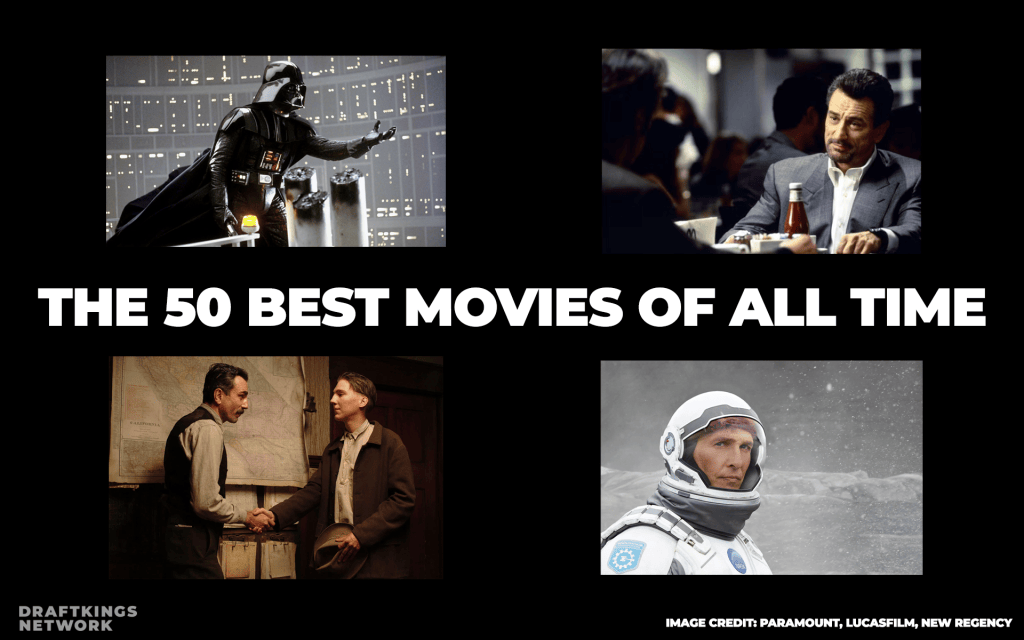
The greatest movies can be timeless, influential, technically groundbreaking or simply impossible to stop watching whenever they come on. Our film writers have compiled their lists of the best movies of all time, which have been aggregated into our final, comprehensive rankings. Narrowing more than a century of film to just 50 selections is inherently subjective, but these are the movies that have endured through generations, shaped the medium and continue to set the standard for what film can be. From golden-age classics to modern blockbusters and international masterpieces, here are the 50 best movies of all time, ranked.
Ranking the 50 Best Movies of All Time
#50. Network
Blake Krass: Network is one of many films on this list that is 50 years old, but just as relevant today as it was then. It is one of the great explorations of media and how easily the public can be swayed by what they see on their television. There are moments in this movie that will make your jaw drop in disbelief if you’ve never seen it before. It’s hard to imagine these themes were groundbreaking half a century ago and are still so prescient today.
#49. Whiplash
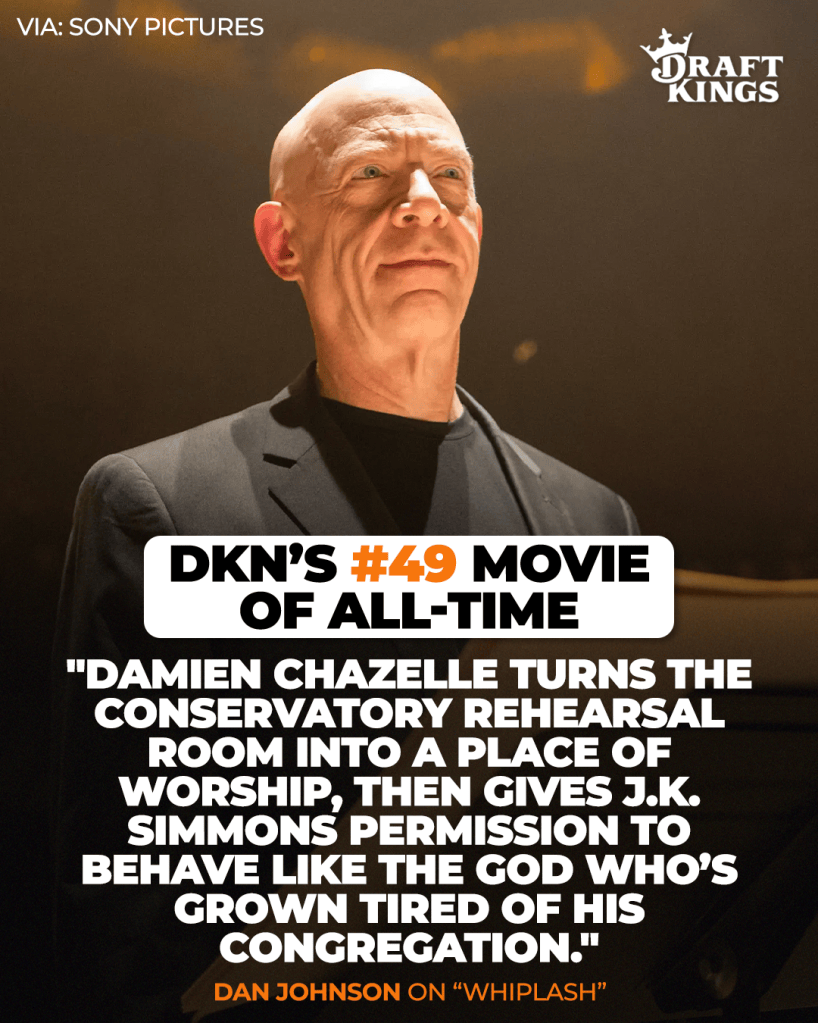
Dan Johnson: A movie, I think, about the particularly American fantasy that being exceptional might excuse us from having to be decent. Damien Chazelle turns the conservatory rehearsal room into a place of worship, then gives J.K. Simmons permission to behave like the god who’s grown tired of his congregation. Simmons understands how seductive that authority can be; every humiliation arrives dressed as an opportunity to prove that you’re the one student who can withstand it. Miles Teller gives us a drummer so hungry to be chosen that he begins doing Fletcher’s work for him, dismissing his girlfriend, sneering across the family dinner table, rehearsing the loneliness he’s decided greatness requires. By the final performance, we’re so exhilarated by what Teller’s Andrew can do that we’ve begun to forgive the man who helped make him this way. Paul Reiser’s face in the wings is devastating, here. What if someone’s finest moment makes you terrified of the beautiful life it promises them?
#48. All the President’s Men
Blake Krass: All the President’s Men is arguably the greatest journalism film of all time. Robert Redford and Dustin Hoffman both give remarkable performances as Bob Woodward and Carl Bernstein. The film shows how a small group of people who actually care about the truth and justice can change the world. This film is a necessary reminder that “Democracy Dies in Darkness.”
#47. Saving Private Ryan
Dan Johnson: The great American war film, I think, because Steven Spielberg understood how easily our reverence for the men who fought could obscure what we’d asked them to endure. That landing at Omaha Beach remains one of the most harrowing things ever committed to film; men drown under the equipment meant to help them survive, and Spielberg makes us stay there with them. And then, of course, Spielberg gives us Tom Hanks, whose decency had become something of a national possession by then, and asks us to watch what commanding men through this does to him. His Captain Miller leads a squad into the countryside to retrieve one mother’s surviving son, with every man beside him carrying his own claim to a life back home. An English teacher from Pennsylvania, trying to remain recognizable to the woman he married. A saved soul wondering if he made it worth it, if he—like all of us wonder—lived well.
#46. Oppenheimer
Cooper Albers: The cinematic highs we reached in summer 2026, anchored by Christopher Nolan’s The Odyssey and the hype around 70mm IMAX, are hard to imagine without the filmmaker first delivering Oppenheimer. The haunting wartime biopic about the father of the atomic bomb dominated the Academy Awards, winning Best Picture and Best Director. And alongside Greta Gerwig’s Barbie, it became a catalyst for drawing mass audiences back to theaters after the pandemic, grossing nearly $1 billion worldwide and earning Nolan unprecedented creative freedom. It almost sounds impossible: a three-hour, R-rated, dialogue-driven biographical drama that was both an awards-season titan and a box office phenomenon. To borrow a line from the film, it’s paradoxical, and yet, it works.
#45. The Odyssey
Dan Johnson: If you ask me, this is the glorious third installment in Nolan’s ultimate thematic triptych, and, in my opinion, the true spiritual conclusion to The Dark Knight trilogy. It all started with Ledger’s Joker, then his exploration of Oppenheimer, and it all came home—pun totally intended—in The Odyssey. Christopher Nolan, we know now, cares most about this man, this struggle: the genius who can crack civilization open, the methods and motives by which he does it, and what it would look like to spend the rest of his life carrying the anarchy he’s wrought. Not only is it the perfect conclusion to this hero’s journey, to which we’ve all borne witness this century in Nolan’s films, but The Odyssey is the one of the top-five grandest cinematic artifacts—deliberately analog in an age of digital shortcuts, too—ever endeavored, period. Christopher Nolan’s masterpiece to date, and an opus I’d be gobsmacked if he transcended the rest of his career.
Read Dan’s full review of The Odyssey here!
#44. Amadeus
Bryan Armetta: The genius of Amadeus is the way its story is framed. It’s not so much about the brilliance of Mozart (Tom Hulce), but why he’s been given such a gift. Told through the jealous eyes of frenemy Salieri (F. Murray Abraham), the film examines the relationship between virtuoso and those that haven’t been granted divine talents. Salieri may despise Mozart’s immaturity, but he’s fully aware that this is an otherworldly composer. His love of music is constantly at odds with personal ambition and jealousness. An audial and visual masterpiece, Amadeus might be the greatest biopic in film history.
#43. Back to the Future
Andy Silva: The quintessential time travel film, Back to the Future features an iconic filmmaker/producer (Spielberg), director (Robert Zemeckis) and star (Michael J. Fox) all at or near their peak. Inspired by Bob Gale’s fascination with the idea of whether he and his father would have gotten along at his high school, Back to the Future brings the laughs, emotion and action of a great summer blockbuster. It’s also become the accepted shorthand for time travel, to the point where it was used as a reference point by Paul Rudd’s Ant-Man in Avengers: Endgame. The amazing part is this film could have disappeared like Marty’s siblings at so many points: from getting rejected by almost every studio for the taboo crush Marty’s mom has on him in 1955 to having to recast Marty after a failed start with Eric Stoltz to working out a deal with Family Ties to get Fox on board. More than 40 years later, the film remains as enduring as Doc’s DeLorean. As Doc tells Marty in Back to the Future Part III: “Your future is whatever you make it. So make it a good one.” Zemeckis, Gale, Spielberg and Fox did exactly that.
#42. Ocean’s Eleven
Andy Silva: Simply put, this movie is pure fun from start to finish. Seeing George Clooney and Brad Pitt assemble their team of entertaining crooks, thieves and con men is about as enjoyable a way to spend a couple of hours as there is. Andy Garcia is delightful as the delightfully detestable Terry Benedict, a worthy foil to Clooney’s Danny Ocean. Steven Soderbergh topped it all off with a fantastic heist sequence that remains as enjoyable to watch today as it was 25 years ago, a testament to the film’s enduring appeal and ability to avoid feeling dated. Do yourself a favor if you haven’t seen this one, roll the dice.
#41. Inception
Sam Connon: If you ask five different people what their favorite Christopher Nolan movie is, you are probably going to get five different answers. So maybe if Inception was part of some other director’s filmography, it would be even higher on this list. The film’s visual effects, sound design and score are among the most influential of all time, on top of the mysterious marketing that made it such a sensation to begin with. Inception is grounded by a beautifully tragic love story, only heightening its flashy sci-fi concepts and intricately-layered plot. For as dense as the movie can be at times, Nolan shows off his best screenwriting traits by making it gripping from start to finish.
#40. The Shawshank Redemption
Jeff Pratt: One of my favorite film fun facts is that out of Stephen King’s extensive adapted filmography, it’s not a horror film that ended up being the best movie, it’s The Shawshank Redemption. Frank Darabont is one of the most underrated film and TV directors of all time, and his best work is undoubtedly this masterpiece. Two excellent performances from Tim Robbins and Morgan Freeman, along with a stellar supporting cast, hammer home the message of hope being a choice that must be made daily to get one through trying times. It’s a theme that cuts through to the core of every single person who watches it, making it one of the most emotional, healing films ever made.
#39. Pulp Fiction
Jeff Pratt: Widely considered Quentin Tarantino’s most popular film — although self-admittedly not his best… stay tuned — Pulp Fiction undoubtedly revolutionized modern cinema, popularizing fragmented, non-linear storytelling that has become a mainstay in countless films that followed it. The dialogue is immaculate, specifically from Samuel L. Jackson’s Jules Winnfield. The star-studded ensemble set the tone for what Tarantino films would become moving forward. Love him or hate him, he’s one of the most influential directors of all time, and this film is a work of art.
Find our rankings of the top 10 Quentin Tarantino characters here!
#38. Indiana Jones and the Last Crusade
Sam Connon: While it’s true that Indiana Jones and the Last Crusade wouldn’t exist without Raiders of the Lost Ark, the capper to the original trilogy is an iconic and keystone modern action film in its own right. The flashback opening with River Phoenix as young Indy feels earned, perfectly setting up a deeper dive into the title character’s priorities and why he does what he does. Sean Connery’s arrival as Jones’ father adds even more to that arc, to say nothing of his incredibly comedic and emotional chemistry with Harrison Ford. The Last Crusade is funny, rousing, emotionally rich and gut-wrenching in all the ways Steven Spielberg’s best films are, resulting in an incredible finale in spite of where the franchise went in the 21st century.
#37. The Lion King
Andy Silva: Disney animation was well into its renaissance by the time The Lion King stampeded into theaters in 1994 with each cartoon classic finding a way to top the last. A coming-of-age tale that also doubles as an animated take on Hamlet, Simba experiences the circle of life, going from cocky prince to wandering vagabond to stately king and father in the space of about an hour and a half. Bolstered by Elton John and Tim Rice’s songs and a visual scale Disney animation had rarely attempted, The Lion King pulls at every heartstring. Seeing Simba overthrow his evil uncle Scar and take his rightful place as king parallels The Lion King taking its rightful place in the pantheon of Disney animation.
#36. Moneyball
Dan Johnson: A movie perhaps as surprising in terms of its lasting impact as, indeed, the subject matter it made shine so brightly. No one expected those Oakland A’s to win 20 games in a row under Brad Pitt’s Billy Beane and Jonah Hill’s amalgam of new-age scouting analysts, and no one expected a baseball movie about seizing market inefficiencies in a top-heavy capitalist system to endure in a Field of Dreams type way. And yet, here we are. Because when we go to the movies, we all want to believe that if we saw the smallest of opportunities—just the slightest gap in the market—we’d seize it, and maybe, one day, pull off something remarkable.
#35. Seven Samurai
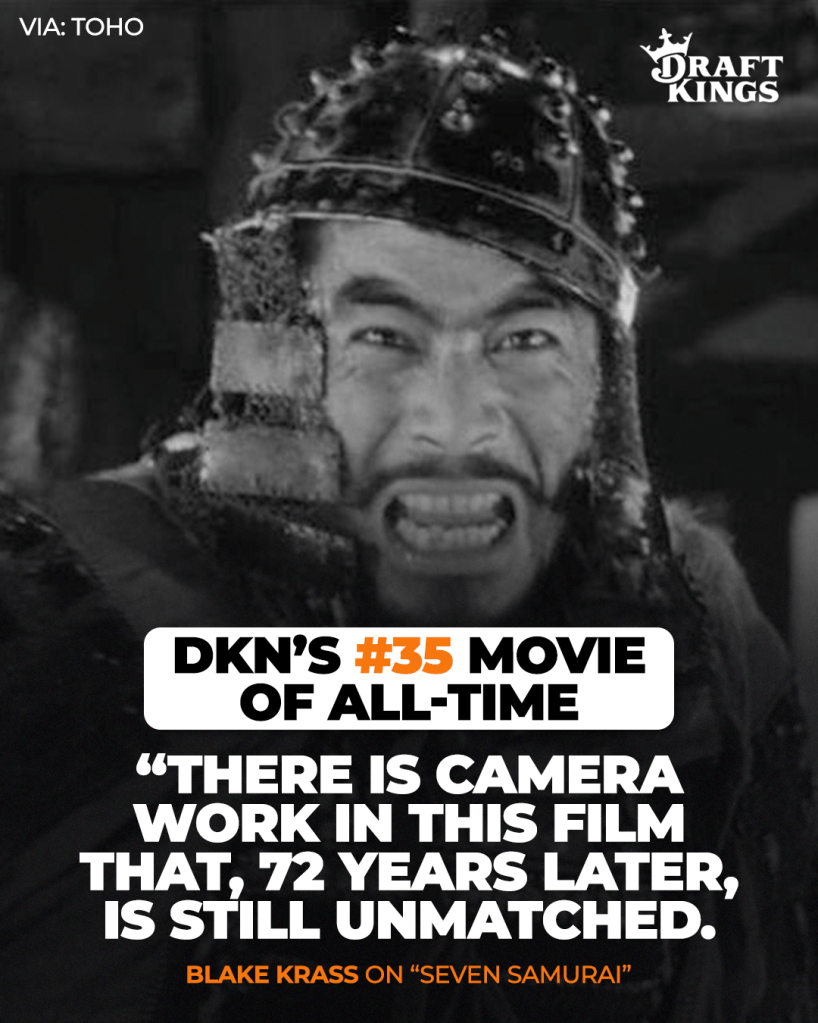
Blake Krass: Akira Kurosawa is one of the great directors of all time, and this is widely regarded as his greatest work. There is camerawork in this film that, 72 years later, is still unmatched. Seven Samurai dives deep into themes of class, identity and honor, while also being an incredibly action-packed film.
#34. Good Will Hunting
Cooper Albers: Best friends Matt Damon and Ben Affleck were barely old enough to drink when they began co-writing the eventual Oscar-winning screenplay for Good Will Hunting, a coming-of-age drama about a self-taught genius from the wrong side of the tracks working as a janitor at MIT. Guided by a university professor and an empathetic therapist, Will Hunting must confront his deepest emotional wounds to realize his full potential. Rooted in the distinct character of Boston and anchored by a career-defining performance from Robin Williams, Damon and Affleck’s cathartic, endlessly quotable story — and their refusal to sell it without landing the lead roles — remains one of Hollywood’s great testaments to betting on yourself.
#33. The Princess Bride
Sam Connon: There really aren’t too many films like The Princess Bride out there. It is a fantastical romance, but not one that ever sacrifices its cozy tone for spectacle. Every last character has at least a handful of iconic lines, even extending to the framing device of a grandfather reading his sick grandson a story. Robin Wright, Cary Elwes, Mandy Patinkin, Chris Sarandon, Wallace Shawn, Andre the Giant, Billy Crystal and Carol Kane are all right at home in their roles, with every last cast member playing perfectly into the story’s unique balance of earnestness and quick-witted humor. The Princess Bride somehow avoids becoming corny and saccharine, instead ascending to the absolute heights of nostalgic camp.
#32. Citizen Kane
Charlie Cummings: Art so often depends on the context in which it exists. If you watched Citizen Kane today, knowing nothing about it, you’d miss much. The rich and powerful yearn for something that money can never buy? Sounds like a story I’m familiar with. Yawn. You’d walk away not knowing this was the origin of that kind of storytelling in movies, and a direct, pointed attack on William Randolph Hearst, the sort of which was unheard of in movies.
For more thoughts on the details in this movie, I’d recommend Roger Ebert’s 1998 write-up, but here’s the skinny: no movie changed the art of filmmaking more than Citizen Kane. Orson Welles tapped into something magical in the script, saw angles nobody else could capture, and created a singular work of art. Context is everything here: when you learn how this movie got made, why it got made, and what changed after it was made, you can’t help but appreciate Welles’ masterpiece.
#31. Star Wars (The Original Trilogy)
Andy Silva: George Lucas’ space opera drew on samurai cinema, Flash Gordon serials, and Akira Kurosawa, then changed the grammar of blockbuster filmmaking. Darth Vader became film’s greatest villain, Luke fulfilled his destiny as the galaxy’s greatest hope and Leia proved to be anything but a damsel in distress. If the impact of the original film wasn’t enough, 1980’s The Empire Strikes Back raised the stakes, becoming the rare sequel to outpace its predecessor while delivering one of cinema’s most shocking moments when Vader declared, “I am your father!” A note to my colleagues on this project who voted to have Star Wars ranked this low: I find your lack of faith disturbing.
#30. Terminator 2: Judgment Day
Bryan Armetta: The greatest science fiction movie ever? The greatest action movie ever? Why not both. The original Terminator is an 80’s cultural landmark, serving as a fascinating twist on the horror genre. T2 takes things up a notch, raising questions on human consciousness, technology’s role in society, and man-made destruction. Even with the heavy subject matter (and I can’t stress this enough) the film is an absolute blast. Riveting set pieces, non-stop action and the greatest role of Arnold Schwarzenegger’s legendary career make this an all-timer.
#29. Superbad
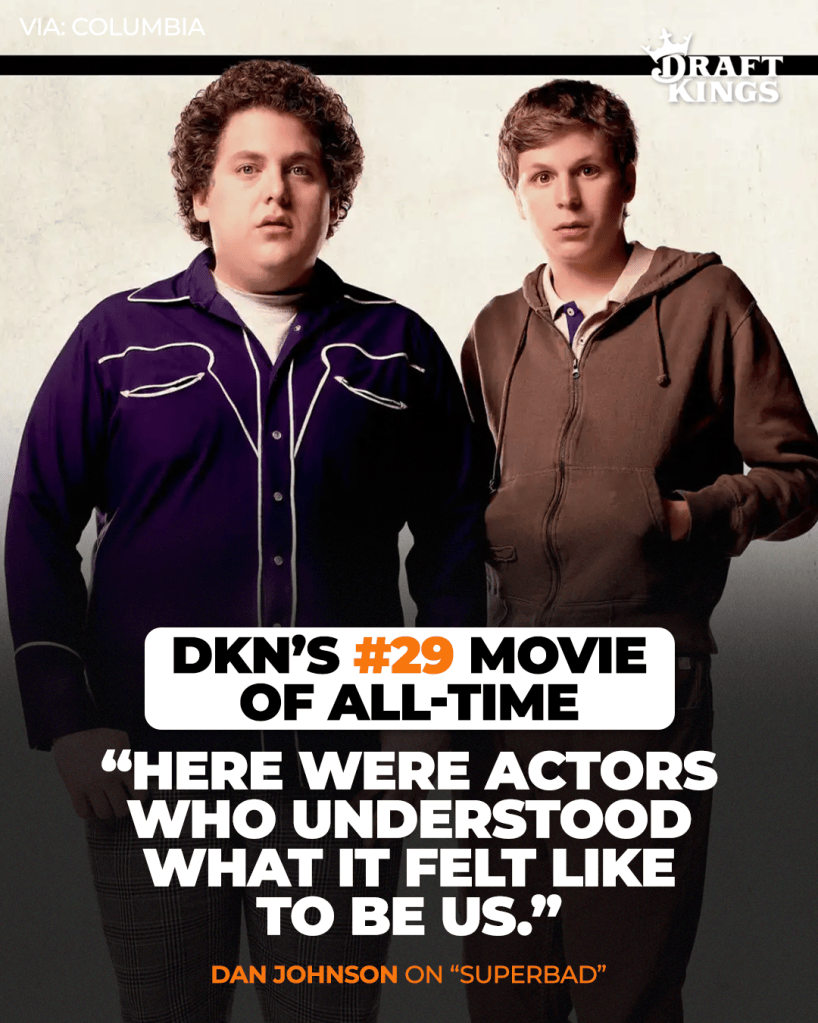
Dan Johnson: The ensemble advent of some of this century’s most hilarious collaborators—Rogen, Goldberg, Hader, Jonah Hill—and, quietly, an absolute gemstone in the ever-growing list of Emma Stone’s accomplishments in Hollywood. Her excellent straight-man performance as Jules in this movie goes understandably unnoticed, here, because my generation was so galvanized by the catharsis in this bildungsroman comedy writ large by Seth, Evan, and McLovin. Here was how we were growing up. Here were writers and filmmakers who listened to and appreciated the secret things which made us laugh; here were actors who understood what it felt like to be us, and were at their best acting out like we did. Who seemed like they wanted to be this way. A comedy for the young folks made crudely cynical hilariously early in their adolescence, and a triumph of late-aughts identification. Our David Copperfield when we were required to read David Copperfield. A movie whose humor, unfortunately, frays—but only slightly—under the weight of its own inherent misogyny as we look back on it some two decades later. But, ultimately, a story about two friends who promise each other, and the world, that people don’t forget. And we don’t.
#28. Inglourious Basterds
Blake Krass: Many would argue that Inglourious Basterds is Quentin Tarantino’s greatest work. Brad Pitt’s Lt. Aldo Raine ends the film by saying, “I think this just might be my masterpiece.” Tarantino is clearly projecting the realization of his own brilliance in this film onto his protagonist. Not only is there comedy and incredible action in this film, but Christoph Waltz also gives one of the best villain performances of all time.
#27. Heat
Charlie Cummings: The De Niro-Pacino link is stronger than ever in Heat. The strength of the scene in the diner alone—”I don’t know how to do anything else.”—would have made this a great movie. A cat-and-mouse game between two incredible characters, weaving together the lives of all those around them, is compelling enough drama to power a movie.
What impresses me most about Heat is its ability to tell each character’s story so quickly. The short but powerful arc of Dennis Haysbert’s character; everything between Chris and Charlene; the glimpses into Michael’s life. And the choice to make the big gunfight one of the most oppressive auditory experiences possible is the kind of creative directing anyone can appreciate.
#26. Taxi Driver
Blake Krass: This is one of the great collaborations between Martin Scorsese and Robert De Niro. It is arguably De Niro’s greatest ever performance, as he descends into madness driving his yellow cab and working out in his New York City apartment. Jodie Foster breaks onto the scene as a brilliant actress at such a young age and is just one of the many highlights of this great film.
#25. Do the Right Thing
Blake Krass: Do the Right Thing is Spike Lee’s American masterpiece that is still very prescient in 2026. It is one of the best New York City movies of all time. The film also dives deep into some of the most important themes in American history, such as race, community, violence and family. There are few better pictures of America towards the turn of the century than this film.
Enjoying our rankings of the 50 best movies of all time so far? You can find more of our film content here!
#24. Alien
Charlie Cummings: Rarely does a movie age this perfectly. Ridley Scott’s sci-fi masterpiece centers on the greatest body horror of all: childbirth. The Xenomorph, a perfect alien monster, dominates every scene with its visceral, dripping horror. Each crew member, down to Sigourney Weaver’s iconic Ripley, comes face to face with the apex space predator. An all-time sci-fi and horror concept mixed into one.
But it’s not just about the creature, arguably the best ever put on screen. It’s not all about the excellent cast. The way that Alien is shot is gorgeous; every frame of the interior of the Nostromo is sleek but textured, dark but inviting. Harry Dean Stanton following the cat into a cavernous room full of dripping and softly rattling chains is a perfect scene for me, showing Scott’s keen early eye for how science fiction should look.
#23. Apocalypse Now
Bryan Armetta: “The horror…the horror…”
Francis Ford Coppola’s Apocalypse Now has become the stuff of legend, due in part to its infamous, years-long production. The behind the scenes insanity has in some ways overshadowed one of the greatest films of the 1970s. An adaptation of Joseph Conrad’s novel Heart of Darkness, the movie is set in the harsh, unforgiving jungles of Vietnam and Cambodia. Captain Willard (Martin Sheen) is handed a task from the government: take out the rogue Col. Kurtz, portrayed by Marlon Brando. What follows is a journey not only up the fictional Nung River, but into the darkest pit of man’s soul. Kurtz might be insane, but what does sanity even look like in the middle of a warzone? A film that nearly transcends the medium, Apocalypse Now is often imitated but never replicated.
#22. The Silence of the Lambs
Dan Johnson: I’m still fascinated by how thoroughly Anthony Hopkins’s Hannibal Lecter has claimed our memory of a movie that belongs, in almost every meaningful way, to Jodie Foster’s Clarice Starling. Here was a young woman moving through the great male institutions of American authority, trying to make herself heard while practically every man in the room took inventory of her. Jonathan Demme lets those men look straight through the camera at us, and suddenly we understand how much work Clarice has to do before she can even begin the work she came for. Hopkins, of course, makes Lecter’s attention feel like an invitation to join the only civilized conversation in the building, which is a fairly remarkable thing to accomplish from inside a cage. Her childhood, offered up as the price of another woman’s life. And Foster makes us feel how much of Clarice’s courage belongs to the little girl who once tried to carry one lamb to safety, still foolishly hoping that saving somebody else might finally let her sleep.
#21. The Shining
Blake Krass: Stanley Kubrick’s The Shining is one of the greatest horror films ever made. Jack Nicholson gives one of the best performances of his career, and the setting is one of the most captivating in film history. There is comedy, horror and suspense, all portrayed with masterful camerawork from Kubrick.
#20. Interstellar
Sam Connon: There was a surge of high-concept, space sci-fi blockbusters that got rolling in the 2010s, bringing us everything from The Martian, Arrival and Blade Runner 2049 to Dune and Project Hail Mary. That run arguably started with Christopher Nolan’s Interstellar, a genuine space odyssey that isn’t afraid to wear its heart on its sleeve. Matthew McConaughey, Anne Hathaway and Jessica Chastain each delivered powerhouse performances, the visual effects remain groundbreaking and the film’s use of theoretical physics makes it ripe for further examination. While Interstellar was a bit divisive at the time of release, it has since garnered a loud and dedicated fanbase – and for good reason, in our opinion.
Find our rankings of the top 10 Christopher Nolan characters here!
#19. Schindler’s List
Blake Krass: Steven Spielberg appears on the list again, this time for a film that was incredibly personal for him. Spielberg grew up among Holocaust survivors and always wanted to tell this story. The performances from Liam Neeson, Ralph Fiennes and Ben Kingsley are all incredible. It is a movie that leaves you floored every time you watch it.
#18. The Departed
Andy Silva: This 2006 mob thriller, adapted from Hong Kong’s Infernal Affairs, brought Martin Scorsese his lone Academy Award for Best Director, as well as Best Picture, Best Adapted Screenplay and Best Editing. The film features a late-career masterclass from Jack Nicholson as mob boss Frank Costello (just don’t ask the noted Lakers and Yankees fan to wear any Boston gear), as well as strong performances from Leonardo DiCaprio, Matt Damon, Mark Wahlberg and Martin Sheen as the cat-and-mouse game of finding the rat in Costello’s crew and the police takes a series of twists and turns before ending with a shot of a rat on a windowsill. The Departed proved that Scorsese could still deliver even decades in on a legendary career behind the camera.
#17. Fargo
Bryan Armetta: A kidnapping gone wrong, so wrong in fact you can’t help but laugh. Murder and misunderstanding are at the heart of several classic Coen brothers pictures, but Fargo is a notch above the rest. Clocking in at just 98 minutes of run time, not a single scene is wasted here. Where the film really shines is as a contrast; police chief Marge (Frances McDormand) is a beacon of hope. In comparison, Jerry (William H. Macy) and his criminal accomplices are pathetic. Legendary cinematographer Roger Deakins is at his best here, capturing the brutal, unforgiving Minnesota winter in all its beauty. Factor in a terrific score from longtime Coens collaborator Carter Burwell, and you have a perfect film.
#16. Raiders of the Lost Ark
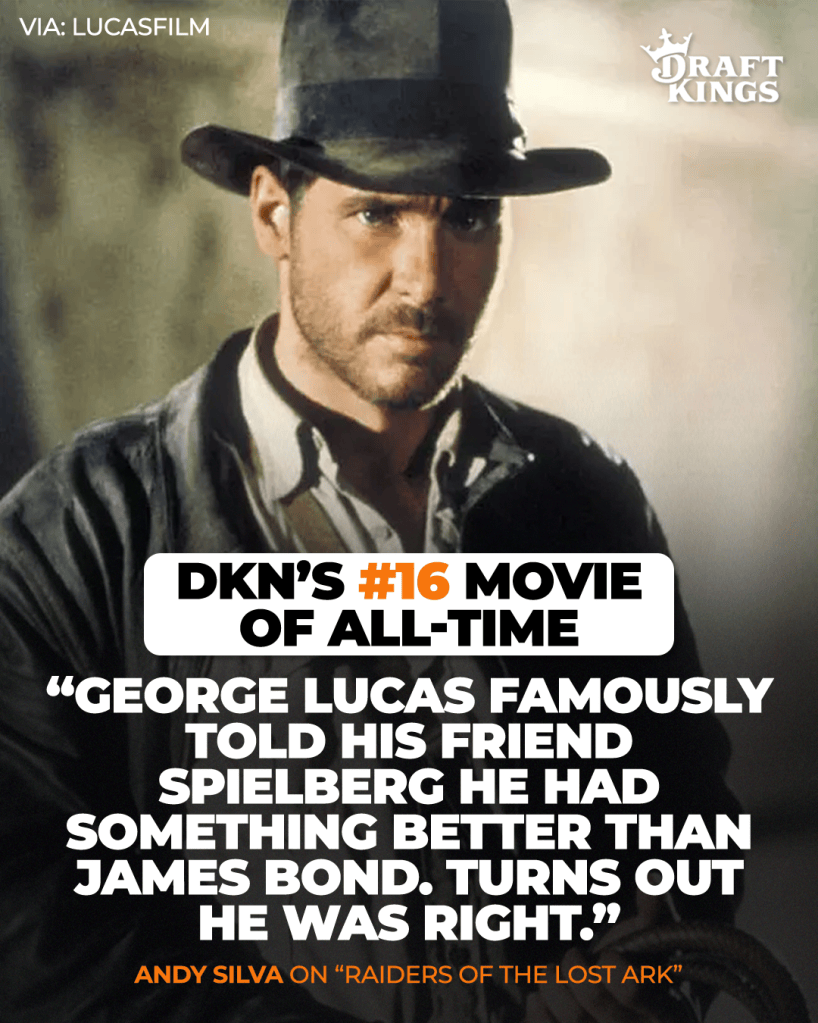
Andy Silva: The iconic Drew Struzan poster for Raiders of the Lost Ark proclaims it as “The Return of the Great Adventure.” It wasn’t empty marketing either, as Raiders had it all: action, adventure, love, laughs and most importantly an iconic hero taking on the most evil baddies possible. Harrison Ford is perfect casting in the role of Dr. Henry Jones (I’d like to underline that line to all the suits thinking about a reboot) and Steven Spielberg adds his fingerprints to George Lucas’ love letter to the matinee serials of the 1930s. Ford’s Indy had multiple weapons at his disposal, from his razor-sharp wit to his trusty bullwhip, so he was comfortable and believable in any and every scene … even if he was deathly afraid of snakes. Lucas famously told his friend Spielberg he had something better than James Bond. Turns out he was right.
#15. Parasite
Jeff Pratt: It’s a bit of a shame that only one South Korean film made this list, as I do believe Memories of Murder was at least also deserving. That said, Bong Joon Ho was never going to miss out entirely, as Parasite is one of the greatest films ever made and a true modern masterpiece. If the subtitle barrier is holding you back from giving this a watch, I cannot stress how much you’re missing out. This film brilliantly dives into class inequality, leaving viewers wondering who the true parasites in the story are, the poor Kims or the wealthy Parks? Bong Joon Ho clearly has strong feelings about the illusion of upward social mobility and how it can bring the worst out of all parties. Every single performance in this film is fantastic, especially Song Kang-ho, who should be regarded as one of the greatest actors of his generation.
#14. 2001: A Space Odyssey
Blake Krass: 2001: A Space Odyssey has set up decades of sci-fi movies that have come after it. Stanley Kubrick’s space movie is still incredibly prescient nearly 60 years later. It is not only a space epic, but also features the dangers of AI in the way a movie made today might. This movie could be watched on mute and still would be a masterpiece. The practical visuals in this film may never be matched again.
#13. 12 Angry Men
Blake Krass: Sidney Lumet is one of the great directors in history, and has multiple films on this list for good reason. Lumet’s ability to make a group of men in a room talking be so suspenseful and captivating is something that few directors in history have been able to do. This film is staged like a play, but is just as thrilling as some of the big spectacles on this list.
#12. Jurassic Park
Jeff Pratt: One of Steven Spielberg’s many masterpieces, Jurassic Park has aged remarkably well for a dinosaur film that had to work with 1993-quality CGI. One particular reason for its success, which so many of its successors have failed to understand, is that dinosaur appearances should be few and far between in order to emphasize their exceptionality. Outside of the spectacle, Jurassic Park separates itself from the pack via its dynamic three-headed cast. Sam Neill and Laura Dern ground a seemingly ungroundable story, while Jeff Goldblum particularly pops as the chaos theorist Ian Malcolm. If Jurassic Park can stand the test of the last 33 years and the evolution of visual effects, it will likely stand the test of time.
Find our rankings of the best Steven Spielberg movies here!
#11. Eternal Sunshine of the Spotless Mind
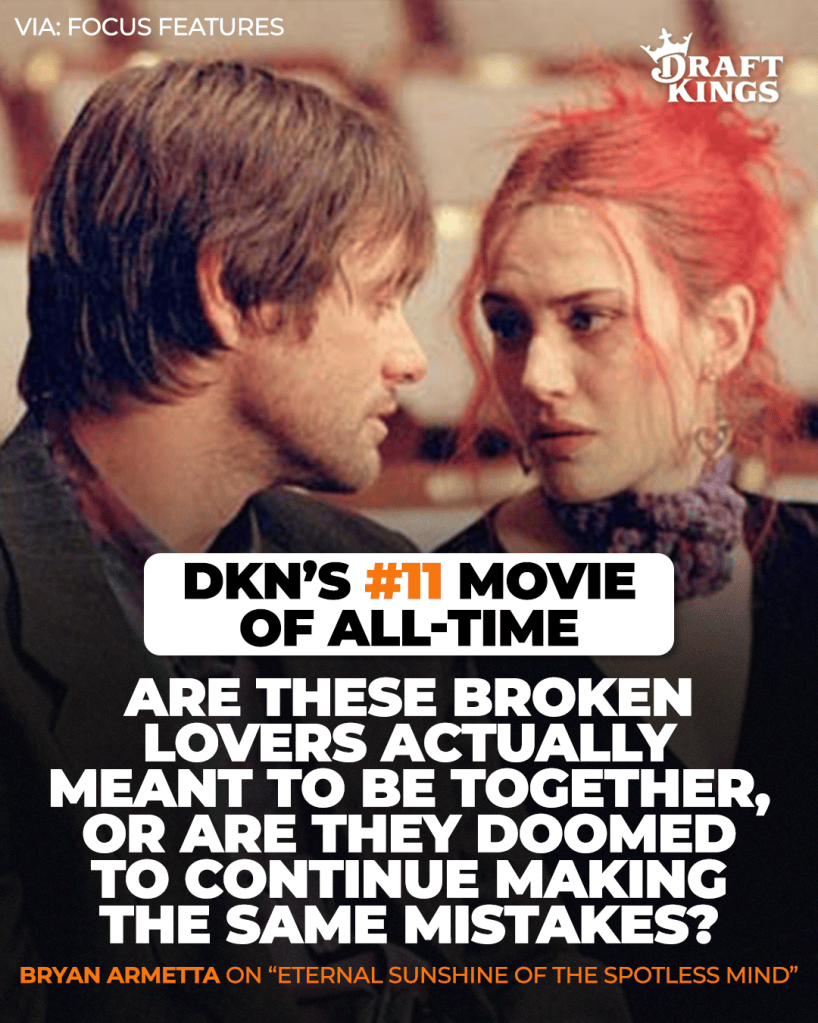
Bryan Armetta: Can a relationship ever get a do-over? That’s the basic premise of 2004’s Eternal Sunshine of the Spotless Mind. Still, that doesn’t really do this film justice. Funny and heartbreaking at the same time, it tells the story of couple, Joel (Jim Carrey) and Clementine (Kate Winslet), both of whom agree to have their memories of the other completely erased. In the aftermath, the two eventually find each other again. Along the way, director Michel Gondry experiments with time, memories and emotion. Are these broken lovers actually meant to be together, or are they doomed to continue making the same mistakes? That open-ended question is part of what makes this a modern classic.
#10. There Will Be Blood
Bryan Armetta: One Battle After Another got Paul Thomas Anderson his first Best Picture win at the Oscars. However, There Will Be Blood is still the auteur’s greatest work. Daniel Plainview (Daniel Day-Lewis) is one of the most sinister characters in 21st century cinema. A man dominated by greed, self-loathing and a lust for power, his rise comes at the cost of human connection. This 2007 epic contains stunning imagery; the oil rig explosion is unforgettable. However, it’s at its most captivating in those moments where Plainview’s brooding, calculating mind is at odds against itself.
#9. The Dark Knight
Dan Johnson: The true beginning, I think, of one of the globe’s greatest directors working through his thematic string, and what an effort to kick it off. Christopher Nolan’s obsession with the confluence between the hero’s journey and its inherent wear on civilization as it stands today—indeed, it’s more than simply varied explorations on the antihero—writ in a Gotham that reeks of more modern Americana than the post-millennium comics could ever hope to. This is when we all began to understand that Christopher Nolan had something to say about civilization, societal constructs, structures falling so simply. All because of Heath Ledger’s Joker, really; Aaron Eckhart’s Harvey Dent was a fine chess piece, and Christian Bale’s Batman a fine vehicle for Nolan’s preferred heroic-conflict-made-man. When Ledger passed, something clicked in the audience for this trilogy. An audience grew up. And the world’s finest director never got to finish the dark melody Ledger’s character whistled as he backed out of the room of mobsters. Not until 2026’s The Odyssey do I feel like Nolan really, meaningfully finished this trilogy. What a fascinating moment in modern film history, this one.
#8. Jaws
Blake Krass: Steven Spielberg was only 26 years old when he directed the masterpiece that is Jaws. Spielberg showed off his masterful camerawork and made the world scared of sharks all in one fell swoop. While the whole film is perfect, once Roy Scheider, Richard Dreyfuss and Robert Shaw head out to sea, it is impossible to stop watching until the end of the film.
#7. The Godfather Part II
Charlie Cummings: Much of what makes The Godfather: Part II the greatest sequel of all time is continuity. The first movie is beyond reproach, but it spends a lot of time setting up the transition between the old and the new. A family run by Vito Corleone, with his eldest son as heir, must become Michael Corleone’s operation; a feud between Vito and Sollozzo becomes Michael settling affairs with the five families. Most importantly, a movie with Marlon Brando at the helm becomes an Al Pacino vehicle by the end. For such a long movie, there’s little time for these drastic changes to marinate.
Part II, on two separate, direct tracks, takes it to another level. Pacino remains a powerhouse as an older, more experienced Michael Corleone, trying to make the family a legitimate business. It also introduces a fresh-faced Robert De Niro, fresh off his first big movie in Scorsese’s “Mean Streets”, as young Vito Corleone. For me, the highlight of the movie is watching De Niro’s younger Vito carve out a space as a young immigrant in New York.
The powerhouse cast anchored by Pacino and De Niro packs a punch in every scene. John Cazale, Diane Keaton, and Robert Duvall all step into bigger roles and take charge. With memorable lines and exchanges throughout, it’s the perfect movie.
#6. Casablanca
Bryan Armetta: Casablanca is a beautiful, enduring romance because our leading man doesn’t get what he wants. Set against the backdrop of World War II, Humphrey Bogart’s world-weary Rick Blaine sacrifices personal love for the greater good. Instead of reuniting with old flame, Ilsa (Ingrid Bergman), he decides to let her go. Amidst the central love triangle, and a terrific supporting cast, we’re also treated to a razor-sharp script. “Here’s looking at you, kid,” “We’ll always have Paris,” “I think this is the beginning of a beautiful friendship.” These aren’t just great lines – they’re some of the most quoted pieces of dialogue in film history. Nearly a century after its 1942 release, Casablanca is still timeless.
#5. No Country for Old Men
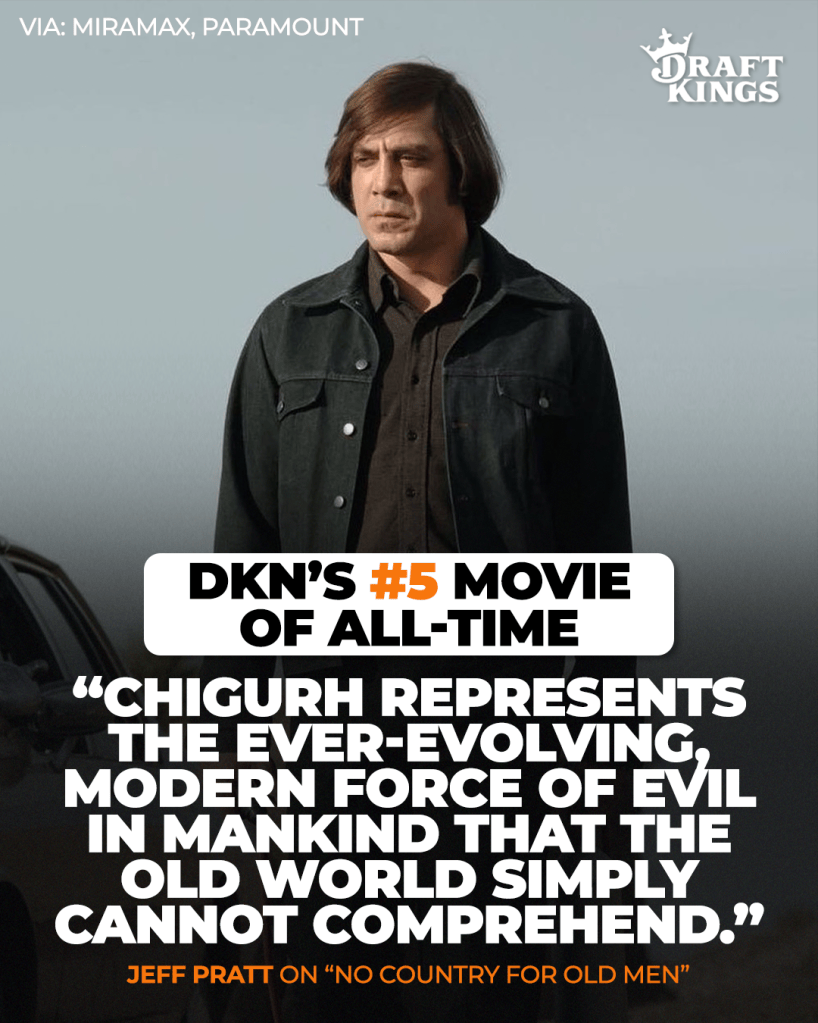
Jeff Pratt: No one sitting in theaters in 2007 realized that the greatest villain in cinematic history had just graced their screen when Anton Chigurh was introduced in Sheriff Ed Tom Bell’s opening monologue of No Country for Old Men, but the hitman wasted no time setting the tone. Clad in utilitarian garb and armed with a captive bolt pistol, Chigurh wreaks havoc across the West Texas desert landscape. A self-imposed arbiter of fate operating within a peculiar predetermined moral code, Chigurh represents the ever-evolving, modern force of evil in mankind that the old world simply cannot comprehend. Javier Bardem delivers one of the most brilliant performances of all time, juxtaposed by Tommy Lee Jones’ Bell and Josh Brolin’s Llewelyn Moss. No Country for Old Men brings no frills to the table, yet leaves audiences contemplating their existence nonetheless.
#4. Goodfellas
Bryan Armetta: “As far back as I can remember, I always wanted to be a gangster.”
From the very opening moments of Martin Scorsese’s Goodfellas, we know we’re in for a ride. The genius of this 1990 picture is that audiences understand why Henry Hill was so infatuated with the luxurious mob life. In fact, it makes the mid-century mafia feel downright nostalgic. A fun first 90 minutes only makes our protagonist’s bloody, paranoid descent even more compelling during the movie’s second half. Complete with brilliant cinematography and Scorsese’s now-iconic soundtrack, Goodfellas might be the essential American film.
#3. The Social Network
Dan Johnson: I’m a believer that if the Great American Novel were a film, it’d be There Will Be Blood. The Social Network is a close second, and my personal favorite film. Spiteful American ambition in the era when capitalism opened its maw to swallow young folks who understood the scope of the Internet. When, of course, none of us knew the surefire power of its reach. But the angstiest of us were sure willing to pioneer. The Social Network as a filmic artifact is David Fincher’s best directorial effort; he took the Aaron Sorkin script and mutated it into a dark tour through the high-minded, glitzy entertainment landscape (Justin Timberlake acts in this film!) of the aughts. A grim foreshadowing of the sorts of the dark tongues spoken in Ivy League frat houses. Intellect as commodity, right around when the general public started understanding the dark, capitalist breadth of the acronym IP. When once these brainiacs were indeed chained to their dorm rooms, they are now beholders—of moneymaking ideas, of course—offered bottle service in so many bicoastal dance club mezzanines. In this case, it’s told via the fictional breaking bad of one of the globe’s most polarizing figures of the century, Mark Zuckerberg, with breakout performances by actors (Jesse Eisenberg, Andrew Garfield) whose work we all still follow today. And, to boot: it has one of the most quotable, evergreen meltdown monologues ever delivered.
#2. The Godfather
Blake Krass: Francis Ford Coppola’s masterpiece is one of the most awarded and iconic American films of all time. Marlon Brando and Al Pacino give two of the greatest performances in cinema history. The exploration of the mafia has set up countless films and series attempting to recreate the magic that Coppola found in The Godfather Parts I and II.
#1. The Lord of the Rings Trilogy
Jeff Pratt: When our writers determined that certain franchises would be grouped into trilogies, it was only up to the formality of our rankings to declare The Lord of the Rings as the greatest films of all time. J.R.R. Tolkien’s source material founded modern fantasy, tapping Peter Jackson with the insurmountable task of bringing it to life. What Jackson managed to produce is a feat that will likely never be replicated.
At its core, the premise of The Lord of the Rings is simple. It’s a story about perseverance, told through the perspective of nine initial members of the Fellowship of the Ring. Within that group, a core four emerged. Frodo Baggins, who represents the capability of ordinary man to carry the weight of moral responsibility through incredible circumstances, a character every single audience member can relate to. Samwise Gamgee, the unsung hero and definition of true loyalty and friendship through hard times. Gandalf, the prophetic guide with endless wisdom and empathy that only age can teach. And finally, Aragorn, the antidote to depravity and corruption, the symbol of humility in a world full of greed. The Lord of the Rings is 558 minutes of magic, meaning, and above all else, hope.
Those are our 50 best movies of all time, ranked! Find more film content here.