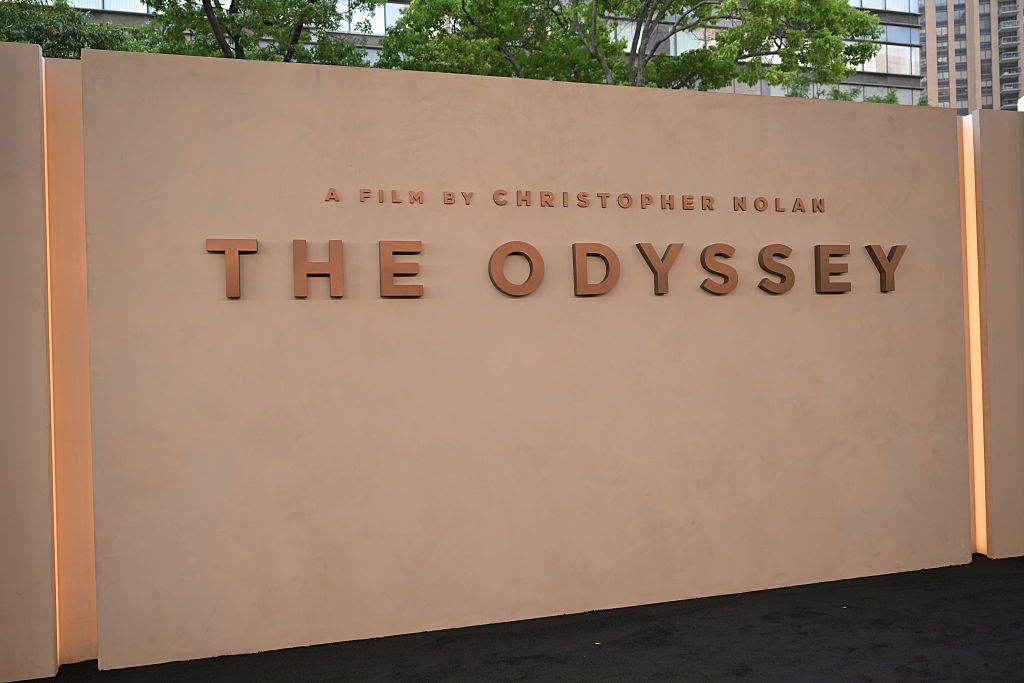
Christopher Nolan’s The Odyssey begins with a percussive oration of its hero’s story, which has now survived nearly 3,000 years. Odysseus, king of Ithaca, helps destroy Troy and then spends another decade trying to return home. The journey places him before gods, monsters, storms, seductions, and the consequences of his own intelligence. Nolan approaches that inheritance with extraordinary physical force, yet the film’s deepest power comes from recognition. Odysseus resembles the haunted, gifted, morally compromised men Nolan has followed throughout his career.
Matt Damon carries Bruce Wayne’s civic purpose and J. Robert Oppenheimer’s knowledge of what brilliance can unleash. He also carries Cobb’s consuming need to reach the family waiting beyond an impossible distance. On Calypso’s island, memory begins slipping with the quiet terror Nolan explored in Memento. Time continues elsewhere, a son grows older, and a kingdom changes shape around an absent king.
Nolan has spent 25 years making variations on the Odysseus hero figure. He has followed gifted men through ruined cities, compromised memories, endless wars, and impossible distances. Homer finally gives him the archetype beneath them all.
The result is Nolan’s most complete film, and easily his most physically overwhelming.
Significant spoilers follow for Nolan’s The Odyssey.
The Odyssey: full review
The film arrives at an ideal moment in Nolan’s career. He now commands the resources required to mount an epic beside Lawrence of Arabia, Ben-Hur, Spartacus, and The Lord of the Rings. Producer Emma Thomas and production designer Ruth De Jong fill the screen with ships, palaces, armor, armies, and coastlines. None of that grandeur feels ornamental. Wet rope strains against hands, bronze weighs upon shoulders, and timber groans beneath men already exhausted by war.
Hoyte van Hoytema photographs this world with the vastness of David Lean and the punishing physicality of Peter Weir. Odysseus and his sailors often appear dwarfed against the sea, exposed within 70mm (famously!) frames that offer nowhere to hide. Both Lawrence and The Odyssey place a legendary man inside landscapes large enough to reveal his private damage. Van Hoytema’s images make glory and loneliness occupy the same immeasurable space.
Ludwig Göransson’s score gives the voyage an immensity that quickly becomes psychological. Bronze gongs, synthesizers, percussion, and the enormous lyre make the ancient world sound newly forged. Martial triumph already carries the grief of what victory required. Waves strike the hull with concussive force while timber, metal, surf, breath, and music close around the sailors. The horizon remains endless, yet Nolan creates moments of sonic suffocation. Open water becomes a sealed chamber whose walls cannot be seen.
The voyage also carries the haunted momentum of Apocalypse Now. Each new island seems to draw Odysseus farther into the spiritual aftermath of Troy. Yet Nolan’s Troy itself feels strangely familiar. Its sun-struck walls, monumental gates, crowded courtyards, and dusty expanses recall Wolfgang Petersen’s 2004 Troy so strongly that the city almost feels like a place cinema has seen us visit many times. Master and Commander lives inside the ships, rigging, wind, and bruising movement of bodies across decks. Peter Jackson’s influence emerges through Nolan’s complete faith in myth as serious dramatic material. Gods, prophecies, sacred weapons, and giants receive the same conviction as soldiers and kings.
What I’m saying is: Before its story or performances take hold, The Odyssey already feels kindred with cinema’s grandest artifacts of scale and physical imagination.
Matt Damon stands at the center of that pressure, his Odysseus weathered by every mile and every remembered body. Damon played a stranded man waiting for rescue in Interstellar and an officer witnessing history’s moral rupture in Oppenheimer. Nolan now combines those earlier traces inside a king who engineered victory and must survive its spiritual consequences. His intelligence remains quick, practical, and occasionally dazzling, although triumph has curdled into shame. Damon lets authority coexist with exhaustion, playing Odysseus as a man learning that survival cannot erase responsibility.
The faces surrounding him deepen the uncanny sensation that Nolan has dreamed this story before. Anne Hathaway, once Bruce Wayne’s final companion and Cooper’s emissary across time, now becomes Penelope, the home toward which the entire film bends. Robert Pattinson leaves behind Neil’s tender omniscience in Tenet and returns as Antinous, turning charm into predation. Benny Safdie follows the frightened Edward Teller of Oppenheimer into the martial authority of Agamemnon. Himesh Patel, Elliot Page, and Bill Irwin also reappear from earlier Nolan worlds, carrying faint memories of Tenet, Inception, and Interstellar into Homer’s. The casting creates a prismatic effect rather than a parade of cameos. These familiar bodies seem to have passed through Nolan’s earlier films before arriving at their archetypal source.
Tom Holland gives Telemachus the uncertain gravity of a son raised beneath an absent father’s legend. Zendaya’s “Athena” watches Odysseus with the cool, unreadable attention of a god seething at a mortal in whom she once had fool’s faith. Charlize Theron’s Calypso glides with the dangerous mercy of forgetting, while Samantha Morton’s Circe makes enchantment feel ancient and bodily and darkly wondrous. Lupita Nyong’o vibrates with rage as both Helen and Clytemnestra, allowing the same face to hold the seduction and devastation surrounding Troy. The ensemble makes Homer’s world feel populated by distinct lives, yet every life also reflects some abandoned possibility within Odysseus.
That sensation reaches its most frightening form on Telepylus and Sicily. The man-eating Laestrygonians possess weight, appetite, and a horrible suggestion of intelligence behind their hunger. The one-eyed Cyclopes are even more disturbing, with wounded faces and bodies moving unnaturally through the landscape. Nolan has never created monsters with this degree of biological and spiritual detail. Their appearance feels like another refraction of the hero rather than a departure from him. They turn appetite, domination, isolation, and corrupted power into flesh.
Guillermo del Toro’s influence feels unmistakable throughout these encounters. The creatures recall Pan’s Labyrinth, where anatomy reveals something essential about violence and diseased authority. Their skin appears damaged, their movement feels laborious, and their suffering never softens their brutality. Nolan leaves enough humanity inside them to make their hunger more disturbing. These are his finest creatures because they belong completely to the moral design of his film. Each monster gives Odysseus another image of what power becomes after civilization falls away.
The voyage therefore moves through more than a series of mythological trials. Each island externalizes some pressure already gathering inside Odysseus. Telepylus gives human appetite a monstrous body. Sicily turns wounded pride into imprisonment. Circe tests the boundary between the human and animal. Calypso offers release through the gradual extinction of memory. Göransson’s music, van Hoytema’s immense frames, the creatures, and the actors all participate in the same movement inward.
This is where the film’s resemblance to Nolan’s previous work becomes most overwhelming. Odysseus carries Oppenheimer’s guilt because his greatest intellectual achievement ends in mass death. He carries Bruce Wayne’s burden because his purpose binds him to a corrupted civic order. He carries Cobb’s homesickness because Ithaca survives as an image across an almost unthinkable distance. On Calypso’s shore, he brushes against Leonard Shelby’s terror that memory can become an authored fiction. Time wounds him as it wounded Cooper, passing through the lives of his family while he remains suspended among the bones of his raft.
The Odyssey can therefore, most gloriously, feel like a dream Nolan has had about his own hero archetype, finally written across 70mm. Damon occupies the center, while Hathaway, Pattinson, Safdie, Patel, Page, and Irwin return like figures remembered from earlier dreams. The new actors enter the same psychic architecture without appearing secondary to its history. Homer’s poem gathers them all beneath the oldest version of Nolan’s favorite man: brilliant, driven, compromised, separated from home, and unsure whether return can restore him.
This also explains the film’s unexpected relationship to and conversation with The Dark Knight trilogy. Bruce Wayne eventually escapes Gotham and receives a private life beyond its burden. Odysseus must sail directly into the damaged society awaiting him. Home requires recognition, judgment, restoration, and further bloodshed. He fails at protecting himself through disappearance. His return asks whether kingship, family, and civilization can survive the methods that won the war.
Homer gives Nolan’s obsessions their oldest and most complete form. War, guilt, memory, time, civic collapse, fatherhood, and the desperate journey home gather around Odysseus. The film contains Nolan’s earlier work in a kaleidoscopic, Charybdis whirlpool of spirit. They resemble modern approaches toward the same ancient figure. Every road now appears to have been leading toward Ithaca. Nolan again playing with time: we must go back in order to understand forward.
That culmination explains why The Odyssey feels vast even during its quietest passages. Nolan’s collaborators do more than supply monumental images, brutal sound, astonishing creatures, or beautifully weighted performances. Together, they make an artist’s entire career shimmer through one foundational myth. The film can hold maritime terror, bodily horror, civic guilt, fractured memory, and domestic longing within the same voyage.
The film’s deepest idea remains painfully simple: one exhausted man crossing an immeasurable world toward a home transformed by his absence. Nolan has spent 25 years following men who believe arrival might restore what war, ambition, obsession, or time has taken from them. Surrounded by actors and collaborators who have carried those obsessions through Nolan’s earlier films, Damon finally gives them one body, one battered face, and one last purpose.
Standing before Ithaca, prepared to enter the palace and confront everything waiting inside, he speaks a line that belongs to Odysseus, Nolan, and the magnificent film they have made together: “I’m bringing it all.”
The Odyssey FAQ
When does The Odyssey come out?
The Odyssey opened in theaters Friday, July 17, 2026, including IMAX and IMAX 70mm presentations.
How long is The Odyssey?
The film runs 2 hours, 52 minutes.
Who’s starring?
Matt Damon stars as Odysseus, with Anne Hathaway as Penelope and Tom Holland as Telemachus. Robert Pattinson, Lupita Nyong’o, Zendaya, Charlize Theron, Benny Safdie, Jon Bernthal, John Leguizamo, Himesh Patel, Mia Goth, and Elliot Page also appear.
Who made The Odyssey?
Christopher Nolan wrote and directed The Odyssey, producing the film alongside Emma Thomas. Ludwig Göransson composed the score.