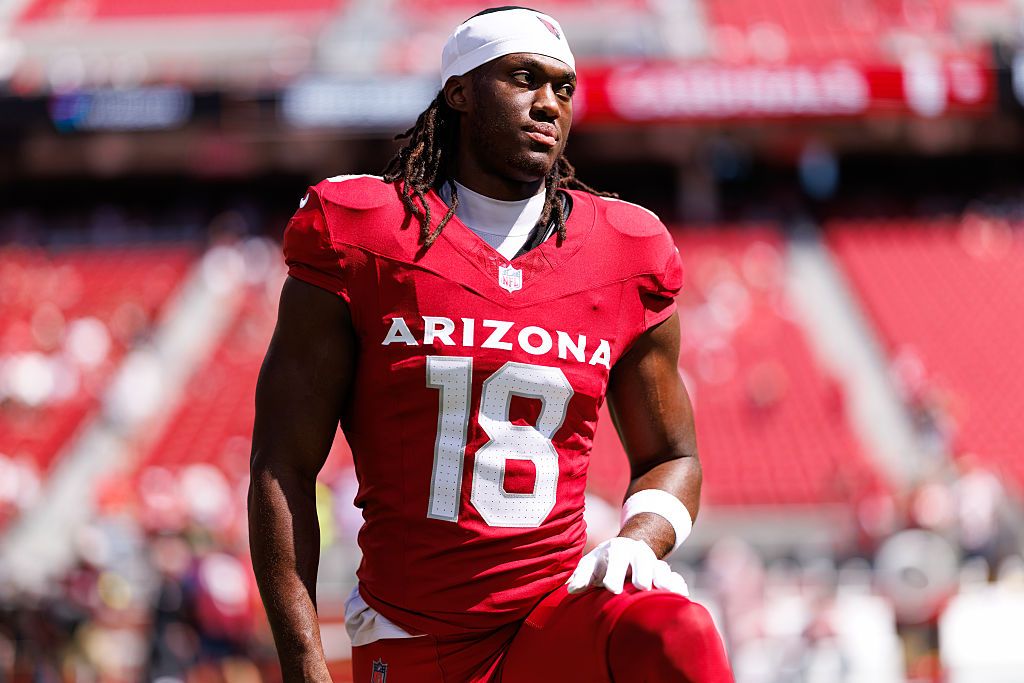
The Houston Texans have acquired wide receiver Marvin Harrison Jr. from the Arizona Cardinals, head coach DeMeco Ryans confirmed Sunday. The former No. 4 overall pick heads to Houston in one of the first major moves of the trade deadline.
For fantasy football managers, the move to Houston gives Harrison a fresh start with quarterback C.J. Stroud, his former Ohio State teammate. It also puts him in a passing offense that has created far more explosive plays than his early-season stat line in Arizona would suggest.
Marvin Harrison Jr. fantasy outlook with Texans
Harrison should remain rostered in every format, but this is more of a long-term upside move than an immediate start-him-every-week situation. He will need time to learn Houston’s system, build timing with Stroud and establish where he fits alongside the Texans’ current pass catchers.
Still, the appeal is obvious. Harrison was one of the most talented wide receiver prospects in recent memory, and is moving from an Arizona offense that failed to consistently feature him into a Stroud-led passing game. Houston needs another outside receiver who can threaten defenses vertically, win on contested catches and create a problem in the red zone.
The early numbers suggest this is a better passing environment than Harrison had in Arizona. Through Houston’s first four games, Stroud had completed 19 passes of at least 20 yards while throwing for 1,141 yards, five touchdowns and no interceptions. He then went 26-for-34 for 260 yards and a touchdown in the Week 5 win over Tennessee without throwing a pick.
That puts Stroud at 1,401 passing yards, six passing touchdowns and zero interceptions through five games. The Texans have not always finished drives, but the downfield production is there. Stroud is averaging roughly 7.6 yards per pass attempt and has already shown he can support explosive receiving weeks.
How Harrison’s 2026 season has gone
Harrison’s third NFL season has been a major disappointment statistically. Through four games with Arizona, he had just five catches for 85 yards and one touchdown on 12 targets. That comes out to 1.3 receptions and 21.3 receiving yards per game.
The lack of production was not simply about playing time. Harrison was on the field for 74% of Arizona’s offensive snaps, but he never became a reliable focal point in the passing game. His final game with the Cardinals was a one-catch, 12-yard, one-touchdown outing against the Giants in Week 4.
Arizona gave Harrison only three targets per game over its first four contests. That is not enough volume to trust him in a weekly fantasy lineup, especially when he caught only five total passes. A trade does not erase that slow start, but it gives him a chance to reset in an offense with a quarterback capable of pushing the ball downfield.
It is a sharp downturn from his rookie season, when Harrison caught 62 passes for 885 yards and eight touchdowns. Injuries and inconsistency limited him to 41 catches, 608 yards and four scores in 12 games in 2025, and his slow 2026 start helped create the opening for a change of scenery.
Should you start Marvin Harrison Jr. after the trade?
Fantasy managers should be patient. Harrison may not be ready for a full workload in his first game with Houston, especially if the trade is finalized close to game day. He is best viewed as a bench stash or matchup-dependent FLEX until his target share and snap count become clear.
That said, Harrison has immediate WR2 upside if he earns a regular role. Houston already had 19 completions of 20-plus yards through four games, and Harrison’s size and downfield ability give him a path to turning a limited number of looks into usable fantasy production.
Managers who can afford to wait should hold rather than sell low after the quiet start. He is also a worthwhile buy-low target in leagues where his current manager is frustrated enough by five catches in four games to move on.
How the trade affects the Texans’ receivers
Harrison’s arrival would make Houston’s receiver group more crowded, but it would not automatically make him the team’s No. 1 option in fantasy. Nico Collins remains the established top target when healthy, while Dalton Schultz, Xavier Hutchinson and Jaylin Noel have all seen work during the Texans’ uneven start.
The biggest impact may be on Houston’s complementary receivers. Harrison has the talent to command outside snaps and downfield looks, potentially lowering the weekly floor for the team’s secondary options. Collins should remain a strong fantasy starter, while the rest of the group becomes more matchup-dependent if Harrison quickly earns meaningful volume.
Fantasy football takeaway
Do not overreact to Harrison’s five-catch start in Arizona, but do not assume the trade instantly solves everything, either. He needs targets before he can become a reliable fantasy starter. The reason to stay patient is that he would be joining a quarterback who has thrown for 1,401 yards without an interception through five games and has consistently created explosive plays.
For now, treat Harrison as a high-upside bench option with a path back to weekly WR2 value once his role in Houston is established.