August baseball has punished anyone waiting only on home runs. The swings remain dangerous, and the contact still arrives with force, but too many well-struck balls finish as doubles, deep outs, or liners directly at defenders. That disconnect has made the traditional power markets harder to trust, even when the underlying matchup points toward damage.
Friday’s card leans into a broader route. These five hitters can clear two total bases through one blast, one ball into the gap, or a pair of clean hits. Recent form, barrel production, pitch-type success, lineup position, and the full pitching path all shape the selections. Until the league’s home-run output catches up with the quality of contact, 2+ total bases remain the better way to back hitters swinging with conviction.
Here’s how I’ll play it. I’ll be pumping out props and predictions for individual games all season, with plenty of coverage here on DraftKings Network. Follow my handle @dansby_edits for more betting plays.
Best MLB player prop bets today
| Player prop pick | Odds | Why I like it |
|---|---|---|
| Alec Burleson 2+ total bases | +100 | Burleson carries a .329/.404/.564 line against righties, 23 doubles, 15 homers, a .375/.483/.833 last-seven surge, 49.2% hard hits, 11.6% barrels, third-place volume, and Feltner’s 5.75 ERA, .507 xSLG, and 11.4% barrel rate allowed. |
| Jackson Chourio 2+ total bases | +110 | Chourio enters with a .277 average, 15 homers, an .805 OPS, eight hits and two homers across seven games, 92.2 mph exit velocity, 47.6% hard hits, 13.7% barrels, second-place volume, and Matthews’ 5.22 ERA and vulnerable four-seamer-slider foundation. |
| Pete Crow-Armstrong 2+ total bases | -120 | Crow-Armstrong owns a .289 average, 26 homers, a .936 OPS, a .304/.423/.652 last-30 line, eight recent homers, 49.7% hard hits, 12.2% barrels, elite 29.5-foot sprint speed, leadoff volume, and access to Kansas City’s 5.37 bullpen ERA. |
| Owen Caissie 2+ total bases | +190 | Caissie supplies 12 homers, 12 doubles, a .519 slugging percentage across 30 games, 91.6 mph exit velocity, 46.7% hard hits, 15.6% barrels, 45.9% sweet spots, a .233 ISO against righties, and Klassen’s .472 xwOBA and 25% barrel rate allowed. |
| JJ Bleday 2+ total bases | +120 | Bleday attacks righties with a .242/.361/.498 line, 10 doubles, 15 homers, seven homers across 30 games, third-place volume, and Washington’s 4.94 bullpen ERA, although Cavalli’s six-pitch mix and .125 sweeper slugging percentage create the card’s sternest opening test. |
In-depth analysis below.
Prop bet analysis
Alec Burleson 2+ total bases (+100)
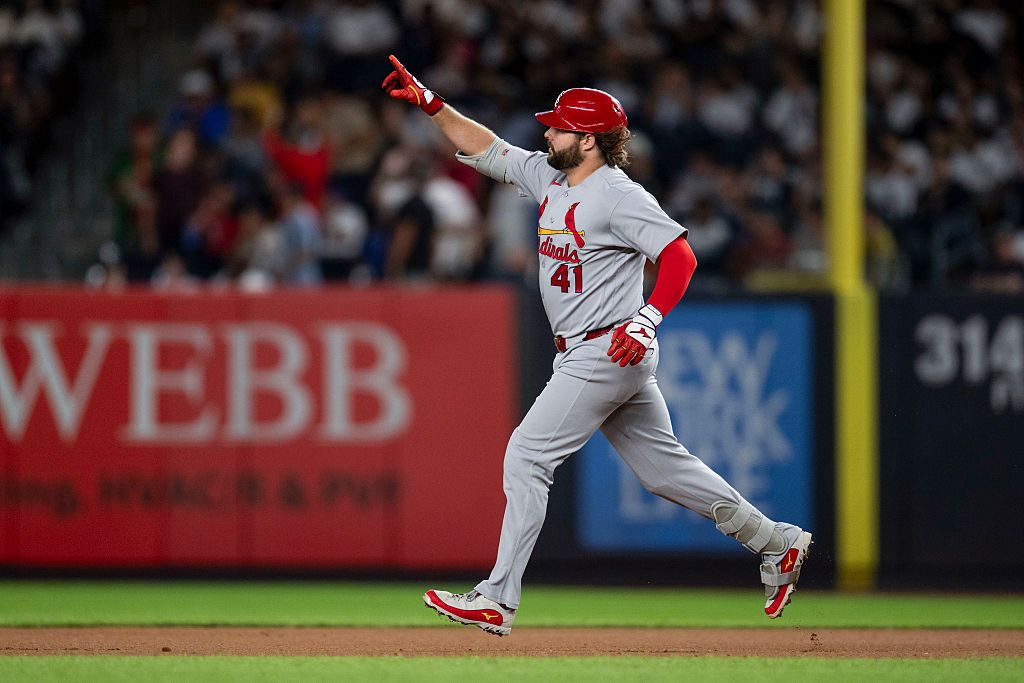
Alec Burleson arrives scorching hot and fully capable of carrying this card. He has batted .375/.483/.833 across his last seven games, with nine hits, three homers, and only five strikeouts. His last 30 games remain outstanding at .321/.378/.505, so this run extends well beyond one explosive series. Burleson has controlled right-handed pitching all season, batting .329/.404/.564 with 23 doubles, one triple, and 15 homers. He can finish this wager through one homer, one gap shot, or two clean singles.
The contact quality adds force behind those results. Burleson owns a 91.8 mph average exit velocity, 49.2% hard-hit rate, and 11.6% barrel rate. He has also reduced empty swings while maintaining enough lift to punish mistakes. His recent pitch-family sample featured 80% hard contact, 40% barrels, and 50% fly balls. That combination belongs in a total-bases market, especially at even money.
Ryan Feltner offers Burleson another hittable right-handed opponent. Feltner carries a 5.75 ERA, 5.62 xERA, .507 expected slugging percentage allowed, and an 11.4% barrel rate. His four-seamer and slider account for over half his pitches, matching Burleson’s strongest recent damage zones. Feltner also lacks the swing-and-miss weapon needed to erase Burleson before contact.
Colorado’s bullpen extends the opportunity with an ERA above 5.00. Burleson should hit third in warm St. Louis conditions, preserving four plate appearances with a clear path toward five. Every meaningful layer supports the wager. Current form, platoon strength, contact quality, lineup position, and weak opposing pitching all point toward another productive night.
Jackson Chourio 2+ total bases (+110)
Jackson Chourio has begun to look dangerous again, and the underlying contact has remained electric throughout the season. He enters batting .277 with 15 homers, 45 RBI, 10 steals, and an .805 OPS. His last seven games produced eight hits, two homers, one double, and four walks. He has homered twice across his last three games, bringing another power surge into a favorable home matchup.
Chourio owns a 92.2 mph average exit velocity, 47.6% hard-hit rate, and 13.7% barrel rate. Those marks reflect substantial growth from last season and support far more than a temporary hot streak. Against right-handed pitching, Chourio has batted .267 with a .458 slugging percentage, 15 doubles, and 11 homers. He carries two strong routes to two bases. One mistake can leave the yard, while his speed and line-drive authority support doubles and multi-hit games.
Zebby Matthews creates an appealing pitch collision. Matthews throws his four-seamer 36.9% of the time and his slider another 21.6%. Chourio has hammered those offerings recently, producing 100% hard contact and 40% barrels across the relevant sample. Matthews owns a 5.22 ERA, while his last seven starts produced a 5.73 ERA and 1.46 WHIP. Opponents have also slugged .558 against his changeup.
Minnesota’s bullpen provides no strong escape route. Its 4.87 ERA ranks near the bottom of the league, exposing Chourio to vulnerable pitching throughout the game. He should hit second behind Brice Turang, giving him one of the card’s strongest five-plate-appearance paths. At +110, Chourio combines premium volume, elite contact, recent power, and a starter leaning heavily upon pitches he drives.
Pete Crow-Armstrong 2+ total bases (-120)
Pete Crow-Armstrong enters this matchup playing breathtaking baseball. He has batted .346/.452/.692 across his last seven games, collecting nine hits, two homers, five walks, and three steals. His last 30 games have been even stronger, producing a .304/.423/.652 line with eight homers. Crow-Armstrong now threatens pitchers with power, speed, plate discipline, and relentless pressure from the first pitch onward.
The season-long numbers confirm his transformation. Crow-Armstrong owns a .289 average, 26 homers, 69 RBI, 29 steals, and a .936 OPS. His contact profile includes a 90.4 mph average exit velocity, 49.7% hard-hit rate, 38.5% sweet-spot rate, and 12.2% barrels. He has also reached 114.6 mph at maximum exit velocity. His 29.5 feet-per-second sprint speed creates extra doubles and triples after ordinary outfield contact.
Daniel Lynch IV provides a legitimate opening challenge. Lynch owns a 1.96 ERA and has suppressed barrels throughout the season. However, Friday marks his first start after working exclusively from the bullpen. His workload should remain limited, creating early access to a Kansas City relief group carrying a 5.37 ERA. Royals relievers have been especially vulnerable recently, posting an 8.84 ERA across the last seven days.
Crow-Armstrong should lead off, maximizing his opportunity for five plate appearances. Kauffman Stadium’s broad gaps reward his speed, while temperatures near 85 degrees should help carry. The -122 price demands more confidence than the other selections, yet PCA has earned it. He owns the strongest combination of current form, lineup volume, power, athleticism, and full-game bullpen access on the board.
Owen Caissie 2+ total bases (+190)
Owen Caissie brings enormous volatility, but +190 pays handsomely for his thunderous contact. His batting average remains modest, yet his damage profile belongs among the card’s most explosive hitters. Caissie has produced 12 homers, 12 doubles, and 50 RBI, while slugging .519 across his last 30 games. His last seven games include only two hits, although both cleared the fence. Every clean connection carries immediate two-base potential.
Caissie owns a 91.6 mph average exit velocity, 46.7% hard-hit rate, 15.6% barrel rate, and 45.9% sweet-spot rate. That sweet-spot mark ranks among baseball’s best and reflects a swing built for lifted damage. Against right-handed pitching, he has posted a .233 isolated-power mark and .460 slugging percentage. A homer cashes instantly, while his loft and exit velocity create a strong doubles path.
George Klassen presents premium velocity alongside serious command risk. His four-seamer averages 96.8 mph, while his sinker sits near 97.1 mph. Klassen’s brief major-league sample produced a .472 expected wOBA, 50% hard-hit rate, and 25% barrel rate allowed. He later rebounded in Triple-A, recording a 2.48 ERA and 0.99 WHIP across six July starts. Klassen still must prove that improved command against major-league bats.
Caissie’s 38.9% strikeout rate remains the obvious danger. He also projects sixth, reducing his plate-appearance ceiling compared with the card’s leadoff hitters. Those concerns explain the generous number. They do not erase the upside. Caissie needs one pitch in the heart of the zone, and Klassen’s power arsenal supplies enough velocity for that mistake to travel. At +190, Caissie offers the card’s best long-price explosion.
JJ Bleday 2+ total bases (+120)
JJ Bleday enters with power surging and a lineup position capable of maximizing it. He has produced 20 homers, 47 RBI, a .470 slugging percentage, and an .814 OPS. His last seven games brought five hits, two homers, seven walks, and a .478 slugging percentage. Bleday has also launched seven homers across his last 30 games, keeping his one-swing route alive every night.
The matchup improves substantially through the platoon split. Bleday has batted .242/.361/.498 against right-handed pitching, with 10 doubles, one triple, and 15 homers across 223 at-bats. More than one-third of his hits against righties have produced extra bases. He should bat third behind Elly De La Cruz and Sal Stewart, creating strong traffic opportunities and four secure plate appearances.
Cade Cavalli represents the toughest starter among these five matchups. He owns a 3.52 ERA, 1.29 WHIP, and 133 strikeouts across 122⅔ innings. Cavalli carries six usable pitches, including a four-seamer, knuckle curve, and excellent sweeper. His sweeper has held opponents to a .109 average and .125 slugging percentage. Bleday cannot simply sit upon one offering.
The late innings preserve the wager. Washington’s bullpen owns a 4.94 ERA and 1.47 WHIP, creating a much softer second matchup. Warm conditions at Nationals Park should also help driven contact, although thunderstorms remain a concern. A delay after first pitch could shorten Cavalli’s outing and expose the bullpen earlier.
Bleday lacks the complete contact profile of the top four selections. His 88.8 mph average exit velocity and 41.7% hard-hit rate create less margin. Still, his platoon power, recent home-run run, premium lineup spot, and +120 price keep him firmly playable.