

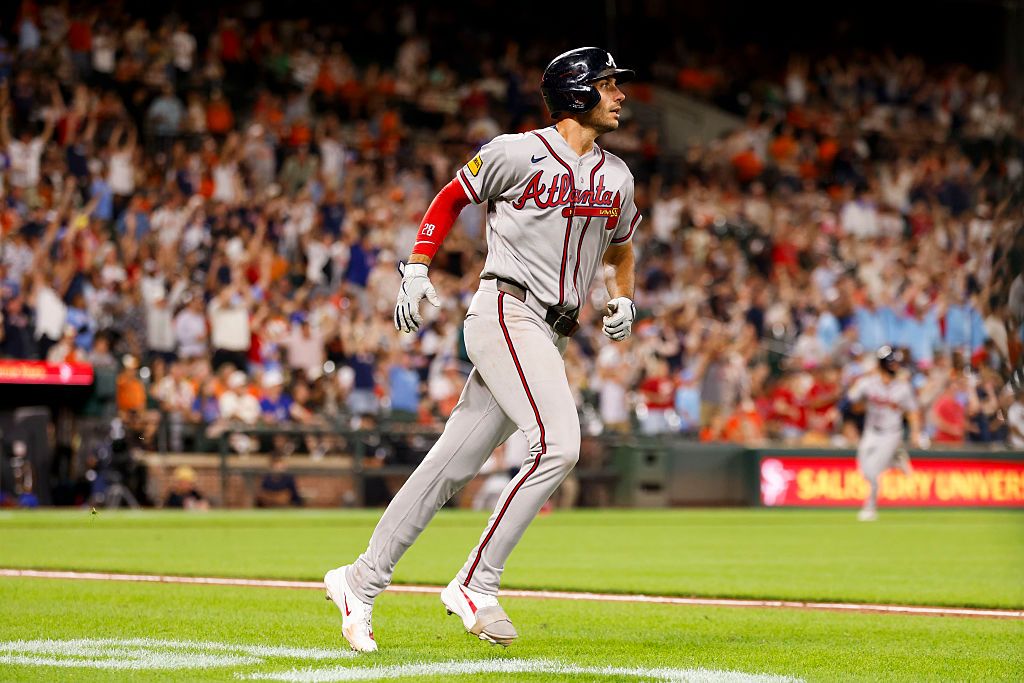
Home-run betting has felt much colder since the All-Star break, even as the leaguewide rate has barely moved. The damage has arrived in frustrating clusters. Loud contact keeps becoming doubles, low liners, wall shots, and warning-track outs. Then one isolated game supplies enough homers to disguise several barren slates.
That unevenness makes a deep card difficult to trust. Sunday demands concentration instead of volume. Each selection combines recent barrel shape, usable lift, a favorable pitch-family collision, and enough lineup position to protect plate appearances. Brandon Lowe owns the cleanest starter vulnerability. Matt Olson carries overwhelming impact quality into two preferred pitch types. Francisco Lindor offers the longest price against a four-seamer built for his swing.
These are high-upside matchup plays rather than broad endorsements of famous power hitters. Each wager has a specific route to the seats, enough statistical support beneath it, and a price capable of rewarding one decisive swing.
As always, I’m here with a breakdown on my three favorite picks from today’s slate of games to swat one out.
Best MLB home run bets today
| Best MLB home run bets today | Odds | Why I like the pick |
|---|---|---|
| Matt Olson | +270 | Olson brings 27 HR, a .262 ISO, .528 SLG, 92.6 mph EV, 50.3% hard-hit rate, 13.8% barrels, and .506 xSLG into warm Camden Yards after producing seven hard hits, five blasts, two barrels, one pulled barrel, and one HR across his last 10 balls in play, while Baz’s 4.05 ERA, 4.26 xERA, .402 xSLG allowed, and 7.0% barrel rate conceal two usable power lanes through a four-seamer and cutter that comprise more than half his arsenal against Olson’s .577 xSLG and 65.4% hard contact versus four-seamers and .564 xSLG against cutters, leaving Baz’s 33% knuckle-curve usage as the primary obstacle to another left-handed barrel. |
| Francisco Lindor | +425 | Lindor’s modest .224/.311/.383 line obscures a 91.9 mph EV, 49.0% hard-hit rate, .438 xSLG, and .340 xwOBA before accounting for a last-10 batted-ball stretch featuring 70% hard contact, 50% fly balls, 20% barrels, and one HR, and his clearest path comes through Sheehan’s 42.4% four-seamer, which has allowed a .653 SLG, .555 xSLG, .379 xwOBA, and 46.7% hard-hit rate, meeting Lindor’s .531 xSLG, .378 xwOBA, 55.9% hard contact, and 11.8% strikeout rate against four-seamers from the No. 2 spot in warm Citi Field conditions. |
| Brandon Lowe | +310 | Lowe attacks Taillon from the No. 2 spot in low-80s Pittsburgh weather with 21 HR, a .228 ISO, 91.0 mph EV, 45.7% hard-hit rate, 12.3% barrels, and .451 xSLG, then adds one HR, a 50% hard-hit rate, 50% blasts, 30% barrels, 20% pull barrels, and 40% fly balls across his last 10 batted balls against a starter carrying a 5.38 ERA, 5.41 xERA, .514 xSLG allowed, 14.4% barrel rate, 22 HR allowed, and 2.75 HR/9, with Lowe’s .643 xSLG, .408 xwOBA, and 54.2% hard contact against four-seamers directly colliding with Taillon’s heavily used and frequently punished fastball. |
In-depth analysis below.
Top MLB home run props today: analysis
Matt Olson to hit a home run (+270)
Olson’s last 10 batted balls include seven hard hits, five blasts, two barrels, and one pulled barrel. Three were fly balls, creating slightly less elevation than Lowe or Lindor. The impact quality remains thunderous. Few hitters can turn an imperfect launch angle into a home run as easily.
His season-long power profile carries the same authority. Olson owns 27 homers, a .262 ISO, and a .528 slugging percentage through 457 plate appearances. His average exit velocity sits at 92.6 mph, with 50.3% hard hits and 13.8% barrels. A .506 xSLG and .438 xwOBA on contact support the production beneath his .872 OPS.
The recent results also belong in the argument. Olson has hit seven July homers while slugging .524 across 95 plate appearances. His .232 monthly average understates the damage because 10 of his 19 hits went for extra bases. He homered Friday, then drew another walk Saturday. Pitchers have continued working carefully despite his reduced batting average.
Shane Baz presents the strongest opposing case among these three starters. Baz owns a 4.05 ERA, 4.26 xERA, .402 xSLG allowed, and a modest 7.0% barrel rate. He has also completed 16.2 July innings without allowing a homer. His recent line contains 18 strikeouts, three walks, and a 3.24 ERA.
Olson still receives two attractive pitch paths. Baz throws four-seamers 33.8% of the time and cutters another 16.9%. Olson has produced a .577 xSLG and 65.4% hard-hit rate against four-seamers. His cutter profile includes a .564 xSLG and 50.0% hard contact. Baz’s changeup has also carried a .622 xSLG allowed despite better surface results.
The knuckle curve keeps this wager below Lowe’s exposure. Baz uses it nearly 33% of the time, generating a 29.1% whiff rate. Olson owns only a .248 xSLG and .200 xwOBA against curveballs. Baz can repeatedly reach that shape if he controls the count. Olson must punish an early fastball or cutter before the matchup narrows.
Olson is confirmed third at Camden Yards, protecting his plate-appearance ceiling. Baltimore should sit near 81 degrees under mostly sunny skies during the opening innings. The price creates enough reward for Olson’s elite contact, though Baz demands smaller exposure.
Brandon Lowe to hit a home run (+425)
Lowe’s last 10 batted balls contain five hard hits, five blasts, three barrels, and two pulled barrels. Four traveled through the air, while one already left the park. That is concentrated home-run contact from a hitter whose power has remained stable across a much larger sample.
His 2026 foundation includes 21 homers, a .228 ISO, and a .468 slugging percentage across 427 plate appearances. Lowe has averaged 91.0 mph on contact, with 45.7% hard hits and 12.3% barrels. His .451 xSLG nearly matches his actual production, confirming that the power has been earned. He has also maintained a productive 16.8-degree average launch angle.
Jameson Taillon gives the wager its sharpest edge. Taillon has surrendered 22 homers through only 72 innings, producing an alarming 2.75 HR/9. His 5.38 ERA sits beside a 5.41 xERA, .514 xSLG allowed, and 14.4% barrel rate. Opponents have not merely accumulated hits. They have consistently reached damaging exit velocities and launch angles. Taillon also allowed two homers across 4.1 innings during his latest start.
The pitch-level fit strengthens the argument. Taillon throws his 91.8 mph four-seamer about 28% of the time. Lowe owns a .643 xSLG, .408 xwOBA, and 54.2% hard-hit rate against four-seamers. He has also posted a .550 xSLG against changeups, another pitch featured in Taillon’s mix. The sweeper can miss Lowe’s bat, though Taillon cannot survive on one shape exclusively.
PNC Park should see temperatures around 82 degrees at first pitch, climbing toward 84 during the early innings. Those conditions should provide reasonable carry without turning the game into an obvious public power environment.
Francisco Lindor to hit a home run (+425)
Lindor’s last 10 batted balls contain seven hard hits, two blasts, two barrels, and one pulled barrel. Five were fly balls, giving his current contact the best elevation rate on this card. One has already become a home run. The recent shape carries far greater power than his season slugging percentage suggests.
Lindor enters with six homers, a .224 average, and a .383 slugging percentage across 206 plate appearances. Those results sit well below his .254 xBA and .438 xSLG. His .308 wOBA also trails a .340 xwOBA. Underneath that gap sits a 91.9 mph average exit velocity and 49.0% hard-hit rate.
The barrel rate remains only 8.8%, which explains part of the long number. Lindor has produced strong velocity without consistently pairing it with ideal angles. The last-10 sample shows that relationship beginning to improve. Half of those balls were airborne, while 20% reached barrel status. That transition creates a credible power-buying window before the season line fully responds.
Emmet Sheehan owns a 5.13 ERA, though his 3.89 xERA demands some respect. His 26.4% strikeout rate can erase entire plate appearances. His 10.3% barrel rate and .400 xSLG allowed remain attackable, especially through one heavily featured pitch.
Sheehan throws his four-seamer 42.4% of the time. That pitch has allowed a .653 slugging percentage, .555 xSLG, .379 xwOBA, and 46.7% hard contact. Lindor owns a .531 xSLG, .378 xwOBA, and 55.9% hard-hit rate against four-seamers. His 11.8% strikeout rate against the pitch also supports frequent, meaningful contact.
Sheehan’s slider provides the escape route. It carries a 38.9% whiff rate and 34.8% strikeout rate. Lindor must prevent Sheehan from reaching predictable breaking-ball counts. His best opportunity should arrive early, when Sheehan still wants the four-seamer inside the strike zone.
Lindor is confirmed second, giving him four-to-five plate-appearance upside within a strong Dodgers lineup. Citi Field should reach 82 degrees around first pitch and 84 during the middle innings. The park remains demanding, though the warm air removes some of its usual resistance.
At +567, the price properly compensates for Sheehan’s strikeouts, Lindor’s ordinary season barrel rate, and Citi Field. The fastball collision remains excellent, while the current fly-ball shape supplies the necessary longshot ceiling.

