The arc of history is long, and as Major League Baseball is the oldest of the four major American sports leagues, most teams have plenty of postseason experience.
That’s not true of the Miami Marlins; although they’ve won two World Series in their 34 seasons, they’ve only made the playoffs four times, suffering a Division Series defeat in 2020 and a Wild Card Series loss in 2023. Those four playoff appearances are the fewest of any team.
This season, Miami has a chance to change that. At the All-Star break, the Marlins sit at 52-45, four games behind the Atlanta Braves atop the NL East and one game ahead of the St. Louis Cardinals for the final Wild Card spot. They hold +200 odds of making the playoffs at DraftKings Sportsbook.
Marlins First Half: Summer Heatwave
Through the end of May, the playoffs would’ve seemed a pipe dream for Miami. It failed to keep up the momentum that had in the second half of the 2025 season, when it went 35-32 and stayed in the playoff race until the final weekend, ultimately falling just short. At that point, the Marlins were just 26-34 and, per FanGraphs, had just a 2.5% chance of making the playoffs.
Since the start of June, though, Miami has gone 26-11 despite losing its final three games before the All-Star break, a stretch that included a pair of six-game winning streaks.
Overall, across the last 30 days, the Marlins have posted a .283/.359/.507 slash line, the best mark in baseball. Otto Lopez has been a breakout star this season, as he leads all of the major leagues with a .334 batting average, and unlike most contact kings, he’s paired that with a little bit of pop, slugging .505 and leading all of baseball in doubles. Xavier Edwards also hit .371 over his last 19 games prior to the All-Star break, with Liam Hicks north of .300 as well. As a team, they whiff at the 13th-lowest rate.
Miami’s offense has been so good that it has been able to withstand its mediocre pitching. 2023 Cy Young Award winner Sandy Alcantara has had plenty of strong starts, posting a 93-pitch shutout on April 1, and he’s been an absolute workhorse, leading the league in innings pitched and batters faced, but he’s also given up at least five earned runs on five separate occasions. Eury Pérez has been quite sharp since he returned from injury but was quite poor in his first 10 starts of the season. The Marlins’ bullpen has been the seventh-best overall, but marquee free agency signing Pete Fairbanks has been horrible, pitching to a 6.83 ERA and ranking in just the third percentage in average exit velocity.
So far, Miami has benefited from a ton of good fortune. While the Marlins’ run differential is in line with their actual record, they’ve over-performed their expected batting average by 12 points and their expected slugging percentage by 31. Lopez’s .290 expected batting average is an elite figure, but not as elite as his actual mark, and Hicks somehow has 15 home runs despite just a sixth-percentile average exit velocity and eighth-percentile bat speed. Max Meyer also has an ERA 1.19 runs lower than his expected mark. Miami’s pitchers have allowed a below-average batting average on balls in play, and its hitters have recorded an above-average mark in such situations. It’s also played a comparatively friendly schedule so far.
Getting lucky across a six-week span isn’t necessarily an indication that the Marlins are going to fall off, but they’ll need to make genuine progress if they want to keep their playoff hopes alive, especially given that they’ll play the seventh-toughest schedule from here on out. Where could that progress come from?
Marlins Second Half Outlook: Progress from Prospects
Thankfully, time is on Miami’s side. The Marlins have the fifth-youngest roster in baseball this season, and only 10 members of their current roster are over 30 years old. They also have the 10th-best farm system in baseball, per Bleacher Report’s latest rankings, and perhaps Thomas White earns a call-up in the second half of the season to shore up the back end of the rotation. Their top hitting prospect, Aiva Arquette, probably won’t make the majors this season, but he has seven homers in just 27 games for Double-A Pensacola, so it’s certainly a possibility if he keeps raking.
The more likely candidates for improvement come from the current roster.
Owen Caissie, the centerpiece of the offseason trade that sent Edward Cabrera to the Chicago Cubs, has been pretty disappointing, slashing just .239/.297/.459 in 80 games and providing just first-percentile fielding value, but his 95th-percentile barrel rate, 83rd-percentile swing speed, and 100th-percentile launch angle sweet-spot percentage suggest that he could be a premier slugger sooner rather than later. After all, Caissie posted a .937 OPS last season in Triple-A and hit three doubles in five games for Canada in the World Baseball Classic, so it’s only a matter of time before that translates into more consistent MLB production. Jakob Marsee finished eighth in NL Rookie of the Year voting last season but has just a .615 OPS this season, and Javier Sanoja’s strong last month could be sustainable, given his age (23).
Pérez certainly qualifies as a young prospect, and he finished seventh in Rookie of the Year voting in 2023 before undergoing Tommy John surgery and missing all of 2024. Given his pedigree and the typical recovery arc for Tommy John patients, expecting his form across his last four starts (23.0 innings pitched, a 1.57 ERA, and a 23:6 strikeout-to-walk ratio) to be sustainable is reasonable. His peripherals are good, as he has an 81st-percentile expected batting average and an 80th-percentile strikeout rate. Alcantara isn’t a young prospect, but he’s gotten unlucky, posting an ERA 0.25 runs higher than his expected mark, and his movement profile isn’t all that different to what it was in his Cy Young-winning campaign.
It’s also possible that Miami makes a few trades, especially to find some pitching help. Fairbanks has still been by far their most-used closer despite his struggles, and neither of the Marlins’ solutions for their fifth starter (Chris Paddack or Ryan Gusto) has been effective at all. Miami has been linked to starters such as the San Francisco Giants’ Robbie Ray and the Los Angeles Dodgers’ Eric Lauer, either of whom would be an upgrade as the fifth starter. There are also a couple of veteran relievers, including 39-year-old former All-Star closer Kirby Yates, who could serve the Marlins’ needs.
Betting Landscape
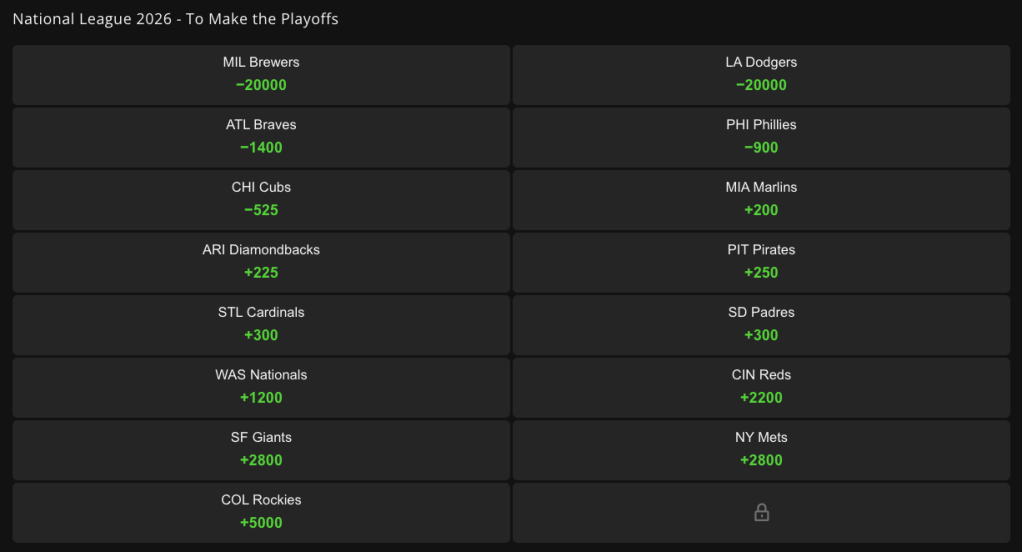
At +200 (an implied 33.3% probability), DraftKings’ projection is less bullish on Miami’s chances than Baseball Reference (53.4%) and FanGraphs (34.0%) are.
I land somewhere in the middle; while the Marlins have plenty of potential pathways to improvement, whether through in-house development or the trade market, expecting improvement out of all of Caissie, Marsee, Pérez, and Alcantara would be unrealistic, and their budget constraints could limit their ability to trade for an impact-maker. Miami’s good fortunate relative to its expected stats on both sides of the ball is likely to regress towards the mean at some point.
The Marlins’ remaining schedule is difficult. They’ll start the second half of the season with a three-game road set against the Milwaukee Brewers, and their three road games against the division-leading Atlanta Braves will come in early August, when the Braves will still be battling for the division. They also have six games (three home and three away) against the Chicago Cubs and Pittsburgh Pirates, with whom they’re battling for Wild Card spots. Four of their seven games against the Washington Nationals, another team in fringe playoff contention, are on the road.
At even odds, I’d bet on Miami to fall short. FanGraphs projects the Marlins to finish 83-79, one game behind the final Wild Card spot. At +200, though, it’s a different story. Miami has shown enough promise and has enough pathways to improvement to justify that gamble.
Best bet: Miami Marlins to make the playoffs at +200.