

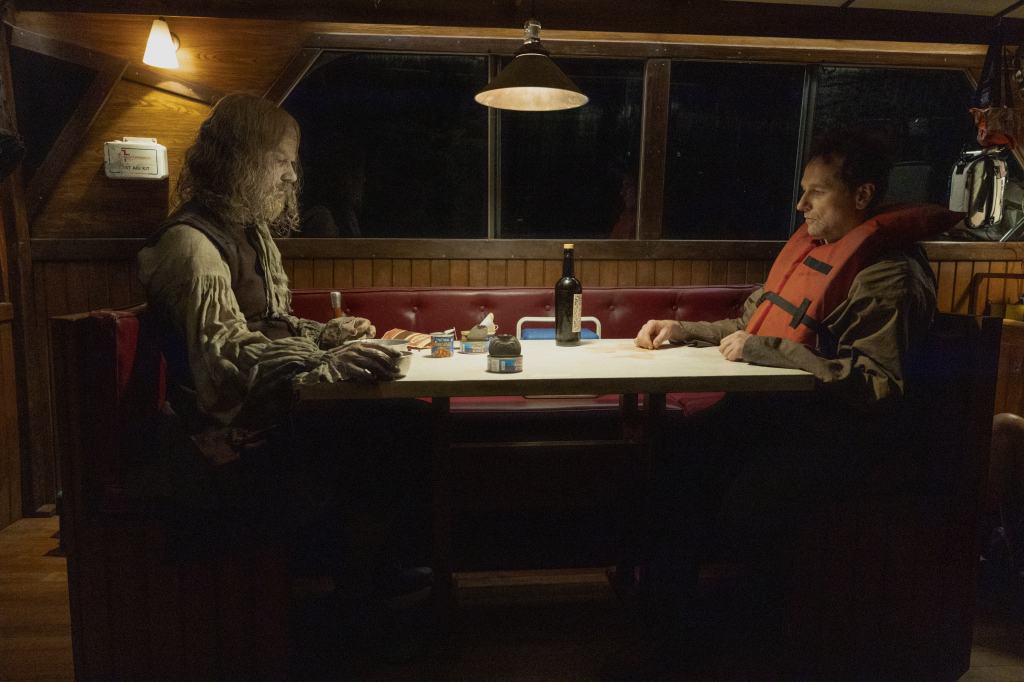
On an island that has spent 400 years laundering sacrifice through town history, the most dangerous person was never going to arrive with thunder, candlelight, and a portrait’s worth of gothic cheekbones. Widow’s Bay has always preferred smaller hiding places: filing cabinets, birth records, inherited surnames, women left out of the official story, and the flat municipal daylight where horror can pass for procedure. Episode 9, “Emergency Shelter,” gives the town its storm, its shelter, its cigarette-lit genealogy seminar, and its answer.
And that is all we can say before the warning: major spoilers follow for Widow’s Bay Episode 9.
Who are the living descendants of Richard Warren in Widow’s Bay?
For a show already stocked with founder sins, maritime theology, cursed tourism, family secrets, and folklore murders, Widow’s Bay still found a way to make its biggest reveal feel sickeningly small. The secret Warren is Ruth Livingston, Tom’s secretary, the woman who has been sitting beside the paperwork the whole time.
Episode 9, “Emergency Shelter,” finally answers the bloodline question that survived Richard Warren’s death. Richard may be ash, the Boogeyman may be back in the island’s bloodstream, and the storm may be swallowing Widow’s Bay whole, but the covenant did not end because the Warren line did not end. It passed quietly, bureaucratically, and almost invisibly into Ruth Livingston.
That is a mean little miracle of television writing. The answer was not Evan, though Evan made emotional sense. It was not Patricia, though Patricia has been moving through the season like someone carrying a curse’s favorite frequency. It was not Wyck, whose folkloric proximity to every awful piece of island history makes him suspicious by default. The answer was Ruth: childless, aging, overlooked, administratively essential, and suddenly transformed into the last living hinge of a 400-year bargain.
Rosemary’s big moment
The reveal arrives through Rosemary, who gives the episode its great cracked-history lecture. She lays the Warren genealogy out on an overhead projector while smoking, a staging choice so perfectly Widow’s Bay that it feels like a school board meeting held during an exorcism. Names, marriages, births, deaths, missing children, half-buried branches, and local calamities pass through the projector light. Rosemary understands the assignment with the custody-file empathy of someone who knows what generations on this island mean. On Widow’s Bay, genealogy is an obituary that learned how to reproduce.
Her language gives the scene its bite. Rosemary does not deliver the Warren family tree in sleek prestige-drama exposition. She talks through the fates of the Warren children with a New England redneck’s gift for blunt catastrophe, the kind of phrase-making born from bad weather, worse men, and a town where nobody needs a poetic euphemism for a dead kid. These children did not become lore because the show wants a neat mythology diagram. They became lore because the island has been chewing on families for centuries and calling the leftovers history.
That is why Rosemary’s near-miss matters. She has the empathy, the documents, the voice, and the shape of the answer. She can feel the curse in the paper. The genealogy, though, is too abstruse to behave. Four hundred years of Widow’s Bay bloodlines twist around daughters, marriages, name changes, erased women, drowned children, and whatever got politely left off the record. Rosemary gets close enough to make the room breathe differently, then misses the hinge: Widow’s Bay, 1959.
That year yanks the curse out of colonial fog and into living memory. The Warren line did not vanish into the sea. It did not end with Richard’s children. It did not return as a flamboyant gothic heir with candlelit cheekbones and a suspicious locket. It reached Ruth Livingston’s desk.
Ruth is the perfect answer because the show has always understood that horror loves administration. Monsters may do the screaming, but towns keep the minutes. Widow’s Bay has records, offices, committees, tourism plans, preservationist instincts, old homes, locked drawers, and people who know exactly which names should never be said too loudly. Ruth has been adjacent to all of that. She is not powerful in the theatrical sense. She is powerful in the way a secretary can be powerful in a place built on secrecy: she knows where things are, who called, what got filed, what got skipped, and which ordinary details formed the island’s nervous system.
The gang’s reaction
Tom understands faster than he wants to. That is where Episode 9 turns from mystery into moral rot. Ruth’s identity does not land on his face as trivia. It lands as temptation. If the last Warren is alive, and the curse depends on Warren blood, then Ruth becomes, to Tom, an answer with a body. The decent mayor, the weary father, the man trying to hold the island together with guilt and panic and civic language, starts doing the oldest Widow’s Bay math: one life against everyone else.
Wyck makes it worse because Wyck knows the island too well. He and Tom begin talking about Ruth’s health, her age, and the shape of her remaining life with the awful tact of men trying to make murder sound like an actuarial question. Ruth becomes a timeline. A medical fact. A possible mercy, if one has already surrendered to barbarism. The storm outside is ancient, but the conversation inside feels older.
Ruth’s childlessness gives the scene its feudal chill. The men are not only discussing the last Warren. They are discussing a spinster, an aging woman without children, a person outside the island’s preferred machinery of marriage, inheritance, and future utility. In the logic Tom and Wyck begin to circle, Ruth’s lack of descendants makes her tidier to spend. No branch continues. No heir carries the name. No obvious family future demands accounting. A woman with no children becomes, in the ugliest possible version of town logic, available.
Patricia’s horror keeps the episode human. She hears the slippage immediately. She hears how fast Ruth has been converted from a person into a solution. Her plea, “What would that make you? What’s it say about us? About this place?” is the line that cracks the episode open. Patricia is not pleading for genealogy. She is pleading for civilization, or whatever small, battered version of it Widow’s Bay still has left.
That question also exposes the oldest disease in the town. Richard Warren’s sin did not remain sealed in the past. He taught Widow’s Bay a grammar of sacrifice. One child for the town. One body for survival. One bloodline turned into civic infrastructure. Four centuries later, Tom and Wyck stand in a shelter during a supernatural storm and begin speaking that language again. They have better manners, better lighting, and worse self-knowledge.
Ruth being the secret Warren answers the mythology. Patricia’s disgust answers the show. Widow’s Bay has never been satisfied with simple curse mechanics. The series keeps asking what fear licenses in respectable people, especially when they can call cruelty responsibility. Tom and Wyck do not have to become cackling villains to frighten us. They only have to speak calmly about Ruth Livingston’s life as though it belongs to the town.
What to expect in the Widow’s Bay finale
Episode 9 ends with Tom walking back out into the storm, presumably headed toward Ruth. It is a gorgeous, rotten cliffhanger because the show gives him no clean heroic posture. The weather is apocalyptic, the town is terrified, the genealogy has narrowed, and Tom has already heard Patricia say the thing he most needed to hear. If he keeps walking, he is not simply chasing the last Warren. He is walking toward the version of himself the island has been trying to make.
The finale has to decide whether Tom can stop thinking like Widow’s Bay. The finale almost certainly begins with Ruth in immediate danger, because Episode 9 ends with Tom moving back into the storm after a conversation that made her life sound grimly negotiable. The question is whether he reaches Ruth as executioner, protector, liar, or some awful combination of all three.
Patricia should matter enormously. Her plea in Episode 9 gives the finale its moral thesis, and the show has positioned her as the person most capable of naming the town’s sickness without hiding behind myth. If Tom tries to justify himself, Patricia is the character best equipped to puncture him. If Ruth survives, Patricia may be the reason the secret Warren remains a person rather than a ritual object.
Wyck remains dangerous because he understands the old order and keeps treating that knowledge as permission. He is useful, grim, and often correct about the island’s mechanics, which makes his ruthlessness more frightening. The finale can use him as Tom’s devil on the shoulder, a local historian who knows exactly how often Widow’s Bay has survived by becoming hideous.
Widow’s Bay FAQ
Who is the secret Warren in Widow’s Bay?
The secret Warren is Ruth Livingston, Tom’s secretary. Episode 9 reveals that the Warren bloodline survived through an abstruse 400 years of island genealogy, with the crucial modern connection hiding in Widow’s Bay, 1959. Rosemary nearly solves it during her overhead-projector family-tree lecture, but Tom appears to understand the danger first.
When does the Widow’s Bay finale come out?
The Season 1 finale, “We Hope You Enjoyed Your Time,” premieres Wednesday, June 17 on Apple TV. Episode 9, “Emergency Shelter,” is the penultimate episode of the season.
Where can I watch Widow’s Bay?
Widow’s Bay is available to stream on Apple TV. Season 1 has 10 episodes total, with the finale releasing on June 17.
Will there be another season of Widow’s Bay?
Apple has not announced whether Widow’s Bay will return for Season 2. Season 1 concludes with Episode 10, “We Hope You Enjoyed Your Time.”

