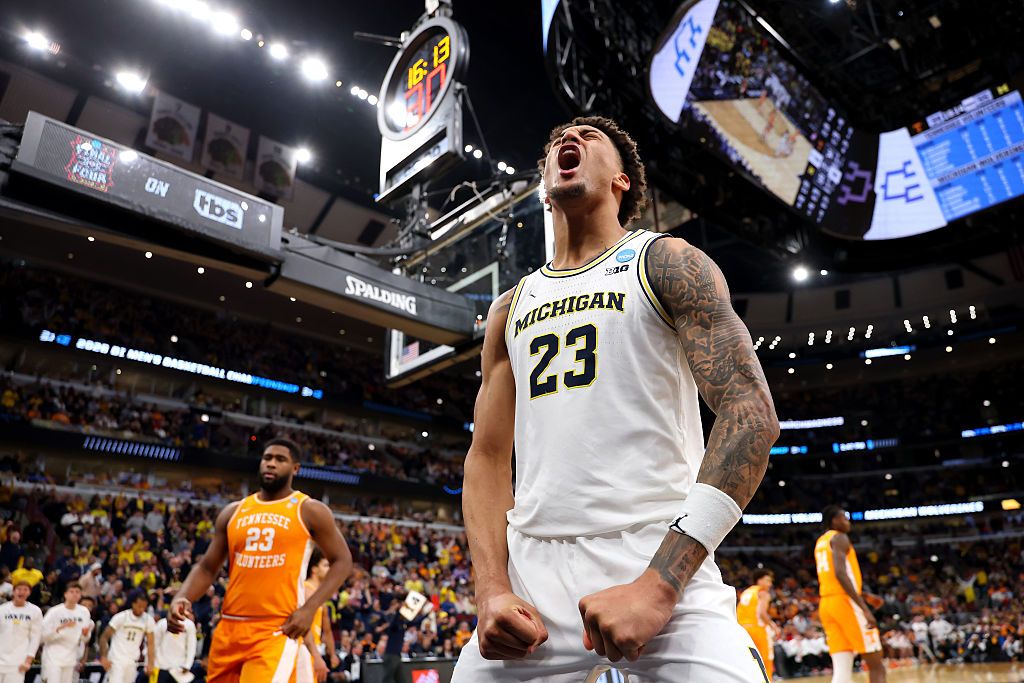
This is the cleanest game of the weekend and maybe the most violent stylistic collision left in the bracket. Michigan walks in 35-3, first in the Big Ten, after becoming the first team to win four NCAA tournament games by double digits while scoring at least 90 in each. Arizona is 36-2, first in the Big 12, riding a 13-game winning streak and fresh off its first Final Four trip since 2001. The Wolverines are built on size, paint finishing, passing and frontcourt depth. Arizona is built on force—86.5 points per game, 50.3% from the field, 19.7 made free throws per game, a 17.7-point scoring margin, and an interior rotation that can keep coming in waves. Michigan is every bit as loaded: Yaxel Lendeborg leads the team at 15.2 points, Morez Johnson Jr. grabs 7.3 rebounds a night, Elliot Cadeau dishes 5.8 assists, and Aday Mara blocks 2.6 shots per game. Arizona counters with Brayden Burries at 16.1 points, Koa Peat at 14.1, Jaden Bradley at 13.3 and 4.4 assists, Motiejus Krivas at 10.4 points and 8.2 boards, and Tobe Awaka at 9.3 points and 9.1 rebounds.
Here are my three favorite player props for the game tonight.
Best Arizona vs. Michigan player prop bets
Elliot Cadeau 7+ assists (-105)
This is still my favorite prop on the board because the role is bigger than the season average. Cadeau averages 10.2 points and 5.8 assists for the year, which already puts him 35th nationally in assists per game. But the recent sample is the part that matters here. In Michigan’s four NCAA tournament games, he is averaging 8.3 assists in 32.8 minutes. He has gone for nine against Howard, seven against Saint Louis, seven against Alabama, and 10 against Tennessee. That means he has cleared this seven-assist ladder in all four tournament games, and he has done it while Michigan scored 101, 95, 90, and 95 points. This is not random shot luck. This is the offense running through him at the exact point of the season when roles are supposed to condense.
The structural case is strong too. Michigan is not asking Cadeau to be a heliocentric scorer. It is asking him to feed size and keep advantage alive. The Wolverines have four double-figure scorers among their main pieces: Lendeborg at 15.2 points, Morez Johnson Jr. at 13.2, Mara at 11.8, and Cadeau himself at 10.2. Johnson shoots 62.5% from the floor. Mara shoots 66.9%. Lendeborg shoots 52.0% overall and 37.2% from three. That is elite conversion equity for any assist bet because Cadeau can generate assists at the rim, on dump-offs, and on kickouts. Michigan’s tournament run has looked exactly like that. AP described the Wolverines as deep and unselfish after Cadeau’s 10-assist game against Tennessee, and that tracks with the season-long numbers.
The matchup does not scare me off. Arizona is physical and disruptive, but it also plays through size and interior pressure, which should keep Michigan’s bigs on the floor and involved. A close game helps too. Cadeau does not need a blowout to get there; in fact, competitive 35-minute games are the sweet spot. The only real caution is the allergic-reaction scare earlier this week, because any late physical limitation would matter for a guard prop. But the reporting said he was fine and under supervision, so unless there is a negative update before tip, the recent role, Michigan’s scoring volume, and the finishing talent around him make seven assists at -105 the cleanest number on this sheet.
Yaxel Lendeborg 18+ points (-105)
This is not a play on median Yaxel. This is a play on the version of Yaxel Michigan has leaned on since the bracket tightened. For the season, he averages 15.2 points, 7.0 rebounds, and 3.3 assists while shooting 52.0% from the field, 37.2% from three, and 81.6% at the line. Those are already excellent all-around numbers. But the tournament form is what makes 18+ attractive. Against Alabama, he went for 23 points, 12 rebounds, and seven assists. Against Tennessee, he scored 27. Reuters had him at 27, seven, and four in the Elite Eight, while AP noted he became the first Michigan player since 1994 to score at least 23 in three straight NCAA tournament games. Maize n Brew also noted he is averaging 25.0 points, 8.3 rebounds, and 4.3 assists over his last three games. That is not just good form; that is primary-option form on the biggest stage.
The path to 18 is broad. Lendeborg is not a one-lane scorer. He has made 193 field goals, 64 threes, and 129 free throws this season. He can get there on cuts, short-roll catches, face-ups, transition, and foul-line work. That matters against Arizona because the Wildcats are good enough that a scorer who needs one specific script can disappear. Lendeborg does not. He can attack smaller matchups, drag Krivas or Awaka away from the rim, or punish switches with touch and strength. Michigan also keeps feeding him because the offense has reached that point in the year where the best player gets first touch in stress possessions.
Arizona is excellent defensively, and this is the reason I kept Lendeborg second instead of first. The Wildcats allow just 68.8 points per game, hold opponents to 39.2% shooting and 31.0% from three, and defend with enough size that easy paint catches are not automatic. But there is a counter to that counter: Arizona’s own offensive pressure should keep Michigan scoring. This is not a low-60s rock fight profile. Arizona averages 86.5 points per game, so Michigan should need real offense for 40 minutes. In a high-leverage, likely competitive semifinal, that points me back to the Wolverines’ best frontcourt shot creator. Eighteen is only three above his season average, and well below the number he has been living at in the tournament.
Koa Peat 16+ points (-105)
This is my favorite Arizona-side number because it fits how Arizona actually wants to play this game. Peat averages 14.1 points, 5.5 rebounds, and 2.7 assists in 27.7 minutes while shooting 53.7% from the field. He does not need threes to score—he has made only six all year—and that is exactly why I like him here. Arizona as a team averages 86.5 points per game, shoots 50.3% from the floor, makes 19.7 free throws per game, and owns a huge scoring-margin cushion because it pressures the rim and lives through contact. Peat embodies that. He is 6-foot-8, 235 pounds, and his scoring profile is built on strength, touch, and getting downhill. This board is hanging 16+ as though his season average is the truest read, but his recent role has clearly climbed.
The tournament sample is the real hook. Peat is averaging 17.5 points in the NCAA tournament. He scored 15 against Long Island, 14 against Utah State, 21 against Arkansas, and 20 against Purdue. That is three clears in four games, and the two biggest clears came in the two biggest games. Against Purdue in the Elite Eight, he played 34 minutes, took 18 shots, grabbed seven rebounds, added three assists, and was named the West Region Most Outstanding Player after leading Arizona back from a halftime deficit. AP and Reuters both highlighted his 20-point effort, and Reuters noted he broke Mike Bibby’s Arizona freshman Elite Eight scoring record. That is not a shrinking role. That is a freshman becoming one of the engines of the offense.
Michigan’s size is the obvious fear. Mara, Johnson, and Lendeborg can make the lane feel crowded, and Michigan has been one of the nation’s better two-point defensive teams by profile. But Peat does not need clean runway on every trip. Arizona has enough rebounding and foul-drawing volume to keep him involved through second-chance points and free throws. The Wildcats also are not a team that defaults to bombing away when the paint gets busy. They keep coming back to force. In a game where Arizona’s cleanest answer to Michigan’s front line is another power forward who can absorb contact and finish through it, 16+ points is a strong number—especially at almost even money.