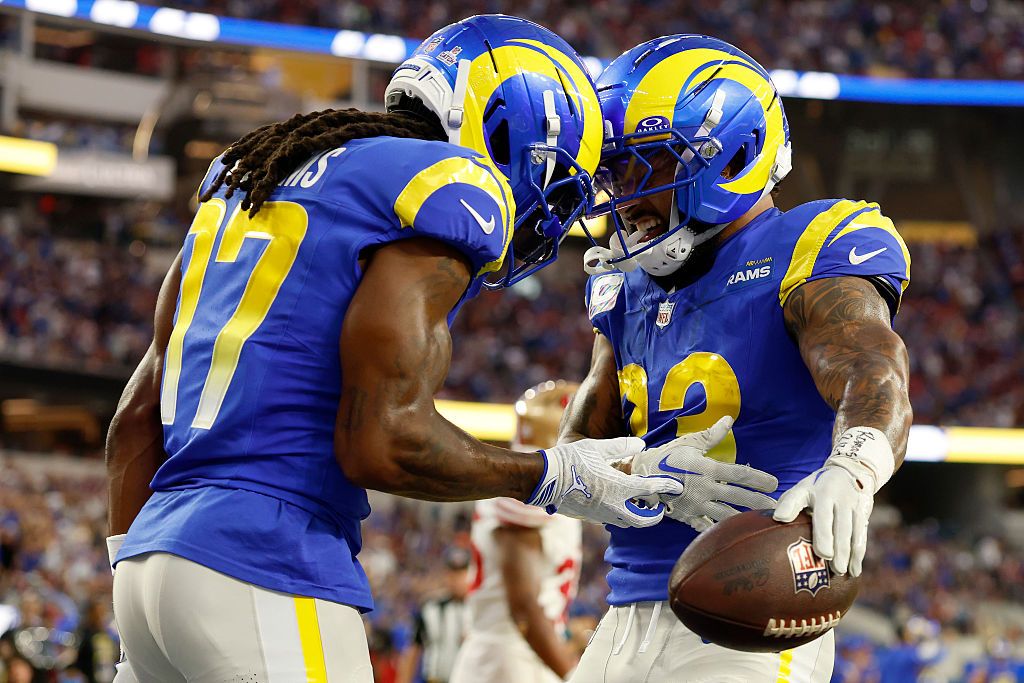
Week 7 arrives with velocity and quirks: an early 9:30 a.m. ET London curtain-raiser at Wembley—Rams–Jaguars—that compresses routines and expands fantasy windows, especially with Puka Nacua and Rob Havenstein ruled out, funneling first reads toward Davante Adams in a condensed script. The slate breathes differently stateside, too: Chiefs–Raiders carries a double-digit spread (KC -12.5, total 45.5), a signal that Kansas City’s passing volume and red-zone cycles should swell, keeping ancillary Chiefs in play. Byes thin the pool—Ravens and Bills sit—so managers must mine matchups and usage trends with sharper intent. Weather adds its own fingerprint: London lists rain and a steady breeze, while Browns–Dolphins points to showers and mid-teens winds—conditions that tilt snaps toward ground games, screens, and tight-end volume. Marquee absences stack beyond Los Angeles—Garrett Wilson trends doubtful for the Jets—so contingency plans matter. The flip side brings juice: Rashee Rice returns from suspension to rejoin Patrick Mahomes with Xavier Worthy and Marquise Brown flanking; CeeDee Lamb declares himself ready after a high-ankle sprain; and George Kittle signals a Week 7 comeback for San Francisco. In short, chase condensed targets overseas, lean into trustworthy workloads at home, and let the elements nudge your flex calls rather than scare you off ceiling. Let’s get right to my Five Lists of Five: Week 7 edition, here, and rummage ourselves some stashes, dart throws, breakouts, and, probably most importantly, as always, running back sleepers for fantasy football Week 7.
The refrain remains the same—All I want is for you to be better than your friends. You’re going to be surrounded by them on Sunday, probably. How sweet would it be if you could be sure you’ve checked every box possible that might guarantee you a resounding victory this week? Some kick-your-feet-up insights? I’ve got some. And I know my audience. The smoke-break audience. The quick-scan-of-the-phone-on-the-way-to-the-fridge audience. The I-ain’t-reading-all-that-but-good-luck folk. I’m a man of the people.
And so: the Five Lists of Five series. Think of these as byte-sized, two-minutes-to-yourself lists to scan during your weekend as you foam at the mouth for any competitive fantasy edge. As much relevant analysis as I can fit into, like, ~250 words per player.
Below: Top five smash starts for fantasy football Week 7. Must-starters based on matchup and sky-high ceilings.
Here are the other offerings from my 2025 Fantasy Football Five Lists of Five: Week 7 edition:
- Top five breakout wide receivers for 2025 fantasy football Week 7
- Top five fantasy football trade targets as of NFL Week 7 of 2025
- Top five breakout running backs for Week 7 of 2025 fantasy football
- Top five WR/CB matchups to target for Week 7 fantasy football
Follow my handle @dansby_edits for all of my fantasy football content—as well as plenty of NFL and College Football betting goodies—all season long.
Top five smash starts for Week 7 of 2025 fantasy football
Quinshon Judkins, RB, Cleveland Browns (vs. Miami Dolphins)
Cleveland can set its jaw and run the ball straight at a defense that invites punishment. Miami yields 168.5 rushing yards per game and 5.6 yards per carry, then layers on an offense-friendly +0.19 defensive EPA. That blend whispers one thing: handoffs become first downs. Judkins brings the right profile for a trench game. He’s stacked 84 carries for 383 yards at 4.6 YPC with two rushing touchdowns in five games. He catches the outlet when needed—nine receptions on 12 targets for 62 yards—and protects gains with 3.2 yards after contact per attempt. He already owns eight runs of 10+ yards (9.5% explosive rate), which turns a routine lane into a 20-yard breath-taker.
Cleveland can pound doubles early, switch to gap when safeties cheat, and let the clock bend toward their back. Miami’s pass metrics amplify the script. They’ve produced only 12 sacks and 1 interception, and they’ve allowed 233.8 passing yards at 8.0 YPA with a laughable 99.4% completion rate on the sheet. Even if noise inflates that number, it signals clean structure. Clean structure creates more snaps and more carries. The staff already trusts Judkins near the stripe—15 red-zone attempts, two TDs—so the moment Cleveland parks inside the ten, the ball should find his chest again. He runs square, finishes forward, and stacks body blows until a crease breaks the series. Start him with conviction. Let a 4.6 YPC runner meet a defense giving 5.6 YPC, and let the fourth quarter belong to his legs. That’s RB1 calculus without the theatrics—just volume, leverage, and a defense that can’t hold water.
Trey McBride, TE, Arizona Cardinals (vs. Green Bay Packers)
Arizona funnels its passing heartbeat through Trey McBride and refuses to apologize. He’s banked 37 receptions on 53 targets (69.8%) for 347 yards and two touchdowns, with 156 YAC (4.2 per catch) and a sturdy 1.54 yards per route run across 225 routes. He doesn’t just touch the ball; he tilts downs—58.5% target success and six receptions on 10 red-zone targets for two scores. He plays like a big slot who never rushes the picture. He sits into voids, shows numbers, and sparks the drive again. Arizona could toggle quarterbacks—Kyler Murray or Jacoby Brissett—and that choice reshapes rhythm, not reliance. Murray stretches plays and drags safeties, which gifts McBride second-window seams; Brissett throws on time and lives inside, which feeds stick and glance. Both are squarely in McBride’s route tree. Marvin Harrison Jr. is expected to play while coming off a concussion designation, so corners and safety help still shade his side; that attention siphons bodies outside and clarifies McBride’s lanes.
Green Bay shapes a runway between the numbers. The Packers allow 221.0 passing yards per game at 5.5 YPA, have logged 12 sacks with only 2 interceptions, and choke the run to 73.0 yards at 3.6 YPC. That profile funnels attempts to the interior. Arizona can sell stretch, fire play-action, and send McBride up the seam once linebackers widen; when safeties sink, he converts sticks and option routes into first downs. He steadies chaos. He accelerates rhythm. Expect 8–10 targets, majority inside 12 yards, with two or three red-zone tags layered off identical looks that marched them there. Tight end rarely grants both floor and ceiling. McBride does, and a defense built to concede the middle magnifies both.
Davante Adams, WR, Los Angeles Rams (at Jacksonville Jaguars)
The alpha stays alpha. Adams has turned 55 targets into 26 catches, 396 yards (15.2 per), and 3 touchdowns, holding depth with a 12.1 aDOT, sustaining efficiency at 1.95 yards per route across 203 routes, and detonating chunks—13 receptions of 15+ yards, exactly half of his catches. Red zone? 13 targets, two scores on two snags. That profile already plays; Wembley just widens the stage. Sunday kicks at 9:30 a.m. ET at the national cathedral, and both clubs arrive 4–2, sharpened by stakes.
Los Angeles trims the read tree and points it at No. 17. Puka Nacua is ruled out, and RT Rob Havenstein sits too, which tightens timing and funnels primary windows to Adams’ boundary diet. Expect condensed splits, stop/comeback to force hips, and the post once a safety widens.
Jacksonville complicates pictures but can’t mute leverage for four quarters. The Jags’ defense sits in the top 10 by EPA per play allowed (-0.07) and punishes mistakes with 10 interceptions; that raises the premium on precision, contested-hand wins, and veteran route craft—Adams’ calling cards. They also tamp the run, which keeps Stafford in pass posture and Adams in the crosshairs. London scripts often reward first-window throws; the Rams can manufacture those with motion, bunch, and tempo, then layer the same picture into deeper daggers once Jacksonville widens.
This is the usage bet you make every time: 10–12 targets, two or three downfield comebacks that flip field position, and multiple red-zone looks mirrored off his early-down picture. Start him everywhere. When half your catches explode and the opponent invites precision over panic, you ride the technician and let the numbers sing.
J.K. Dobbins, RB, Denver Broncos (vs. New York Giants)
Denver can set the tempo and let Dobbins carry the refrain. He’s carved 91 carries into 442 yards (4.9 YPC) with four touchdowns, flashing pop on 14 runs of 10+ yards (15.4%) and finishing through hits at 3.2 yards after contact per attempt. He wastes nothing—zero fumbles, a miracle in 2025—and he cashes near the stripe: four TDs on 14 red-zone attempts (28.6%). The receiving trickle—six catches on nine targets for 23 yards—keeps the floor intact if drives hiccup. That’s a complete, trustworthy workload profile in a week that wants the ball in his hands.
New York’s surface invites patience. The Giants allow 128.8 rushing yards per game at 5.1 YPC, carry a mildly offense-friendly +0.02 defensive EPA, and have tallied 12 sacks and four interceptions while still spilling first downs on the ground. That’s the exact template for Denver to marry duo and inside zone to quick game, stack possessions, and hand Dobbins the fourth quarter. When fronts tire, his pad level becomes a metronome—four yards, five yards, then the crease that tilts a series.
Short fields become leverage; leverage becomes touches inside the ten. That’s where his profile shines, and where weeks swing on two snaps. You chase touchdown equity at running back because it pays even when efficiency wobbles; Dobbins brings both, with symmetry on his side: a 4.9 YPC runner meeting a defense coughing 5.1 YPC. Pencil 18–22 touches, multiple goal-to-go carries, and a closing stanza that belongs to his legs. Start him with conviction and let the trenches write your points.
Rashee Rice, WR, Kansas City Chiefs (vs. Las Vegas Raiders)
Kansas City has the runway built; Rice supplies the lift. He hasn’t logged a 2025 snap, but last year’s four-game flash reads like a manifesto: 24 receptions on 29 targets (82.8%) for 288 yards (12.0 YPR) and two TDs, with an elite 3.27 yards per route run on 88 routes, a 33.0% target rate, 29.2% explosive-catch rate, and 7.8 YAC per reception. The return arrives now—Kansas City activated him post-suspension and teammates framed the plan simply: fold Rice into a room with Xavier Worthy and Marquise Brown and let the offense breathe again.
Context screams volume. The market posts Chiefs -12.5, total 45.5—a game script that hands Patrick Mahomes extra possessions and red-zone cycles. Mahomes enters with 1,514 yards, 11 TDs, two INT and top-five efficiency by QBR, a passing profile supported by 213 attempts in six games and league-leading red-zone usage. Kansas City leans pass by design and pace, which amplifies a first-read separator with post-catch torque.
Las Vegas offers a canvas, not a cage. The Raiders sit 11th in total defense by yards (311.0/game) but remain permissive through the air in structure and personnel; the pass rush spiked last week with 21 pressures and six sacks, yet season-long pressure has flowed mostly through Maxx Crosby, now at 4.0 sacks. Expect spot-drops and simulated pressure rather than sticky man—exactly where Rice’s slants, glance routes, and over routes punish leverage.
Deployment won’t be coy; Kansas City has already said he’ll be seeing a large portion of the target share. Motion creates free releases, stacks steal leverage, and RPO glances become chain-movers; when linebackers widen, Mahomes layers the deep-over. Treat Rice as a high-end WR2 with WR1 voltage the instant he’s active: project 8–11 targets off that 33% earning profile, strong conversion rooted in 82.8% hands, and live end-zone equity as the Chiefs cycle possessions. He gives this attack its throttle; you capitalize, not hesitate.