Tight ends flipped for fantasy football in 2024. Brock Bowers rewired expectations with true WR-level volume and separation. Trey McBride owned share and efficiency but ran cold on touchdowns. George Kittle stayed nuclear on a per-route basis, punishing busted leverage. Sam LaPorta’s counting stats dipped, but his red-zone role hardened. Travis Kelce’s volume held while explosiveness slipped. Mark Andrews lived on touchdowns with lighter yardage. The signal is clear. Offenses now treat tight ends like slot weapons, not afterthoughts. Teams design first reads and motion to spring them free. The age curve finally mattered, and youth surged. The middle class bloated with names that didn’t separate weekly. I don’t really see any of these trends as anomalies, so as I went into my 2025 fantasy football TE ranks, all of these datapoints on the NFL landscape informed my approach for this year.
In 2025, I’m betting traits and roles, not résumés. I want players who run routes, win early, and get fed inside the ten. I’m fading timeshares, in-line grinders, and “cardboard” snaps that don’t earn throws. If I miss an early separator, I chase creativity and ascending offenses. Give me tight ends who stress safeties and bend zones, not chip ends and disappear. That’s the blueprint. Below are the rankings and analysis.
Follow my handle @dansby_edits for all preseason and fantasy draft kit content—as well as plenty of NFL betting goodies—all summer long.
If you’re interested in my other rankings, which do inform some of my departures from the industry consensus (FantasyPros) rankings here, check them out:
- Fantasy Football 2025 QB ranks: Top twelve quarterbacks to target on draft day
- Fantasy Football 2025 RB ranks: Top 25 running backs to target on draft day
- Fantasy football 2025 WR ranks: Top 30 wide receivers to target on draft day
Fantasy Football TE ranks 2025: Top fifteen tight ends
Dan Johnson’s 2025 TE ranks at a glance:
TE1. Brock Bowers (TE1)
TE2. Trey McBride (TE2)
TE3. George Kittle (TE3)
TE4. Sam LaPorta (TE4)
TE5. T.J. Hockenson (TE6)
TE6. Dalton Kincaid (TE16)
TE7. David Njoku (TE9)
TE8. Travis Kelce (TE5)
TE9. Mark Andrews (TE7)
TE10. Evan Engram (TE8)
TE11. Tucker Kraft (TE12)
TE12. Kyle Pitts (TE17)
TE13. Tyler Warren (TE10)
TE14. Colston Loveland (TE11)
TE15. Brenton Strange (TE24)
My 2025 tight end strategy, which leans hard into ceiling and departs from consensus “safety,” prioritizes route dominance and red-zone leverage over name value. I’m happy to pay for true difference-makers when a WR tier breaks: Brock Bowers (TE1) and Trey McBride (TE2) are early anchors, with George Kittle (TE3) and Sam LaPorta (TE4) next in line when they slip. If I pass on that tier, I pivot to Dalton Kincaid (TE5) in the Round 5–6 window for his path to a top-two team target role, then T.J. Hockenson (TE6) and David Njoku (TE7) at value.
I’ll selectively buy Travis Kelce (TE8) and Mark Andrews (TE9) only at discounts—age and TD-rate volatility cap their ceiling at cost. In the upside pocket, I’ll target Tucker Kraft (TE11) and—big ol’ sigh—Kyle Pitts (TE12) as swing-for-the-fences profiles, then mix in rookies Tyler Warren (TE13) and Colston Loveland (TE14) for second-half surges. Brenton Strange (TE15) is my cheap volume stabilizer if I wait and double-tap late.
We’re chasing ≥80% route participation, ≥22% TPRR, ≥1.8 YPRR, and consistent inside-10-yard-line usage. I’m fading low-aDOT safety valves and timeshare in-line types. I’m not Zero-TE, but I’m unapologetically upside-first: either secure one elite early at a WR/RB tier break, or wait and take two darts from the Kincaid/Njoku/Kraft/Pitts/Warren/Loveland band, with Strange as the floor. Full analysis below.
Top fifteen tight ends for fantasy football 2025: player profiles & analyses
TE1. Brock Bowers, Las Vegas Raiders (ADP: TE1)
Bowers delivered a historic rookie campaign in 2024, immediately redefining the position. He became the first rookie tight end ever to top 100 receptions (finishing with 101 catches for 1,067 yards by Week 16), ultimately leading all TEs with 1,194 receiving yards on the season. At just 22, Bowers is a target hog and athletic mismatch in the Raiders’ offense. He commanded roughly a quarter of the team’s targets—the highest share of any NFL pass-catcher last year—as Las Vegas funneled everything his way. That massive volume (133 targets and 26 red-zone looks) fueled a league-best 262 PPR points for a TE. Bowers’ 2024 efficiency was elite as well. He averaged over 2.0 yards per route run with a strong 72% catch rate.
The scary part? There’s room for more touchdowns. Despite all those opportunities, Bowers scored only 4 times, partly due to a struggling Raiders offense. With a new coaching staff (Pete Carroll) and veteran QB upgrade, the offense should improve, giving Bowers more red-zone conversions even if his target share dips slightly. His blend of volume, talent, and efficiency is unrivaled. Think prime Travis Kelce, but 13 years younger. Bowers is a weekly positional advantage with a sky-high floor and ceiling. Barring injury, he’s a near-lock for 90+ catches and 1,000+ yards again. In full PPR, he’s the clear TE1. A rare centerpiece at the positionworth building your draft around.
TE2. Trey McBride, Arizona Cardinals (TE2)
McBride broke out in a big way last season, finishing as the TE2 in fantasy points per game (15.6). The 25-year-old became an absolute target magnet in Arizona’s offense. Among 47 qualifying tight ends, McBride ranked first in target share and third in yards per route run in 2024. He piled up 111 catches for 1,146 yards (both second only to Bowers among TEs), showing an uncanny ability to get open. McBride was essentially the Cardinals’ co-No.1 option, regularly commanding ~30% of targets. His only shortcoming was touchdown production.
Despite seeing the second-most red-zone targets among TEs, McBride found the end zone just four times (only 2 receiving TD) – an outlier case of bad luck. He still averaged a robust 15.6 PPR points, but his expected output was 19.2 PPR if his TD rate were normal. In other words, McBride had a top-1 overall TE season hiding in plain sight. Heading into 2025, he’s locked in as Arizona’s offensive centerpiece and should continue to thrive. At 6’4″ with 4.5 speed, McBride creates mismatches at all levels. His chemistry with Kyler Murray (on whom I’m very high this season in my QB ranks) is excellent. He’s the first read on many dropbacks. If those touchdowns positively regress, McBride could easily finish as the TE1 overall. Even without a scoring spike, his target volume and yardage give him a rock-solid floor. McBride offers an elite combination of weekly consistency and league-winning upside, making him a worthwhile pick right after Bowers.
TE3. George Kittle, San Francisco 49ers (TE3)
The 32-year-old Kittle reminded everyone in 2024 that he’s still an elite playmaker at the position. He turned in 78 catches for 1,106 yards and eight touchdowns, ranking top-three among tight ends in all major receiving categories. Kittle’s calling card—explosive efficiency—was on full display: he averaged 14.2 yards per catch (best among TEs with 50+ receptions) and remained over the 2.0 yards per route run benchmark of dominance. Simply put, when Kittle got opportunities, he delivered chunk gains and game-breaking plays. He finished as the PPR TE3, and his eight scores were tied for second-most at the position.
Working in a loaded 49ers offense, Kittle benefited from favorable matchups as defenses honed in on Christian McCaffrey, Deebo Samuel, and Ricky Pearsall. Brock Purdy capitalized by finding his star tight end for big plays down the seams. There is some volatility to Kittle’s weekly output due to the wealth of 49ers weapons. And minor injuries have been a theme in his career, though he managed 15 games last year. Deebo’s now gone, and Brandon Aiyuk’s timeline (and organizational investment beyond anything but dollars-and-cents) is murky. Which is to say, Kittle’s upside is unmatched outside the top two TEs. He’s one of the few who can singlehandedly swing a matchup with a 150-yard, multi-TD outing.
At age 32, a slight decline could begin, but there were no signs of it in his metrics last year. He still moved exceptionally well and earned targets at a high rate. With Purdy growing more comfortable, Kittle should remain a high-efficiency, high-upside TE1. Pencil him in for around 70-80 catches and 900+ yards. If he stays healthy for a full slate, his ceiling is a top overall TE finish in 2025.
TE4. Sam LaPorta, Detroit Lions (TE4)
LaPorta enters his third season as one of the bright young stars at tight end. The 24-year-old followed up his stellar rookie campaign with a solid 2024: 60 receptions, 726 yards, and seven touchdowns in 16 games. While his catch and yardage totals dipped slightly in a deep Lions offense, LaPorta emerged as a go-to red-zone weapon, with those seven TDs trailing only Mark Andrews and a couple others among TEs. At 6’3″/245, LaPorta combines wide-receiver-like route running with a running back’s tenacity after the catch. He led all tight ends in YAC as a rookie, and continued to show that tackle-breaking ability in 2024.
Jared Goff clearly trusts LaPorta in key situations. He often schemed open on third downs and near the goal line. One of LaPorta’s strengths is that he’s a three-down player: he rarely leaves the field (playing ~80% of snaps) because his blocking is competent, which keeps him in for play-action shots and screens alike. The Lions’ plethora of weapons (Amon-Ra St. Brown, Jameson Williams, Jahmyr Gibbs, etc.) does cap LaPorta’s target share in the 15-18% range, which can lead to some quiet weeks when Detroit leans on the run or spreads the ball. He was around 11 PPR points per game last year. Good, but not elite.
However, given his talent and growing role, there’s upside for more. If the Lions increase his involvement, LaPorta could push for 800+ yards. Even if his volume holds steady, his knack for finding soft spots in coverage and making contested catches keeps him a steady mid-range TE1. LaPorta offers youth, reliability, and touchdown upside on a strong offense. A great combination in this tier.
TE5. T.J. Hockenson, Minnesota Vikings (TE6)
It was a tale of two seasons for Hockenson: in 2023 he was a PPR monster (914 yards on 86 catches), but in 2024 an injury derailed his campaign. He managed only 41 receptions for 455 yards and zero touchdowns in 10 games last year, before a back injury shut him down. Assuming full health for 2025, Hockenson projects as a high-volume rebound candidate.
Still just 28, he’s in his prime and has already shown a fantasy TE1 ceiling (he finished as the PPR TE2 in 2022). At 6’5″ with sure hands, Hockenson excels at working the intermediate seams and sitting in zone pockets. Ideal stuff to profile as a safety blanket for a new quarterback. Minnesota did change QBs (rookie J.J. McCarthy takes over), and while that introduces some uncertainty, a young QB’s best friend is often a reliable tight end over the middle. Hockenson could very well lead the Vikings in targets early on as McCarthy gains comfort, especially with defenses focused on Justin Jefferson.
There are some red flags: Hockenson’s efficiency metrics have been merely average. In 2024, even before the injury, he was only around 11 yards per catch and his yards per route were middling. He’s more of a volume-dependent producer than a big-play threat. Additionally, injuries have cropped up multiple times in his career. That said, the Vikings paid a premium to acquire and keep Hock, so expect new coach Kevin O’Connell to scheme plenty of looks his way in the quick passing game. A stat line of ~75 catches for 800 yards and ~five TDs is a reasonable projection if he stays on the field. Rock-solid in PPR. Hockenson may not possess game-breaking explosiveness, but his high target floor and red-zone role in a pass-friendly offense make him a safe bet for top-five TE production, with top-three upside if everything clicks. Just like every other guy here—I know.
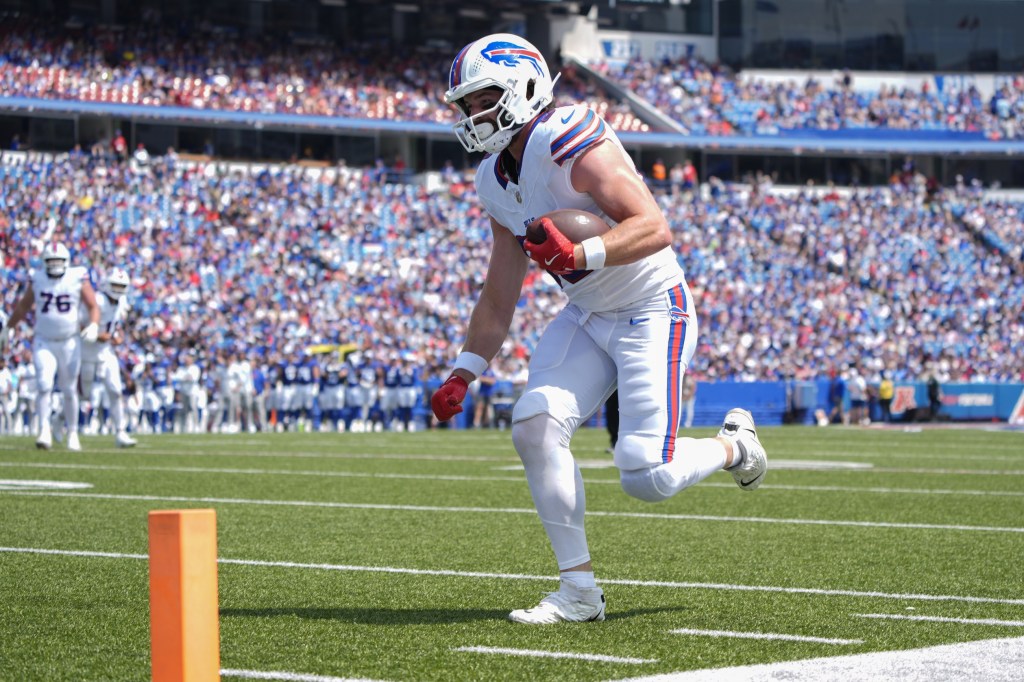
TE6. Dalton Kincaid, Buffalo Bills (TE16)
Bang! How’s that for an ADP departure. Indeed—we’re doubling down on Kincaid in 2025. I called him a league-winning draft piece last August. That went terribly! Belly-up bad! But, in the spirit of data-backed reasons to throw good money after bad, I’m telling you: Kincaid’s way too slept on headed into 2025’s fantasy season.
Kincaid is a classic third-year breakout candidate poised to explode in 2025. Don’t be fooled by his modest 2024 stats (44 catches, 448 yards, two TD in 13 games), the underlying signs point to a major leap coming. Kincaid spent much of last season splitting routes with veteran Dawson Knox, but by December he had clearly established himself as the more dynamic option. A natural seam-stretcher at 6’4″/240, Kincaid possesses wideout-caliber hands and body control. Josh Allen’s trust in him grew noticeably down the stretch, especially on third downs. In fact, some of Kincaid’s underwhelming production can be pinned on circumstance and variance: he had the third-most uncatchable targets among tight ends (25 errant throws), as Buffalo’s passing attack misfired at times. With a bit more accuracy and timing, Kincaid’s numbers would have looked very different.
Looking ahead, the Bills offense has vacated targets; behind Khalil Shakir the pecking order is open, and rookie WR Keon Coleman is still developing. This opens the door for Kincaid to potentially be Allen’s second-favorite target. Buffalo’s coaching staff has hinted at more 12-personnel sets to keep Kincaid on the field even if Knox is healthy. Remember, Kincaid was a first-round pick in 2023 for a reason: he drew Travis Kelce comparisons as a prospect for his route savvy and ball skills.
Now at age 25, with two years of NFL acclimation, the stage is set for that talent to translate. Expect a big jump into the 70+ catch, 800-yard range. Kincaid’s upside is immense . In this high-powered offense, a top-five TE finish is within reach if he grabs a 18-20% target share. He’s exactly the kind of high-ceiling pick to target at a discount, even if his floor (with Knox still around) is a tad lower than the elite options.
Double or nothing.
Note: Not that I think it’ll change what the Bills do much, but I don’t think Kincaid’s stock suffers whatsoever with all this James Cook drama.
TE7. David Njoku, Cleveland Browns (TE9)
Njoku quietly emerged as a target hog last season, finally delivering on the promise that made him a first-round pick in 2017. In just 11 games, he amassed 64 receptions, 505 yards, and five TDs on 97 targets—a pace that would have shattered his career highs if not for missed time. When healthy, Njoku functioned as Cleveland’s 1B option alongside erstwhile-departed Amari Cooper, commanding 20%+ target share with a team-high 17 red-zone targets over that stretch. At 6’4″, 246 with plus athleticism, he punishes linebackers on seams and wins leverage in condensed spaces. He averaged 13.5 PPR points per game when active, squarely in TE1 territory.
The 2025 lens stays bullish, though. Cleveland’s quarterback room has turned over and is in a total holding pattern, but Njoku’s usage under Stefanski is scheme- and situation-proof: quick-game first reads, stick/choice in the middle, and designed red-zone looks. The growth of Jerry Jeudy should help by stressing coverage horizontally and pulling bracket help off Njoku between the hashes. His 2024 efficiency (7.9 YPC) undershot talent; with steadier timing he projects closer to ~10–11 YPC, which pushes him toward 75–800–6 outcomes over a full slate. Health is the watch item—rib and ankle issues cost time last year—but his role is bankable and his athletic profile remains elite.
We’re prioritizing upside at TE, and Njoku checks that box without sacrificing volume. He offers a rare blend of bankable targets, heavy red-zone involvement, and after-catch juice. If the new starter stabilizes the intermediate passing game, Njoku’s weekly floor rises while preserving spike-week potential. Draft confidently as a mid-round top-five outcome bet with a sturdy top-eight floor.
TE8. Travis Kelce, Kansas City Chiefs (TE5)
Yes, Kelce is the same Travis Kelce who dominated fantasy for the past decade. But, at 36, he’s finally shown signs of being mortal. In 2024, Kelce had a noticeable dip in production: 97 catches, 823 yards, and three touchdowns over 16 games. Remarkably, he still caught a ton of passes (nearly six per game) and was heavily targeted by Patrick Mahomes, but the downfield impact wasn’t the same. His 8.5 yards per catch was by far the lowest of his career, indicating that defenses blanketed him and forced more dink-and-dunk connections. And despite leading all TEs with 26 red-zone targets, Kelce found the end zone only three times. An anomaly for a player who’d scored 9+ TD in six straight seasons.
So what do we do with Kelce now? On one hand, he’s a first-ballot Hall of Famer still attached to an elite QB. He led all tight ends in targets (133) and if a few more had converted into TDs, he’d likely have finished as a top-three TE again. Positive regression in the scoring department is a fair bet; Mahomes isn’t going to stop looking Kelce’s way near paydirt, and the chemistry they share could easily yield 6-8 TDs in 2025.
On the other hand, age is undefeated, and brand emphasis has become a massive priority for this man as he navigates his NFL career (Happy TS12 to all who celebrate, by the way!). Kelce looked a half-step slower, and the Chiefs have added young receiving weapons which could siphon a bit of volume as they prepare for life after him. We’re comfortable lowering the floor here in favor of younger upside, which is why Kelce slots in at TE8. You’re drafting him hoping for one more vintage year. Something like 80 catches, 900 yards, and six TDs is totally doable, and would still be TE1 material. Just temper expectations: Kelce is no longer a weekly 20-point cheat code, but he’s still a high-floor starter who will have spurts of brilliance in that prolific KC offense.
TE9. Mark Andrews, Baltimore Ravens (TE6)
Andrews has been an elite fantasy tight end for years, and he remained productive in 2024. We’re not going to talk about the play for which Andrews’ season will be most remembered. But perhaps it’s not entirely not a bellwether for what to expect in 2025.
Though productive, the Ravens used Andrews in a very different way than expected. He posted 55 receptions for 673 yards (a relatively underwhelming output) but spiked 11 touchdowns to lead all TEs in scoring strikes. Essentially, Andrews became Baltimore’s red-zone battering ram, even as his between-the-20s usage dipped in a more receiver-centric offense. With the arrival of Zay Flowers and a new pass-happy OC Todd Monken, Andrews saw his targets per game drop slightly and his yardage was his lowest since his rookie year. But when the Ravens got near the goal line, Lamar Jackson still zeroed in on his big 6’5″ tight end. Hence the career-high TD total.
Looking to 2025, Andrews remains in his prime at 30 and should continue as a high-value target for Jackson. There is a bit of concern around his overall volume: Flowers emerged as a true WR1, and Baltimore also has Rashod Bateman and others to spread targets. Andrews’ 2024 target share (about 19%) was solid but not the massive ~27% he saw in 2021. However, with his size and savvy, he’s virtually unguardable in the paint. He converted a whopping eight of those 11 TDs from inside the 10-yard line. Even if his weekly yardage hovers in the 40-50 range, those 6-point plays buoy his fantasy value tremendously.
One notable factor: Andrews has dealt with some serious injuries and hasn’t completed a full season since 2021. That risk and a slightly lower yardage ceiling push him down a bit in my upside-focused ranks. Nonetheless, he’s a proven high-floor TE1. Think of Andrews as a five-catch, 50-yard per week guy who might score any given Sunday. That’s extremely useful, just not quite as flashy as the younger options above.
TE10. Evan Engram, Denver Broncos (TE8)
Engram finds himself in a new home and an intriguing situation for 2025. After two productive years in Jacksonville, his 2024 was cut short. He logged only 47 catches for 365 yards and one TD in nine games amid hamstring and shoulder injuries. Now healthy and signed by Denver, Engram will step into head coach Sean Payton’s offense, which historically has been friendly to athletic tight ends. At 6’3″ and still running a sub-4.5, Engram brings field-stretching ability that the Broncos’ TE room lacked. Bo Nix blossomed into what feels like a legitimate second-year NFL quarterback late last season (his rookie year) and a Sean Payton offense has a penchant for targeting big targets in the red zone. That’s something Engram can capitalize on with his leaping ability.
It’s worth noting that Engram is just one year removed from a 73-catch, 766-yard season in 2022, and he followed it in 2023 with 41/481/3 in a full season. So the pedigree of production is there. In Denver, he should slide in as the clear TE1. Payton could deploy Engram similarly to how he used Jimmy Graham or Jared Cook, moving him around formations to create mismatches. The key question is volume: Denver still has target competition in Courtland Sutton and the emergent Marvin Mims and Troy Franklin. Engram may not see a massive target share, but even six-ish looks per game could yield strong results given his efficiency.
He was top-five among TEs in yards per route in 2022 and remains a tough cover for linebackers. Don’t expect a huge TD surge (Engram has never topped six scores in a season), but a line around 65-700-5 is very attainable. That places him squarely in low-end TE1 territory. Engram offers a nice blend of athletic upside and veteran experience. He’s a solid pick if you miss out on the younger breakout candidates, with a chance to surprise if Payton fully unlocks him.
TE11. Tucker Kraft, Green Bay Packers (TE12)
Kraft is a name shooting up draft boards after a big second half of 2024. A year ago, he began as Green Bay’s number-two tight end behind fellow rookie Luke Musgrave, but an injury to Musgrave opened the door. Kraft blew it wide open.
In 10 games without Musgrave, he tallied 29 catches for 425 yards and six touchdowns, immediately showcasing a nose for the end zone. Those six TDs over that stretch were the most by any tight end in the league during that span. At 6’5″, 259, Kraft is a sturdy target with soft hands and surprising agility (he was a YAC standout at South Dakota State). By season’s end, it was clear he had surpassed Musgrave on the depth chart. Green Bay’s coaching staff praised Kraft’s blocking and reliability, allowing him to play virtually every snap.
Now entering 2025, Kraft profiles as the Packers’ do-it-all starting tight end. Quarterback Jordan Love really clicked with him in the red zone and on scramble drills, developing chemistry typically seen with veterans. Any young QB will likely appreciate Kraft’s big catch radius as a safety valve. One impressive aspect: despite being a third-round pick, Kraft showed veteran-like savvy in finding soft spots in coverage. Big reason he earned trust so quickly.
Over a full season, he has legitimate top-eight TE upside, especially if those touchdown opportunities remain high. I am unconcerned about the Packers’ bloated WR room of field-stretching hornets with questionable hands. I project something like 50–60 receptions, 600–700 yards, and 6-8 TD as very feasible for Kraft. Given his current ADP, Kraft offers one of the best risk/reward profiles at TE. He’s young, ascending, and attached to an offense that will feature him. Don’t be surprised if he finishes as this year’s breakout star at the position.
TE12. Kyle Pitts, Atlanta Falcons (TE17)
Right. Let’s just get to it then, shall we? You saw the name; you had the reaction. I had to write the name here, knowing you’d see it, and have your reactions; I had my own moment of defeat there. So, honestly, we’ve all processed this enough—yes? And, if you haven’t, the Internet has already done a jolly-good job raking over the coals the idea of Kyle Pitts as a TE1 in 2025. And here we are.
Few players embody the upside vs. floor dilemma like Pitts. The 25-year-old is one of the most physically gifted tight ends ever to enter the league—6’6″, 240-lb unicorn with 4.4 speed –—yet he’s been a fantasy frustration the past two seasons. In 2024, Pitts once again underwhelmed, failing to reach 600 yards and scoring only a couple of times. He was alarmingly underutilized, seeing six or fewer targets in each of the Falcons’ final 10 games as the previous coaching staff oddly schemed more looks to Jonnu Smith.
So why rank him here at TE12? Because the scenario has changed in 2025. Atlanta has a new head coach and a new quarterback in Michael Penix Jr., and early signs point to a Pitts renaissance. Penix—official Pitts golf buddy—has openly stated he plans to “throw a lot of passes to Pitts” and that we’re going to see “a lot of [Pitts making big plays]” in this offense. In the first practice of camp, reports noted Pitts making multiple downfield chunk plays. That’s while lining up often as a wide receiver. It appears the Falcons finally recognize that a player with Pitts’ skillset needs to be featured, not a decoy.
Health-wise, Pitts is coming off a minor foot injury that limited him in spring, but he was medically cleared for camp and is moving well. Let’s not forget, Pitts topped 1,000 yards as a rookie. His ceiling is immense if deployed properly. There is certainly risk. We’ve been burned before by Atlanta’s usage, and Penix is still an unproven NFL QB. But at this stage in drafts, swinging for a potential difference-maker makes sense. If Pitts even approaches his talent level, he could smash this ranking. A line like 65–70 catches, 800+ yards and 5+ TD is within reach. The downside is more inconsistent usage, but given my willingness to chase upside at TE, Pitts is a gamble we’ll happily take as a back-end TE1 with top-five upside.
I said happily, but do I really mean it?
TE13. Tyler Warren, Indianapolis Colts (ADP TE10)
Warren enters the NFL with as much hype as any tight end not named Bowers. Indianapolis grabbed him at No. 14 overall in the draft. That’s an eye-opening investment which speaks to his talent. Why the excitement? Warren won the 2024 John Mackey Award as the nation’s top TE after a jaw-dropping senior year at Penn State: 104 receptions, over 1,000 yards, plus a do-it-all role that saw him even score four rushing TDs out of wildcat looks. At 6’6″, 256 lbs, Warren is an athletic freak with an unusual skill set. He played QB and fullback earlier in his career, and the Nittany Lions built a special package around his versatility.
The Colts seem intent on doing the same. In training camp, they’ve “put a lot on his plate,” already lining him up in the backfield and installing plays to maximize his unique abilities. Warren has responded by making “wow” plays, including a spectacular off-balance one-handed catch that drew roars from the crowd and praise from coach Shane Steichen. The opportunity in Indy is big. The Colts haven’t had a true go-to TE since Jack Doyle, and none of the veterans on the roster have Warren’s upside. There will be a learning curve (reports say his first few practices featured some drops as he adjusted to NFL velocity), and we must acknowledge the quarterback situation: Anthony Richardson is still raw as a passer, and the Colts even brought in Daniel Jones to push for the job. That could mean inconsistent week-to-week passing volume.
However, a young QB often leans on the tight end, and Steichen knows how to scheme easy TE completions. Warren might start a bit slow as he polishes his route running, but by midseason we could see him as a featured offensive weapon. Expect some gadget usage to boost his value too. While rookie TEs rarely finish top-10, Warren’s combination of elite pedigree, draft capital, and creative usage give him a real shot. He’s a high-upside TE2 who could be delivering TE1 numbers by season’s end if his development stays on track.
TE14. Colston Loveland, Chicago Bears (ADP TE11)
Chicago made a bold move drafting Loveland 10th overall in April despite having other roster needs. Yet again, a testament to how much they believe in his talent. Loveland is a 6’5″, 245-pound playmaker from Michigan who drew comparisons to Dallas Goedert during the scouting process. In college, he displayed a knack for acrobatic catches and a wide catch radius, and that has carried over to Bears camp. Early reports from Halas Hall rave that Loveland has been a standout in padded practices, making highlight-reel grabs (soaring high for one catch over a cornerback, snatching a pass over the middle and absorbing a big hit from a veteran safety).
Importantly, his previously injured shoulder—he had surgery in January—is holding up well through contact. The Bears clearly envision Loveland as a dynamic, every-down tight end in new coach Ben Johnson’s offense. He even drew praise from Johnson for his instincts and ability to do it all (block and receive) right away.
Now, tempering expectations: Chicago does have an established TE in Cole Kmet, who just signed an extension and is a solid player in his own right. Early in the season, Kmet may still run more routes as the vet. But Loveland brings a vertical element Kmet doesn’t. He can stretch the seam and win up the seam with speed. It wouldn’t be surprising if the Bears run more two-TE sets to get Loveland on the field immediately. Ben Johnson has shown he’ll use the tight end in the red zone, and Caleb Williams will only benefit from a massive target in the money areas. Loveland’s leaping ability and strong hands make him a prime end-zone target out of the gate.
Rookie tight ends can be volatile, but Loveland’s draft pedigree and summer performance suggest he’ll have a significant role. Think of him as a boom-bust TE2 initially—maybe 40-50 yards some weeks, quiet in others—but with a trajectory to potentially overtake Kmet as the primary receiving TE later in the year. By fantasy playoff time, he could be the kind of weapon that pays dividends. He’s worth stashing for the upside alone. In dynasty formats he’s gold, but even in redraft, Loveland could be a second-half difference-maker once he fully finds his NFL footing.
TE15. Brenton Strange, Jacksonville Jaguars (ADP TE24)
Rounding out my list is a deep sleeper with a legitimate path to every-week relevance. Readers of my other columns know just how high I am this year on Trevor Lawrence and the Jaguars’ offense under Liam Coen. I think Strange has fallen too out of focus, here.
With Evan Engram gone from Jacksonville, Brenton Strange steps in as the Jaguars’ likely starting tight end, and he’s more ready than you might think. A second-round pick in 2023, Strange spent his rookie year learning behind Engram but was gradually integrated, finishing 2024 with 40 catches for 411 yards and two touchdowns. In fact, once Engram missed time late in the year, Strange flashed nicely as a fill-in, averaging over five targets per game down the stretch. At 6’4″, 253, Strange is a fluid mover who excels on option routes and leaks. He’s not a blazing downfield threat, but he finds openings and has reliable hands.
Importantly, Trevor Lawrence developed trust in Strange, targeting him in some high-leverage spots. Now, as the entrenched starter, Strange has a chance to capitalize fully. The Jaguars offense under Doug Pederson historically peppered the tight end with targets, and I don’t see much turnover there with Liam Coen, who made Cade Otton and O.J. Howard legitimate threats at times.
Opportunity is king in fantasy, and Strange’s opportunity just skyrocketed. Engram’s release opens a chance for Strange to take over, and he’ll be a popular fantasy sleeper. Jacksonville didn’t bring in a veteran replacement, a vote of confidence in the young TE. What can we expect? There will likely be some growing pains. Strange isn’t as freaky an athlete as some on this list, and defenses won’t ignore him now. But playing in a Trevor Lawrence-led offense that is ascending, Strange could stumble into plenty of production just by being on the field a ton (he’s also a solid blocker, so he’ll earn snaps).
A 50-500-4 stat line is a reasonable projection, which would put him in the fringe TE1 conversation. If he shows a knack for the end zone, there’s upside for more. As the 15th tight end, Strange is essentially free in drafts but could end up a starting-caliber asset. He’s an ideal late-round target or waiver wire watch. Don’t be afraid to take a flier. You might land the Jags’ new safety valve and snag a sneaky top-12 TE by season’s end.