2024’s season saw a massive overhaul for starting quarterbacks in the NFL. Truly, absolutely, and resolutely gone is the age of the pocket passer as a relevant fantasy football asset. We’re now squarely in the age of the Orc, to paraphrase Lord of the Rings. Most folks call them unicorns, however. Dual-threat quarterbacks are a pure necessity, now, and five (if you include J.J. McCarthy) starting sophomore quarterbacks can do double-damage on the gridiron that way. I’m talking about Jayden Daniels, Caleb Williams, Drake Maye, Bo Nix, and J.J. It all leads to the questions: what’s the best strategy for drafting fantasy football quarterbacks in 2025, especially with other major legacy QB names in the mix with the sophomore surgers? Josh Allen, Lamar Jackson, Jalen Hurts, Joe Burrow, and Patrick Mahomes haven’t gone anywhere at all. But where should they be drafted? What are their fantasy outlooks? How should the QBs be ranked?
And, for guys like Bryce Young and even Anthony Richardson, it feels a little bit like their sophomore campaigns, doesn’t it? Year one under Matt Rhule might as well be a throwaway for Young after what we saw in the second half of last year. Anthony Richardson hasn’t stayed on the field long enough—for, indeed, reasons both medical, strange, and performance-related—for the Colts to really know all can do.
This is obviously a bit of a fluid document, seeing as it’s possible I’ll shift ranks around based on training camp developments, preseason injuries—all the nightmarish stuff that could absolutely derail someone’s fantasy draft should they curate a team too early this summer. Keep checking back here for noted updates.
Fantasy Football QB ranks 2025: Top twelve quarterbacks
Dan Johnson’s 2025 QB ranks at a glance:
QB1. Jayden Daniels (ADP: QB3)
QB2. Josh Allen (QB1)
QB3. Lamar Jackson (QB2)
QB4. Jalen Hurts (QB4)
QB5. Patrick Mahomes (QB6)
QB6. Bo Nix (QB8)
QB7. Joe Burrow (QB5)
QB8. Kyler Murray (QB9)
QB9. Trevor Lawrence (QB18)
QB10. Dak Prescott (QB12)
QB11. Drake Maye (QB16)
QB12. Justin Fields (QB14)
My 2025 quarterback strategy, which deviates from the industry’s quite a bit toward the back-end of the top twelve, leans into upside and stability:
I’m locking in dual‑threat studs Josh Allen (QB2) and Jalen Hurts (QB4), and betting on rebound seasons from Patrick Mahomes (QB5) as his supporting cast realigns and takes shape. A while. Over all of them, I’d prefer securing the consensus young superstar Jayden Daniels (QB1) for his rookie‑to‑sophomore jump. I absolutely love Bo Nix’s (QB6) ceiling in this rookie-to-sophomore jump area, too.
In the middle rounds, I’ll target deep‑value breakouts and bouncebacks Trevor Lawrence (QB9), Dak Prescott (QB10), and Drake Maye (QB11). I’ll avoid overpaying for last year’s unsustainable touchdown outliers (fading Burrow slightly; passing hard on Baker Mayfield and Brock Purdy) and prioritize quarterbacks whose metrics—rushing floor, play‑action success, PFF grades, average depth of target, and turnover‑worthy play rate—signal both high floors and genuine breakout ceilings without busting my draft budget.
Full analysis below.
Top-twelve quarterbacks for fantasy football 2025: player profiles & analyses
QB1. Jayden Daniels, Washington Commanders (ADP: QB3)
If we’re talking about quarterbacks with rushing upside, the volume for Jayden Daniels in 2024 (averaged 4.0 scrambles per game for 35.0 yards, best among quarterbacks in both figures) should have us blissed-out and ecstatic. You’re hoping the addition of Deebo Samuel and the eventual smoothing-over with Terry McLaurin will protect Daniels a bit more in the pocket. And while Dan Quinn, Kliff Kingsbury, & co. have every reason to want to have their franchise gemstone unscuffed in year two, as we mentioned, rushing numbers tend to increase for quarterbacks between rookie-and-sophomore campaigns. The performance jump is historically real, and why wouldn’t we see that from Jayden Daniels, given his peripherals and underlying metrics? His intangibles?
It’s not just scramble attempts where Daniels is elite. Yes—keep in mind what I just noted above were the plays he averages per game in which the protection breaks down and he needs to generate yards on his own with his legs. Scrambling is just where he was most elite.
As far as general rushing attempts go, Daniels ranks second per game and churns out 52.4 yards on the ground each outing, underlining his dependable baseline and scoring upside. He logged 8.7 carries per contest and saw 39 red‑zone opportunities, making him a constant aerial and ground threat. His six rushing touchdowns might be the baseline this year, not the ceiling.
It’s why Daniels is my number-one-overall quarterback. Allen, Jackson, and Hurts are all deeply entrenched into their offenses, standings ladders, conference climbs, etc. They are not whatsoever unsexy names because of that, and could easily blow by Daniels’ numbers if Washington reduces his scrambling/rushing by even just 15%. I just don’t think they will. Jayden Daniels is what worked in 2024. You don’t dissuade a quarterback whose bold decisionmaking with both his arms and his legs led to a rookie-best 14 wins.
Daniels fits my profile. Rookie-to-sophomore jump—check. Rushing volume—like, check-plus. Vertical offense—yup.
But what about a sophomore slump?
Not concerned. Every indicator points toward him following the classic rookie‑to‑sophomore jump. Historically, quarterbacks who average 4+ scrambles and 35+ rushing yards per game as rookies nearly always see their rushing volume—and overall production—rise in Year 2. As mentioned above, Daniels already finished 2024 first among QBs with 4.0 scrambles per game, and ranked second in designed carries and designed-carry-average-yardage. Those numbers establish a high rushing floor that nearly guarantees weekly fantasy stability and upside. He also logged 39 red‑zone opportunities and six rushing TDs as a rookie; even a modest uptick in goal‑line usage could push that to double digits.
Deebo Samuel and Terry McLaurin create one of the best dual‑threat WR duos in football, ensuring clean pockets and high‑leverage opportunities, especially on play‑action. Dan Quinn and Kliff Kingsbury have designed protection schemes that maximized Daniels’ scrambling prowess in 2024, and they now have every incentive to protect their franchise gemstone. His underlying metrics—20 big‑time throws (15th among QBs, ~3.3% BTT rate), just 11 turnover‑worthy plays (45th), and an average depth of target that jumped to 7.9 yards (35th)—also suggest a sharper, more explosive passing profile ahead. When you combine a proven rushing floor (595 scramble yards, first; 148 designed runs, second), elite decision‑making under duress, and an upgraded supporting cast, a sophomore slump simply isn’t in his playbook.
He’s my QB1.
QB2. Josh Allen, Buffalo Bills (ADP QB1)
Josh Allen has delivered unparalleled consistency at quarterback over the past five seasons, ranking no worse than third in fantasy points per game each year. Even as the Bills shifted from a pass‑heavy to a more balanced offense—his dropbacks per game falling from 38.4 in 2023 to 31.9 in 2024—Allen remained a weekly difference‑maker. He finished 2024 with a 91.8 overall PFF grade, including an elite 82.9 passing and 94.4 rushing grade , translating into 3,731 passing yards, 28 passing TDs, and six interceptions on 483 dropbacks (63.6% comp., 7.7 YPA).
Where most quarterbacks lose rushing upside over time, Allen still churned out 531 rushing yards and complemented that with 12 rushing TDs, giving him 40 total touchdowns for the fifth straight season. His ability to find the end zone on the ground is what separates him from every other signal‑caller; in Weeks 14–15 on the road he posted back‑to‑back 55.3 and 44.9 fantasy points, largely fueled by designed runs and scrambles under Duress‑to‑Sack rates that remain surprisingly low despite constant pressure attempts.
Buffalo’s front five allowed just 13 sacks all year and returns every starter, which should help Allen regain even more passing volume in 2025. The receiving corps, bolstered by Elijah Moore and Josh Palmer and the ever‑explosive Khalil Shakir (821 rec yds, four TDs), gives Allen fresh weapons after the Bills moved on from Stefon Diggs. The offense still ranked second in points per game and sixth in red‑zone scoring, a testament to how Buffalo maximizes Allen’s dual–threat skill set.
You want to nitpick? His 12 rushing touchdowns in 2024 marked his second consecutive double‑digit ground‑score season—part of a 27‑rushing‑TD two‑year total that’s unlikely to repeat as defenses collapse the red zone. Without a rebound in passing attempts, his ceiling might be capped, despite elite per‑dropback efficiency. Even with Buffalo’s league‑best offensive line, Allen’s age‑30 campaign follows 1,480 career rushes that threaten his explosiveness. And while he led all QBs in goal‑to‑go carries and was second in red‑zone TD rate, regression toward the mean might suggest his floor isn’t as superstar-safe as it was in years past.
Still—Allen’s blend of arm talent, mobility, and red‑zone usage cements him as the fantasy QB2. His rushing floor shields against off‑weeks, and any uptick in pass attempts—enabled by an elite O‑line and improved wideout depth—only raises his ceiling. In best‑ball or season‑long formats, Allen isn’t just a QB1; he’s the model of weekly stability and upside you build your roster around.
QB3. Lamar Jackson, Baltimore Ravens (ADP QB2)
Lamar Jackson’s 2024 campaign was nothing short of an historic masterclass: he led all quarterbacks with 488.1 fantasy points (28.7 ppg) by throwing for 4,172 yards (6th among QBs) and a career‑high 41 touchdowns—an 8.6 % TD rate that ranks third all‑time—while adding 915 rushing yards and four more scores on just 8.2 designed carries per game. His 94.0 overall PFF grade (second of 75 QBs), 92.6 passing mark (third), 78.7 % on‑target rate and league‑best 1.5 % turnover‑worthy play rate underline a passer who has finally combined supreme efficiency with his trademark explosiveness. Jackson’s 9.4-yard average depth of target (4th) and 3.14‑second time‑to‑throw (most in NFL) reflect a signal‑caller who not only extends plays with his legs but also attacks downfield with precision.
Baltimore’s offense gave him an ideal environment: a top‑3 ESPN pass‑blocking line returned intact, Derrick Henry’s 25.3 carries per game kept defenses honest, and play‑action schematics under Todd Monken maximized Jackson’s accuracy. His top supporting cast—Zay Flowers, Rashod Bateman, Mark Andrews, and Isaiah Likely—all posted growth in separation and yards per target, ensuring clean reads and high‑leverage opportunities on third downs and in the red zone.
That said, some regression risk exists: his 8.2 rushing attempts per game hit a career low, and historically only three quarterbacks have sustained an 8 %+ TD rate in back‑to‑back seasons—none of whom avoided a drop the second year. As Jackson ages and opponents spy more frequently, we could see a modest decline in his ground production. Yet even a slight pullback would leave him well inside the top three at the position—his blend of volume, efficiency and upside remains unmatched heading into 2025.
QB4. Jalen Hurts, Philadelphia Eagles (ADP QB4)
I view Jalen Hurts as perhaps the safest high‑end QB1 in 2025, thanks to his unparalleled rushing floor and passing upside. In 2024 he averaged 206.5 passing yards and 1.3 touchdown throws per game while churning out 42.2 rushing yards and a rushing score each week, finishing fifth in fantasy PPG at 22.6. His 68.7 percent completion rate (80.1 percent adjusted), 8.0 yards per attempt and 5.0 percent TD rate were career highs, even as his 76.3 overall PFF grade (66.8 pass, 88.7 rush) undercut the low‑end passing grade some expected, reflecting an offense that leaned heavily on his legs. Near the goal line he tied for second with 18 carries inside the five, converting 28 attempts inside the 10 into scores—fueling 14 rushing TDs (second among QBs).
Hurts’ workload tilted run‑heavy—just 25.5 dropbacks per game versus 10.5 rush attempts—which limited volume but elevated efficiency: his play‑action EPA ranked top 5 league‑wide. He absorbed a career‑high 51 sacks (22.9 percent pressure‑to‑sack rate), a byproduct of a new system under OC Kevin Patullo and occasional offensive line hiccups, yet still managed a 3.21‑second time to throw and a 21.5 percent pressure‑to‑sack rate that underscore his pocket mobility.
With A.J. Brown, DeVonta Smith and Dallas Goedert all healthy for the first time, and Saquon Barkley commanding defenses between the tackles, Hurts will see more favorable play‑action opportunities and clean pockets—likely lifting his 66.8 passing grade back toward his 2022–23 marks (83+). Even if his dropbacks tick up, his rushing floor (88.7 PFF grade) ensures a weekly floor of 18–20 PPR points and a ceiling north of 30 in shootouts, cementing him as my clear QB4.
QB5. Patrick Mahomes, Kansas City Chiefs (ADP QB6)
Patrick Mahomes’ dip to QB13 in fantasy points per game during 2024—after ranking among the top six in each of his first five seasons—underscores how even an all‑time great can be hamstrung by his supporting cast. Despite finishing as the highest‑graded quarterback by PFF over those first five years (ahead of Brady and Rodgers), Mahomes managed just four top‑10 weekly finishes last season and placed among the top 12 in only 37.6 percent of games—down sharply from an 88.2 percent hit rate in 2022. A brutal 12‑game stretch without a single top‑12 finish revealed the Chiefs’ passing game woes, as Mahomes’ career‑low 6.8 YPA (3,928 yards on 581 attempts) and 4.4 percent touchdown rate reflected both diminished downfield tempo and the absence of healthy difference‑makers. Deep‑ball production cratered alongside Rashee Rice’s knee injury (just three games with 50%+ snaps) and Hollywood Brown’s limited return from shoulder surgery, leaving rookie Xavier Worthy to carry an inexperienced corps until the playoffs. Even Travis Kelce logged an 8.5 yards‑per‑catch career low.
Yet the advanced metrics tell a fuller story: Mahomes still posted an elite 85.8 PFF passing grade and 79.1 PFF rushing grade, led all QBs with a 6.9‑yard average depth of target and generated a Big‑Time Throw rate of 2.9% alongside a turnover‑worthy play rate of just 2.1%. His league‑low 2.76‑second time‑to‑throw and 17.0 percent pressure‑to‑sack rate speak to his ability to process quickly under duress, finishing with a career‑high 93.5 NFL passer rating. These numbers confirm Mahomes’ talent remained rock‑solid even when the scenery did not.
Looking ahead, a fully healthy Rice, a consistent Worthy, and a revamped line (anchored by Kingsley Suamataia and Jaylon Moore) should restore balance to Kansas City’s offense. Mahomes’ age‑29 profile still carries a sky‑high ceiling—his floor hovers near QB12—but his current QB6 ADP fairly prices in both upside and ongoing risk until his receiving corps proves it can stay on the field. That blend of elite efficiency, unrivaled play‑making metrics, and projected supporting‑cast rebound cements him as our QB5, reflecting confidence that he’ll outperform nearly every other signal‑caller once the pieces align. In 6‑point passing‑TD formats, that discount may vanish quickly—locking in Mahomes before he reclaims peak form remains the shrewdest play.
QB6. Bo Nix, Denver Broncos (ADP QB8)
I love this kid. How can you not? I’m only slightly higher on him than his current ADP, but it’s undeniable that he’s the sophomore quarterback with the highest expectations to deliver an undeniable QB1 fantasy season. I think he does it.
Nix entered the league amid draft-day uncertainty, mostly because of his age and tenure throughout the FBS, but finished his rookie year as a genuine fantasy force. After stumbling through three games with zero touchdowns and four interceptions, he averaged 21.3 fantasy points over the final 13 weeks. His 2.9 scrambles per game ranked third among quarterbacks, producing 21.2 yards and 0.12 touchdowns per contest, each good for a top‑seven league mark.
Nix threw 29 touchdown passes on 567 drop‑backs—sixth‑highest volume—and posted 3,775 yards despite a shaky supporting cast. PFF graded his overall play at 76.4 (22nd of 75), with a 72.8 passing grade clean and a 39.8 grade under pressure. His rushing grade of 77.0 (16th of 76) reflects a true dual‑threat skill set, and that’s what we’re hunting for in terms of draft-day quarterback value.
Denver’s offensive line, rated among the league’s best for pass protection, and new weapons like Evan Engram, RJ Harvey, and Pat Bryant, give Nix a stout foundation. With Sean Payton’s system—Engram’s role is going to be particularly fascinating; he’s that “Joker” Payton loves—and an improved cast, Nix boasts the ideal mix of passing volume, mobility, and scheme fit to challenge for a top‑five fantasy quarterback finish in 2025.
QB7. Joe Burrow, Cincinnati Bengals (ADP QB5)
We’re all impressed with what Joe Burrow did last year, but we need to be concerned about potential ceiling regression. He was forced to throw so much that he fumbled the ball 11 times; not only was the offensive line a priority for the Bengals this offseason, but they likely understand the other two phases of their game asked too much of the passing offense.
It’s just—his profile screams regression risk. He ranks fifth in PPR fantasy points per start over the last three seasons, yet his game rests almost entirely on touchdown efficiency rather than rushing floor. In 2024 he delivered 43 scores on a 6.6 percent TD rate—but only six of 37 quarterbacks with a 6 percent+ conversion rate improved their fantasy output the next year.
His ground gains averaged just 1.9 rushing points per game, leaving him devoid of the sticky, 62 percent year‑over‑year carry‑over that runners enjoy. Without a rushing floor his touchdown total feels dangerously unsustainable. If Burrow can’t supplement his arm with legs, a steep fantasy downturn could loom in 2025. Let us also not forget how stalwart all the secondaries are in the AFC North this year. Burrow’s in a unique position, in this way. And don’t forget about that RPO efficiency mentioned above, which might be difficult to maintain this year.
QB8. Kyler Murray, Arizona Cardinals (ADP QB9)
I know a lot of people are ready to move on from Kyler Murray, but I’m still buying in as my QB9, like a lot of the industry. And I suspect this is his last chance saloon trip to break into the top‑five discussion. In 2024 he finished as a weekly QB1 in all six of his NFL seasons, clearing 18 PPR points per game with 3,851 yards (11th), 21 passing TDs (13th), and 572 rushing yards (4th) plus five scores. He ranked 10th in EPA, ninth in True Completion Percentage, and 8th in Red‑Zone Completion Percentage, while posting a 75.9 PFF pass grade and a tidy 2.2 percent turnover‑worthy rate.
The caveat is his shrinking rushing role: his 4.6 rush attempts per game and 2.2 designed runs were career lows, and his red‑zone carries dipped below expectations after two straight under‑performing seasons. Without that floor, his 2.1 percent TD rate over expected suggests some pass‑TD upside, but he’ll need to sustain—or even exceed—2024 efficiencies to offset volume decline.
A healthier usage of his legs could push him back toward mid‑QB1 territory. The offensive line returned all five starters, delivering a top‑10 sack rate and a 2.87 second average time to throw, and OC Drew Petzing’s post‑bye shift from –5.1 percent to +6.7 percent pass‑rate over expected shows they can lean on his arm when needed. Second‑year star Marvin Harrison Jr. should step up as a true WR1, and Trey McBride’s 7.9 expected TDs and 28.4 percent target share over his last 23 games hint at bigger red‑zone role.
I’m willing to give Murray one more shot—if he scraps for more designed runs and Harrison takes the next step, his dual‑threat ceiling still rivals the league’s best. But if the rushing usage stays down, he’s capped around 20–22 PPR points per game, making QB8 feel like the peak of this particular last chance.
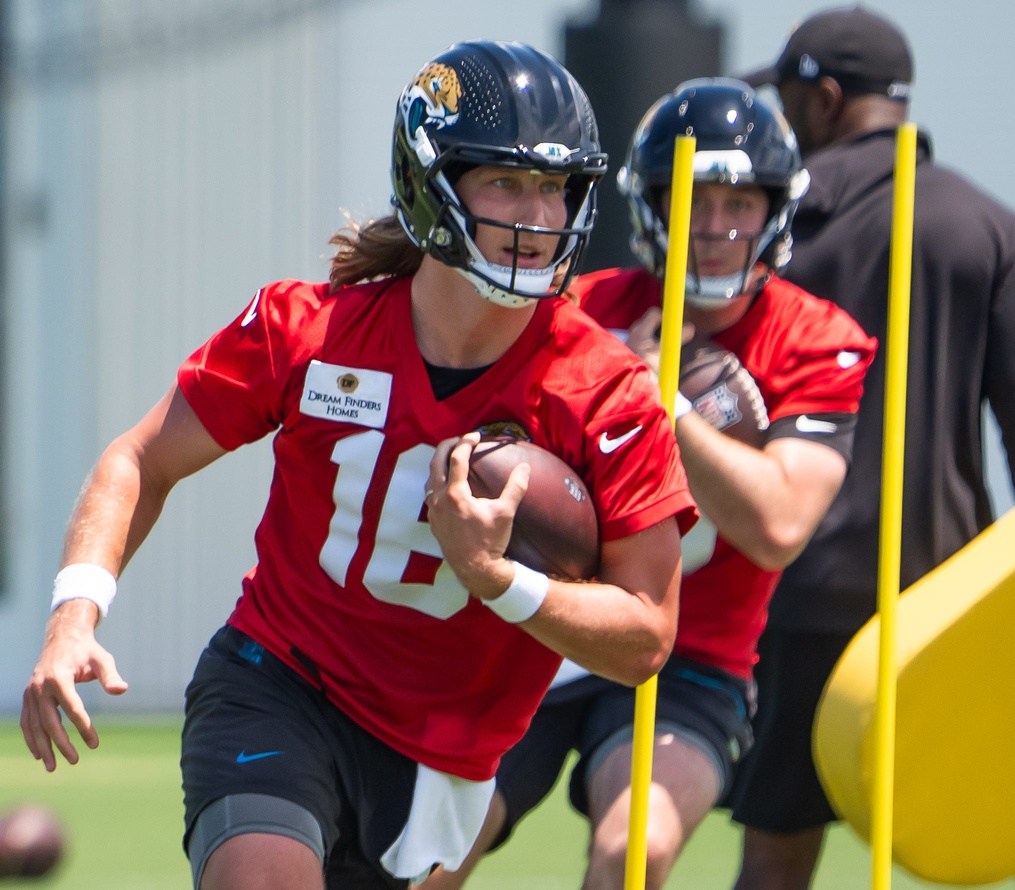
QB9. Trevor Lawrence, Jacksonville Jaguars (ADP QB18)
So here’s where I’d say my deviations from the consensus rankings begin to jump considerably. Lots of folks would have Baker Mayfield or Brock Purdy in this spot, but those are two quarterbacks I’m actively fading this year. We’ll get to, most urgently, TLaw, but here’s why Baker isn’t in this spot for me: When you factor in his volatile turnover‑worthy play rate and the fact that no quarterback since 1988 has repeated a touchdown conversion rate like Baker’s (more on that later) in consecutive seasons, his mid‑QB1 ADP flat-out looks overly optimistic.
Trevor Lawrence’s QB18 consensus feels wildly off-base once you dig into both the metrics and the context surrounding his 2025 outlook. He’s coming off three straight seasons of posting a big‑time throw rate above 6.0 % (peaking at 7.1 % in 2024—fourth‑most among QBs) and leading all qualifiers with a 12.3 yards per attempt ADOT in 2024, yet the market treats him like a middling mid‑round dart throw. That ignores the fact his down‑field accuracy (69.4 % intermediate accurate throws) actually leapt into the top quartile once you adjust for targeted depth, and he out‑performed expectation by nearly 20 yards per game over his final stretch before injury.
His 76.8 overall PFF grade—driven by a 73.8 passing mark and a 75.6 rushing grade—underscores balanced growth, and his 1.8 big‑time throws per game rank fourth among all QBs even as his turnover‑worthy throw rate remains elevated.
Even his weakest flashes last year came when the Jaguars’ porous offensive line gave him a 22.8 % pressure‑to‑sack rate (well above the 17 % league average), yet he still managed a 46.3 % pressured completion rate—tied for best among QBs with 70+ pressure snaps. He dropped back 284 times for 2,045 yards, 11 TDs and just seven INTs, yet scrambled 92 times for 361 yards and six rushing scores—proof his legs can carry fantasy value even if the pass rush closes in.
Pro Football Focus ranked Jacksonville among the offseason’s most-improved lines, noting Patrick Mekari’s upside despite a down year, Robert Hainsey’s potential rebound, and Wyatt Milum’s exceptional college run‑ and pass‑blocking grades (97th percentile) with zero sacks allowed over three seasons. All signs point to a drastically upgraded front five aiming to finally give Trevor Lawrence the protection—and run support—he’s lacked.
Offensively, he’ll benefit from Liam Coen’s system that emphasizes shorter, rhythm‑building throws (Lawrence ranked 48th in deep accuracy last year but 6th in short‑to‑intermediate accuracy), meaning far fewer of those 30 % deep misses and far more high‑percentage looks. Add in rookie Tetairoa McMillan alongside Brian Thomas Jr. and Travis Hunter—one of the league’s best young duos in contested catch rate—and you’ve got the exact ingredients to push Lawrence back into top‑10 territory. His post‑injury surge—20.2 fantasy points per game over five healthy outings—hints at what he can sustain with a stronger line and playbook.
At QB18 price he’s basically free upside. You’re banking on a truly elite young arm with a year of experience, a new OC whose track record says he’ll simplify reads and boost completion rates, plus the most dangerous receiving duo of his career. Discounting him that heavily feels less contrarian strategy and more like leaving obvious value on the board. He’s firmly my QB9.
QB10. Dak Prescott, Dallas Cowboys (ADP QB12)
Dak Prescott’s 2024 flop masked far more than just a nagging hamstring tear. He came into camp riding the high of an MVP‑caliber 2023, only to post career lows in completion rate (64.7%), yards per attempt (6.9) and QBR (45.3) before a Week 9 hamstring injury sidelined him. Even before the injury, his analytics cratered—he finished in the bottom five in EPA per play, Success Rate and on‑target percentage—while Dallas’ weak No. 2 receiver group (Jake Ferguson, Jalen Tolbert, Brandin Cooks) and a makeshift O‑line left him under siege (21.5% pressure‑to‑sack rate).
Now, though, I’m bullish on a Phoenix‑style rebirth. Jerry Jones mortgaged mid‑round draft capital to acquire George Pickens, a 6’3″ vertical threat averaging 16.3 yards per catch, instantly giving Prescott a true No. 2 to stretch defenses while CeeDee Lamb commands the short and intermediate zones. Jake Ferguson remains a reliable chain‑mover, and rookie guard Tyler Booker joins an O‑line that should rebound after ranking in the bottom five in pass‑block win rate.
On the coaching front, Brian Schottenheimer’s promotion to head coach and Clayton Adams’s arrival as OC promises a more aggressive, “create violence” mentality—think more motion, more play‑action, more clean pockets. Schottenheimer’s wrinkles helped Russ Wilson rack up touchdown passes in Denver, and Adams has pledged to lean into Prescott’s skill set rather than hedge his instincts.
At age 32, Prescott still posted 21.9 fantasy points per game in 2024, despite that ugliness and a shortened season. His career averages include multiple seasons of six rushing TDs; a modest rebound on designed runs (27.6 carries projected) could plug in an extra 3–5 fantasy points weekly. His 2.0 big‑time throws per game over the last two seasons rank second among QBs, so with healthier weapons and a stabilized staff, I expect that touchdown upside to return.
Prescott’s ADP sliding to QB18 feels overplayed. I see a mid‑QB1 floor with top‑8 ceiling, thanks to a Lamb‑Pickens duo, a rejuvenated O‑line, and a new play‑caller unafraid to let his QB throw more often. In a year where every point matters, I’m happy to bet on Dak at a discount.
QB11. Drake Maye, New England Patriots (ADP QB16)
I believe Drake Maye represents a true breakout candidate at QB11, and I’m excited by his blend of youth, mobility, and a suddenly upgraded supporting cast. Last season, Maye showed consistent growth once he took over the Patriots’ offense, throwing between 200 and 290 yards in most starts and finding the end zone in every game he played at least 30% of snaps. Over those outings he scrambled 3.5 times per game for 31.3 yards—the second‑best marks among all quarterbacks—which gave me confidence in his weekly floor even when passing volume stalled. He finished as a top‑10 fantasy quarterback in his first two starts and remained inside QB12–QB18 for the rest of his starts, proving he can sustain fantasy production even in tough matchups.
I’m particularly intrigued by his rushing upside and scheme fit. Maye generated 407 scramble yards and two rushing scores despite a porous offensive line. Now, under Josh McDaniels, I expect his average depth of target (7.4 yards last year) to climb closer to league average, giving him more downfield opportunities. McDaniels’ teams in Las Vegas and New England consistently ranked among the NFL’s highest in target depth, so Maye should see cleaner reads and more chunk‑play looks.
I also love the veteran additions around him, both off the field and on. Stefon Diggs tore his ACL last October and projects as Maye’s Week 1 WR1. Should Diggs not be ready then, he should be in action by October, and he was on pace for 1,000 yards in 2024 before the injury, so he’ll be a trusted security blanket on broken‑down plays. Rookie additions Kyle Williams, the wideout from Wazzou, posted a 73.3 percent success rate vs. man coverage (75th percentile) and dominated quick‑game routes—83.9 percent on outs, 86.8 percent on slants—demonstrating true YAC upside, while RB TreVeyon Henderson totaled 850 receiving yards and six TDs at Ohio State, ran a 4.43 forty, and graded 96.3 on gap runs versus 85.7 on zone. McDaniels will have the flexibility to dial up play‑action and quick throws to build Maye’s confidence. The rookie offensive line—anchored by Will Campbell and Jared Wilson—should finally provide Maye with the protection he lacked in Year 1, completing a rookie-to-sophomore bump that makes him a top‑12 upside target at QB11.
I’m locking in Maye as my QB11 because he checks every box: a second‑year leap, elite scramble metrics, plus a revamped offense that now mirrors his strengths. Yes, he showed some inconsistency in intermediate throws and footwork, but that’s fixable with coaching, and it’s a small price to pay for a quarterback with genuine dual‑threat upside. In best‑ball or season‑long formats, I’m thrilled to grab Maye at his current cost—he carries top‑12 upside and a reliable rushing floor that few other mid‑round QBs can match.
QB12. Justin Fields, New York Jets (ADP QB14)
Right. There’s now the matter of Justin Fields’ toe. I’m hanging onto him at my overall QB12 until we get more concrete news, but I want to note that prior to the training camp injury, he was my QB8. I’m moving him to around QB12 after that dislocated toe in his right foot this week. Even though the Jets say it’s “day to day” and not serious enough to sideline him long, toes can linger—especially for a dual‑threat quarterback whose entire game depends on planting, pushing off, and scrambling. Training camp injuries often flare up once contact ramps back up in full pads, and Fields has already dealt with groin, rib, shoulder, hip, and thumb issues earlier in his career. With a first‑time offensive coordinator in Tanner Engstrand and Tyrod Taylor waiting in the wings, any hiccup in practice reps or preseason rhythm could set him back in mastering the new scheme. I’d rather wait on him until he’s clearly healthy than pay a QB8 price for a risk‑laden QB12.
Otherwise, the sky is the limit when he’s healthy:
Justin Fields checks every box for a top‑eight fantasy quarterback in 2025. Thrust into duty last year in Pittsburgh before he was just as suddenly thrust out, he handled 161 drop‑backs for 1,106 yards, five scores and just one interception, but it was his legs that moved the needle. He ranked first in the NFL with 3.4 scrambles per game, piling up 110 yards on the ground and five rushing touchdowns, and earned a 76.8 rushing grade (17th among QBs). Overall, PFF pegged him at 71.5—solidly above average.
When healthy, Fields delivers rare consistency: he averaged 19.1 fantasy points per start in 2024—good for seventh among all quarterbacks—and has produced at least 19 PPG in every season he’s started, including 20.7 PPG in 2022 and 21.2 PPG through the first five weeks of 2023. His rushing profile is elite not just in volume but in efficiency—over the past three seasons he leads the league in scrambles per game, scramble yards per game (31.3), and scramble‑touchdown rate—locking in a weekly floor that few signal‑callers can match.
Justin Fields’s value hinges on more than just his rushing floor—it’s his volume and efficiency in high-leverage situations that lock him into a top‑eight projection when healthy. He led all quarterbacks with 11 carries inside the 10‑yard line through Week 6, turning 45% of those goal‑line attempts into touchdowns and averaging 0.83 rushing scores per game. Under pressure he still completed 58.3% of his throws with a turnover‑worthy play rate near the league’s best, and he forced 10 missed tackles on scrambles—tied for third among QBs—while averaging 7.5 yards per designed carry. Even in a conservative passing scheme, his 67.2% play‑action completion rate for 8.3 yards per attempt hints at breakout upside as the Jets lean more on his strengths. That blend of per‑snap efficiency, rushing upside, and proven scoring profile cements Fields as a clear top‑eight fantasy quarterback target across an entire season, no matter which team he’s on.
And it’s the Jets, now. With New York’s revamped offensive line shoring up his blind side and a rising corps of playmakers around him—Garrett Wilson hauled in 82 catches for 889 yards and seven touchdowns last season, ranking fourth on the Jets in targets (135) and seventh in yards per route run (2.10)—Fields isn’t just set to sustain his numbers; he’s poised to elevate them. Rookie Arian Smith adds deep‑threat speed (16.8 yards per catch in college), and tight end Mason Taylor graded out in the top half among rookies in catch rate. Fields may well have more security‑blanket options than he’s ever had.
When healthy.
Notes, honorable mentions, early shifts
A note on Baker Mayfield (ADP QB7) and Brock Purdy (ADP QB10)
I’m steering clear of both Brock Purdy and Baker Mayfield despite their mid‑QB1 ADPs, and here’s why:
Brock Purdy’s profile screams regression risk. He operated in one of the NFL’s most efficient offenses in 2023, but 2024 exposed cracks when injuries struck his supporting cast. His yards per attempt dipped from 8.9 to 7.9, his TD rate ballooned to an unsustainable 7.2% (41 scores on 570 attempts), and his interception total spiked to 16. Without Christian McCaffrey, Brandon Aiyuk, and Trent Williams available for large chunks of the season, his rushing floor cratered (just 378 yards and three rush TDs), sending his PFF rushing grade from 90.6 to 46.8. According to Late Round Fantasy Football’s J.J. Zachariason, historical QB data shows that guys with 7%+ TD rates almost never match it again—drafting Purdy as a mid‑range QB1 feels like riding the high of a one‑off.
Baker Mayfield’s ceiling is equally tethered to touchdown regression. He turned in a 7.2% TD rate last year—no quarterback since 1988 has repeated that in back‑to‑back seasons—and lacks any rushing upside to buffer a passing dip. His turnover‑worthy play rate sits near the league’s worst, and his completion metrics under pressure remain volatile. In short, Mayfield’s ADP is banking on another outlier TD conversion year, with zero insurance if it falls back to earth—an unnecessary gamble at QB1 prices. The Buccaneers’ returning weapons will help, and Emeka Egbuka is just sick, but fantasy managers should be demanding a bigger discount on a player (players, including Purdy) whose ceiling is tethered to touchdown regression and whose rushing floor offers scant insurance against passing variance.
A note on J.J. McCarthy (ADP QB20)
I had J.J. McCarthy as my QB11 until we got news that Justin Jefferson is nursing a mild hamstring strain. I’ve moved him to my QB16, and still wanted to provide my write-up here for him.
The industry’s QB20 tag for McCarthy—even behind Mayfield, Purdy and Prescott—is a glaring market inefficiency. He managed pressure better than any first-round QB in 2024 (responsible for just 11.5 percent of pressures), and his 72.3 percent completion rate while scrambling proves his poise under duress. While McCarthy will inevitably have rookie hiccups—missed reads, occasional turnover-worthy throws—his ceiling exceeds that of most second-year QBs. Expect weekly fantasy outputs in the 18–22 point range, with upside 25+ point performances when the play-action game clicks. His ADP around QB20 (superflex) or late rounds (one-QB) vastly underestimates his upside.
He steps into Kevin O’Connell’s system, which vaulted Kirk Cousins to QB8 and Sam Darnold to QB9, fully healthy behind a revamped line featuring Darrisaw, O’Neill, Kelly and Fries. At Michigan he threw with 72.3 percent accuracy—even while scrambling—then managed pressure better than any first‑round QB in 2024, responsible for just 11.5 percent of pressures (seventh‑best NFL equivalent). His mobility translated to 9.0 yards per scramble and he excelled attacking the intermediate middle (85.7 percent catchable on 14 targets). Meanwhile, Mayfield’s upside is capped by a lack of rushing floor, Purdy faces fresh injury questions and Prescott offers only 1.2 rushing PPG. McCarthy’s rare blend of elite pressure management, zone‑splitting accuracy and scramble upside—paired with Jefferson, Addison and Hockenson—gives him a weekly floor and top‑12 ceiling, making his QB20 tag a glaring market inefficiency.
Jefferson’s mild hamstring strain and Addison’s suspension do, however, alter McCarthy’s ceiling considerably. Until we get more news that Jefferson is full-go, we need to discount McCarthy, despite his upside, to just outside the QB1 range. With, however, every intention of moving him back into the top-12 should we hear good news from Vikings training camp.
Brief scouting report
Since we’re all a bit unfamiliar with J.J.’s play, what with the year-removed bit:
McCarthy excelled at Michigan in anticipation and accuracy, particularly attacking the intermediate-middle of the field—where he completed 85.7 percent of targets (12/14) and outpaced every other zone in catchable-throw rate. His deep-left accuracy sat at 42.9 percent (6/14), deep-middle at 68.2 percent (15/22) and deep-right at 30.0 percent (3/10), reflecting both arm strength and room for growth on outside-field shots. On pinpoint throws—where elite NFL QBs live—he hit just 40.9 percent down the middle but boasted 78.1 percent on short patterns (57/73) and a perfect 100 percent behind the line, demonstrating true precision when asked for touch passes.
McCarthy isn’t just a cagey drop-back passer—he can run. At Michigan he averaged 9.0 yards per scramble (20 scrambles for 180 yards) and 7.1 yards per designed run, showing the kind of dual-threat foundation that lifts QB floors by 3-5 fantasy points weekly. In Minnesota’s system, his legs will keep drives alive and unlock highlight plays, giving him a high weekly floor even if his passing game cools. His legs were crucial during Michigan’s National Title run in 2023-24.
McCarthy profiles as a top-12–top-15 fantasy option with QB1 weeks sprinkled throughout, making him an ideal high-upside QB2 in superflex formats or a value WR3-RB4 pivot in shallower one-QB drafts. I slot him at QB11, believing he’ll deliver at worst a fringe-QB1 season—capturing McCarthy before he ascends into the mid-QB1 range could be a league-winning move.