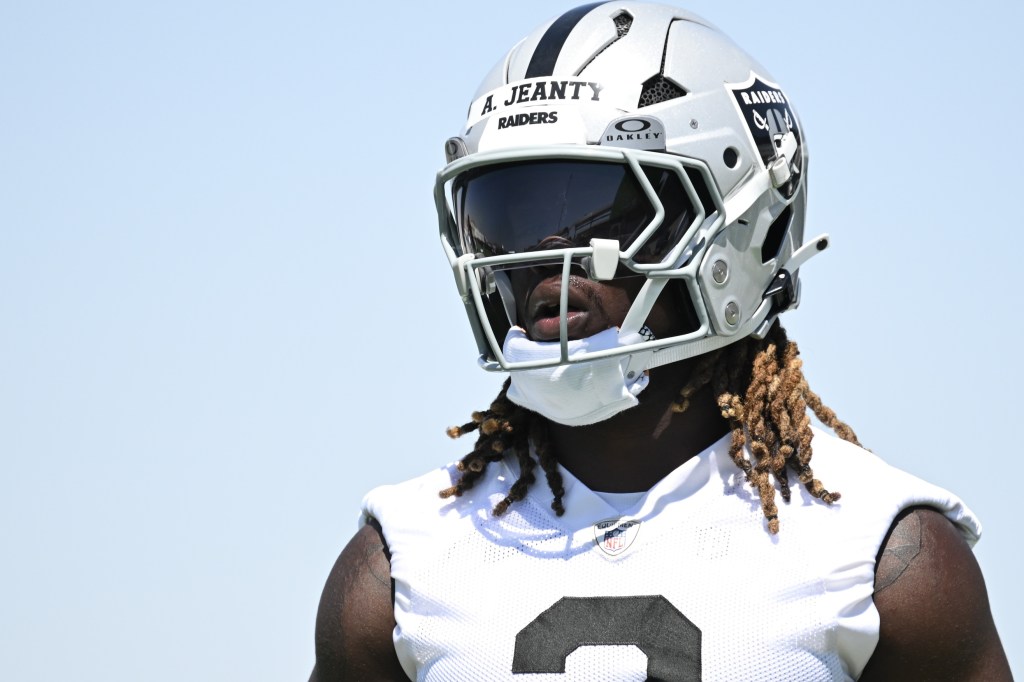
Time to sweep all of last year’s hay out of the stables. Dust the rafters, clean the beams, spruce the veneer on the wooden gates. New year, new horse-minded, dawg-hearted feature backs to carry the rock for not just NFL depth charts, but our glorious fantasy football teams. Newcomers like Ashton Jeanty, Omarion Hampton, and R.J. Harvey have marquee expectations in year one based on their situations and collegiate pedigrees. 2024’s surprises—Bucky Irving, Chase Brown, James Cook—seem to be getting some fade from the industry in terms of where to rank running backs this year. Below, I’ve got season-long fantasy football running back rankings for the 2025 season for RBs one-through-twenty-five. Full player profiles, strategy, etc.
If you’re interested in my other rankings, which do inform some of my departures from the industry consensus (FantasyPros) rankings here, check them out:
- Fantasy Football 2025 QB ranks: Top twelve quarterbacks to target on draft day
- Fantasy football 2025 WR ranks: Top 30 wide receivers to target on draft day
Top 25 running backs for Fantasy Football 2025
Dan Johnson’s 2025 RB ranks: at a glance
RB1. Bijan Robinson, Atlanta Falcons (ADP RB1)
RB2. Jahmyr Gibbs, Detroit Lions (RB2)
RB3. Ashton Jeanty, Las Vegas Raiders (RB5)
RB4. Saquon Barkley, Philadelphia Eagles (RB3)
RB5. Derrick Henry, Baltimore Ravens (RB7)
RB6. Bucky Irving, Tampa Bay Buccaneers (RB10)
RB7. Josh Jacobs, Green Bay Packers (RB8)
RB8. Christian McCaffrey, San Francisco 49ers (RB4)
RB9. Kyren Williams, Los Angeles Rams (RB12)
RB10. Chase Brown, Cincinnati Bengals (RB9)
RB11. Breece Hall, New York Jets (RB13)
RB12. Jonathan Taylor, Indianapolis Colts (RB11)
RB13. James Cook, Buffalo Bills (RB16)
RB14. De’Von Achane, Miami Dolphins (RB6)
RB15. Kenneth Walker III, Seattle Seahawks (RB15)
RB16. James Conner, Arizona Cardinals (RB18)
RB17. Omarion Hampton, Los Angeles Chargers (RB19)
RB18. Alvin Kamara, New Orleans Saints (RB14)
RB19. Chuba Hubbard, Carolina Panthers (RB17)
RB20. D’Andre Swift, Chicago Bears (RB21)
RB21. Aaron Jones, Minnesota Vikings (RB23)
RB22. Travis Etienne, Jacksonville Jaguars (RB31)
RB23. Treyveon Henderson, New England Patriots (RB25)
RB24. R.J. Harvey, Denver Broncos (RB24)
RB25. Tyrone Tracy, New York Giants (RB32)
Strategy at a glance
I built my RB rankings around three core pillars: high-upside youth, target share in PPR, and downside protection via workload certainty. First, I leaned heavily on young backs who combine three-down workload with explosive playmaking—the Bijan Robinson, Jahmyr Gibbs, Ashton Jeanty tier—because I believe the league is moving faster and favoring dynamic runners who can catch and block. By drafting rookies and sophomores early, I’m banking on that rookie‑to‑sophomore “breakout bump history (think 2024 Robinson and Gibbs parallels), and capturing generational talent before the consensus prices in their upside.
Second, I prioritized pass-game involvement. In PPR formats, 70+ targets can swing a season—so, like the industry, I elevated backs in high-PPR offenses (Gibbs in Detroit, Barkley with a loaded Eagles receiving group, Jeanty in Vegas’s emerging pass-friendly scheme). That explains why I slot Breece Hall and James Cook slightly higher than pure runners; their third-down snaps and target volume create a weekly floor that pure bell‑cows can’t match when the run game stalls.
Third, I protected against injury and committee volatility by valuing proven three-down workhorses over committee splits. That’s why Derrick Henry stays inside my top five, despite age, and why I push veterans like Josh Jacobs ahead of unproven handcuffs. Even with Christian McCaffrey’s elite ceiling, I’m wary of the 49ers’ injury track record and committee potential, so he drops a few slots. As with De’Von Achane, on whom I’m markedly lower than the industry.
It’s a winning strategy. It balances ceiling (youth and burst), reliability (target floor and snap share), and risk mitigation (workload certainty). Unlike consensus boards that binge on name recognition or recency bias, my approach zeroes in on underlying usage trends, offensive context, and PPR mechanics—giving me an edge in building a rock‑solid, high‑upside backfield.
Top 25 running backs: player profiles & analyses
RB1. Bijan Robinson, Atlanta Falcons (ADP RB1)
The Falcons’ second-year phenom is poised for a massive 2025 after an outstanding 2024. Bijan built on a strong rookie season and erupted for 1,456 rushing yards and 14 touchdowns, averaging 4.8 yards per carry. He also caught 61 passes for 431 yards, finishing with 1,887 scrimmage yards, behind only Barkley, Henry, and Gibbs. Robinson’s film and metrics back up the production: he earned a 92.1 PFF rushing grade in 2024 (second among RBs) and an 82.2 receiving grade (eighth), showcasing elite dual-threat ability. He was also Pro Football Focus’ most valuable RB by WAR last season.
Despite Atlanta’s inconsistent QB play, Robinson was a weekly fantasy force—logging 10 games of 20+ PPR points and 10 top-10 weekly finishes. At just 23 years old, he’s still ascending in a run-focused Falcons scheme. With improved quarterback stability (Atlanta is optimistic in young QB Michael Penix Jr. developing), Bijan could reach even greater heights. He offers a rare blend of power, vision, and receiving chops. Draft him confidently as fantasy football’s premier asset this season.
RB2. Jahmyr Gibbs, Detroit Lions (ADP RB2)
Coming off a breakout sophomore campaign, Gibbs looks like a PPR superstar in the making. In 2024, he dominated defenses for a league-high 2,283 yards from scrimmage in his first year as Detroit’s lead back. That included 1,412 rushing yards (fifth in NFL) at an excellent 5.65 yards per carry (third), plus significant receiving contributions. Gibbs led all running backs with 20 total touchdowns last season—his nose for the end zone is elite, as evidenced by him scoring in 13 different games (tied for the NFL lead). He’s a true dual threat, already amassing 104 receptions over his first two seasons and averaging over 50 catches per year.
At just 23, Gibbs is extremely explosive in space and runs behind one of the league’s best offensive lines. With OC Ben Johnson departing and a new coordinator (John Morton) in Detroit, there’s some concern about scheme changes. Don’t overthink it. Gibbs’ talent and role are secure; the Lions even deployed him and Montgomery together at times to maximize Gibbs’ mismatches as a receiver. With his elite speed and open-field agility, plus goal-line usage, Gibbs carries top-three fantasy upside. He’s a PPR dynamo who should be drafted with confidence as a high-end RB1.
RB3. Ashton Jeanty, Oakland Raiders (ADP RB5)
The highest-ranked rookie on my board, Jeanty lands at RB3 for me—a notable jump above industry consensus (FantasyPros ADP RB5). The Raiders spent the sixth overall pick on Jeanty, and new head coach Pete Carroll has indicated the team views him as a feature back. Jeanty brings an exceptional pass-catching skill set that should translate immediately. In offseason workouts Carroll praised that “Ashton…caught the ball really well”, signaling Jeanty’s role on all three downs. In his final year at Boise State, he was a true dual threat (2,601 rushing yards—second-most in FBS history—with plenty of receiving usage). Las Vegas boasts a high-octane offense and plans to utilize Jeanty much like Carroll did with Marshawn Lynch in Seattle—but with more targets out of the backfield.
Let’s lean into the Carroll/Lynch dynamic of a bruising, multi-dimensional back. In 2024 he posted a PFF College Elusive Rating of 95.4—among the nation’s best—while breaking or evading a tackler on 42% of his carries. His 4.5 yards after contact per attempt and 12.8% breakaway run rate (carries of 15+ yards) underline true big‑play upside. Even more impressive, Jeanty ran 78% of his snaps as a receiver, hauling in 35 passes with a 90.1 PFF receiving grade and an 82% catchable‑throw rate—elite hands for any back. Those metrics, combined with his vision, burst, and balanced skill set, justify slotting him ahead of established veterans and make Jeanty a locked‑in RB3 for 2025. It justifies, at least, taking the chance. And I will.
Admittedly, ranking a rookie as the RB3 is aggressive, but here’s why I’m higher than the consensus. First, Jeanty’s situation is ideal: he steps into a lead role on Day 1 behind a solid offensive line, without a proven veteran blocking his path (the Raiders’ other backs are change-of-pace types). Second, his receiving chops give him a PPR edge over more one-dimensional runners. While FantasyPros ADP has him around the eighth overall pick (RB5) in drafts, I’m comfortable bumping him above even Saquon Barkley. Barkley’s injury history and expected workload management in Philly contrast with Jeanty’s fresh legs and every-down opportunity. Barring a committee approach (Carroll did hint at mixing in others to “take the load off” the rookie early), Jeanty has top‑three RB upside, especially in PPR where his target share could be elite for a running back.
RB4. Saquon Barkley, Philadelphia Eagles (ADP RB3)
Barkley is the reigning NFL Offensive Player of the Year after a monster 2024 season in which he led the league with 2,005 rushing yards on 345 carries and scored 13 rushing TDs. Moving to Philadelphia unlocked his big-play ability behind an elite offensive line, as he ripped off seven runs of 40+ yards and powered the Eagles to a Super Bowl title. Given that résumé, it’s no surprise Barkley is the consensus RB1 in early drafts. However, for PPR purposes I’ve slid him to RB4. Why? Two reasons: receptions and risk. Barkley’s passing-game usage was modest in Philly—the Eagles utilized him more as a pure rusher (he had fewer than 40 receptions in 2024). Jalen Hurts tends to target backs less than a typical QB, and Philadelphia often deploys a committee on passing downs. That caps Barkley’s PPR ceiling relative to the uber-targeted backs that dominate leagues in this era.
The other factor is durability and workload management. Barkley amassed well over 350 touches including playoffs last year, and the Eagles have incentive to keep him fresh (they extended him through 2028). At 28 years old with a history of lower-body injuries, it’s plausible Philadelphia spells him more often with other backs, especially on third downs or in blowouts. I still expect elite production—Barkley’s rushing efficiency and touchdown upside remain among the best—but a slight decline in volume or targets knocks him just below my top three. In short, while the industry still views Barkley as the RB1, I’m a bit more cautious in PPR and rank him RB4, preferring the younger, heavier-utilized receivers at the position, and Jeanty’s lightning-in-a-bottle potential.
RB5. Derrick Henry, Baltimore Ravens (ADP RB7)
The King keeps his crown—even at 31, Henry is running wild. In 2024, now with Baltimore, he delivered another vintage performance: 1,921 rushing yards (second in NFL) and a league-leading 16 rushing TDs. Those monster stats made him the RB4 in PPR scoring in 2024, despite his minimal receiving usage. Henry’s formula is well-known: unrivaled volume and tackle-breaking power. He has led the NFL in carries in four of the last seven seasons and logged 325 carries last year. Baltimore’s run-heavy scheme fit him perfectly—they leaned on Henry to grind down defenses, especially with Lamar Jackson battling injuries.
At his age, the workload is a double-edged sword: we have to consider wear and tear, yet Henry continues to look like an outlier. His burst and long speed haven’t fallen off much, and his conditioning is legendary. The Ravens also plan to utilize him more in the screen game this year, which could goose his PPR value slightly. Fantasy managers often underrate Henry in PPR drafts, but as he showed by finishing top-five last year, touchdowns and yardage trump receptions when they’re this high.
Banking on another near-2,000 yard season is aggressive, but Henry has made a career of beating expectations. Baltimore’s offense should be more balanced in 2025 (healthier passing game), which might cap Henry’s absolute ceiling. However, his goal-line role is untouchable and this offense will present plenty of red-zone chances. Draft Henry as a rock-solid RB1—yes, he’s a unicorn at 31, but until we see him slow down, 1,500+ yards and 12+ TD is the baseline. Just pair him with some pass-catching backs to smooth out the occasional low-reception weeks.
RB6. Bucky Irving, Tampa Bay Buccaneers (ADP RB10)
The secret’s out: “Bucky” Irving looks like a future star. As a rookie fourth-round pick in 2024, Irving exceeded all expectations, amassing 1,514 yards from scrimmage and 8 total touchdowns. He rushed 207 times for 1,122 yards (5.4 YPC) and 8 TD and added 47 receptions for 392 yards as a receiver. That performance made him the first Bucs rookie to rush for 1,000+ yards since Doug Martin—and earned Irving the title of highest-graded rookie (of any position) in the NFL per PFF. Irving runs with a unique blend of vision and elusiveness. Despite being 5’10”, 195 lbs, he runs between the tackles fearlessly and consistently makes the first man miss—so much so that Coach Todd Bowles said Bucky has a skill you can’t teach after Irving led the team in explosive runs and forced missed tackles.
One advanced stat underscores his PPR upside: Irving was targeted on 24.5% of his routes run, fourth-highest among all NFL RBs. In other words, when he’s in on passing downs, Tampa looks to get him the ball. With Baker Mayfield often checking down behind a shaky O-line, Irving’s reception totals could climb even higher in 2025. The Buccaneers still have Rachaad White on the roster, but by year’s end Irving had clearly become the lead back, starting three games and even winning NFC Offensive Player of the Week with a 185-yard outing. Heading into this season, Irving has a secure role as Tampa’s top runner and an ascending role in the passing game.
His arrow is pointing straight up—I view Irving as a strong RB1 in PPR. Draft him confidently as a surefire RB1 wherever he’s falling; he’s a player I’m higher on than consensus (some industry ranks have him outside the top 10, but PFF graded him as a top-five back overall in 2024). Bet on the talent here. I am.
RB7. Josh Jacobs, Green Bay Packers (ADP RB8)
After leading the NFL in rushing in 2022, he had a solid but less spectacular 2023 and then saw his Raiders contract situation play out tumultuously. Now in Green Bay, Jacobs remains the helm of a backfield that should give him plenty of opportunities once more.
In 2024 with Green Bay, Jacobs still put up 1,329 rushing yards and 15 rushing TD on 236 carries – good for 4.6 yards per carry and a Pro Bowl nod. Notably, he was on fire down the stretch: from Weeks 11-18, Jacobs was the fantasy RB3 overall, carrying many managers through the playoffs. He also chipped in as a receiver (around 35 catches for 300+ yards, though no one else really hogged targets in that offense).
The Packers still lack a proven No. 1 wide receiver, and with Jordan Love/Sean Clifford at QB, Matt LaFleur will likely lean on the ground game and short passes. Jacobs could feasibly approach 300 touches again.
One question: how much of his 2024 production was due to Green Bay feeding him out of necessity? His efficiency was just okay (4.4 YPC career), but volume propelled him. At 27, Jacobs is in his prime and runs with a physical style and excellent contact balance. Green Bay’s offensive line is decent, and their scheme (outside zone) fits Jacobs’ one-cut running, as we saw last year. Year Two in that offense should be fantastic for Jacobs’ potential.
Also, keep in mind Jacobs has 50+ targets in each of the last two seasons—he’s an underrated PPR contributor. I rank him as a mid-tier RB1/RB2. While he might not have the ceiling of the younger explosive backs, he offers a high floor. Double-digit touchdowns are very plausible given Green Bay’s tendency to run in the red zone. I wouldn’t trust Jordan Love there, either.
If you can grab Jacobs as your RB2 after getting an elite RB or WR in Round 1, that’s a winning start to your draft. But I think he’s just a tipple undervalued, and a great bet for another wild year.
RB8. Christian McCaffrey, San Francisco 49ers (ADP RB4)
McCaffrey’s ranking here reflects the risk-reward calculus that fantasy drafters know all too well. On talent and track record, CMC is arguably the best PPR running back in the game—a true unicorn who can put up 1,000 rushing and 1,000 receiving yards in the same year. However, 2024 was a nightmare: McCaffrey played only four games due to injuries, suffering a high-ankle sprain and later a shoulder issue that landed him on IR. In those four games, he actually looked like his usual self (averaging ~20 PPR points), but availability was the issue. It tends to be with CMC.
Now 29 years old with a lengthy injury history, McCaffrey carries more risk than the younger backs ranked above. But that risk could be your reward. It sounds outlandish to call the consensus number-one pick of past years a value play, but early ADP in 2025 has CMC falling to the late second round because of injury concerns. If he slips and you can grab him as an RB2, that’s potential league-winning upside. Even here, at RB10, where I’ve ranked him—I acknowledge I might be wildly low. The industry certainly believes I am.
I encourage McCaffrey cynics like myself to remember: in 2023 he played a full season and finished as the RB2 overall. In Kyle Shanahan’s 49ers offense, McCaffrey is the engine when healthy—he’ll get 15 carries and around five targets a game, behind a strong O-line and amid plenty of scoring chances. San Francisco has invested in beefing up their training staff and adjusting practice regimens to keep stars like McCaffrey and Kittle/Aiyuk healthy (a storyline to watch). If it pays off, CMC could easily return to 90+ receptions, ~1,700 total yards, and 15 TD form.
Those are league-winning numbers. Of course, you have to bake in the injury downside—maybe you draft an extra RB or two for insurance. I think the pendulum might have swung too far: if you’re scared off McCaffrey, it sounds like you’re about to get a great value.
CMC remains a high-end RB1 whenever he’s on the field. Just be sure you have depth behind him, and enjoy the ride if he stays upright. I’m just not interested in that route this year. Ranking McCaffrey RB8 means I’m likely passing on him altogether. If I lose the championship this year because of that—yeah, it’ll hurt. What else can I say?
RB9. Kyren Williams, Los Angeles Rams (ADP RB12)
Kyren Williams has quietly become a model of consistency. The former Notre Dame standout took over the Rams’ backfield in 2023 and hasn’t looked back, posting back-to-back seasons of 1,100+ rushing yards. In 2024, Williams improved on his Pro Bowl 2023 numbers, rushing for 1,299 yards (seventh in NFL) and 14 touchdowns. Those 14 rushing TD were a career high and gave him 26 rushing scores over the last two seasons—only guys like Henry and Barkley have more in that span. At 5’9”, 194 lbs, Williams doesn’t wow you with size or speed, but he is extremely efficient and versatile. Sean McVay trusts him in pass protection and as a receiver, so he rarely leaves the field (he had around 35 receptions in 2024).
The Rams did draft a running back each of the last two years—Blake Corum last year, and, a favorite sleeper of mine this year, Jarquez Hunter—yet Williams remains the lead dog. Why? Because he excels in McVay’s zone scheme with his vision and one-cut running. He’s patient letting blocks develop, then bursts through for steady gains—evidenced by 27 runs of 10+ yards last year. LA’s offense is in a mini-rebuild with Stafford aging and new receivers stepping up, but that might only increase reliance on the ground game. Williams is entering the final year of his rookie deal and is motivated (the team has even begun extension talks after his continued success).
In PPR, Williams is more steady than spectacular—he’ll catch two or three balls a game, and rarely have the huge 50-yard receiving play. But the consistent rushing production (he’s logged 15+ carries in the majority of his games the past two years) and nose for the goal line make him a high-floor RB2. Think of him in the mold of a Mark Ingram in his prime: not flashy, but piling up stats week after week. I see little reason for a drop-off, barring injury. Draft Williams as a safe RB1 and enjoy the quiet-yet-significant fantasy points he racks up every week.
Let’s also note: Matthew Stafford is dealing with a back injury in training camp, so that’ll be something to watch when it comes to pass/run play splits in the early season.
RB10. Chase Brown, Cincinnati Bengals (RB9)
One of our favorite sleeper-turned-starter stories from 2024, Chase Brown is now firmly on the RB2 radar. The industry sees him as firmly on the RB1 radar, and I don’t entirely disagree.
As a fifth-round rookie in 2023, Brown played sparingly behind Joe Mixon, but by 2024 the Bengals handed him a much larger role, and he delivered. Brown registered 990 rushing yards on 229 carries (4.3 YPC) and added nearly 360 receiving yards, for 1,350 scrimmage yards in 2024. He found the end zone seven times on the ground and five times through the air (12 total TD in 28 career games so far). Impressively, Brown had a streak of five straight games with 100+ scrimmage yards in Weeks 11–16, proving he could be a consistent producer and not just a one-week wonder. That late-season surge coincided with Mixon’s departure and the Bengals embracing Brown’s explosiveness. In terms of play style, Brown (5’9”, 205) is a compact back with great burst—he ran a 4.43 forty and it shows on the field with how quickly he hits the hole. He also has soft hands, honed by catching passes from Joe Burrow (who loves checking down when teams drop deep to cover Chase and Higgins).
The context is excellent: Cincinnati’s offense is top-tier, providing ample red-zone opportunities and light fronts (since defenses fear the pass). Brown’s only competition for touches right now is aging Mixon (now in Houston) and maybe a mid-round rookie, but it looks like the Bengals trust Brown as the guy. I expect him to enter 2025 as the clear starting RB on a potential Super Bowl contender. That’s a recipe for fantasy success. The only reason he’s not higher is a modest ceiling—Cincy will remain pass-first (Burrow, Chase, Higgins will dominate the game plan), so Brown might rarely see 20+ carries. But if he settles in around 15 carries and three-to-four targets per game, he’ll comfortably provide fringe-RB1 value. I think he’s here to stay as a reliable fantasy starter, and am happy to draft right on par with consensus, given the upside if the Bengals offense truly finds its wheels. It already has its wings.
RB11. Breece Hall, New York Jets (ADP RB13)
This whole birdshot of Achane, Taylor, Hall, and Walker III was particularly tough to rank, I think. I say that because as I’m writing up Breece Hall as my RB12, I realize how firmly I believe in his upside as opposed to both Taylor and Achane. I at least might want to invest in him more. This is right around the same tier where the industry has Cook, and I’ve basically just swapped him for Achane. And, as my RB12, Breece Hall rounds out my RB1s for 2025.
Hall’s 2024 season can only be described as a sophomore slump, but savvy fantasy managers should view it as a buying opportunity. Let’s remember the talent here: as a rookie in 2022, Hall was averaging 5.8 YPC and on pace for 1,500+ scrimmage yards before an ACL tear halted his campaign. He flashed true home-run ability (including a 62-yard TD vs. Denver that year). Fast forward to 2024: Hall returned to play 16 games, but clearly wasn’t 100% early in the year and the Jets’ offense was a mess. He finished with 876 rushing yards (4.2 YPC) and five touchdowns, adding around 300 receiving yards. Those numbers were underwhelming relative to expectations, hence the disappointing label. However, there were encouraging signs. As the season progressed, Hall’s explosiveness returned—in fact, he led all running backs in runs of 20+ yards from Week 10 onward.
Also, the Jets made big changes this offseason: they brought in a new offensive coordinator, Tanner Engstrand, known for creative run schemes, and they pulled off a shocker trade for QB Justin Fields. Fields’ presence at QB could be a boon for Hall—mobile QBs often open rushing lanes and boost RB efficiency. Reports out of Jets camp indicate that Engstrand is installing more gap-blocking runs, which suit Hall’s style (Hall averaged 5.6 YPC on gap-scheme runs vs 3.7 on zone last year). With another year separating him from the ACL injury, I expect Hall to regain his elite burst consistently. Don’t forget, this was a player many had as a top-five dynasty RB a year ago. We’re bullish on a career year in 2025—think 1,200+ rushing yards and double-digit total TD potential. The Jets’ offensive line is a concern, but improvements are expected with health and draft investments.
Hall is a classic post-hype sleeper: I rank him as a low-end RB1 with top-10 upside. Draft him in the late second or third round and you could be very happy—just make sure to monitor his health in preseason to ensure he’s fully explosive again.
RB12. Jonathan Taylor, Indianapolis Colts (ADP RB11)
Taylor is a fascinating case study of talent vs. situation. He’s only a couple of years removed from a 1,811-yard, 20-TD season in 2021 that won countless fantasy championships. But since then, it’s been bumpy. At times, it’s been bad. Like how 2023—when he was the consensus number-one fantasy pick—was injury-marred (ankle surgery) and deflating.
2024 saw a bounce-back of sorts: Taylor averaged 17.5 PPR points per game in 2024, which is excellent—but he missed five games and the Colts’ offense was anemic, limiting his overall output. He finished with around 1,100 rushing yards and eight touchdowns in 12 games. Now the Colts are in year two of the Anthony Richardson experiment at QB, and the offense still really concerns analysts. This one, at least.
Stacked boxes and inconsistent QB play could again cap Taylor’s efficiency. That said, great running backs often transcend their environment, and JT has that kind of talent. He’s still just 26, with rare combination of size (5’11”, 225) and speed (4.39). When he finds a crease, few can house-call like Taylor (he’s had five career TD runs of 40+ yards). In the passing game, Taylor isn’t Alvin Kamara, but he’s capable—expect maybe 30 catches if Richardson checks down more. A healthy Taylor behind a solid O-line (Quenton Nelson and company) should produce.
The key question: will Indy generate enough scoring drives to give Taylor ample TD chances? Last year, he often had to grind for yards with little support. We saw flashes of his old self though, including multiple 20+ fantasy point outings. Given the uncertainty, I rank Taylor as a high-end RB2 with RB1 upside. He’s the classic great-player,-bad-team dilemma. Though wouldn’t it just be fitting if the Colts had it more together than we thought as an offensive personnel unit?
If you draft him, you might want to also target a safer RB later for balance. But don’t be shocked if Taylor silences the doubters—it wasn’t long ago he was considered the top dynasty egg in the game. If Richardson and the new coaching staff can field even an average offense, Taylor could easily surpass this ranking. He’s a potential bargain if he slides to Round 3, which he legitimately might. People aren’t eager to draft Colts of any kind in 2025.
RB13. De’Von Achane, Miami Dolphins (ADP RB6)
Achane is the kind of player who can win a week on one play. The Dolphins’ speedster enters Year 3 as one of the most electrifying backs in football. In 2024, Miami unleashed Achane more, and he responded by racking up over 1,300 scrimmage yards and 10 total TDs. His per-touch efficiency is absurd—as a rookie in 2023 he averaged 8.8 yards per touch, and while that regressed slightly with more volume, he’s still a threat to house it anytime he gets a crease. Coach Mike McDaniel’s creative offense maximizes Achane’s strengths: he’s constantly put in motion, lined up as a receiver, and fed on outside runs that let him use his world-class speed. In PPR formats, Achane’s value is boosted by his receiving profile. He caught 45 passes last year and should see similar or more this season.
There is a always a note of caution with a player of Achane’s physical profile: he is small (5’9”, 188) compared to backs who can burst through interior up-front defenders, and Miami doesn’t want to overwork him between the tackles. The Dolphins added Jaylen Wright and Alexander Mattison to the backfield, indicating they plan a committee approach once more. In standard leagues that might ding Achane’s value, but in PPR, his role is secure—he’ll get all the high-value touches (targets, designed space plays) even if someone else takes occasional inside carries.
And it’s important that we remember that as we get deeper into these rankings and encounter committee-minded backfields—all touches, no matter the distribution of snap share, are not created equal. Last year, even with a timeshare, Achane finished as a PPR RB1 in points per game. As long as he stays healthy, a line of ~800 rushing yards, ~500 receiving, and ~eight TDs is very achievable, and that puts him firmly in the RB1/2 borderline with upside for more.
I think the industry is just overvaluing per-touch efficiency with this particular player profile, and I’m not convinced Achane will be an RB1 effective on a week-to-week basis in late November and December come fantasy playoffs time. As with CMC, I’ll likely be passing on him this year. But—I know, I know. There’s just as much a shot this is his best year yet. Can he really get more efficient, though? Or have we just seen a ceiling I don’t think he’ll reach this season?
RB14. James Cook, Buffalo Bills (ADP RB16)
Note: I had James Cook as my RB8, and this analysis reads as such. I’ve moved him down to 13 while we await his contract news.
James Cook took a major step forward in 2024, transforming the Bills’ backfield from a weakness into a strength. He posted his first 1,000-yard rushing season, finishing with 1,009 rushing yards on 207 carries (4.9 YPC) and 16 total touchdowns. That TD explosion was unexpected—Cook had been used sparingly at the goal line prior to last year, but he capitalized on Buffalo’s high-powered offense to score often (he had a stretch with a TD in five straight games). In PPR formats, Cook’s value comes from his all-purpose role: he had nine games with 15+ fantasy points in 2024, the most by a Bills RB since LeSean McCoy in 2016, highlighting how frequently he was involved.
As the brother of Dalvin, James shares some traits: excellent acceleration, smooth receiving skills, and the ability to make sharp cuts at full speed. Entering 2025, Cook is firmly Buffalo’s lead back. The Bills also, as ever, will have Josh Allen and Ty Johnson and perhaps even Ray Davis stealing some goal-line scores. That said, Cook’s proficiency in the passing game ensures he’ll find other ways to rack up points. When he’s on the field with Allen, good things happen—defenses key on the QB, giving Cook light boxes to run against and open space on checkdowns.
One area to watch: Cook has had ball security issues at times (a couple of fumbles last year). But Buffalo has shown confidence in him, and he rewarded it. Looking ahead, Cook profiles as a mid-range RB2 with upside. If he retains the goal-line role and stays efficient, he could push for top-12 status again. Even if his TD rate regresses, his roughly ~15 touches per game (including three-to-four targets) in an elite offense give him a sturdy floor. He’s a great fit for a Zero-RB or Hero-RB draft strategy, as you can often get him in the middle rounds and enjoy near-RB1 production on many weeks. He’s currently the RB16 by ADP, and I’ve got him a full eight slots ahead of that.
RB15. Kenneth Walker III, Seattle Seahawks (RB15)
Walker’s 2024 was a tale of two halves: when on the field, he was productive, but injuries cut his season short to 11 games. He tallied 573 rushing yards and seven touchdowns in those games, leading the Seahawks in rushing for the third straight year. Seattle’s backfield did become more crowded with Zach Charbonnet in the mix, but Walker remained the clear starter when healthy. Looking ahead, the key for Walker is staying on the field. He’s dealt with some nagging injuries that have cost him games over 2022–24. When he’s active, Seattle trusts him. One underrated development: Walker expanded his role in the passing game last year. After barely being targeted on third downs as a rookie, he actually led all running backs with 15 receptions in two-minute drill situations in 2024, indicating that the Seahawks kept him in during hurry-up offense. He only turned those into 92 yards, but it’s promising usage for PPR.
We know what Walker brings as a runner—exceptional burst through the hole and a finishing gear that produced several long TD runs in 2022. He had nine rushing TDs as a rookie and seven last year despite the shortened season. If he plays, he scores. Seattle’s offense might shift slightly with the arrival of Najee Harris, but that’s more of a footnote than a threat to Walker’s workload. By mid-season, Walker could flourish again. I see Walker as an RB2 with upside. Injury risk keeps him out of the surefire RB1 tier, but when he’s right, he can give you RB1 weeks. Draft him as a mid-range RB2 and hope for 16+ games; if you get that, he’ll likely outperform this ranking all the way to the championship.
I do think, however, as always, Charbonnet is a reality Walker III owners need to deal with. Circumstantially, this might be a committee-minded backfield that has every reason to distribute high-value touches equally between its 1A and 1B. I’ve ever been skeptical of fantasy managers getting a full feature-back season out of Walker III in Seattle, and I remain so. Which means, to be entirely transparent: by ranking him right along with the industry, I’m taking the coward’s way out. I find Walker one of fantasy’s hardest players to rank this season.
RB16. James Conner, Arizona Cardinals (RB18)
Year after year, Conner defies the odds and produces. And yet each year the fantasy market is lukewarm. I was bullish on Conner last year, called him a league-winner. And I’m back to tell you: we’re not writing off Conner in 2025! Granted, I had him as my RB13 in preseason last year, and I could see him finishing with better seasons than Walker, Taylor, Achane, if things break right. But RB17 is my confident slot for Conner this year, and that’s only just above his consensus rankings.
He’s coming off back-to-back 1,000-yard rushing seasons, and last year he totaled 1,094 rushing yards (4.6 YPC) and eight rushing TDs, plus 47 catches for 414 yards and another TD receiving. That’s over 1,500 scrimmage yards and niene scores—fantastic output for an “old” back on a bad team. In fact, Conner turned 30 this year, but he’s showing minimal signs of slowing. Pro Football Focus gave him an 90.4 overall grade for 2024, fifth-best among RBs, reflecting his hard-nosed, efficient running and dependable pass-catching. The Cardinals offense has been a mess, cycling through QBs and lacking weapons, yet Conner has been the one constant. Of course, with age comes the fear of cliff. There’s a chance he’s going to fall off at some point, many will say. They’ll point to his injuries. Fade his ADP. But, I ask you, what other back in this tier is not without meltdown risk?
Conner is still the unquestioned starter in Arizona; the team didn’t draft an RB early, and only has change-of-pace guys behind him. New Cardinals OC Drew Petzing loves to establish the run and utilize RBs in the short passing game, which suits Conner’s skill set. We expect Arizona to lean on Conner heavily again, especially while they break in a new quarterback. He might not be the flashiest pick, but volume is king in fantasy, and Conner will get it. A small warning: the Cardinals offense has struggled to score many TDs in the Kyler Murray era, capping Conner’s elite upside. But he’s been their goal-line hammer, so he’ll still likely lead the team in touchdowns. Murray will for sure steal some, and I project the passing game to improve, anyways.
I view Conner as a so-steady-it’s-sexy RB2. If you start RB-heavy, he’s an ideal third RB— who can fill in or start based on matchups. Or if you go Zero-RB, snagging Conner in the middle rounds could pay huge dividends. Eventually the wheels might come off. But you said that last year, didn’t you? All he did was post another 1k rushing campaign. Until proven otherwise, Conner keeps bruising along, and so should you with him in your lineup. Deliberately and joyously.
RB18. Omarion Hampton, Los Angeles Chargers (RB19)
A new face in the fantasy landscape, Hampton is a rookie power back who could make an immediate impact with the Chargers. Drafted in the third round out of UNC, Hampton brings an impressive résumé: in 2023 at North Carolina, he rumbled for 1,504 yards and 15 rushing TDs, finishing second in the ACC in rushing. At 6’0” and 220 lbs, Hampton runs with a bruising style – he’s not afraid of contact and often requires multiple defenders to bring him down. What stood out in college was his ability to handle a heavy load (he often had 20-25 carries in UNC’s run-heavy game plans) and his knack for breaking big plays despite his bigger frame. He had several runs of 50+ yards in his college career, showing deceptive speed in the open field. Now in Los Angeles, Hampton steps into a backfield in transition. The Chargers let J.K. Dobbins and Gus Edwards walk in free agency, but they brought in Najee Harris via trade from Pittsburgh. However, Harris’ Fourth-of-July injury is exactly the sort of first impression an every-down contributor does not want to make, especially to a Chargers team that fizzled out so pyrotechnically last year. See what I did?
So, enter Hampton as my RB 16. It’s likely Hampton will form a 1-2 punch with someone, where Hampton takes on the primary runner role and the 1B handles pass-protection and some short yardage. That could limit Hampton’s PPR upside slightly—he wasn’t a huge pass-catcher at UNC—but he’s capable if asked. In fact, scouts noted Hampton has reliable hands and could develop into a three-down back. For now, I project him as the Chargers’ definite starter on first and second downs, including at the goal line. Harris’ injury introduces more third-down work than Hampton might have otherwise gotten out of the gate.
Justin Herbert’s offense will provide scoring opportunities, and the Bolts’ offensive line is solid. Hampton could realistically post a 1,100 yard, ~eight TD rookie season if things break right. That would make him a solid RB2. I have him ranked here as a high-end RB2 with upside. He’ll probably be a bit TD-dependent early on, but volume should be decent, and the offensive line is killer. If he impresses in camp and secures a bigger share, don’t bump him up your draft board. I’m drafting and ranking Hampton at his ceiling.
Keep an eye on any camp buzz—the Chargers haven’t had a feature back like him since perhaps Melvin Gordon, and I expect Greg Roman to ride the rookie more than expected if he shows well.
RB19. Alvin Kamara, New Orleans Saints (RB14)
There’s a feeling in the fantasy community that Kamara is “past his prime,” but he might still have some magic left. In 2024, despite turning 29, Kamara quietly put up 950 rushing yards and six rushing TDs in 14 games. More importantly for PPR, he remained heavily involved as a receiver: 68 receptions for 543 yards and 2 TD. That made it six straight seasons where Kamara caught 65+ balls. That’s incredible consistency that keeps his fantasy floor high. The Saints offense last year was disjointed, yet Kamara “kept plugging along,” recording his second consecutive 1,000+ yard rushing season. His bruising running style didn’t prevent him from catching passes; while the offense has plenty of weapons, Kamara still contributed steadily in the short passing game. Yes, the efficiency is down from his peak, and he doesn’t break as many long runs. But New Orleans still trusts him as their offensive centerpiece.
With utter uncertainty and HC Dennis Allen determined to make a playoff push, expect the Saints to lean on their proven veteran. Last year, folks thought there’d be a changing of the guard. Seeing as, of course, the Saints did draft Kendre Miller and signed Jamaal Williams, but Miller is now in Kansas City and Williams is coming off an injury-riddled year.
In fact, the Saints did not acquire any new RB to threaten Kamara’s role—a strong vote of confidence. In PPR leagues, Kamara could be a steal at his current ADP. He was a top-10 RB in total points as recently as 2022, and even last year when people thought he was disappointing, he finished around RB15 in PPR. We rank him similarly here, just a touch lower, with potential to exceed that if the touchdowns tick back up.
One caution: as ever, durability. Kamara has taken a lot of hits over the years and missed three games last year. But he’s far from washed. He still looks explosive in camp, and teammates rave that his work ethic hasn’t changed. If you see Kamara sitting there in the mid rounds, don’t pass up the opportunity. Getting a guy who could catch 70 passes and score double-digit TDs that late is rare. He may not be a sexy pick anymore, but sometimes those are the picks that win leagues.
RB. Chuba Hubbard, Carolina Panthers (RB17)
Two years later, Hubbard emerged from the shadow of Christian McCaffrey to stake his claim as Carolina’s prototypical do-all lead back. He did some great Danny Woodhead impressions, too.
In 2024, he played all 17 games (starting 12) and logged 1,195 rushing yards on 250 carries (4.78 YPC) with 10 touchdowns—by far career highs across the board. He also chipped in 233 receiving yards on 39 catches. Those raw numbers placed him 11th in the NFL in rushing yards. The key was a bit of improvement for second-year QB Bryce Young and a bit of a protection scheme shift to unlocking Hubbard’s downhill running style. They emphasized a zone scheme that Hubbard excelled in, showing improved power and tackle-breaking. In fact, Hubbard’s yards after contact per carry jumped to 3.5 in 2024 from 2.9 in 2023, indicating he was running harder and finishing runs.
For fantasy, Hubbard was a bit boom-bust (the Panthers offense was inconsistent), but he notched six games of 20+ PPR points in 2024, showing a ceiling when game script cooperated. Looking to 2025, Carolina’s offense is expected to take a step forward. They have a young QB with an ascending ceiling in Bryce Young. The front office bolstered the O-line, which should mean more sustained drives. New OC Brad Idzik and new running game coordinator Bernie Parmalee helm the film rooms Hubbard spends his time in, and Dave Canales & co. brought him on with Hubbard’s style in mind.
Hubbard is slated to remain the lead back; the Panthers didn’t make any high-profile RB additions. They did bring in former Cowboys RB Rico Dowdle to be a change-of-pace/breather-spell option, but Hubbard should still see the majority of early-down and goal-line work. He’s a sturdy back who now stands at age 26 in his prime. We rank Hubbard as a mid-RB2 who has RB1 potential week-to-week if Carolina’s offense surprises.
He might fly under the radar in drafts because he’s not a flashy name, but production is production. With another ~250 touches on deck and a hopeful uptick in overall team efficiency, Hubbard could push for 1,300 total yards and 8-10 scores again. He’s a great depth pick who could end up an every-week starter if the Panthers offense indeed “gets better” as many anticipate.
RB20. D’Andre Swift, Chicago Bears (RB21)
Swift’s career renaissance continued in 2024 after his move to Chicago. Handed the Bears’ starting job, Swift played all 17 games and logged 959 rushing yards and six TDs, plus 42 receptions for 386 yards (though, surprisingly, zero receiving TDs). The raw stats might not jump off the page (3.8 YPC), but context matters: Chicago’s offensive line struggled at times, and Caleb Williams’ inability to move the ball downfield siphoned off a lot of rushing opportunities. Still, Swift proved he could be a durable workhorse, which was a big question mark from his Detroit days.
Now under a new coaching regime, we’re bullish on Swift’s role. Notably, the Bears did not bring in any major competition for him despite media speculation. Through 2024’s Week 6 in Pittsburgh he had already looked explosive, ranking high in scrambles and designed rushing yards. As a result, Chicago’s offense installed a conservatively tailored game plan that maximized his strengths and still got him 26.5 touches per game. For PPR, Swift’s value has always come from the passing game. It’s encouraging that both Ben Johnson and Getsy were parts of the Lions staff in 2022 when Swift saw 70 targets. He knows how Swift can be utilized as a receiving weapon.
With Chicago’s offense shifting to a new scheme entirely, we anticipate more checkdowns and designed RB passes to keep the chains moving. Swift excels in space; he’s extremely dangerous on angle routes and screens. Remember, this is a player who once had a 78-catch season and has multiple 50+ catch seasons. If Chicago’s coaches lean into that, Swift could easily snag 60-70 balls this year.
The main knock on him has been consistency. He’ll have a 25-point week followed by a quiet one. Some of that is usage-dependent, and we’re optimistic Chicago will feed him steadily. At 26, Swift is in his prime and motivated (contract year coming). I slot him firmly as a low-end RB2. If he can recapture some of the efficiency from early 2024 and maintain volume, he could outperform this rank.
Just keep an eye on the Bears’ offensive line and Caleb’s development in the new offense; those will ultimately dictate how often Swift finds the end zone. Still, getting an every-down back who has already shown 70-catch upside at this point in rankings is something to appreciate.
RB21. Aaron Jones, Minnesota Vikings (RB23)
Jones reminded everyone in 2024 that he’s still got juice in those legs. In his first year with Minnesota, he posted career-highs in carries (255) and rushing yards (1,138), averaging a solid 4.5 YPC. It was his first 1,000+ yard rushing season since 2019, and he did it at age 30. He also scored 5 rushing touchdowns, his most since 2020, and added 49 receptions. Jones has always been a dependable receiver. That’s why we love him.
The Vikings were smart in how they deployed him, often rotating series with Ty Chandler to keep Jones fresh. As a result, he still looks explosive entering his ninth season, according to local reports. When you watch the tape, Jones’ burst through the hole and ability to cut on a dime remain evident. Looking to 2025, he’ll likely maintain a similar role for the Vikings. They parted ways with Alexander Mattison, but acquired former 49ers RB Jordan Mason to mix in. And news out of training camp is that they’ll be using Mason quite a bit in this committee. Not all touches are equal! Jones should still get ~15 touches per game, especially with Kevin O’Connell committed to balancing the offense to support new QB J.J. McCarthy.
One thing to note: Jones might not primary goal-line back anymore; the Vikings often used a bigger back in those situations, which limited Jones to five TDs despite plenty of red-zone trips. That caps his upside compared to his Green Bay days, when he’d score 15+ TD in a season. But, as a PPR asset, Jones is steady. He runs a lot of routes and has great chemistry with the checkdown game. In fact, his 39.4% rate of carries gaining 5+ yards over the last five seasons is the best among all RBs, illustrating how consistently positive his plays are.
For fantasy, I see Jones as a high-floor flex/fringe RB2. The age and durability are concerns. At some point, per-touch decline will happen. We didn’t see it last year. Given how late you can draft him, Jones could be a savvy veteran pick who gives you RB2 weeks when matchups are right. Just temper expectations on touchdowns. A line around 900 rushing yards, 300 receiving, and maybe 5-6 total TD is reasonable. That would place him around this ranking. If he exceeds that, fantastic. Draft him as depth and use him when the Vikings project to be in close or leading game scripts.
RB22. Treyveon Henderson, New England Patriots (RB25)
Henderson is a name to remember. He’s a rookie fresh off a storied collegiate career who could shine in the Patriots’ new-look offense. Drafted early in the second round (38th overall) in 2025, Henderson was widely considered the best RB in the class after Ashton Jeanty and Omarion Hampton. At Ohio State, he displayed a dynamic skill set: in his final collegiate season, he ran for 1,577 yards (back-to-back 1,400+ yard seasons) and averaged 6.5 yards per carry, showing breakaway ability on any given touch. In fact, Henderson had 54 runs of 10+ yards in 2024, second in FBS only to Jeanty.
New England’s coaching staff has been raving about this kid. Coach Josh McDaniels (back in Foxborough as OC under new HC Mike Vrabel) is already scheming ways to get Henderson the ball in space. In training camp, Henderson has been heavily involved in passing drills, running routes from all over the formation. Reports from Patriots camp say he’s creating mismatches as a receiver, even getting open deep on wheel routes. Henderson himself said the Pats are giving him opportunities to flex out wide and showcase skills he didn’t get to in college.
This is music to fantasy managers’ ears, because it hints at a significant PPR role. Think back to how the Patriots used Shane Vereen or James White in the past. Henderson has the potential to be that, and more, because he can also run between the tackles with authority.
Of course, there’s Rhamondre Stevenson to consider – but notably, New England traded Stevenson on draft day, clearing the path for Henderson. He’ll likely share a touch or two with veteran Antonio Gibson, but the Patriots drafted Henderson to be a playmaker. And with rookie QB Drake Maye expected to take that rookie-to-sophomore elite jump, checkdowns to the RB could be plentiful as Maye adjusts to NFL defenses.
I project Henderson to be the key cog in this new fold to the Patriots’ offense. Perhaps ~12 carries and 3-5 targets per game from the jump. If so, he can deliver flex value right away, with upside to become a RB2 as the season progresses.
I rank him here as an exciting flex option. He has drawn comps to Alvin Kamara for his slashing style and receiving ability. The Patriots haven’t had a true home-run threat at RB in a while; Henderson might be that guy. If you draft him, have some patience early on as he settles into the pro game. But the payoff could be a second-half surge.
Keep a particularly close eye on how New England uses him in preseason; it might tip off just how big a role he’s going to have. I’m betting it’s significant.
RB23. Travis Etienne, Jacksonville Jaguars (RB31)
Etienne is one of the trickiest players to rank this year. On one hand, he has sky-high upside in a Jaguars offense that should be ascending under Trevor Lawrence, who readers know I’m very high on this season.
On the other hand, 2024 was a lost season for Etienne, plagued by injuries and inconsistency. After finishing as a top-five fantasy RB in 2023, Etienne saw his production plummet: he managed only 558 rushing yards (3.7 YPC) and two touchdowns in 15 games, before eventually being shut down with a foot injury. He simply wasn’t himself, lacking the same explosiveness we saw pre-injury. The bright side: he’s still just 26 and now presumably healthy after an offseason of recovery. If he can get back to his 2023 form, watch out. That year he piled up 1,125 rushing yards, 316 receiving yards, and 12 total TD (including a league-high five runs of 40+ yards). Etienne’s calling card is his acceleration and long speed . Few can turn a small crease into a 50-yard gain like he can.
We also know he has chemistry with Lawrence (college teammates at Clemson), especially on screen passes and option routes. Why, then, is he ranked down here? It’s partly a hedge against last year’s injuries and partly the competition factor. Jacksonville drafted Tank Bigsby in 2024, and while Bigsby didn’t set the world on fire, he siphoned some goal-line carries. The Jags also signed veteran Kareem Hunt who might mix in on passing downs.
There’s a chance Jacksonville employs a more committee approach to keep Etienne fresh. But make no mistake, the team is expecting a bounce-back. Coaches have said they want to get Etienne more touches in space and recapture that 2023 magic. Also, with Travis Hunter and Brian Thomas, Jr. stretching defenses, boxes should be light(er!) for Etienne to exploit.
He’s a fringe RB2/RB3. If you’ve built a stable RB group, taking Etienne as a swing-for-the-fences pick could pay huge dividends. He has the talent to outperform this ranking by a lot. Swift could very well rejoin the top-12 conversation if all goes well. But I want to see it again before fully buying in. Watch his preseason burst and cutting ability; that will tell a big story. Don’t buy into the Tank Bigsby first-team touches news just yet; remember, all touches are not created equally.
Draft Etienne if he falls to a reasonable spot, and cross your fingers for a return to form. He’s a classic boom/bust pick, but one that could tilt a league if he booms.
RB24. R.J. Harvey, Denver Broncos (RB24)
Harvey is another rookie to monitor in a big way, as he could seize a significant role in Denver sooner than later. The Broncos snagged Harvey in the second round (60th overall) of the 2025 draft, making him the highest-drafted UCF running back ever. GM George Paton and coach Sean Payton were thrilled to get him, even saying Harvey was “the best RB in the draft not named Jeanty.”
So what do they see in him? For starters, production: Harvey posted back-to-back 1,400+ rushing yard seasons at UCF, including 1,577 yards in 2024 (6.5 YPC) with 14 TDs, and caught ~20 passes each year. He’s a compact 5’9”, 208 lbs with a low center of gravity and superb balance. Broncos scouts raved about his vision and instincts – in fact, Payton thought Harvey had the best vision in the entire draft class. This showed up in his big-play stats: Harvey had 54 runs of 10+ yards and 32 runs of 15+ yards last season, showcasing his ability to consistently generate chunk plays. He’s also plenty fast (4.44 in the 40) and highly explosive in agility drills. Now consider Denver’s situation: they traded away Javonte Williams, leaving the depth chart wide open.
There’s a clear path for Harvey to be the Broncos’ featured back from Day 1. Early camp reports say he’s picking up the playbook quickly and has flashed in OTA sessions with his burst. Payton is an old-school coach who, when he finds “his guy” at RB, will feed him in a workhorse capacity. Of course, as a rookie, Harvey will have to earn full trust. Things like pass protection could affect how many snaps he plays initially. But talent-wise, he’s a three-down back who takes care of the ball (just two fumbles on ~500 college touches). The Broncos clearly believe in him. They gave him a contract quickly and are marketing him as a face of the new young core.
For fantasy, that means you shouldn’t be afraid to invest a late pick here. There’s legitimate 200+ carry, 40-catch rookie season potential. Think something like 1,100 total yards and 6-8 TD as a median projection. That lands him right around this RB25 range, with upside for more if he truly is, as some say, a the steal of the draft for Denver.
He well could be the steal of the fantasy drafts at RB24.
RB25. Tyrone Tracey, New York Giants (RB32)
Tracy might be one of the more exciting second-year names on this list, and I’m higher on him than most. Here’s why. The Giants spent a fifth-round pick on Tracy in 2024, converting him from a college wide receiver to a running back, and it turns out they found a hidden gem. As a rookie last year, Tyrone Tracy Jr. led the Giants’ backfield with 839 rushing yards on 192 carries (4.4 YPC) and five rushing TDs, while adding 38 catches for 284 yards and a receiving TD. On a per-game basis, he was steady, often in the 50–60 rush yards range with a few catches. Not league-winning, but solid for a rookie thrust into a starting role after Saquon Barkley’s departure.
The context was rough: New York’s offense was among the league’s worst, offensive line play was poor, and QB play was inconsistent. Yet Tracy made the most of every touch. One stat that leaps out is that he avoided negative-yardage runs on 93.2% of his carries, the third-best rate among backs with 170+ attempts. In plain terms, even behind a bad line, he rarely got hit in the backfield. It’s testament to his vision and decisiveness. At 5’11”, 210, Tracy has a low center of gravity and runs with good pad level, allowing him to slip through creases. His background as a receiver also shows: the Giants would motion him out to the slot and throw screens, and he looked natural catching the ball.
As we enter 2025, Tracy is in line to remain the Giants’ starting RB, and likely see even more work. The team did not re-sign Barkley and didn’t invest high draft capital in a replacement. They did draft rookie Cam Skattebo out of Arizona State, who is a fantastic sleeper in fantasy this year, and is making waves in training camp. Still, Skattebo will be change-of-pace. Tracey will be every-down. Skattebo, however, will certainly steal some high-value pass plays, which is why Tracey isn’t ranked higher for me.
We’re betting on Tracy continuing his upward trajectory. He has the trust of the coaching staff thanks to his ball security and reliability (only 1 fumble all last year). We’ve ranked him here because the ceiling might be capped by the Giants’ overall offensive limitations – defenses could key on him if the passing game remains weak. But if Daniel Jones rebounds or their new rookie QB injects some life, Tracy could flourish. We see a scrappy, do-it-all back who might not be flashy but will deliver honest production. I’m a big fan of Tracy’s. Call it a gut feel backed by his impressive conversion to RB. He’s the kind of player you draft late and suddenly find you have a starting RB on your hands. Don’t sleep on him.