It’s still only July yet, so when you haul open the hangar door to the aircraft bay, you’ll be letting beautiful summer sunshine in on all the sparkling turbines. Truth be told, what you see in the airfield here is my preseason opus. There’s nothing I love in football more than wide receiver play. The spectacular grabs. The grappling between secondary and wideout. The technicalities of a good route-run. Gloves that rise above all other helmets like a pyrotechnic pop of color; the chaos of the catch point. It’s all glorious. And, as with most years, the wide receiver position is only getting deeper for fantasy football. This top-30 list alone is comprised of at least 33% rookies and sophomores. We’ll address strategies for what wide receivers to draft, when to draft them, and break down analysis for each player’s profile. Fantasy Football 2025 wide receiver ranks are finally, mercifully, here. From rookies, to potential breakouts, to sleepers—I’ve got you covered below.
Really. It’s probably covered. 300-word analyses for each player. This thing’s a one-stop encyclopedia. We reach for the stars on every fantasy football piece here at DKN. And we’re never coming down.
If you’re interested in my other rankings, which do inform some of my departures from the industry consensus (FantasyPros) rankings here, check them out:
- Fantasy Football 2025 QB ranks: Top twelve quarterbacks to target on draft day
- Fantasy Football 2025 RB ranks: Top 25 running backs to target on draft day
Top 30 wide receivers for Fantasy Football 2025
Dan Johnson’s top 30 wide receivers: at a glance
WR1. Ja’Marr Chase, Cincinnati Bengals (ADP WR1)
WR2. Malik Nabers, New York Giants (WR5)
WR3. Justin Jefferson, Minnesota Vikings (WR2)
WR4. Ceedee Lamb, Dallas Cowboys (WR3)
WR5. Puka Nacua, Los Angeles Rams (WR4)
WR6. Amon-Ra St. Brown, Detroit Lions (WR6)
WR7. Garrett Wilson, New York Jets (WR13)
WR8. Drake London, Atlanta Falcons (WR9)
WR9. Brian Thomas Jr., Jacksonville Jaguars (WR8)
WR10. Nico Collins, Houston Texans (WR7)
WR11. A.J. Brown, Philadelphia Eagles (WR10)
WR12. Jaxon Smith-Njigba, Seattle Seahawks (WR12)
WR13. Marvin Harrison, Jr., Arizona Cardinals (WR20)
WR14. Ladd McConkey, Los Angeles Chargers (WR11)
WR15. Tyreek Hill, Miami Dolphins (WR13)
WR16. Mike Evans, Tampa Bay Buccaneers (WR17)
WR17. Davante Adams, Los Angeles Rams (WR16)
WR18. DJ Moore, Chicago Bears (WR19)
WR19. DeVonta Smith, Philadelphia Eagles (WR23)
WR20. Jaylen Waddle, Miami Dolphins (WR26)
WR21. Tee Higgins, Cincinnati Bengals (WR15)
WR22. Jameson Williams, Detroit Lions (WR30)
WR23. Calvin Ridley, Tennessee Titans
WR24. George Pickens, Dallas Cowboys (WR31)
WR25. Tetairoa McMillan, Carolina Panthers (WR27)
WR26. Courtland Sutton, Denver Broncos (WR22)
WR27. Terry McLaurin, Washington Commanders (WR20)
WR28. Emeka Egbuka, Tampa Bay Buccaneers (WR41)
WR29. Zay Flowers, Baltimore Ravens (WR34)
WR30. Ricky Pearsall, San Francisco 49ers (WR47)
WR31. Josh Downs, Indianapolis Colts (WR42) – [I miscalculated and gave you one extra player profile!]
Strategy at a glance
I always begin with opportunity metrics, efficiency indicators, and team-level context. Rather than leaning on reputation or perceived breakout potential, I leaned on measurable usage trends—specifically target share, route participation, and deployment within offensive schemes projected to support consistent passing volume.
The backbone of the ranking relies heavily on WOPR (Weighted Opportunity Rating), which synthesizes both target share and air yard share into a single, predictive measure of opportunity. When WOPR is supported by RACR (Receiver Air Conversion Ratio)—which measures how effectively a receiver turns air yards into actual yards—and YPRR (yards per route run), we begin to get a clear picture of both the role a player has and how efficiently they operate within that role. Players with strong marks in all three often land in the upper tiers of expected PPR output.
Where I deviate most from the consensus, in order of where I have them ranked: Malik Nabers, Garrett Wilson, Marvin Harrison Jr., Jaylen Waddle, Jameson Williams, , Ricky Pearsall, and Josh Downs. I’m stamping my name on these gentlemen this season within this list of thirty. Each represents the intersection of volume growth, deployment upside, and, by my estimation, mispriced breakout potential. These are wideouts with strong target-per-route trends, expanding roles, and quarterbacks capable of elevating efficiency. The mindset wasn’t chasing too much promise or pedigree—it was identifying where usage and talent are converging ahead of consensus. Every one of these players showed clear indicators—whether it was WOPR, YPRR, route expansion, or target consolidation—that point toward value exceeding ADP. These aren’t long shots. They’re signals we trust before the market adjusts.
Top 30 wide receivers: player profiles & analyses
WR1. Ja’Marr Chase, Cincinnati Bengals (WR1)
I’m confidently drafting Ja’Marr Chase as my top wideout in 2025. He’s a volume monster coming off a dominant 2024 where he led the NFL in catches, yards, and touchdowns, outscoring the next-best WR by 68 PPR points. At just 25, Chase is in his prime and operating as Joe Burrow’s clear alpha target. His role has actually expanded – Cincinnati shifted him into the slot more with a lower aDOT each year, feeding him high-percentage looks to maximize his touches. Even with a shorter target profile, Chase remained efficient (eighth in YPRR last season) and piled up a career-high 175 targets. In PPR, that blend of massive targets and solid efficiency is fantasy gold.
Chase’s advanced metrics underscore his elite usage. He’s commanding roughly 30% of Cincinnati’s targets and a huge chunk of air yards (a WOPR among league leaders), yet still converting opportunities at a strong clip (e.g. 2.52 RACR in 2024, indicating he turned air yards into real yards at an excellent rate). With the Bengals’ defense still suspect, shootouts force Burrow to keep peppering Chase. The result is a sky-high floor and week-winning ceiling. As the consensus 1.01 pick, I have zero hesitation. Chase’s unique combination of target share, yardage after catch ability, and red-zone use makes him a tier above the rest. He’s a set-and-forget WR1 who can singlehandedly carry a fantasy squad.
WR2. Mailk Nabers, New York Giants (WR5)
Malik Nabers is my favorite young breakout and firmly a top-three PPR WR for 2025. As a rookie last year, Nabers was sensational: he finished top-five in targets, receptions, and air yards, translating to an overall WR6 finish. He led the entire NFL in target share at about 32%—unheard of for a first-year player—and accounted for nearly half of the Giants’ passing offense. That elite usage yielded a monster WOPR and immediately put him in the conversation with Chase and Jefferson. Nabers’ advanced stats pop off the page: a high aDOT coupled with a strong RACR shows he can get open downfield and convert those air yards efficiently. He also earned PFF’s highest grade among LSU receivers in college, and that polish translated instantly.
I love Nabers’ situation in 2025. The Giants offense remains intact, and while Daniel Jones is gone, the QB room might actually be improved (Russell Wilson or, should things go south for Russ, rookie Jaxson Dart from Ole Miss). Nabers proved quarterback-proof last year, producing regardless of inconsistency under center. With a secure alpha role and potentially better QB play, his already excellent 17.5 PPR points per game could climb toward 20. At 22, his ceiling is sky-high.
Brian Daboll’s system has historically funneled volume to top receiving options, and with no true competition for alpha targets in New York, Nabers projects for immediate top-five target share. Whether it’s Russell Wilson or Jaxson Dart under center, both have shown the willingness—and necessity—to lock onto their primary read. Nabers is that read. With Justin Jefferson managing a hamstring strain, the safer volume profile belongs to Nabers. It might have regardless of the training camp injury for JJ. Nabers is a vertical separator with elite RAC (run after catch) ability, and when volume meets conversion at this level, that’s how league-winners are made.
Aggressive managers are taking him as the WR5 in drafts, and I’m taking him as the second one off the board. Nabers brings a rare combination of target hog volume, deep threat ability, and after-catch talent. He’s an elite, high-upside WR1 that I’m building around everywhere.
WR3. Justin Jefferson, Minnesota Vikings (WR2)
Justin Jefferson is my next pick, an elite technician who offers both consistency and explosion. He posted a commanding 28.1% target share last season (steady around 27% over two years) and increased his yards per route run to 2.61—fourth-best in the league. Even missing time, Jefferson delivered seven top-10 PPR weekly finishes in 2024. That high WOPR (weighted opportunity) – combining heavy targets and air yards—cements him as a volume king. At 26, Jefferson’s in his prime and has proven QB-proof so far. The Vikings did change QBs (JJ McCarthy steps in), but Kevin O’Connell’s pass-friendly scheme remains. Minnesota consistently ranks near the top in expected pass yards and TDs, so I expect Jefferson’s opportunities to remain elite.
Few can match Jefferson’s route mastery and separation skills. He’s a threat at all depths—evidenced by his strong success versus man and zone coverage—and his aDOT around 11 yards lets him rack up both chunk plays and chain-moving catches. His RACR is excellent, meaning he converts air yards into real yards with efficiency. In short, Jefferson is always open and the clear focal point of the offense. Even with a new quarterback, I’m not downgrading him. He’s a locked-in top-two WR who offers week-to-week stability (nearly a 27% target share floor) and overall WR1 upside. After Chase, Jefferson’s the safest high-ceiling pick in PPR drafts.
Having said that, data on preseason injuries lingering and affecting regular-season performance is more damning than ever. And so I bump Jefferson, whose mild hamstring strain will hold him out of camp for a bit, down to my WR3.
WR4. CeeDee Lamb (WR3)
I’m bullish on CeeDee Lamb as a top-three PPR receiver. Entering his age-26 season, Lamb has ascended into the elite with back-to-back 1,000+ yard campaigns and hefty catch totals. 2025 sets up even better: Dallas added George Pickens outside, which will keep defenses honest and free Lamb up in the slot where he thrives. Lamb already saw a heavy dose of slot routes last year, and that usage should persist. It’s a recipe for high reception volume and YAC opportunities. In 2024 he quietly posted strong efficiency (solid yards per route run) despite Dallas’s offense sputtering at times. With Dak Prescott healthy and the Cowboys likely in more shootouts (their new DC might struggle, creating pass-friendly scripts), Lamb’s target totals could tick up further.
From an advanced metrics angle, Lamb is in his prime with a robust target share around 25-27% and an aDOT in the intermediate range, balancing volume and big-play ability. His reliable hands and route craft make him Prescott’s go-to on key downs, and he’s improved against all coverages. The only knock has been drops, but that hasn’t stopped him from producing. Last year, he was targeted over 150 times and finished top-six in PPR scoring. I expect similar or better in 2025. Lamb’s current ADP is mid-first round (around sixth overall), which I find fair for a safe, high-upside WR1. I’m confident drafting Lamb as the centerpiece of my receiving corps.
WR5. Puka Nacua, Los Angeles Rams (WR4)
Puka Nacua exploded onto the scene and I’m keeping him in my top tier. Don’t let the Day 3 NFL draft pedigree fool you – Puka proved he’s a fantasy star. In an injury-shortened 2024, he averaged 18.8 PPR points (WR3 on a per-game basis) once he got healthy. His usage was outrageous: after Week 8, he saw at least eight targets every game. Puka’s underlying metrics are video-game level. He led the NFL with a 43% target share when on the field, the highest in the league. That’s an absurd WOPR, especially paired with a 4.03 yards per route run mark, indicating elite efficiency on that massive volume. In short, when Puka ran a route, he was hyper-productive and vacuumed up targets at a historic rate.
Heading into 2025, I expect continued dominance. The Rams offense is revamped and actually more dangerous. Matthew Stafford still quarterbacks, and now Puka is paired with Davante Adams – meaning defenses can’t key solely on Nacua. Some might worry Adams steals looks, but I see it differently: Adams will draw top coverage and Puka’s chemistry with Stafford is already proven. With over 200 vacated targets leaving and Stafford’s tendency to pepper his guys, there’s room for both to feast. Puka is a catch machine (on pace for ~100 catches last year) with an 8-12 yard aDOT that yields a steady PPR floor. He even showed spike-week ceilings, leading the league in target share during his healthy stretch. At around a late-first/early-second round ADP, he’s a steal. I’m treating Puka as a set-and-forget WR1 with top-three overall upside in PPR.
WR6. Amon-Ra St. Brown, Detroit Lions (WR6)
“The Sun God” Amon-Ra St. Brown is PPR royalty and a locked-in first-round value. All this guy does is vacuum targets and produce. In 2024 he notched his third straight 100+ reception, 1,000-yard season, showcasing unmatched consistency. His route running is silky and his understanding of zone coverage is elite, allowing him to always present a target to his QB. Last year, Amon-Ra refined his technique even more (adding head fakes and body control to shake defenders), and it showed in the metrics: he earned 0.28 targets per route (28%) and 2.53 yards per route run. Both are elite indicators of high usage and efficiency. His fantasy points per route was a strong 0.62, and he was even better against man coverage (0.73 FP/route, ninth-best). In other words, he gets open at will and converts targets into catches and yards at a top-tier rate.
At age 26, St. Brown is entering his prime in a potent Lions offense. Even with OC Ben Johnson gone, the scheme remains loaded with talent. Jared Goff trusts Amon-Ra implicitly on short and intermediate routes, reflected in a modest 8.2-yard aDOT that guarantees a high weekly catch count. He’s the engine of Detroit’s passing game, evidenced by a target share consistently around 27-30%. I expect the Lions to remain among the league’s top scoring teams, so scoring opportunities will be plenty. With his high reception volume, reliable role, and improving team context, Amon-Ra offers one of the safest floors in fantasy and still brings PPR ceiling (he quietly scored 12 TDs last year). He’s a set-and-forget WR1 who belongs in the top half of Round 1 in PPR drafts.
WR7. Garrett Wilson, New York Jets (WR13)
Garrett Wilson is a league-winner in waiting. The talent that made him a first-round NFL pick has started to manifest in fantasy, and 2025 looks like the year he jumps to true WR1 status. In 2024, with the Jets’ QB situation in flux, Wilson still managed a WR21 finish in PPR points per game. He commanded a hefty 26% target share and 35% of the air yards, one of only a few wideouts to hit those marks in consecutive seasons. That elite opportunity (WOPR off the charts) kept him producing despite modest efficiency (1.71 yards per route run). Now the Jets offense is undergoing a makeover: Aaron Rodgers is gone, but in comes a creative coaching staff and quarterback Justin Fields, whose skill set could actually benefit Wilson. Fields excels in short-to-intermediate passing, and that’s where Wilson shines. He was third in the NFL in evaded tackles per reception, showing dangerous YAC ability on those routes.
Crucially, Wilson’s competition for targets has thinned. Davante Adams soaked up looks early last year, but he’s now in LA. Roughly 37% of the Jets’ targets and nearly half the red-zone targets have been vacated. Wilson is set to be the unquestioned focal point. I expect his target share to easily sit in the 28–30% range with an aDOT around 10–12 yards, yielding a high PPR floor each week. Don’t overlook his touchdown upside either. With his route savvy, he could cash in on more of those red-zone looks in 2025. At an ADP in the late second round, Wilson is a smash value. I’m drafting him as a low-end WR1 knowing he can perform like a surefire one. His blend of volume, youth (25 years old), and playmaking skill makes him one of the best investments this year.
WR8. Drake London, Atlanta Falcons (WR9)
I’m aggressively targeting Drake London as an ascending WR1. He broke out in 2024 with career highs across the board and finished as the WR13 in PPR points per game. But the underlying usage suggests an even bigger 2025. London commanded a whopping 157 targets (third-most among WRs) and caught 100 balls. Once Atlanta made a quarterback switch to Michael Penix Jr., London’s downfield opportunities spiked. His average depth of target jumped from 10.7 to 12.5 yards. His yards per game surged from ~66 to over 117 with the improved QB play. That tells me London’s talent was being unlocked; he was getting sharper targets and converting them into major production. He ended with over 1,000 yards and nin TDs, and I think that’s just scratching the surface.
For 2025, the arrow is pointing straight up. The Falcons’ passing game is consolidating around London as the clear No.1. Kyle Pitts has disappointed and the only other notable receiver is Darnell Mooney, who won’t threaten London’s target dominance. London already saw about a 29% target share in 2024, and that could creep over 30% this year. He also was among league leaders in end-zone targets and deep targets once the offense opened up. A prime recipe for touchdowns and chunk plays. I legitimately see top-five WR upside here. At 6’4” with contested-catch prowess and refined routes, London is a nightmare matchup. If Atlanta’s offense continues to improve under Penix, London could push 1,400+ yards and double-digit TDs. I have him as my WR8 overall (around 14th pick) and believe he could easily beat that. Draft London with confidence as a high-upside WR1.
WR9. Brian Thomas Jr., Jacksonville Jaguars (WR8)
Brian Thomas Jr. is one of my favorite youthful bets. A second-year receiver poised to crash the elite tier. He burst onto the scene as a rookie in Jacksonville last year, posting 87 catches, 1,282 yards, and 10 TDs, and amazingly finishing as a top-five fantasy WR. That kind of debut is rare and demands our attention. Thomas earned such volume partly out of necessity (the Jags had injuries to other playmakers), but he delivered whenever called upon. In one stretch where backup QBs were throwing, he still put up over half his season’s production in just eight games. He’s already thrived in suboptimal conditions. His combination of 6’4” size, downfield prowess, and red-zone acumen translated immediately to making up for bad quarterback play.
The outlook for Thomas in 2025 is electric. Jacksonville made significant offensive upgrades: Trevor Lawrence returns healthy, they invested in the O-line, and notably, they drafted phenom Travis Hunter at number-two overall who will draw defensive attention. With nearly 160 targets vacated by departures (TE Evan Engram, WR Christian Kirk, etc.), Thomas’s already high target share (roughly 26% as a rookie) could actually rise. He’s the clear number-one WR on an ascending offense. Efficiency-wise, expect growth: he was already winning versus top coverage, and better protection plus Hunter stretching defenses should yield more open looks for Thomas. At 22, he’s only improving his route craft and chemistry with Lawrence. I’m valuing him as a late first/early second-round pick in drafts. Thomas has the talent and situation to be a weekly difference-maker. I wouldn’t be shocked if he pushes for top-five WR status again. Get on this hype train now.
WR10. Nico Collins, Houston Texans (WR7)
Nico Collins has quietly become a fantasy superstar in the making, and I’m treating him as a fringe WR1. Standing 6’4” with 4.43 speed, Collins always had the athletic profile; in 2023–2024 he put it all together. In 2023 he broke out with a 80/1,300/8 line, and despite missing five games in 2024, he still posted 68 catches, 1,006 yards, and seven TDs. The efficiency metrics jump off the page: he ranked third among WRs in yards per route run (2.92) and ninth in yards per target (>10) last season. That elite per-target production, coupled with a respectable ~23% target share, indicates a player who wins both in volume and efficiency. Importantly, his aDOT is healthy (he can stretch the field), yet he’s shown he’s not just a deep threat. He can command intermediate targets and use his big frame in the red zone.
The only thing holding Collins back has been durability. He’s missed four games each of the past two years. If he can stay on the field, 2025 could be a top-10 fantasy campaign. Houston’s offense is on the rise. C.J. Stroud developed great chemistry with Nico, and now in year three together, that connection should flourish. The Texans did bring in Christian Kirk, but I see that as helping more than hurting; defenses can’t key solely on Collins now. Collins still projects as the clear X receiver and primary target in the passing game. At age 26, he’s in his prime and from the same draft class as guys like Chase. He’s just been a late bloomer. Nico is not a PPR mirage; his high yards per target and touchdown production are real. With likely 130+ targets incoming and his efficiency, a top-12 finish is within reach. I’m thrilled to snag Collins in the late first or early second round of drafts as a big upside WR2 who can perform like a WR1. WR10 feels incredibly low for Collins, but it’s just by virtue of the faith I have in Wilson’s, London’s, and Thomas Jr.’s upside.
WR11. A.J. Brown, Philadelphia Eagles (WR10)
A.J. Brown brings a rare blend of physical dominance and efficiency, and I’m banking on a monster bounce-back in 2025. Even in a “down” 2024 where he missed time, Brown still finished as the WR10 in half-PPR (and around WR15 in full PPR) while playing only ~13 games. When healthy, he was an absolute alpha: he opened the season with four straight 84+ yard games, and by mid-year he was leading the entire NFL in air yard share (over 50%) and commanding a 30% target share. In other words, more than half of the Eagles’ aerial yards were intended for Brown. That’s an an absurd Air% that underscores his role as the go-to downfield threat. His yards per route run hit a career high as well, showing that he was at peak efficiency with his opportunities.
Looking to 2025, everything is aligned for a career year. Philadelphia has a new offensive coordinator in Kevin Patullo, who has hinted at a more aggressive passing approach. The Eagles actually threw 115 fewer passes last year than in 2023; I anticipate that correcting upward, giving Brown even more chances. At 28, he’s still in his prime and remains the unquestioned top target in a potent offense. His aDOT (often in the 12-15 yard range) means chunk plays and touchdown potential on any catch. While he’s historically been a bit more valuable in non-PPR due to big plays, don’t overlook his volume. Brown can easily push 140+ targets. Given his talent and situation, I’m drafting him confidently as a just-outside-the-top-10 WR with top-five upside. He offers a weekly ceiling few can match, and Philadelphia’s offense should provide plenty of scoring chances. This is still an A.J. Brown WR1 season waiting to happen.
WR12. Jaxon Smith Njigba, Seattle Seahawks (WR12)
I’ve got Jaxon Smith-Njigba locked in at WR12, and there’s no hesitation. He’s stepping into a wide receiver room that’s been cleared out. With DK Metcalf off the roster and Tyler Lockett fading into a part-time role, JSN is now the unquestioned WR1 in Seattle—and that changes everything.
The production in 2024 didn’t blow anyone away, but the underlying data tells the real story. His route participation jumped to over 87% in the second half of the season. In that span, his targets per route run hit 23.4%, and he led Seattle in first-read targets. He wasn’t just out there—he was being prioritized. He finished with a 22.8% target share over the final seven games and drew 11 or more targets in three of his last five. The breakout was already happening.
The advanced metrics back it up. His YPRR rose to 1.89 down the stretch, up from 1.21 in the first half. His RACR settled in at 0.78—strong for a player seeing lower-aDOT work—and his catch rate was north of 70%, which fits perfectly in our PPR model. You want stable volume and high conversion rates? JSN checks both boxes. His 8.2 aDOT from air yardage data suggests his role expanded beyond just shallow routes late in the year.
Seattle’s pass volume rose significantly once they turned the offense over to a tempo-based, spread formation attack. With no true competition for targets and a WR1 workload already ramping, I’m projecting 130+ targets, 90+ receptions, and top-12 PPR output. JSN isn’t just a breakout. He’s a route technician with volume, separation, and a rising offensive tide behind him. WR12 is hardly aggressive, here.
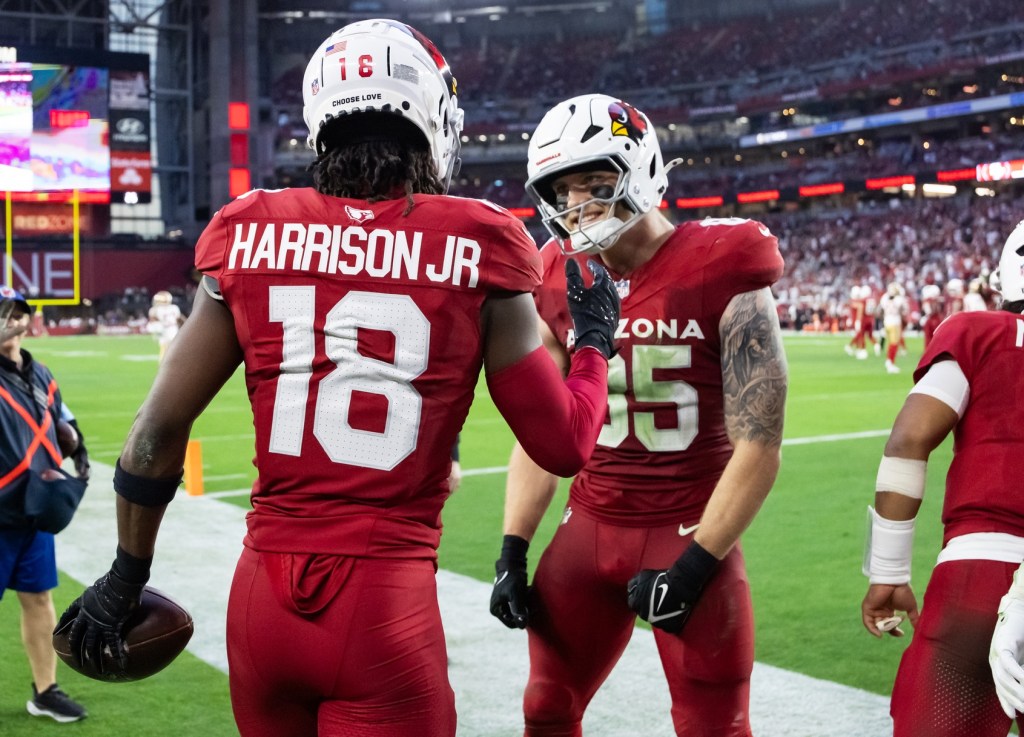
WR13. Marvin Harrison Jr., Arizona Cardinals (WR20)
Speaking of aggressive! I’ve got Marvin Harrison Jr. locked in at WR12, and I’m not blinking. This isn’t a disappointing-rookie-year-post-hype bet—Harrison’s profile boasts elite indicators and immediate alpha usage. Harrison posted a 3.44 YPRR in college against top-tier Big Ten competition and a 37% dominator rating, putting him in the same pre-draft tier as Chase and Jefferson. He landed in Arizona and instantly commanded volume. His 2024 numbers quietly finished top-20 in target share (24.6%) and air yard market share (33.2%) as a rookie. That doesn’t happen by accident. A lot of those air yards, however, can be considered a bit empty. Kyler Murray simply didn’t have it with Harrison Jr. for a lot of last season.
Underlying opportunity metrics back this it up—his 12.4 aDOT was well above average, and while his RACR sat at 0.61, just below elite, it was efficient enough to turn deep targets into usable PPR production. He logged 106 targets, caught 71 balls, cleared 950 receiving yards, and saw eight end-zone looks in just 11 full games. That’s rare. It’s sticky. And it’s a profile I chase.
I’ve heard the pushback. His 1.92 YPRR fell below the 2.0 threshold many analysts flag. But nearly every sub‑2.0 rookie who cleared 100 targets at age 22 or younger took a leap in Year 2. Olave, Waddle, London—they all lived in that range. The breakout arc is baked in.
Kyler Murray ranked top‑10 in adjusted yards per attempt from Week 10 onward, and Arizona played faster than they have in four years. Harrison is the engine now—no true WR2 threat, only Trey McBride and James Conner siphoning red-zone work, but theirs are schemed. He’s the outside focal point. WR12 isn’t a reach—it’s a recognition of what the numbers already showed. Volume. Youth. Alpha deployment. I’m in now, before everyone else catches up.
WR14. Ladd McConkey, Los Angeles Chargers (WR11)
His profile screams PPR value—route precision, separation, and an immediate WR1 role on a high-volume passing attack. He isn’t a slot-only weapon. His tape shows boundary chops, deceptive vertical speed, and elite change-of-direction quickness. More importantly, the data backs his trajectory.
Looking at 2024’s opportunity metrics, McConkey’s air yards share and target per route run rates were already impressive for a rookie who played through injuries. His 22.5% target rate when on the field ranked top-25 among all wideouts with 50+ targets. Combine that with a 2.08 yards per route run and a RACR over 0.70, and you see a player who converts opportunities into efficient production. Few rookies step into the league that polished—McConkey did.
The Chargers’ passing attack was starved for reliable targets last season, and McConkey’s role was expanding with every game. With Keenan Allen and Mike Williams gone, he’s the centerpiece of Justin Herbert’s passing tree. Herbert’s adjusted completion percentage jumped to 76% when targeting McConkey, and his quick separation rate opened up quick-strike options the offense lacked. Expect 120+ targets and heavy red-zone scheming given his precise route timing.
Critics point to his size and supposed lack of elite athletic traits. I see a technician with elite efficiency metrics and an offense built for volume. His 7.9 aDOT fits perfectly into the high-volume, high-efficiency PPR model. Add in his ability to win underneath while still stretching defenses, and WR14 seems just about right. He’s the perfect WR2 with WR1 upside.
WR15. Tyreek Hill, Miami Dolphins (WR14)
Tyreek Hill is a polarizing pick in 2025, but at WR15 in my ranks, I’m cautiously including the Cheetah as a top-20 piece for his game-breaking upside. Let’s address the elephant in the room: Hill is now 31 and showed signs of decline in 2024. He finished just WR18 overall and a concerning WR28 in PPR points per game. For a guy drafted top-five last year, that was a letdown. Age and injuries (a wrist issue early on) clearly hampered him, and Miami’s scheme shift didn’t help. The offense funneled more targets to running back De’Von Achane and even TE Jonnu Smith, leaving Hill and Waddle with less volume. Hill’s final stat line (around 900 yards and six TDs) was pedestrian by his standards.
So why is he still in my top 20? Because few players can do what Tyreek does when right. He can still win you a week almost single-handedly with a couple of long scores. Miami’s offense under Mike McDaniel is creative, and if they recalibrate to get Hill more involved (not a stretch, given his talent), he could easily outperform this ranking. Hill’s advanced metrics dipped, but he still has elite speed and field-stretching ability (his aDOT remains among the higher end for top WRs). His RACR was lower in 2024, implying a lot of unrealized air yards – some due to scheme/QB issues. If Tua (or whoever is QB) can get Hill the ball in stride, those big plays will return.
I do approach Hill with caution in managed leagues. He might give you some dud weeks and his body is more fragile now. But as a mid-round pick, the cost is finally reasonable for the risk. In best ball, he’s still attractive for those spike weeks. In PPR redraft, I see him as a volatile WR2/3. Value him below the name brand; I certainly am. But don’t completely write him off. If you build a hangar of solid receivers, having Hill as a home-run swing could be a league-winning move. Just be prepared for some inconsistency as father time and Miami’s evolving offense temper his week-to-week reliability.
WR16. Mike Evans, Tampa Bay Buccaneers (WR17)
Mike Evans continues to defy aging curves. Entering his age-32 season, he remains one of the NFL’s premier touchdown scorers. His 2024 campaign ended with 1,228 yards and 13 touchdowns, marking his sixth career season with double-digit scores. Evans commanded a 25.1% target share in Tampa Bay’s offense while finishing top-10 in end-zone targets. Baker Mayfield trusted him heavily in contested spots; Evans converted 62% of contested looks, one of the best marks among outside receivers. His red-zone target rate sat at 30.3%, confirming that the Buccaneers’ scheme still revolves around him near scoring territory. Advanced tracking graded him with a 2.05 yards per route run (YPRR), right in line with his career efficiency despite declining separation numbers. While some fear the eventual rise of younger weapons, Evans’ volume and touchdown equity give him WR1 upside every week. He is ranked here conservatively but still represents a steady anchor for drafters who value consistent production with explosive ceilings.
Evans provides a high floor (I pencil him in for at least 70 receptions, 1,000 yards, and eight scores as a baseline) and still that top-10 ceiling if touchdowns pile up.
WR17. Davante Adams, Los Angeles Rams (WR16)
Davante Adams may be 32, but he remains an elite technician and a target hog. It’s a perfect combo for PPR! In 2024 with the Jets, Adams still tallied 85 catches, 1,063 yards, and eight TDs, finishing as a fringe WR1 (WR13 overall at 17.1 PPR points per game). Now he lands in the Rams’ high-octane offense, essentially replacing Cooper Kupp as Matthew Stafford’s veteran go-to. There’s concern that emerging star Puka Nacua will siphon looks, but I see plenty to go around. In fact, from Week 10 on last year, Nacua was drawing ~37% of targets (11+ per game), so the Rams can support a concentrated passing attack with two receivers. Adams’ presence might actually help the offense sustain drives and reach the red zone more often. He’s one of the best ever at converting inside the 20. Notably, Adams has six career seasons with 10+ TDs, trailing only a few Hall of Famers in that department. His knack for getting open in tight areas (fade routes, quick slants) will be a boon for a Rams team that lacked a consistent end-zone weapon (Nacua had only six end-zone targets last year).
Adams still boasts a robust WOPR: he’ll likely see ~25% target share and a healthy chunk of air yards in Los Angeles. His aDOT has been moderate in recent years (around 10 yards), which is fine – he racks up catches underneath and still can burn defenses on double moves. With Stafford’s trust, I expect Adams to flirt with 90+ receptions. Don’t sleep on his efficiency either; in 2024 his points per game (17.7) when paired with Aaron Rodgers was top-five. He’s shown he elevates quarterback play as much as they elevate him. Drafting Adams in the late third or early fourth round feels like theft. You’re getting a proven WR1 who’s as consistent as they come. Especially in PPR, where his route savvy translates to tons of easy completions, Adams remains a set-and-forget high-end WR2 with upside for more.
WR18. DJ Moore, Chicago Bears (WR19)
D.J. Moore slots in at WR18 for me, and this ranking is all about balancing his undeniable talent with a much murkier situation around him. Let’s start with the talent: Moore is still the same dynamic receiver who posted three 1,100+ yard seasons in Carolina with mediocre quarterbacks. When he moved to Chicago in 2023, we saw glimpses of his ceiling unlocked – he had a career-best year in 2023. However, 2024 was a very different story. The Bears made several moves that ultimately capped Moore’s volume. They drafted Rome Odunze in the top 10 of the 2024 draft, they brought in veteran Keenan Allen, and they eventually transitioned from Justin Fields to rookie Caleb Williams at QB. The result was Moore’s targets and yards per game plummeting. He ended 2024 as the WR16 in total points, but on a per-game basis he was only the WR32. Essentially, Moore was buoyed by a couple big early games, but week-to-week he became very inconsistent as all those new pieces got worked in.
Now heading into 2025, one could argue things have gotten even more crowded for Moore. The Bears have a new head coach (Ben Johnson, former Lions OC) who is known for scheming up the slot receiver heavily. And who’s likely to occupy the slot? Not Moore, but rather second-year WR Luther Burden, whom the Bears took in Round 2, or possibly Odunze if they kick him inside. Chicago also spent a top-10 pick on a receiving tight end, Colston Loveland, adding another mouth to feed. When I put all this together, I see a scenario where Moore’s target share could actually decline from the ~22% it was last year. If he’s stuck as an outside receiver while Burden or Odunze soak up the high-percentage slot targets that Johnson’s scheme creates, Moore might continue to hover around five-to-six targets per game with a reliance on big plays. His effort waned late last season as frustration set in, which is another concern. Will he stay engaged if early on he’s not getting the ball enough? These are legitimate red flags that justify not treating Moore as the surefire WR2 he was a couple years ago.
The upside case is too strong to ignore. If, for example, Moore ends up playing more slot than we think or Johnson adapts and makes him the “souped-up Amon-Ra St. Brown” of this offense (remember, Johnson schemed St. Brown open repeatedly in Detroit), then Moore could absolutely smash this ranking. He’s only 28, and we’ve seen him command 120+ targets consistently in the past. Perhaps Caleb Williams will develop better chemistry with him in year two of their partnership – it’s possible that after a full offseason, Williams will identify Moore as the true alpha and feed him accordingly. Also, if any injuries happen to those young guys (or if they simply aren’t as pro-ready), Moore’s workload could bounce back in a big way. In essence, WR18 is a hedge: I’m cautious, recognizing Moore’s floor in this new-look offense might be lower than ever. But I’m also unwilling to drop an elite talent much further than this, because I know he has the skill set to put up a 1,200-yard, 8-TD season if things break right.
As a fantasy manager, I’d draft Moore as a high-variance WR2. One with potential headaches if Chicago doesn’t prioritize him, but also one who could be a steal at this rank if his talent forces the Bears’ hand. I’m a little more comfortable drafting Moore in the late fourth or fifth round this year (hoping his ADP dips), and maybe his value will change between now and Week 1. But if he holds this rank as a borderline top-20 receiver, it’s going to be really hard to click that button without some positive reports out of Chicago.
WR19. DeVonta Smith, Philadelphia Eagles (WR23)
Devonta Smith is one of the best real-life receivers, and he’s quietly an outstanding fantasy asset too. He averaged 15.3 PPR points in 2024, which was good for top-20 per game, despite playing in a run-heavy Eagles offense. Think about that. Philly’s offense revolved around a 2,000-yard rushing season from Saquon Barkley, yet Smith still commanded a 28% target share and posted 833 yards and a career-high eight TDs in just 13 games. When he was on the field, nearly one-third of the Eagles’ passes went his way. An absolutely elite level of involvement. Smith’s efficiency is also stellar: he only got ~6.8 targets per game, but he made them count, scoring roughly 15 PPR points per game. That speaks to his route running and big-play ability. His aDOT typically sits around 11-12 yards, and he has a knack for making difficult sideline catches and getting open deep when defenses focus on A.J. Brown.
The concern with Smith is volume, given the Eagles’ run-first nature. However, I expect a slight shift. Philadelphia won the Super Bowl, yes, but they know they can’t overwork Barkley forever. Plus, Smith is simply too good to not scheme the ball to. He’s an elite separator and was a Heisman winner for a reason. At 25, he’s hitting his prime and has built tremendous chemistry with Jalen Hurts. The Eagles return all their key pass-catchers and paid Brown big money, so defenses can’t double Smith often. I’m forecasting something like 120 targets for Smith in 2025. With his talent, that could yield ~90 receptions and 1,100+ yards. His touchdown count may fluctuate (eight last year could regress slightly), but he’s efficient enough to still produce WR2 numbers even on moderate volume. He’s currently going off the board around WR23, which is a bargain. Smith gives you a high weekly floor (he rarely disappears in games) and legitimate WR1 spike weeks when Philly is forced to air it out. I’m targeting him as a strong WR2 who could smash expectations if the Eagles throw even a little more.
WR20. Jaylen Waddle, Miami Dolphins (WR26)
Jaylen Waddle enters 2025 in an unusual position: a proven producer but now positioned as Miami’s primary short-area chain mover. His 2024 season produced 84 catches, but only 947 yards, as defenses forced more underneath routes. His average depth of target (aDOT) dropped to 7.4 yards, down from 9.9 in 2023, reflecting Miami’s pivot. The encouraging piece is his efficiency in that role. Waddle posted a 77% catch rate on targets under 10 yards and ranked top-five in the league in yards after catch per reception at 6.3. He also faced zone coverage on 61% of routes and posted a 79% success rate against it, showing he can consistently uncover underneath. With defenses tilted toward Tyreek Hill, Waddle’s role as the volume-driven slot and quick-hitter weapon appears secure. He handled 27% of Miami’s third-down targets last year, signaling trust in high-leverage situations. He also ranked inside the top-15 in targets per route run (TPRR) at 24.8%, reflecting how frequently Tua Tagovailoa looked his way despite lower aDOT. His efficiency stayed intact, with 1.92 yards per route run, which quietly mirrored Stefon Diggs’ output from 2024. In red-zone sets, Waddle’s usage ticked up to a career-high 17% share, showing Miami trusts him in compressed spaces. We rank him here anticipating a low-aDOT but highly successful year in which efficiency and reliability outweigh splash plays.
WR21. Tee Higgins, Cincinnati Bengals (WR15)
Tee Higgins remains a tricky evaluation, but in the middle of round three I love the upside he presents. He’s the clear number-two target for Joe Burrow’s Bengals, which in itself is a valuable role given the team’s high pass volume. 2024 was a bit frustrating for Higgins – he missed five games and finished just over 900 yards with 10 TDs. The positive is that he showed a nose for the end zone, setting a career high in touchdowns and even delivering a 131-yard, 3-TD explosion in the fantasy playoffs. The negative is that much of his production was touchdown-dependent; his yardage and catch totals were modest for a top-20 WR. In fact, Higgins’ fantasy points were buoyed by those scores, raising concerns about consistency. His target share hovers around 20-22%, which is solid but not elite since Ja’Marr Chase dominates targets in Cincinnati.
That said, Higgins’ talent is undeniable. He’s 6’4″ with great contested-catch ability and timing. His aDOT is usually around 12–13 yards, meaning he’s used on intermediate and downfield shots. That naturally leads to higher variance week to week (hence the best-ball appeal of his profile). But in PPR, he’s still going to have plenty of usable weeks, especially if the Bengals offense stays aggressive. Burrow trusts him in tight coverage, and Higgins’ red-zone role is lucrative – he’s a primary end-zone threat on fades and posts. Health is key; multiple seasons of nagging injuries (hamstring, quad, etc.) are something to monitor. If he can play a full slate, 1,100+ yards and double-digit TDs are attainable. I’d caution that Higgins might be a bit boom-bust compared to some others in this range, but as a high-end WR3 or low-end WR2 on your roster, he offers immense spike-week potential. I value him around WR15–18, which makes him worth the price if you can stomach minor inconsistency for major upside.
WR22. Jameson Williams, Detroit Lions (WR30)
Williams posted a 20.4% target share from Week 10 onward after fully supplanting Josh Reynolds and ramping up to a full-time route share. Over that stretch, he averaged 6.9 targets per game, including four contests with eight-or-more targets. His air yards per target spiked to 13.1, and his air yard share hit 32.5%, both elite downfield metrics. He wasn’t just a splash-play guy anymore—he became the vertical focal point in Detroit’s offense, which ranked top-six in pass rate over expected in neutral game scripts.
His YPRR climbed to 2.04 over those final eight games, breaking the 2.0 barrier that predicts Year 3 breakouts. RACR held at a respectable 0.66, which is impressive considering the deeper route tree he was asked to run. He showed marked improvement in timing, separation against press, and trust from Jared Goff. That trust showed up in the red zone—Williams saw seven red-zone targets in his final five games, a massive shift from early usage.
Critics question his floor. I get that. But at WR24, I’m not chasing floor—I’m betting on talent finally being matched with opportunity. There’s no more Amon-Ra target vacuum in the slot. Detroit’s staff has publicly said they’re building the receiver room around Williams’ vertical gravity. This is a blazing 4.3 athlete entering Year 3 with a full snap share and ascending usage profile. The metrics confirm what the eye test already screamed: the breakout is real. WR24 is the hedge against him becoming the 2025 version of 2022 Christian Watson—and the payoff is league-winning.
WR23. Calvin Ridley, Tennessee Titans (WR28)
Ridley’s in Tennessee now alongside rookie quarterback Cam Ward, and this makes him one of 2025’s trickier projections. His final year in Jacksonville produced 1,129 yards and eight scores, but volatility defined his weekly outcomes. He had 11 games with fewer than seven targets, finishing with a 22.4% target share that looked strong on paper but translated into just 1.72 yards per route run (YPRR), his lowest since 2020. That inefficiency stemmed in part from a contested catch rate that dipped to 41% and a catch rate on targets of 58.3%, both signaling age-related decline in his perimeter dominance.
Still, Ridley’s strengths remain intact. He posted above-average success rates on slants (78%) and digs (74%), routes that fit Ward’s aggressive but rhythm-based style. His slot usage also ticked up to 24.6% in 2024, the highest of his career, indicating Tennessee may look to diversify his looks rather than rely solely on boundary isolation. That’s critical, because Ward’s vertical tendencies—he averaged 9.4 air yards per attempt at Washington State—create natural openings for Ridley’s intermediate work.
Ridley now sits in a wideout room competing with—who? Rookie Bru McCoy? It’s pretty narrow target priority. We rank him as a volatile WR2/3 swing: capable of spike weeks in Ward’s downfield system, but with durability and consistency concerns that limit his full-season reliability.
WR24. George Pickens, Dallas Cowboys (WR31)
I’ve got George Pickens at WR24—a touch more optimistic than consensus. And that’s exactly where he belongs. He’s not a target hog, but he’s a splash-play machine with ascending potential and real upside in the right weekly script.
The numbers show both the boom and the bust. Pickens ranked second in the NFL in aDOT last season at 15.6 yards, finished with a monstrous 42.8% air yard share, and cleared 1,140 yards on just 95 targets. His 17.3 yards per catch led all wide receivers with 75+ targets. That kind of deep-ball dominance matters—even in PPR. He doesn’t need 140 targets to make noise when he’s ripping off 40-yard touchdowns and commanding almost half his team’s air yards.
But I’m not pushing him into the WR2 tier, because I’m not blind to the volatility. His target share sat at 19.2%, and he fell under six targets in nine different games. Pickens isn’t high-volume, but he is high-leverage—and that’s why WR29 works. He’s the exact kind of player who gives you spike weeks, with just enough consistency to warrant weekly flex play.
The quarterback upgrade helps. Dak Prescott is the best quarterback Pickens has played with yet. Add in a new offensive system that projects more vertical passing volume, and Pickens has the setup to match or beat this rank.
He’s not mispriced at WR29. He’s appropriately valued for his explosive profile—capable of singlehandedly flipping a matchup when he hits, and insulated just enough by deep usage to keep his floor from falling out. This is exactly where he belongs in PPR formats.
WR25. Tetairoa McMillan, Carolina Panthers (WR27)
Tetairoa McMillan is one of the most intriguing rookies this year – a dynasty darling who could pay off immediately in redraft. Drafted by Carolina in the early second round, McMillan profiles as a prototypical X receiver at 6’4”, 219 lbs. He has the size and physicality to win outside, but don’t pigeonhole him as just a jump-ball guy. Scouts noted his surprisingly refined route running and release package – he can leverage his frame to create separation, and he’s slick even in tight areas. Basically, he’s not a stiff; he’s drawn comparisons to Drake London for being a big target magnet with sneaky agility. His college production at Arizona was stellar: 174 catches, 2,271 yards, 18 TDs over his final two seasons. That screams consistency and the ability to handle volume.
For 2025, McMillan steps into an ideal situation. The Panthers drafted him to be their clear X receiver from day one. Bryce Young is in his second year and needs a reliable outside weapon – McMillan can be that guy. The Carolina depth chart at WR is wide open; they’ve been searching for a true #1 target. I expect McMillan to see a hefty target share early, perhaps 20%+ as he acclimates, with room to grow if he develops quick chemistry with Young. One thing to temper: rookie receivers can have growing pains, and McMillan isn’t a burner (so he’s not likely to house a slant for 80 yards like Tyreek). But he makes up for it with excellent ball skills and football IQ. In the red zone, he could feast immediately. His size and catch radius make him a prime end-zone option on fades or back-shoulders.
All told, I view McMillan as a safe WR3 with upside. Dreaded phrase. His floor is bolstered by projected steady volume (I’d bet on 100+ targets if healthy), and his ceiling comes from touchdown potential and big plays if defenses underestimate him. He’s currently going in the mid-to-late rounds of drafts, which feels like stealing a potential 70-75 catch, 1,000-yard rookie. I’m not sleeping on Tetairoa. He’s built for consistency and may be a weekly starter sooner than later.
WR26. Courtland Sutton, Denver Broncos (WR22)
Courtland Sutton is a savvy veteran pick who gives you value at his cost. He’s coming off a 2024 where he quietly amassed over 80 receptions and nearly 1,100 yards with eight touchdowns. Importantly, he did that with a rookie QB on a struggling Broncos team. Sutton’s usage was elite: he ranked second in the NFL in total air yards and was top-10 in targets, routes run, and red-zone targets. Essentially, he was Denver’s workhorse wideout, acting as the deep threat (seventh in deep targets with 26) and the primary end-zone option. His share of the passing pie yielded a WOPR near the top of the league. Lots of air yards, plus lots of targets. The only thing that held him back from a WR1 season was touchdown variance. He scored eight times, which is solid, but consider that Terry McLaurin scored 13 in the same span; that gap explains why McLaurin was valued higher despite similar usage.
Looking at 2025, Denver’s situation is relatively stable. They retained their play-caller, which is a plus for continuity. The Broncos did bolster their run game (adding a rookie TE Pat Bryant for blocking and RB RJ Harvey), which might signal a bit more rushing. But I don’t expect that to torpedo Sutton’s role. If anything, a stronger run game could create more play-action deep shots for Sutton. At 29, he’s still got gas in the tank and remains the alpha WR on the roster. Jerry Jeudy is gone (traded to Cleveland), which actually happened mid-season last year and coincided with Sutton’s spike in usage. With no significant new competition for targets, Sutton should again see a healthy target share (think 24-25%). Sure, the Broncos might not be a top-flight offense, but volume is volume. Sutton’s aDOT is high, so he might have a few dud games when those downfield targets don’t connect, but he’ll also have blow-up games when they do. I love him in best ball as a WR3, and in redraft he’s a steady WR3/flex who could produce like a WR2 if Denver’s offense improves. He’s a discount veteran that rounds out a roster nicely, providing a high floor (he rarely goose-eggs given his steady targets) and some ceiling if the touchdowns tick up.
WR27. Terry McLaurin, Washington Commanders (WR18)
Note: I’m currently leaving McLaurin at WR27, because I do believe he’ll eventually end up back in Washington. He might miss a few games, which docks his WR1/WR2 potential. If we get news he’s moving to a new team, however, I’ll likely drop him into squarely-WR3/4 range.
“Scary” Terry McLaurin is the model of consistency, and now he’s tasted the ceiling too. For the first five years of his career, McLaurin was a lock for WR15–30 range each season. Then 2024 happened: he erupted with 82 receptions, 1,096 yards, and 13 touchdowns, finishing as the WR6 overall. That TD spike (second-most in the NFL) drove his breakout, and while some regression is possible, I’m still very high on him as a reliable WR2. Washington’s offense is on the upswing. They added Deebo Samuel this offseason, which might sound like competition, but I believe it helps Terry more than hurts. Deebo will command defensive attention and touches in the backfield, potentially capping McLaurin’s absolute target ceiling, but also creating more space and better matchups for Terry outside. With Dyami Brown and Olamide Zaccheaus gone, there are vacated targets available to soften the blow of Deebo’s arrival. I’m expecting McLaurin’s target share to remain in the ~22–24% range, with perhaps fewer targets but higher quality looks.
In PPR, McLaurin has a solid floor. Pencil him in for 80+ catches and ~1,100 yards. He’s an efficient route runner at all levels and has quietly posted strong yards per route metrics given Washington’s QB carousel. Now with Jayden Daniels at QB (who impressed as a rookie) and another year in Eric Bieniemy’s system, the Commanders could be a sneaky-good passing unit. One stat I love: McLaurin delivered a top-24 WR week 69% of the time in 2024. That kind of consistency week-to-week is huge in lineup setting. At 29, Terry is in that veteran sweet spot where he knows how to get open and the team knows how to use him. He may not repeat 13 TDs, but even 7-9 scores keeps him firmly in the high WR2 mix. He’s a safe pick in the mid-rounds (ADP late third round) who also still has WR1 upside if Washington’s offense clicks again.
Of course—there is the matter of this whole contract dispute we’ll need to monitor. Part of this WR16 ranking is a little bit of that caution. But I’d be lying if I said I wouldn’t drop McLaurin more if things get uglier in the capitol.
WR28. Emeka Egbuka, Tampa Bay Buccaneers (WR41)
Egbuka arrives in the NFL as a prototypical “power slot” receiver, built for timing offenses that emphasize leverage and precision. At Ohio State, he logged 73.6% of his snaps from the slot and lined up off the line on 81% of plays, showing how frequently he operated in space. His game thrives underneath and in the intermediate areas, where he consistently found soft spots against zone (83.6% success rate) and uncovered quickly on timing routes. He also handled press at a high level when challenged, winning 81.3% of those looks despite limited reps. Against man, he produced a steady 68.1% success rate, showing that while he’s not a dominant separator outside, he’s more than functional.
On a route-by-route basis, Egbuka excelled on slants (87.5%), outs (78.6%), and curls (75%), while converting 100% of his sampled screens and comebacks. He isn’t a true vertical threat—his success on nines was 47.4%—but his skill set fits neatly with what Tampa Bay needs in 2025. He owns elite hands, securing 75% of contested targets with only a 1.8% drop rate, and stylistically echoes receivers like Amon-Ra St. Brown and Robert Woods in his blend of toughness, processing speed, and leverage mastery.
This rank is a bet on role and timing. Tampa Bay spent the 23rd overall pick on him, and the depth chart is already tilting his way—McMillan is out multiple weeks, and Chris Godwin is still working back from PUP management. Egbuka’s fit is clear: slot and inside-out snaps with pro-ready pacing, while Mike Evans absorbs boundary volume. Baker Mayfield has leaned on slot receivers before, and Tampa’s scheme prioritizes leverage throws to the middle. Egbuka projects for 7–9 targets in competitive scripts, with schemed red-zone looks layered in off motion.
At WR28, the expectation isn’t explosive efficiency after the catch—he was tackled on first contact 70% of the time in college and broke multiple tackles on just 6.7% of touches—but consistent production in the exact areas PPR managers value. He’s a safe floor play who could outkick the ranking quickly if Mayfield funnels volume his way.
WR29. Zay Flowers, Baltimore Ravens (WR25)
A volume dominator Zay Flowers is not. But he doth not need to be. Or whatever.
Flowers’ game thrives on explosiveness, separation, and target efficiency inside a compact route tree. He finished 2024 with a 22.1% target share and led Baltimore’s wide receivers in both air yards and red-zone targets—a critical stat line given Lamar Jackson’s continued top-tier scoring efficiency.
The air yards data backs it up. Flowers posted an aDOT of 9.6, a RACR of 0.73, and an air yard share of 28.7%. That combination shows a balanced usage profile: not just a gadget guy, not just a lid-lifter. He wins in the intermediate window, carves zones with speed, and earned a 1.97 YPRR—nearly breaking the predictive 2.0 threshold that flags breakout WR2s in Year 3. His role steadily expanded across 2024, and he closed the year with four games of 8+ targets in Baltimore’s final six.
Lamar isn’t a volume passer, but that’s baked in. I’m not expecting 140 targets—I’m projecting 110+ high-leverage looks in a hyper-efficient offense where Flowers is the first read more often than Mark Andrews now. He’s the clear WR1 in Baltimore’s offense, and he draws free access off play action more than any wideout in the league.
The doubters will cite low total volume, but the elite target quality and his after-catch juice make up for it. His 489 YAC yards ranked top‑12 last year. This is the kind of explosive WR2 that swings PPR matchups when he catches six balls for 100 yards and a score. At WR22, I’m locking in upside, growth curve, and elite fit with his quarterback. He’s not just safe—he’s lethal in the right script.
WR30. Ricky Pearsall, San Francisco 49ers (WR47)
Pearsall might not be on everyone’s radar yet, but the data says he should be. This isn’t just a depth-chart projection—it’s a profile that already checks the breakout boxes for a Year 2 contributor in full PPR.
First, the context. Pearsall was handpicked by the 49ers in Round 1 in 2024, and that matters. Shanahan doesn’t draft skill players in the first round unless he’s scheming them touches—see Brandon Aiyuk. Pearsall’s college tape already showed what the 49ers crave: short-area burst, surgical footwork, and rare body control. He’s not just a slot receiver; he lined up outside on over 40% of his snaps at Florida, and he was productive from every alignment. He suffered a freak, tragic gunshot wound at the beginning of the season. He not only miraculously survived; he went onto start NFL games after he returned form IR.
Once active last season, Pearsall immediately stepped into a meaningful role. He played over 75% of snaps in his first appearance and remained a regular part of the rotation even after Samuel and Jennings returned. While his target volume dipped during the midseason stretch, Pearsall ended the year with an encouraging finish: back-to-back games of 8-141-1 and 6-69-1, while also contributing as a rusher. He reached four receptions in five of 11 games and maintained a target share not far behind Deebo Samuel’s from Week 7 onward.
While Pearsall trailed his teammates in overall yards per route run, he ranked near the top of the team in receiving success rate, signaling efficient on-target play. His college production at Florida also reflected big-play ability, with 15.2 yards per catch over five seasons, and he showed versatility both as a runner and returner..
Brock Purdy led the league in passer rating and adjusted yards per attempt last season. Pearsall’s 2024 preseason usage suggests he’ll see high-percentage looks, likely out of motion and into space. His college catch rate was 70.3%, and his YPRR at Florida rose to 2.51 his final year. That’s serious efficiency.
I’m not projecting a WR2 season. But in PPR, route density and conversion matter—and Pearsall has both. At WR29, I’m drafting for late-season growth, YAC juice, and an elite offensive environment. He’s my final wideout for a reason: floor, ceiling, and an offense that manufactures production. That’s a bet I’ll make every time.
WR31. Josh Downs, Indianapolis Colts (WR42)
Josh Downs might be the most underappreciated PPR asset out there. He broke out in 2024 on a Colts team that was, frankly, a passing dumpster fire. Despite missing a couple games to injury, once he returned, Downs led Indianapolis in targets, touchdowns, and success rate for the remainder of the season. In the games he played, his team target share was a whopping 34.1%. That’s Cooper Kupp/Davante Adams territory! Outrageous for a second-year slot receiver on a bad offense. What it means: whenever Downs ran a route, the quarterbacks locked onto him. And he rewarded them: he finished top-five in route win rate and targets per route run among all WRs. His ability to separate quickly out of the slot made him a safety blanket, even though Indy shuffled QBs (Anthony Richardson to Joe Flacco). Downs was essentially immune to the chaos, which is a testament to his talent and role.
Now, 2025 brings changes that I view as positives. The Colts have brought in Daniel Jones, who has shown he leans on slot receivers and shorter routes (he’s become “slot dependent” as a passer). That fits Downs like a glove. Downs operated with an ultra-low aDOT of 6.8 yards (7th-lowest among starters) and a 72% slot rate (4th highest). In other words, he lives in the short area, precisely where Jones loves to throw. Indianapolis also drafted a pass-catching TE (Tyler Warren) and beefed up O-line, showing intent to improve the pass game protection. None of the new additions threaten Downs’ slot role. In fact, Warren might draw coverage from LBs, opening the middle for Downs. With Richardson still around as a developmental QB, there’s a chance he starts some games if he progresses; if not, it’s Jones.
Downs is practically free in drafts (ADP around WR50), which is mind-boggling. There may not be a better value on the board. He has legitimate 100-catch upside if things break right. Even if the touchdowns are modest (he’s small and Indy’s offense may stall in the red zone), the PPR volume alone could make him a weekly WR2. I’m grabbing Downs everywhere as a bench steal who I suspect will be starting for me by mid-season.