

Sofia Coppola’s Priscilla will immediately bring the validity of how important viewpoints are to your attention. There are many ways to think of the late Elvis Presley’s legend – the extravagant performance robes, the 500 million records sold, and the aura that has impersonators emulating his image today. We tend to view Elvis from the sight of an enamored onlooker when it comes to chronicling his life, but the 1985 novel, Elvis and Me is the inspiration here. There are two points of entry as you enter Coppola’s film. One is of Priscilla Beaulieu (Cailee Spaeny) off-screen, readying her trademark black eyelashes and walking on a plush carpet. The second is the then 14-year-old at a diner counter doing homework at a U.S. Air Force base in Germany.
Priscilla is desperate to find someone to be friends with. She hasn’t connected with anybody at school and mainly hangs out at home with her parents. That’s exactly when she gets invited to a party at the then-24-year-old Presley’s (Jacob Elordi) house. This, of course, takes some convincing by Priscilla and a friend of Elvis’s/fellow soldier’s part, but they allow her to go. It’s there where Coppola puts the audience within the gaze of Beaulieu and how this love affair started. As you can imagine, it would be overwhelming for the biggest artist in the world to talk to you as a normal human being. It’s intoxicating, but also disturbing. Coppola doesn’t stop showing how uncomfortable this union is, given the group of adults came together and allowed something like this to take place.
:format(webp):no_upscale()/cdn.vox-cdn.com/uploads/chorus_asset/file/25050371/https___cdn.sanity.io_images_xq1bjtf4_production_754fd15d110d9971e88f0f8455f599f6ac625818_5165x3443.jpg)
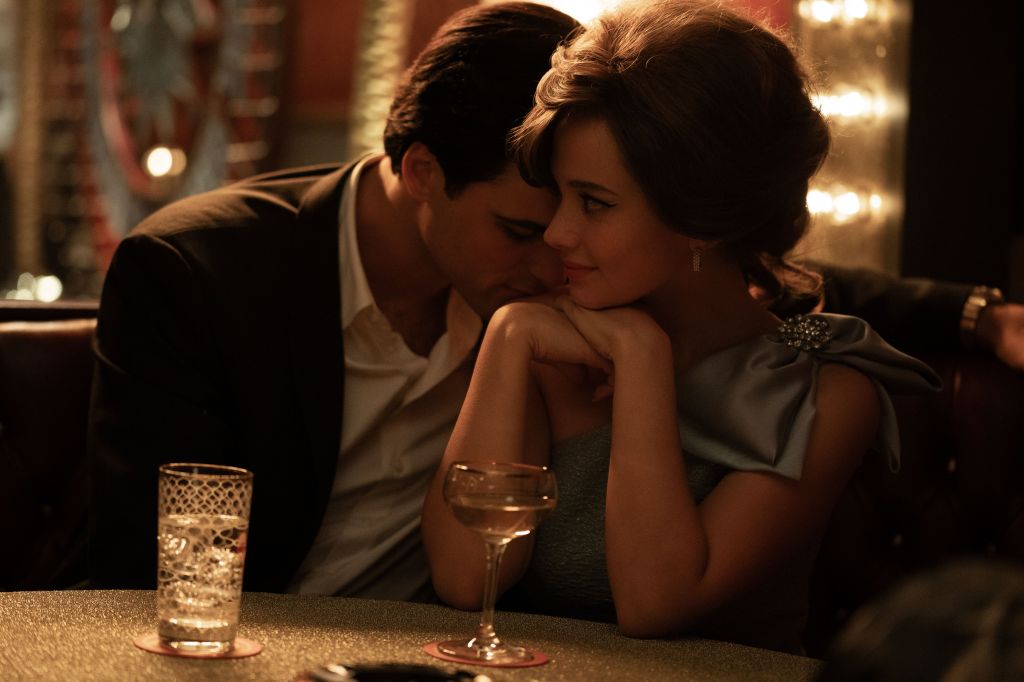
Within their first few conservations, the audience sees where the attraction started. Both parties seek a sense of home and find it within each other somehow. Priscilla is astounded that this man is looking to confide in her despite who he is and what he personifies. For Elvis, perhaps there was love and having somebody’s ear to listen to all that was stirring inside of him. There’s a palatable tension within the early scenes between Spaeny and Elordi when they are alone. It’s as if he knows it’s wrong, but something both keeps him restrained, but overtakes him at the same time.
Even as one of the biggest pop culture figures of all time is within the narrative, Coppola doesn’t allow that to deter from telling Priscilla’s story. Elordi’s performance of “The King” is less attuned to the on-stage persona of the man and more so the domesticated version that many didn’t get to see. Priscilla doesn’t have any of Elvis’s music, but honestly doesn’t need it. Phoenix and Sons of Raphael take care of the musical stems, placing you within that period nicely.
Spaeny undergoes an arch that peaks towards the end of the film, perhaps too quickly in where the endgame ultimately falls. But after they spend time together, Elvis eventually goes back to the States to start a film career. He promises he’ll keep in touch, and of course, Priscilla obliges. One of the most harrowing scenes of the film happens when they get to the airport, and a multitude of female fans mob Elvis’s limo.
As he gets on the plane, Priscilla exits the car as his source of love interest and stands as one of his admirers. It’s a theme that cycles throughout the film and is rather heartbreaking because, for a time, Priscilla becomes frozen within that state in time. She’s unique enough to catch Elvis’s eye but not enough to keep it from wandering or leaving. This problem intensifies when she turns 17, and her parents allow Priscilla to live with Elvis in Memphis on the promise that she will continue attending a Catholic school. When we envision Graceland, we think of beauty, neatness, and wealth. All of this is true when it comes to Priscilla’s arrival, but it also serves as something of a restrictive time capsule.
:format(webp):no_upscale()/cdn.vox-cdn.com/uploads/chorus_asset/file/25050398/https___cdn.sanity.io_images_xq1bjtf4_production_c374e07eb0e4bcfa14afb10487d69012b742798d_5285x3523__1_.jpg)
She’s not allowed to bring friends home due to privacy concerns, can’t play outside on the massive lawn with the dog Elvis gave her, or even get a job at the local dresser. Philippe Le Sourd’s beautiful, style-driven cinematography provides a false hope of what this “paradise” is supposed to feel like. Then there’s Elvis himself. He’s often gone for large chunks of time shooting movies and beckoning Priscilla to stay in Memphis to “keep the home fires burning.” When he is home, he’s dominant in what Priscilla wears, their sex life and pushes back on any of her inklings of his tabloid with sudden spaces of anger. Priscilla knows things are wrong, but the unknown is scarier than the life she’s clinging on to.
Throughout strife, Coppola shows us happier moments of them together – but even those have a bit of darkness. For the many bonfires, bumper car rides, and ventures to Las Vegas, Priscilla is the only woman present. Let alone the only person of her age around. When she and Elvis are together, it’s mostly confined to Graceland or their bedroom. It’s almost as if Elvis lives an entirely different life outside those walls, and Priscilla’s life never starts. The prize is being married and having a child with the man everybody wants, but that comes with a cost. You’re always playing a role for someone, even if it’s the person who is supposed to love you the most.
It’s funny what a castle can personify, depending on where you’re standing. If you’re looking at it from the outside, you’ll wonder about the infinite treasures it holds. Being inside could make you feel distant and cold from anything warm and human. Coppola provides Priscilla with her day in the sun, where she rejects the crown she’s given. Although with more haste than the build-up would entail. In the end, there are two paths, and at first, both are caught in a trap they can’t walk out. But once Priscilla gets the resolve to walk out that door, the other story of the man himself careens down the rabbit hole of tragedy. What matters to Coppola provides Priscilla with the last frame and say.
