

This review is published as part of DraftKings Network’s 2023 New York Film Festival coverage.
Frankenstein and adjacent stories mainly follow the blueprint of Mary Shelley’s original 1818 novel. A scientist decides to dabble in reanimation to defy death and restart life. They partake in an experiment to do so and briefly bask In the marvel of such scientific pursuit. After the “creature” becomes aware, even resentful and vengeful, they realize this type of creationist conquest comes at a cost.
Yorgos Lanthimos’s Poor Things, based on Alasdair Gray’s 1992 novel, takes these notions and flips them into a comical, sexual, and mentality-enlightening journey of self-discovery. It’s one of self-assuredness and agency within a world looking to lock those principles down with restrictive social values. It’s a man’s world, and the invention (or rebirth) of Bella Baxter (Emma Stone) is about to be an astute, inquisitive tornado moving through it.
Bella’s inclusion into the world is not without tragedy, as the film’s opening minutes show a woman resembling her jumping off a moving ship into the ocean. From there, it’s like a birth in reverse, with Dr. Godwin Baxter (Willem Dafoe) bringing her back to life. Much of her early time is devoted to learning a finite amount of words a day, walking in a toddler-like fashion, smashing plates on the ground, and the beautiful pleasures of masturbatory conquests. As Bella learns more about the world, she becomes hungry to explore more. An acute sense of wonder and innocence has gone untainted by the world’s troubles.
:format(webp):no_upscale()/cdn.vox-cdn.com/uploads/chorus_asset/file/25009204/140_YLpt67_124.jpg)
Although through every corner of this magnificently constructed Victorian world, a man wants something from her. Dr. Baxter (who she calls “God”), at least at first, wants to keep her home to protect her. Over time, the experiment-to-creator relationship turns into a father-daughter one. An emotional connection is created within him as Bella sets course on the more significant and more outstanding. Godwin’s research assistant, Max McCandless (Ramy Youssef), takes a likeness to Bella and even asks for her hand in marriage with the caveat that she must stay within the compound.
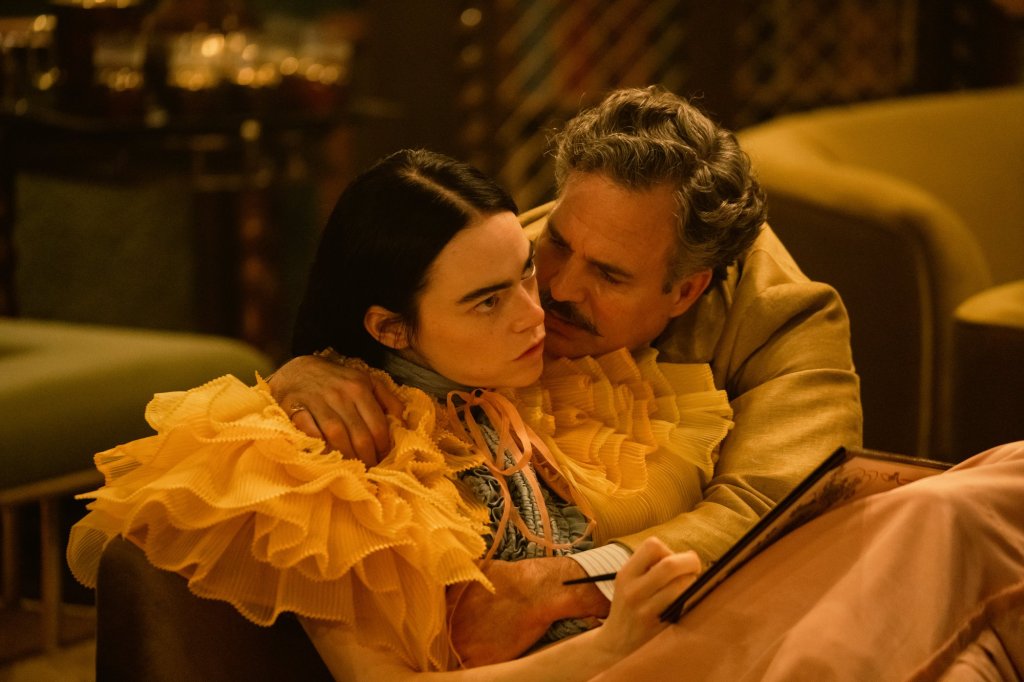
His humility opens the door for a hired lawyer and somewhat sleazy Duncan Wedderburn (Mark Ruffalo) to swoop in and proposition Bella to travel with him across Europe. She obliges, and at first, a tour of wealth and sexual escapades turns into a profound, liberating journey that enjoyably frustrates Wedderburn. A brilliant radiance omits from the performance of Stone; as the film moves forward, Bella’s character is whipsmart, brash, well-intentioned, and, in silent moments, mesmerized by what the world at large has to offer.
During a long sequence of bedroom play with Wedderburn, she asks him why people don’t do this all the time. Within a brief stay in Lisbon, she stops and takes in a beautiful song with child-like amazement. As Duncan amasses a considerable amount of cash winning in a casino, Bella gathers it and gives it all away (albeit to the wrong people) because she wants to help those who are poorer in a nearby village. Ruffalo is delightful as he comes apart, realizing there’s no way to nail down Bella’s need for adventure. While Poor Things is funny and unapologetically sexually charged, Stone exhibits a range of emotions that invoke the more significant story at play.
In this world, men don’t know what to do with a woman who doesn’t necessarily need them to survive. Harry Astley (Jerrod Carmichael), a self-professed cynic Bella meets on a cruise ship and says humankind is all “cruel beasts.” Bella’s unshakable curiosity doesn’t allow that viewpoint to infect how she lives her life. Tony McNamara’s screenplay allows for the story of Bella Baxter and the revision of who she used to be in her past life to co-exist and ultimately join together. As Poor Things starts in a black-and-white tone and evolves into color as the film progresses, the beautiful production design of James Price and Shona Heath takes shape.
Robbie Ryan changes the viewpoint of the camera lenses to depict the vastness of the landscape as we look through Bella’s eyes and how enclosed it can be when the men of this world look at her. It’s the narrow peripheral our main character refuses to shrink to fit as the “normal” mores of a craving for sexual pleasure, using it to your advantage, and the gaining of the knowledge of the world at large combine to make “the creation” better than anyone could have imagined.
Our minds always click to the classic view of Frankenstein’s monster – complete with a flat top and nuts and bolts, but Bella has no strings. It’s to the audience’s delight to see a woman completely unfazed by what society expects from her in Poor Things. Its inhabitants are shaping around that rather than looking to snuff that fire out (there is one particular sequence in which it tries too harshly). Oh, what a world that would be.
