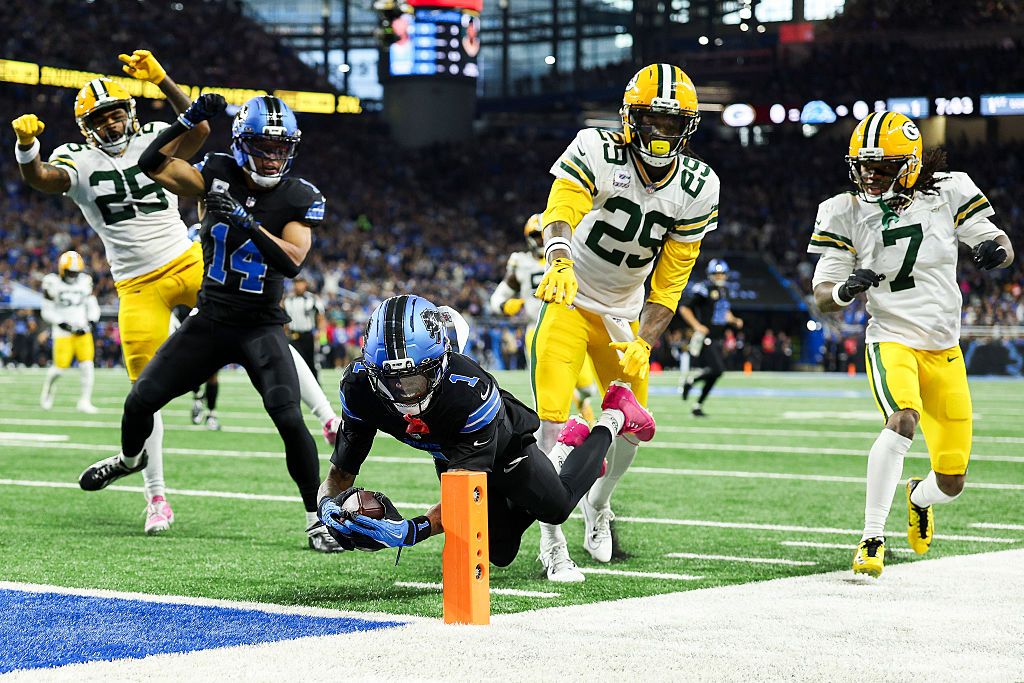
The Detroit Lions have seemingly flown under the radar this season, in part because offensive brilliance has been so expected of them in the Dan Campbell-Jared Goff-Jahmyr Gibbs-Amon-Ra St. Brown era. Still, the Lions are 4-2 to open the 2026 season, currently occupying a playoff position.
Detroit’s No. 2 receiver, Jameson Williams, had had a slow start to the season after emerging as a fantasy-viable option over the prior two campaigns, but after a 91-yard, two-touchdown (26.1-FPT) effort in Week 7 against the Green Bay Packers, Williams is back on track to produce at a similar level to his 2024 and 2025 campaigns.
The Lions will have a potentially pivotal matchup in Week 8, as they will travel to face the Minnesota Vikings, who currently hold the division lead, with all four NFC North teams in a playoff position. Is Williams worth starting in fantasy football this week?
Results and Usage
Williams produced fewer than 50 yards in each of his first three games of the season, but he picked it up in Week 4, snagging six of his eight targets for 102 yards (19.2 FPTS), although he failed to find the end zone. Then, Williams once again dipped below the 50-yard threshold in Week 5, but he scored his first two touchdowns of the season (18.7 FPTS). He combined volume with a nose for the end zone in Week 6, and as a result of his three strong performances, he’s up to WR22 despite playing one fewer game than several other pass-catchers.
Advanced numbers are mixed on Williams. Pro Football Focus has given him just the 62nd-highest offensive grade among 118 qualified wide receivers, a dip after he finished 31st last season. However, per the NFL’s Next Gen Stats, he’s still produced a respectable 2.7 yards yards of average separation per targeted route and gained 0.2 more yards after the catch per reception than expected, slight downgrades from the marks he posted in 2024 and 2025 but not terrible, either. Despite the fact that he has struggled with drops, Goff has still recorded a 127.9 passer rating when throwing to him, the best mark on the team.
Future Outlook
As a deep threat, Williams has always had some boom-or-bust in him, as he had multiple games with zero receiving yards last season and only cleared 15 FPTS in eight of his 17 games. Given that his success rate is higher than it was in 2025 and he also had a fairly high drop rate last season, there’s no reason to suggest that his role will diminish any time soon. In the aggregate, Williams is a worthy fantasy asset because of his propensity for explosive plays. Although he actually only ranks fourth on the team in targets, Detroit’s offensive hierarchy is clear, so he isn’t at risk of losing targets.
He has impeccable chemistry with Goff. Although he’s created less separation this season than in seasons past, Goff is an accurate passer, ranking 16th in completion percentage over expectation and throwing 14 touchdown passes without an interception. He’s also been the seventh-most aggressive passer this season, per the NFL’s Next Gen Stats, which both underscores his faith in Williams and Campbell’s scheme. Goff has posted the league’s best offensive grades on throws traveling 20 or more yards downfield, making 17 passes without a turnover-worthy play, so Williams — who ranks second on the team in average depth of target — should continue to thrive.
Despite the Vikings’ 6-0 start and a defense that has limited opposing wide receivers to the fourth-fewest FPTS per game, Williams could still be worth starting. Minnesota has tried to incentivize opponents into throwing it long, forcing the 11th-deepest average target, and as a result, it’s actually given up the ninth-most 40-plus-yard catches. Much of the Vikings’ impact is a result of their blitz-heavy scheme and league-best 35.7% pressure rate, but Goff has been the seventh-best high-volume quarterback at passing under pressure. There’s also somewhat of a quality gap between Isaiah Rodgers (PFF’s third-ranked starter among 103 qualified corners) and the man who starts opposite from him, James Pierre (12th).