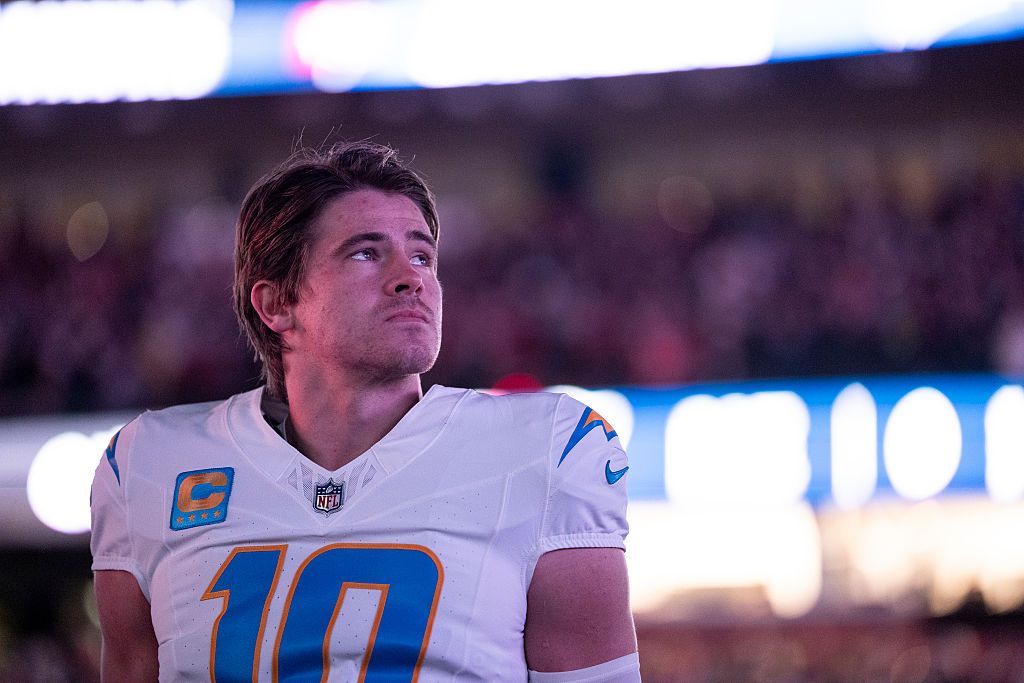
Justin Herbert enters 2026 with a compelling MVP case and a demanding price. Los Angeles has won 11 games in consecutive seasons under Jim Harbaugh. Herbert has reached 5,000 passing yards before and once threw 38 touchdowns. He has also produced elite ball security, meaningful rushing value, and repeated late-game excellence.
Those strengths have never arrived together during a complete contender season. Herbert’s best statistical year came before Harbaugh rebuilt the Chargers. His cleanest season ended with only 23 touchdown passes. Last year brought 11 wins, but Herbert’s efficiency collapsed behind an injured offensive line.
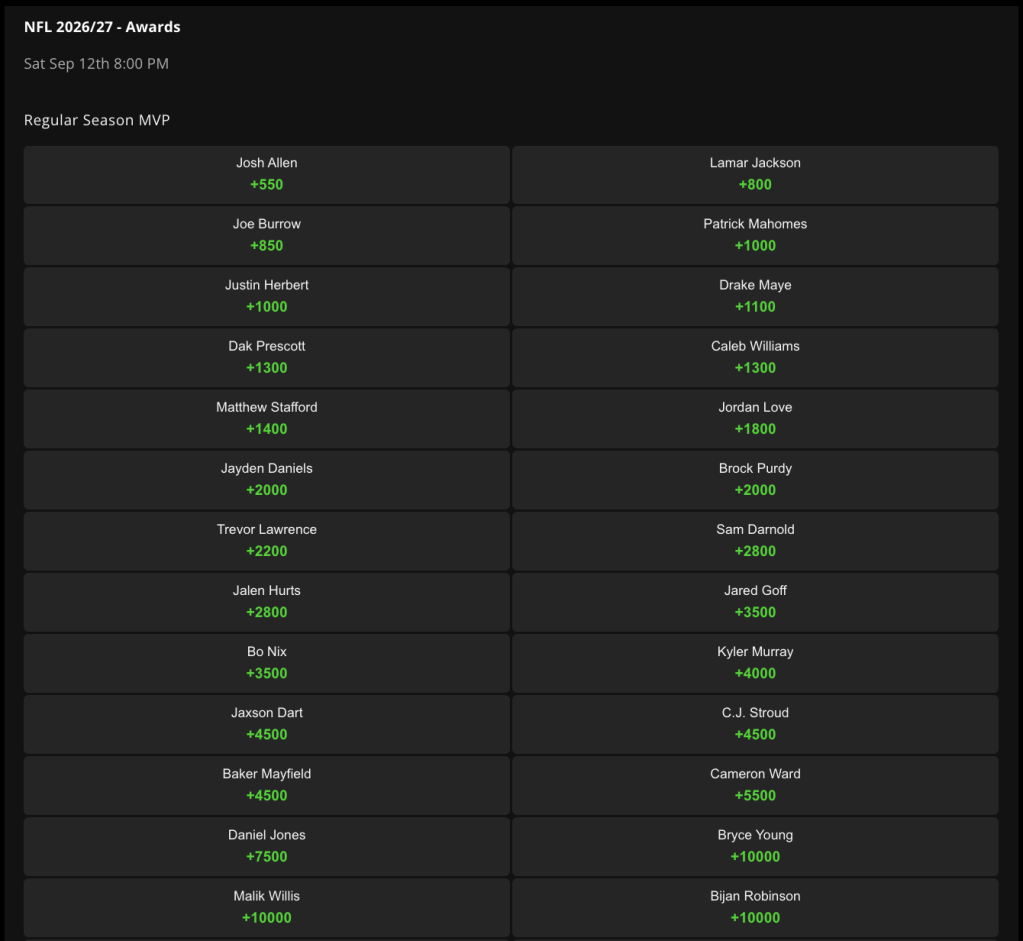
Mike McDaniel’s arrival gives Los Angeles a plausible way to combine those separate pieces. The Chargers also return Rashawn Slater and Joe Alt, added Tyler Biadasz, and expanded an already versatile tight-end room. Herbert must improve substantially to win MVP at +1000. The offseason changes give that improvement a sound statistical basis.
Justin Herbert 2026 NFL MVP: Making the case
Herbert completed 66.4% of his passes for 3,727 yards, 26 touchdowns, and 13 interceptions last season. He averaged 7.3 yards per attempt and posted a 94.1 passer rating. Those figures represented adequate quarterback play, although they never approached MVP production. His 13 interceptions matched his combined total from the previous two seasons.
The advanced profile was more concerning. Herbert generated only 19.35 total EPA across 649 plays. His 0.03 EPA per play and 46.84% success rate placed him well outside the award’s serious efficiency range. His passing plays generated only 4.51 EPA, while his rushing produced 14.84. The Chargers received more expected value from Herbert’s improvisation than his passing.
Protection explains much of that imbalance. Herbert faced a league-high 263 pressures and absorbed 54 sacks, second-most in football. His sack rate climbed to 8.78% after sitting at 7.12% in 2024. Those sacks erased 301 yards and reduced his net yards per attempt to 6.1.
Slater missed the entire season after tearing his patellar tendon. Alt played only six games before an ankle injury ended his year. Herbert spent most of the schedule without either starting tackle, then fractured his left hand late in the season. He still started 16 games and led Los Angeles to an 11-5 record in those starts.
Herbert also contributed to the pressure problem. His average time to throw sat around 2.7 seconds, while his average target traveled 8.12 yards. He continued asking injured protection to hold through intermediate and vertical concepts. His scramble rate rose to 7.97%, another sign that too many dropbacks escaped their intended structure.
That aggression remains central to Herbert’s value. His 43 completions of at least 20 yards showed that Los Angeles still created downfield gains. The problem came between those explosives. Herbert’s 46.84% success rate meant fewer than half his plays produced positive expected value. MVP seasons require explosive production alongside reliable down-to-down offense.
Los Angeles finished 12th in total yardage but only 20th in scoring. The offense converted an excellent 45.8% of third downs, third-best in the league. It then scored touchdowns on only 47.4% of red-zone possessions, ranking 29th. The Chargers attempted 41 field goals and finished with only 36 offensive touchdowns.
That disparity offers Herbert a direct path toward better counting numbers. The offense already sustained possessions and reached scoring territory. It repeatedly failed to finish those drives. A moderate red-zone improvement could add six or seven touchdowns without requiring a major yardage increase.
Herbert’s rushing season also deserves more weight. He ran 83 times for 498 yards and two touchdowns, averaging 6.0 yards per carry. The yardage established a career high by 192 yards. His legs preserved drives, created 14.84 EPA, and prevented the offense from collapsing completely.
The rushing production should decline if protection improves. That would be healthy for both Herbert and the offense. McDaniel can preserve selected movement throws and third-down scrambles without repeating 83 rushing attempts. Herbert only needs 300-to-350 rushing yards to strengthen an elite passing résumé.
His career establishes the statistical ceiling. Herbert threw for 5,014 yards and 38 touchdowns in 2021. He followed with 4,739 yards during an injury-compromised 2022 season. In 2024, he posted a 23-to-three touchdown-interception ratio and generated 0.11 EPA per play.
Herbert has already demonstrated high volume, low turnover rates, and valuable rushing. He has never combined them with 12 wins and top-five efficiency. The 2026 case depends upon those traits finally meeting during one season.
Voters have already shown some willingness to credit his circumstances. Herbert received one first-place MVP vote last season despite finishing ninth in passing yards. That voter emphasized the offensive-line injuries, hand fracture, and Herbert’s role in another 11-win campaign. Better raw production would give that argument broader support.
McDaniel and the rebuilt line can change Herbert’s efficiency
McDaniel’s first priority has been reducing the burden on Herbert. He has emphasized quicker completions, better route timing, and fewer plays requiring extraordinary quarterback creation. His stated benchmark has been frequent releases within 2.4 seconds. Herbert averaged approximately 2.7 seconds last year.
That difference appears small but carries enormous consequences. Edge pressure often needs nearly three seconds to reach the quarterback. Throws arriving before receivers complete their breaks can defeat pressure without additional blockers. McDaniel has rebuilt Herbert’s footwork around matching each drop to the route’s timing.
Herbert has spent much of his career waiting to confirm separation, then overpowering tight windows with arm strength. McDaniel wants the ball delivered toward space before the receiver turns. That approach can improve yards after catch, lower sack exposure, and produce easier first-down completions.
The adjustment should also create more contrast within the passing game. Defenses forced to defend quick throws cannot attack every snap with aggressive rush lanes. Once edge players begin chasing early releases, Herbert’s mobility becomes more dangerous. McDaniel has said the Chargers will retain their downfield passing rather than copying Miami exactly.
Herbert’s average target depth should remain higher than McDaniel’s previous quarterbacks. His arm allows Los Angeles to pair quick-game volume with deeper outbreak throws. The objective involves creating a healthier distribution, rather than turning Herbert into a screen-dependent passer.
The returning tackles provide another substantial change. Slater and Alt are expected to be ready for Week 1. Alt earned Pro Bowl recognition despite playing only six games. Slater was a Pro Bowler in 2024 before missing last season. Their return restores premium talent at the two positions most connected to Herbert’s pocket depth.
Biadasz strengthens the interior. He finished ninth among qualifying centers with a 71.5 overall PFF grade last season. His 67.1 pass-blocking grade also ranked ninth, while his 71.2 run-blocking grade ranked 11th. Herbert has praised his command and ability to accelerate the offense’s tempo.
The line still carries uncertainty. Cole Strange projects at right guard, while left guard remains an open competition. Slater is returning from a major knee injury, and Alt underwent ankle rehabilitation. Calling the unit solved would ignore meaningful health and depth concerns.
It nevertheless enters camp with a far higher ceiling. Herbert took 54 sacks last season. Reducing that total to 35 would preserve 19 additional passing plays before considering extended drives. At Herbert’s career average of 7.2 yards per attempt, those plays alone represent roughly 137 passing yards.
The greater gain would come from possessions that continue. Los Angeles punted or attempted field goals after too many promising drives. Fewer negative plays could move the offense from 20th in points toward its top-12 yardage ranking. That shift would place Herbert nearer 35 passing touchdowns.
McDaniel’s rushing structure should help. His final four seasons with San Francisco produced 8,538 rushing yards and 237 runs of at least 10 yards. Los Angeles now has athletic tackles, a veteran fullback in Alec Ingold, and several usable tight ends.
Omarion Hampton rushed for 545 yards and four touchdowns across only nine games as a rookie. He added 32 catches, 192 yards, and another score. Kimani Vidal supplied 643 yards during Hampton’s absences, while Keaton Mitchell owns a 6.3-yard career rushing average.
A more credible rushing game should improve early downs and play-action efficiency. Herbert faced too many obvious passing situations last season. Los Angeles attempted 569 team passes while producing only 4.4 yards per rush. More efficient rushing can reduce pressure without reducing Herbert’s total opportunities.
The receiving corps lacks an established 1,300-yard star, which remains the offense’s clearest limitation. McDaniel must create aggregate production through varied personnel and alignment.
Ladd McConkey led the Chargers with 66 receptions, 789 yards, and six touchdowns last season. His 106 targets carried a 9.87-yard average depth. He already has 1,978 yards and 13 touchdowns through two seasons, placing him among the most productive receivers from his draft class.
Quentin Johnston caught 51 passes for 735 yards and eight touchdowns. He has scored eight times in consecutive seasons, giving Herbert a legitimate boundary and red-zone threat. Johnston still needs greater route-to-route consistency, but his scoring production has become dependable.
Oronde Gadsden caught 49 passes for 664 yards and three touchdowns as a rookie. His 13.55 yards per reception ranked eighth among tight ends on the SumerSports board. McDaniel can move him away from traditional in-line assignments and attack linebackers through seams and crossing routes.
David Njoku adds a proven red-zone target. He has 384 career receptions for 4,062 yards and 34 touchdowns. Nineteen of those scores came during the last four seasons, alongside 1,478 yards after catch. Twenty-six of his 34 career touchdowns have occurred inside the red zone.
Charlie Kolar supplies the blocking element. His 71.5 run-blocking grade ranked sixth among qualifying tight ends last season. Kolar allows McDaniel to maintain credible rushing formations without removing Gadsden or Njoku from the passing picture.
That personnel flexibility can improve Herbert’s red-zone numbers. Los Angeles can use two or three tight ends, then force defenses to declare heavier personnel. McConkey and Johnston become harder to cover when linebackers replace defensive backs. Hampton also gives the offense a stronger goal-line rushing presence.
Herbert threw 26 touchdowns despite the Chargers’ 47.4% red-zone conversion rate. Raising that rate toward league average could place him around 32 scores. Better protection, greater pace, and improved yards after catch can supply the remaining growth.
Herbert still needs a top-seed season
The team pathway is credible but unforgiving. Los Angeles has gone 11-6 during both Harbaugh seasons. The Chargers have reached the playoffs twice, yet they have not won the AFC West. Another Wild Card berth with ordinary passing numbers will leave Herbert outside the serious MVP race.
The defense provides a stable base. Los Angeles ranked ninth in points allowed, fifth on third downs, and fourth in red-zone defense last season. The unit allowed 20.0 points per game despite facing 1,003 opposing plays. Those results kept the Chargers competitive while the offense ranked 20th in scoring.
Herbert therefore does not need to rescue a bad team. He needs the offense to become worthy of the defensive support. A jump from 21.6 points per game toward 26 would likely produce 12 victories. It would also create enough touchdown volume for an MVP résumé.
The schedule supplies both danger and opportunity. Los Angeles faces opponents that went 151-138 last season, the league’s ninth-hardest schedule by winning percentage. The Chargers visit Buffalo, Seattle, Kansas City, Baltimore, Tampa Bay, Miami, and Denver.
The first six weeks include Josh Allen, the defending champion Seahawks, Denver, and Kansas City. Herbert cannot spend September learning the offense slowly. Arizona and Las Vegas open the schedule at SoFi Stadium, giving McDaniel two manageable games before that difficult stretch.
The national résumé will develop in November and December. Los Angeles visits Baltimore on Monday night, hosts New England on Sunday night, and hosts San Francisco on Thursday night. The Chargers also close against Kansas City and Denver, likely with the division still unsettled.
Those games create direct comparisons with Allen, Lamar Jackson, Drake Maye, and other leading candidates. Herbert will have several chances to produce the victories MVP voters remember. The same schedule can also bury the case through losses and compressed statistics.
His postseason history remains irrelevant to the formal ballot but relevant to public perception. New England held Herbert to 159 passing yards during another first-round defeat. He took six sacks, absorbed 11 hits, and lost a decisive fourth-quarter fumble.
The 2026 regular season must establish greater authority before the next playoff game arrives. Herbert needs commanding performances against elite competition, not another season carried by explanations. The market has already recognized McDaniel’s arrival and the returning tackles.
At +1000, Herbert’s implied probability sits slightly above 9%. That price requires a far stronger season than his 2025 efficiency suggests. It also offers less margin than Jordan Love, Matthew Stafford, or several deeper candidates.
My projection places Herbert near 4,500 passing yards, 35 touchdowns, and nine interceptions. I would add approximately 350 rushing yards and three scores. That creates 4,850 total yards, 38 touchdowns, and a credible top-five efficiency profile.
Reaching those totals requires his sack rate to fall near 6%. His EPA per play must rise from 0.03 toward 0.15. Los Angeles also needs to lift its red-zone touchdown rate from 47.4% into the mid-50s.
Those improvements are substantial. They also connect directly to the Chargers’ offseason decisions. McDaniel is shortening Herbert’s timing. Slater and Alt restore the edges. Biadasz stabilizes the middle. Njoku strengthens the red zone, while Hampton gives play action greater authority.
Herbert belongs in the second group of MVP selections behind Maye and Allen. His established ceiling remains higher than last season’s production. The surrounding offense now offers a credible mechanism for recovering it.
The price is aggressive, but the case is serious. Herbert needs better protection, faster processing, and six-to-eight additional passing touchdowns. Los Angeles spent the offseason addressing each requirement.
Best bet: Justin Herbert to win 2026 NFL MVP (+1000)