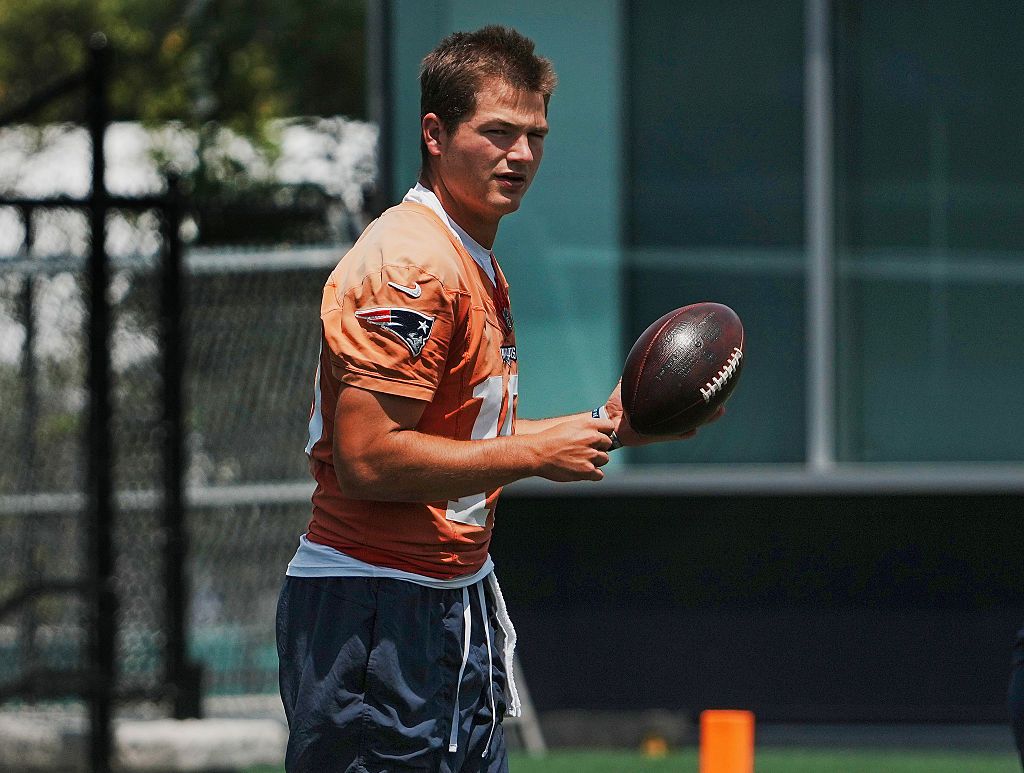
Drake Maye entered last season as the gifted young quarterback expected to drag New England toward competence. He finished it five voting points from NFL MVP and one victory from a championship. The Patriots have since placed A.J. Brown beside him, strengthened his protection, and preserved the offensive system that unlocked him. That changes the nature of this wager. Maye no longer needs a speculative third-year leap or a generous reading of unfinished talent. He already played well enough to win the award.
As you can see from the odds board as it stands on DraftKings Sportsbook, Maye is 11-to-1 to win the award this year.

New England spent the offseason making his next case harder to deny. At +1100, Maye owns the field’s best blend of proven excellence, available growth, team strength, and betting value.
Drake Maye 2026 NFL MVP: Making the case
His 2025 season deserves to be remembered as far more than a breakout. Maye completed 72% of his passes for 4,394 yards, 31 touchdowns, and eight interceptions. He averaged 8.9 yards per attempt and finished with a 113.5 passer rating. He also rushed for 450 yards and four touchdowns, pushing his total offense beyond 4,800 yards. Those numbers already carried the traditional shape of an MVP season. The play-by-play data was even stronger. Maye led qualified quarterbacks with 169.96 total EPA and 0.26 EPA per play. His 52.96% success rate confirmed that the production arrived steadily, rather than through scattered deep completions. New England possessed one of football’s most dependable offenses whenever Maye touched the ball.
The manner of that production gives the 2026 case its weight. Maye paired his remarkable completion percentage with a 9.52-yard average target depth. Quarterbacks rarely attack that far downfield while completing almost three-quarters of their passes. Next Gen Stats credited him with more than 200 passing EPA, placing him in rare modern company. He also led the league with 112 downfield completions and 99 completions under pressure. Defenses heated his pocket, rotated their safeties, and closed the middle. Maye kept delivering the ball beyond the sticks. His finest work came outside structure, yet his weekly production never depended upon chaos. He could win from the pocket, create after protection failed, and punish coverage downfield.
That range separates Maye from younger candidates whose MVP cases still require several assumptions. Jordan Love needs more volume. Justin Herbert needs a dramatic efficiency rebound. Trevor Lawrence needs his passing results to catch his total-touchdown production. Maye already owns the advanced résumé each would hope to build. His film grade, tracking data, passing production, and team record reached the same conclusion. He had become one of the league’s defining quarterbacks before his 24th birthday. There is still room for refinement, but the foundation has already hardened. Betting Maye means backing another season of established quarterback play inside a richer offense.
The voters have already endorsed him. Matthew Stafford won the 2025 award with 366 points and 24 first-place votes. Maye finished with 361 points and 23 first-place votes. One changed ballot could have reversed the result. Stafford’s 4,707 passing yards and 46 touchdowns ultimately overwhelmed Maye’s efficiency advantage. That result gave New England a precise offseason assignment. Maye needed more scoring opportunities and a receiver capable of changing difficult throws into touchdowns. He received both. Voters will not spend September deciding whether Maye belongs among the league’s elite. They settled that question last winter. His 2026 campaign begins with the credibility usually reserved for established winners.
New England built an offense for a bigger season
A.J. Brown changes the offense at its most important point. Maye spent last season creating elite production without a true boundary-dominating receiver. Brown can defeat press coverage, finish through contact, and win after the defense understands where the ball must go. Those skills become especially valuable on third down and inside the red zone. Passing windows shrink near the goal line, and scheme eventually reaches its limit. Brown gives Maye an answer against tight man coverage and bracketed formations. He also commands safety attention before the snap. That influence should create cleaner space for Hunter Henry, DeMario Douglas, and New England’s secondary receivers.
Romeo Doubs strengthens the same equation from the opposite side. He caught 55 passes for 724 yards and six touchdowns last season. Doubs can now attack second cornerbacks instead of carrying an entire outside receiving game. Brown draws the hardest coverage. Doubs works against weaker leverage. Douglas retains his quickness underneath, while Henry controls seams and intermediate space. The Patriots suddenly possess a receiving room with defined jobs and complementary skills. Maye threw 31 touchdowns on only 492 attempts last season. He should receive more volume, better isolation targets, and stronger red-zone personnel. Reaching 37 or 38 touchdown passes no longer requires an unrealistic conversion spike.
New England’s pace leaves another route toward louder production. The Patriots finished second in scoring while ranking only 18th in offensive plays. Maye reached 4,394 passing yards despite attempting fewer than 500 throws. Jared Goff and Dak Prescott received considerably more volume. Even a moderate increase would push Maye toward the league lead in passing yards. Another 45 attempts at 8.5 yards each would add nearly 400 yards. His completion percentage can retreat from 72% without damaging the broader résumé. Greater opportunity can absorb reasonable efficiency regression. Maye could become statistically larger while looking slightly less perfect.
Josh McDaniels also enters his second full season with this version of Maye. Their first year together already produced immediate command, vertical aggression, and elite efficiency. Another offseason should expand Maye’s authority before the snap. He can identify pressure sooner, change protections, and reach favorable matchups without extending every difficult play. That development may never appear inside one glamorous metric. It should appear through fewer wasted downs, fewer sacks, and more sustained drives. The Patriots have no reason to reinvent their offense. They can deepen an attack that already ranked among football’s best.
Protection remains the clearest area for improvement. Maye absorbed 47 sacks and posted a 7.81% sack rate last season. The line deserves part of the blame, although Maye’s appetite for creation also invited punishment. He occasionally held the ball after the progression had exhausted itself. Those plays produced spectacular escapes and avoidable collisions in equal measure. Alijah Vera-Tucker strengthens the interior beside a young line with another year of continuity. Better communication should help against simulated pressure and late movement. Maye also knows exactly where his own corrections must come. A decline into the mid-30s in sacks could preserve several drives across the season. Those extra possessions become yards, touchdowns, and wins.
The postseason exposed the same fault with brutal clarity. Maye threw six touchdowns and four interceptions during New England’s playoff run. He also fumbled seven times and lost four. Seattle’s championship pressure repeatedly forced him into desperate attempts to rescue broken plays. None of that altered the MVP vote, which closed before the postseason. It still provided a clear offseason education. Maye must protect the football when the defense wins the down. Brown gives him a stronger emergency answer. Vera-Tucker gives him cleaner interior space. Experience should teach him when creation becomes self-destruction. The next stage of Maye’s growth may arrive through restraint.
His rushing ability protects the weekly floor while that refinement continues. Maye ran for 450 yards, scored four times, and moved the chains on 38 carries. He creates value against man coverage and punishes defenses that lose contain. New England never needs to treat him like Lamar Jackson or Josh Allen. Maye’s legs work best as a correction when the called play breaks down. That keeps drives alive and gives him another route toward 40 total touchdowns. A season containing 4,600 passing yards, 38 passing scores, 400 rushing yards, and four rushing touchdowns would command every ballot.
The path to the award is already open
The team requirement also remains comfortably within reach. New England rose from four victories to 14 and finished with a +170 point differential. That record will probably regress against a harder schedule. The Patriots can lose two additional games and preserve a powerful MVP platform. Eleven or 12 victories would keep Maye near the top of the AFC. The tougher schedule may even strengthen his candidacy through larger national games and meaningful December football. Voters remember signature victories over other contenders. Maye should receive several chances to build them.
The field carries enough weakness to make +1100 especially appealing. Allen owns the safest weekly path, yet +550 demands a near-perfect season. Stafford enters his age-38 campaign after throwing a career-high 46 touchdowns. Burrow’s passing ceiling remains immense, although his recent injury history cannot be ignored. Jackson must recover from a battered season under a new coaching structure. Mahomes is returning from major knee surgery. Herbert still must transform environmental excuses into elite production. Love has Maye’s efficiency without Maye’s volume or established voter support.
Maye carries fewer unresolved questions than any challenger available at a comparable price. His greatest concerns involve regression from extraordinary accuracy, a harder schedule, and the physical cost of his style. Each concern arrives with a credible answer. More passing volume can offset a lower completion rate. New England’s point differential can absorb record regression. Better protection and stronger receiving talent can reduce unnecessary contact. The Patriots improved the exact areas that limited Maye’s first MVP run.
My projection places Maye near 4,650 passing yards, 38 passing touchdowns, and 10 interceptions. Another 400 rushing yards and four scores would carry him beyond 5,000 total yards and 40 total touchdowns. That production would answer Stafford’s decisive advantage from last season. It would also keep Maye’s superior play-by-play efficiency at the center of the vote.
The most persuasive MVP bets begin with a player who has already shown the winning season. Maye showed it at 23. He led the league’s advanced tables, transformed the Patriots, reached the Super Bowl, and nearly took the award. Brown can turn difficult completions into touchdowns. Greater pace can turn efficiency into volume. Better protection can turn brilliance into control.
Last season ended five points short. This season should end with Drake Maye holding the trophy.