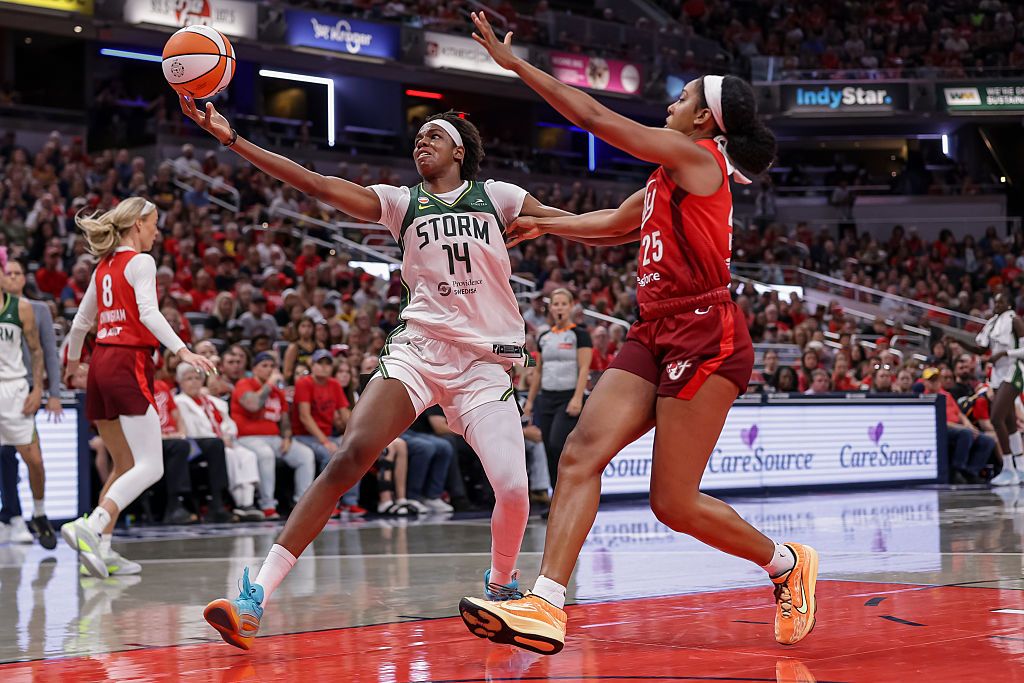
Battles between consecutive first overall picks don’t happen frequently in sports, but when they do, they’re always blockbuster events, especially when both are playing well. It’s impossible for the first overall picks in the 2025 and WNBA 2026 drafts to meet, since they play on the same team, so WNBA fans are left with matchups between the second overall picks in each class.
That’ll happen both tonight and Wednesday night, when the Minnesota Lynx, who have 2026 second overall pick Olivia Miles, and the Seattle Storm, led by 2025 second overall pick Dominique Malonga, face off. Malonga played just 14 minutes in the teams’ prior matchup while recovering from a concussion, but she’s back to full strength ahead of tonight’s 10:10 p.m. ET contest in Seattle.
Both teams will have two absences. The Lynx will continue to be without perennial MVP candidate Napheesa Collier after her offseason ankle surgery, as well as Emma Čechová, who tore her ACL in her third game in the WNBA. Meanwhile, the Storm will be without Ezi Magbegor (face) and development contract player Taina Mair.
Minnesota is a 9.5-point favorite on DraftKings Sportsbook (-485 Moneyline), with the total set at 173.5 points. Seattle is +370 on the Moneyline. Below, I’ll break down tonight’s final matchup and offer a prediction.
Lynx at Storm Best Bet
Seattle Storm +9.5 (-110): 10 points is a very significant line, especially for a road team, and the Storm should be capable of limiting the Lynx on the perimeter, forcing their offense to become more one-dimensional. Minnesota hasn’t won by more than nine points in more than a month.
Lynx at Storm prediction, pick
Despite missing Collier, it’s been business as usual for the Lynx. This season, Minnesota has had the league’s second-best offense and second-best defense, and its net rating is 3.1 points per 100 possessions better than any other team’s. The Lynx are also on a five-game winning streak, the third-longest active streak in the WNBA. Four different players, including Miles, are averaging more than 15 points per game, and Miles, Natasha Howard, and Courtney Williams were all named All-Stars. Minnesota’s experience could hardly stand in starker contrast to that of the Storm, who rank third-to-last in offensive rating, seventh in defensive rating, and third-to-last in net rating while sitting just 6-21, at the bottom of the league standings. Flau’jae Johnson has been effective, even if inefficient, as a rookie, and Malonga was named an All-Star, but losing Skylar Diggins and Nneka Ogwumike has clearly hurt.
The Lynx should have the advantage in interior play. While both teams have finished fairly efficiently, with their restricted-area conversion rates separated by just 0.1 percentage points, Minnesota has attempted 4.7 more close-range tries per game. Additionally, while Seattle has attempted more non-restricted paint tries, the Lynx have been more efficient from that zone. They’ve also limited opponents to the second-lowest percentage at the rim, and the Storm have allowed the fifth-highest mark despite starting Malonga, who’s amassed 0.9 defensive win shares in just 489 minutes and ranks ninth in block percentage. Overall, Minnesota has outscored its opponents by 6.7 points per game in the paint, while Seattle has been outscored by 1.1 points per game.
The Lynx have also been a better rebounding team, ranking fifth in rebounding percentage while the Storm rank fifth-to-last, and even Malonga (who ranks seventh in total rebounding percentage individually) hasn’t helped with that, as they still rank just 11th since she returned from concussion protocol. Minnesota has especially thrived in transition, ranking second in points off of turnovers and fifth in fast-break points per game, and while the Lynx have played pretty cleanly, Seattle has had problems in the transition game on both ends of the ball. Neither team has drawn many fouls, but Minnesota has been somewhat better at not fouling.
Neither of these teams has been very reliant on perimeter shooting, but the Lynx have been better on the shots they have attempted. While the Storm have generated more three-point looks, they’ve connected at just the ninth-highest rate, while Minnesota has been the league’s most accurate team. Of the Lynx’s five players attempted at least three three-pointers per game, only Dorka Juhász, who’s played just four games, has connected at below a 36% clip. For Seattle, Johnson has connected at just a 27.4% clip, and Zia Cooke has made only 29.4% of her threes. Both teams have been excellent at guarding the perimeter, as opponents have hit fewer than one-third of their threes against each team, although the Storm are the only team to have held their opponents below 30% shooting from deep.
Minnesota’s advantage in the paint should be enough to decide this game, but its offense is slightly more one-dimensional if Seattle can take away its three-pointers. If the Storm can funnel the Lynx downhill to their twin towers of Malonga and 2026 third overall pick Awa Fam while avoiding foul trouble, they should cover the spread, especially at Climate Pledge Arena, where they’ve actually had a positive net rating. The Lynx haven’t won by double-digit points since June 17, and Seattle has looked better as of late, losing each of its last three games by fewer than 10 points.