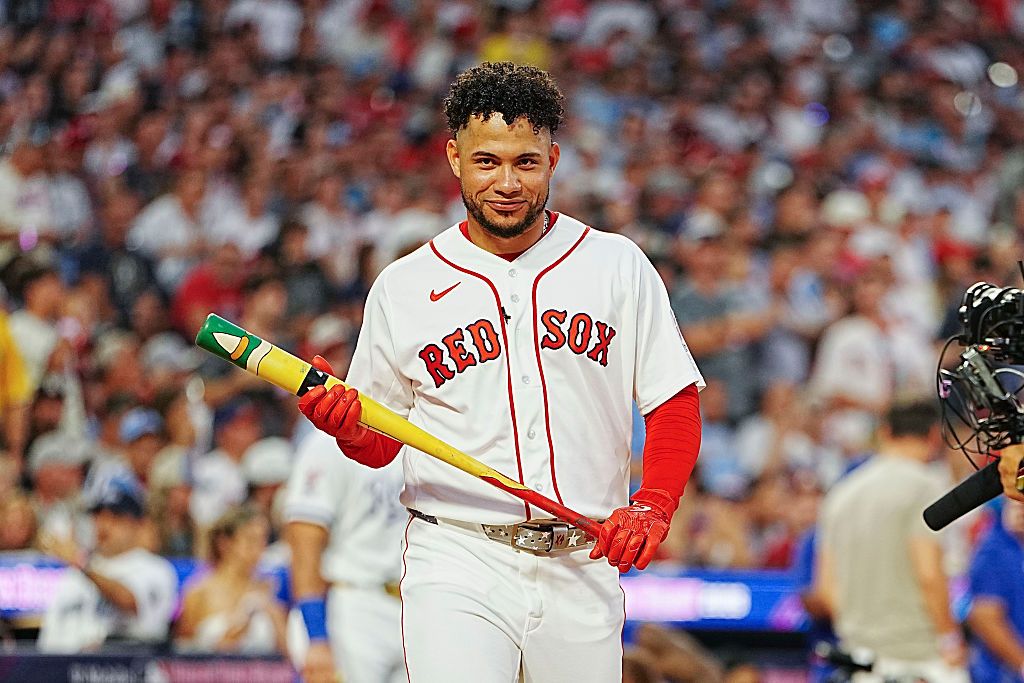
The Red Sox left Boston 11 games below .500 and returned from Queens carrying, most unexpectedly and most gloriously, a postseason race home with them. They swept nine road games across Anaheim, Chicago, and New York. A broken airplane stranded them overnight before the Mets series. Their equipment reached Citi Field shortly before they did. Boston still won that night, then completed its first perfect road trip of that length since 1977.
That extraordinary fortnight carried the Red Sox into the All-Star break at 46-48. They are half a game outside the final American League Wild Card position. The sportsbook now prices Boston at +145 to reach October, an implied probability of 40.8%.
Momentum alone cannot support that price. Boston’s case rests upon stronger evidence: run prevention, defensive excellence, returning talent, and a forgiving Wild Card field. The offense still leaves a considerable bill unpaid.
Follow my handle @dansby_edits for more betting plays.
Red Sox first half: a breakdown
Boston’s season began with losses and a managerial firing. Alex Cora opened 10-17 before Boston dismissed him and five coaches. Chad Tracy drove from Worcester to Baltimore and inherited a roster already losing its intended shape. Tracy reached the break at 36-31 without anything resembling the planned rotation. Garrett Crochet made six starts before shoulder trouble intervened. Ranger Suárez, Connelly Early, Trevor Story, Roman Anthony, Marcelo Mayer, and Triston Casas soon joined him on the injured list.
Boston stood 31-44 on June 21, with an 8.4% playoff probability. The Red Sox have since gone 15-4, including 14-2 after June 25. Their recovery also carries statistical support. Boston’s +27 run differential produces a 50-44 expected record, four wins better than its actual standing. That gap explains why a losing team still commands a serious futures price. Boston is 21-21 against winning clubs and 29-21 away from Fenway. Its 17-27 home record remains one of the season’s stranger failures.
Pitching and defense have preserved the summer. Boston’s staff owns a 3.59 ERA, 3.78 FIP, and 3.89 xFIP across 832⅓ innings. Its 23.0% strikeout rate, 7.8% walk rate, and 1.04 HR/9 support the broader run prevention. Suárez delivered Boston’s finest first half before straining his groin. He posted a 3.15 ERA, 2.61 FIP, 25.8% strikeout rate, and 6.9% walk rate. His 0.49 HR/9 completed an ace-level profile. Payton Tolle added a 3.11 ERA and 3.23 FIP through 84 innings.
Jake Bennett arrived quietly and filled the strike zone. He owns a 2.64 ERA, 3.02 FIP, 4.4% walk rate, and 50.7% ground-ball rate. Only Sonny Gray remains from the Opening Day rotation. Gray has delivered eight consecutive quality starts and a 2.54 ERA, though his 3.53 FIP forecasts some regression. The bullpen has made every narrow lead feel defensible. Garrett Whitlock carries a 2.18 ERA, 2.59 FIP, and 24.2-point strikeout-minus-walk rate. Aroldis Chapman owns a 2.20 ERA, 2.40 FIP, and 0.31 HR/9. Their reliability has allowed Tracy to win games the lineup never broke open.
They also pitch behind one of baseball’s strongest defensive outfields. Ceddanne Rafaela has produced 2.9 WAR, 12 steals, and 10.3 defensive runs. Wilyer Abreu has paired a 107 wRC+ with excellent right-field defense. Rafaela’s range turns dangerous gap contact into outs during Boston’s many three-run nights.
The offense offers far less assurance. Boston owns a .243/.314/.387 line, .310 wOBA, 92 wRC+, and .144 isolated power. Its 85 home runs rank last in MLB. A .308 expected wOBA offers little evidence of hidden positive regression. Willson Contreras has carried an unreasonable share of the lineup. He reached the break at .285/.379/.542 with 20 homers, 61 RBI, and a 151 wRC+. His .256 isolated power nearly doubles Boston’s team figure.
The surrounding order has spent too many innings waiting for authoritative contact. Jarren Duran has 13 homers and 14 steals, yet owns a .194/.259/.350 line. His 64 wRC+ and 30.1% strikeout rate have dulled the speed that once destabilized entire games. Caleb Durbin’s 13.9% strikeout rate supplies dependable contact. His .228/.293/.393 line and 86 wRC+ still leave the order short. Carlos Narváez has defended well behind the plate while producing a 44 wRC+. Boston’s recent success came through run prevention, opportunism, and composed late-game execution.
Second-half outlook: Getting healthy
Suárez offers the safest and nearest reinforcement. He can return July 21 and hopes to miss only the minimum 15 days. A healthy activation would remove an emergency starter while easing the weekly burden on Whitlock and Chapman. Suárez averaged more than five innings across 17 starts and produced 3.0 WAR.
Anthony carries the greatest offensive influence. A partially torn tendon in his right ring finger has sidelined him since May. He cannot return before August, though his latest specialist examination revealed no unexpected damage. His .229/.354/.321 line concealed stronger contact. Anthony produced a .352 expected wOBA, 92.3 mph average exit velocity, and 47.4% hard-hit rate. His 9.3% barrel rate and 15.4% walk rate would immediately deepen Boston’s lineup. A return remains likelier than a lost season. Mid-August appears ambitious without a completed hitting progression. A September activation would leave Anthony little time to reshape the race.
Crochet belongs inside Boston’s highest-end outcome. His 6.30 ERA looked alarming, while a 4.30 FIP and 26.8% strikeout rate offered some reassurance. Opponents still produced a 45.3% hard-hit rate before his shutdown. He had not begun a full throwing program at the latest update. Bullpens, live hitters, rehabilitation starts, and workload buildup still await. August represents an earliest possibility, rather than a dependable appointment. Pitching again and returning as a normal starter are separate outcomes. Five meaningful starts remain possible, though less likely than not. Useful September innings would raise Boston’s ceiling without supporting the base projection.
Story has resumed baseball activities after sports-hernia surgery, though he remains below full speed. His .206/.244/.303 line offers little offensive promise. Competent shortstop defense would still improve several fragile infield combinations. Mayer and Isiah Kiner-Falefa remain out with forearm stress reactions. Early received matching opinions on his posterior elbow inflammation. Casas stopped swinging after another wrist problem interrupted his abdominal rehabilitation. Those uncertain returns should remain outside Boston’s central case.
Public projections already assign partial playing time to several injured players. Their expected value cannot simply be added atop Boston’s current playoff probability. The upside comes from earlier, healthier returns than those systems currently anticipate.
The call-up picture offers coverage rather than rescue. Brayan Bello has returned after his Triple-A reset, carrying a 6.06 ERA and 4.94 FIP. His best role may involve three or four innings behind a short starter. That arrangement would limit repeated exposure and protect Boston’s highest-leverage relievers. Kristian Campbell remains the most practical position-player recall, though his Worcester production has stayed modest. Franklin Arias is 20 and still playing at Double-A. Anthony Eyanson remains there as well. Boston’s farm system can cover an injury, but it cannot produce the established right-handed hitter this lineup lacks.
Jahmai Jones adds a matchup option after hitting .137 for Detroit. Craig Breslow’s next move will reveal how management views the clubhouse’s recovery. Selling would recast the winning streak as a farewell performance. Buying would reward a roster that forced its season back into relevance.
Betting landscape
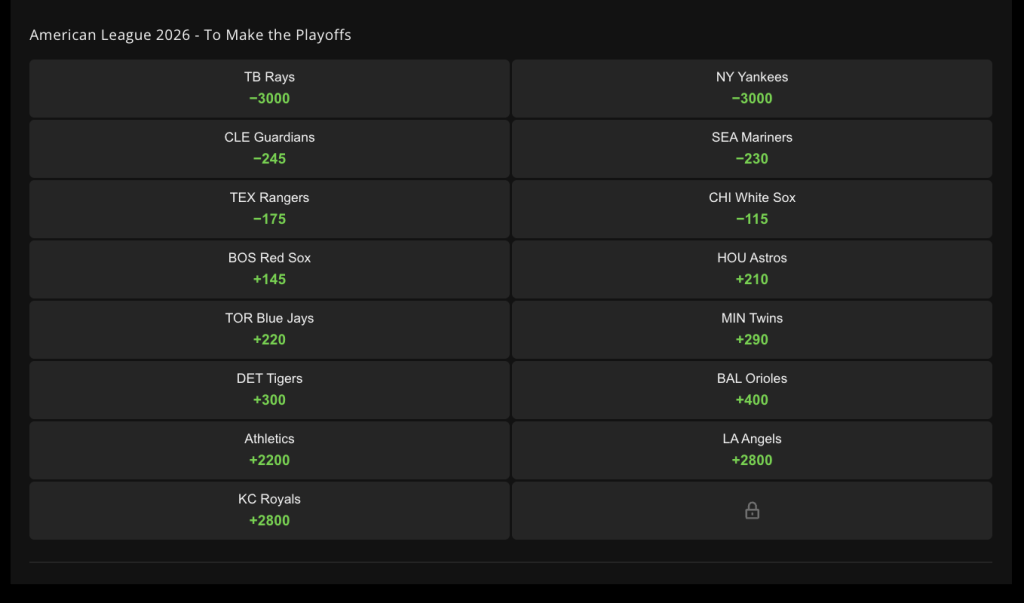
The AL East title has almost vanished from Boston’s path. Tampa Bay leads by 10 games, while New York owns an eight-game advantage. Both clubs sit at -3000 to reach the postseason, leaving Boston’s case almost entirely inside the Wild Card race.
Cleveland is priced at -245, Seattle at -230, Texas at -175, and Chicago at -115. Boston follows at +145, ahead of Houston, Toronto, Minnesota, Detroit, and Baltimore. The market treats the White Sox as considerably safer, although the projections see little separation. Chicago is 50-45 with a +35 differential, yet projects for 80.5 wins and a 40.8% playoff probability. Boston projects for 80.7 wins and a 40.0% chance.
Seattle’s 83.5-win projection gives it the strongest position among the Wild Card contenders. Texas lands at 82.6, while Cleveland remains securely placed despite a slightly negative run differential. Boston probably must pass Chicago and one of those three clubs. It also must hold off five teams priced between +210 and +400.
The schedule provides leverage without much mercy. Boston’s remaining opponents own a combined .501 winning percentage, the 12th-hardest slate in MLB. The second half opens with 10 Fenway games against Tampa Bay, Baltimore, and Toronto. Those games can alter the standings and Craig Breslow’s deadline posture before August arrives.
Fenway has been inhospitable all season, with Boston carrying a 17-27 home record into the break. The Red Sox return with their best baseball and their most urgent organizational decision. A strong homestand should settle any debate about selling. Another collapse would reopen every uncomfortable question the winning streak temporarily quieted.
Boston’s +145 price implies a 40.8% playoff probability. One leading projection sits almost exactly there at 40.0%, while another simulation reaches 51.7%. I place the Red Sox near 43%, producing fair odds around +133.
That estimate credits the +27 run differential, strong run prevention, excellent defense, and Ranger Suárez’s likely return. It discounts Garrett Crochet’s uncertain workload and an offense still leaning heavily on Willson Contreras. The edge at +145 is modest, though Chicago’s -115 price looks difficult to defend against nearly identical projections.
Boston has spent the season surviving conditions that should have buried it. The Red Sox endured a managerial firing, a dismantled rotation, and Roman Anthony’s extended absence. They still reached the break half a game from October, with underlying numbers supporting their revival.
Best bet: Boston Red Sox to make the playoffs at +145. My projection lands at 83-79, enough for the final American League Wild Card. The price remains playable to +140, with stronger value at +155 or better.