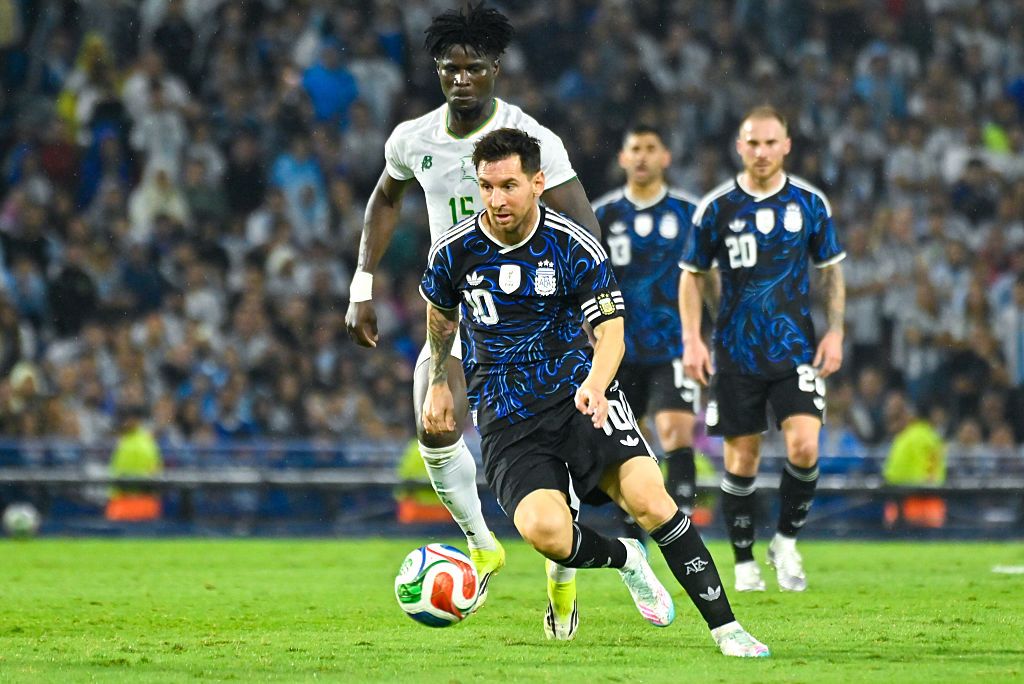
Though Europe has been the most successful continent throughout World Cup history, winning 12 of the 22 prior editions of the tournament, football might well be more synonymous with South America. The widely-recognized greatest player in football history, Lionel Messi, comes from the continent, and Brazil is the most successful individual team with arguably the most vibrant sporting culture. It wouldn’t be a surprise to see a South American team win this summer’s World Cup, especially now that there are six participants, tied for the most since the maiden competition in 1930, which had seven.
I’ve already analyzed Europe in the first part of this five-part series, in which I’ll go through which team is likely to be the most successful on each continent. Today, I’ll break down the South American participants, followed by Asia, Africa, and North America.
First, I’ll break down which COMNEBOL countries are participating in this summer’s World Cup, sorted by their odds of lifting the trophy on July 19 at DraftKings Sportsbook.
List of South American countries in the 2026 FIFA World Cup
Brazil (+800)
Argentina (+850)
Colombia (+4000)
Uruguay (+6500)
Ecuador (+9000)
Paraguay (+15000)
Which South American country will advance the farthest? Pick, best bet
The two traditional giants of the continent have the two shortest odds, with the Seleçao the fourth-favorites overall and the Albiceleste the fifth-favorites. It makes sense; Argentina is the highest-ranked team from the continent at third in the world, and Brazil ranks sixth. Still, they’re far from the only strong teams, as the lowest-ranked team from South America is No. 40 Paraguay, and all six are expected to qualify for the knockout stage. The last time every South American representative qualified out of the group stage came in 2010, when fourth-place finisher Uruguay ended up being the continent’s best team. The Celeste, who won in 1930 and 1950, could end up being contenders again, as could Colombia, but the talent gap is realistically too steep for Paraguay or Ecuador to overcome.
As they were ranked second in the world rankings when the draw was conducted, the Albiceleste have arguably the easiest draw. Their group doesn’t feature any other member of the world’s top 20, with the second-highest-ranked team No. 24 Austria. Algeria had an uninspiring performance in the Africa Cup of Nations, and Jordan lost some of its potency when striker Yazan Al-Naimat tore his ACL. The contender with the next-most friendly group is Uruguay; while the Celeste will surely find it difficult to leapfrog Spain, Saudi Arabia has been in exceptionally poor form in its recent friendlies and Cape Verde is a debutant, though the Blue Sharks managed to beat top an African qualifying group featuring Cameroon with ease. Los Cafeteros’ group features Portugal, as well as a defensively sound Asian debutant in Uzbekistan and a pretty well-rounded, veteran-led DR Congo. The Seleçao have the hardest group: World No. 8 Morocco would’ve been a Pot 1 team had the draw been made a few months later, Scotland is stacked with talent throughout Europe’s top five leagues, and Haiti has pulled from its expatriate community within France to develop a very solid squad of its own.
The Round of 32 will likely bring the first all-South American matchup of the tournament, as Argentina will face Uruguay in the first knockout stage if the Albiceleste win their group and the Celeste finish second in theirs. The winner of that matchup would arguably have an easier opponent in the Round of 16, though, as it’d face the runner-up in either Group D or G (which seem most likely to be the United States, Turkey, Egypt, or Iran) before a likely date with Portugal in the quarterfinals. Colombia could quickly find itself in a difficult position if it can’t top the Seleçao das Quinas in its group, because it’ll face the Group L runner-up, which is currently tracking to be 2018 runner-up Croatia, and if it manages to win that match, Spain likely awaits in the Round of 16. If Brazil wins its group, it’ll face the runner-up in Group F, likely to be either the Netherlands or Japan, but its road would get trickier in the Round of 32, as it’d then be on track to face the runner-up in Group I, a proverbial “Group of Death” that features France, Senegal, Norway, and Iraq. The Seleçao would arguably be better off allowing the Atlas Lions to win the group, as the Group C runner-up will begin the knockout stage with a date against whichever team tops Group F (the Netherlands or Japan) and then the runner-up in either Group A or Group B in the Round of 16. Still, Brazil wouldn’t be able to avoid Group I for long; it’d likely face the winner of that group, presumably Les Bleus, if it were to fall short in the group but win its first two knockout matches.
Although no nation has been the best-performing COMNEBOL team in two consecutive tournaments since the Seleçao did so between 1994 and 2006, I’m going with Argentina once again. Brazil has plenty of talent all around its squad, with Alisson manning the net and arguably the world’s best center-back in Gabriel anchoring a rock-solid back line, but Gabriel’s partner, Éder Militão, is out, and further up the pitch, a couple of young right wing options in Estevâo and Rodrygo are either out or in heavy doubt. The Seleçao also don’t have a true superstar No. 9, with Chelsea’s João Pedro (15 goals in 34 matches) likely the best option. Similarly, Los Cafeteros lack depth in the attack behind Luis Díaz, and they finished their qualification campaign with four losses, three draws, and three wins from their final 10 matches. Uruguay, too, is somewhat unconvincing; its two best players on paper, Federico Valverde and Ronald Araújo, have both had tumultuous domestic campaigns, and it lost to the United States in a friendly, 5-1, last fall. By default, then, the most complete team is the Albiceleste; Emi Martínez could be the best goalkeeper in the world, midfielders Enzo Fernández and Alexis Mac Allister have improved since the last World Cup, and whichever of Lautaro Martínez and Julián Álvarez plays alongside Messi gives him a lethal strike partner. Messi’s career will end in the semifinals against England.