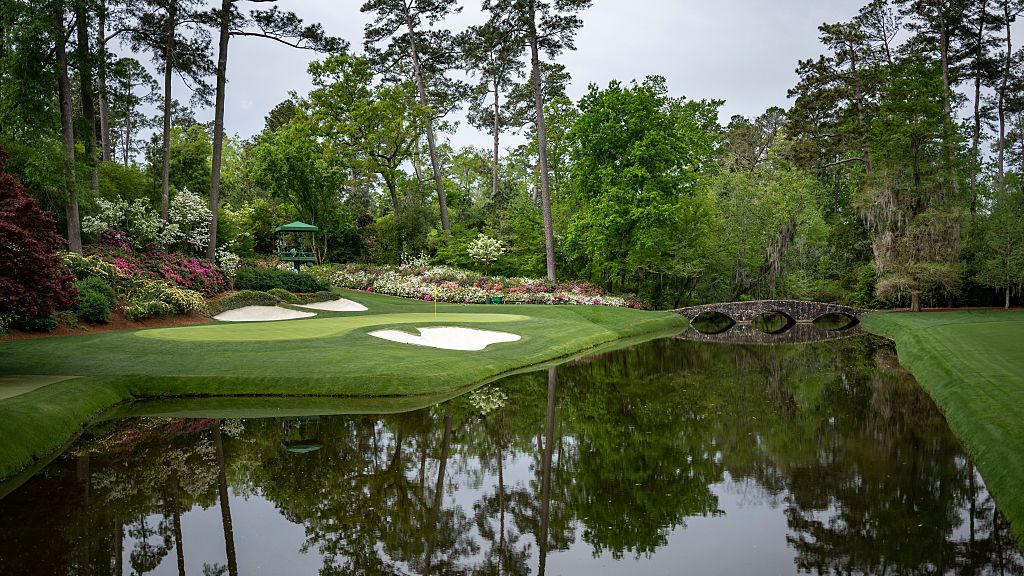
The PGA TOUR has reached the first major championship of the season, which means it’s time for the Masters Tournament. The Masters is probably the most famous tournament each year that provides the most memories, nostalgia and traditions for any golf fan. It truly is a “Tradition Like No Other” and one of the best weeks in golf every year. Unlike the other majors that are played in different venues, the Masters Tournament takes place every year at Augusta National Golf Course in Augusta, Georgia. The major championship will be held this year from Thursday, April 9, through Sunday, April 12, barring any weather delays.
Let’s start Masters week with a look at the format, history and course for the Masters Tournament.
The Format of the Masters
An invite to the Masters is one of the most prestigious honors players can win. This year, the field is 91 players deep with the top 50 (and ties) making the cut and playing the weekend. All four rounds are played on Augusta National Golf Course, a par-72 that is one of the most well-known tracks to any pro or golf fan. Almost every hole has iconic memories and performances tied to different places throughout the track.
The purse for the Masters has not beek announced for 2026, but will likely exceed last year’s total of $21 million. The winner claimed $4.2 million and the iconic green jacket, which will be placed on the winner by Rory McIlroy, last year’s champion.
The history of the tournament
The Masters has more history attached to it than almost any other event on the PGA TOUR. It began in 1934 after grand slam winner Bobby Jones and architect Alister MacKenzie spent four years transforming the property from a plant nursery. The names of the holes still honor “The Fruitland Nurseries.” Each hole features the shrub, flower or tree that is in the name of the hole along the layout of the hole. The club claims that more than 80,000 plants of over 350 varieties have grown around the property over the years.
The tournament began in 1934 as the “Augusta National Invitation Tournament.” Horton Smith walked away with the victory and claimed the first-place purse of $1,500 (and no green jacket). The next year, the front-9 and back-9 flipped in the order, setting the course in its current order of play.
The tournament wasn’t played for three years due to World War II, but the Masters grew into the event golf fans know and love today throughout the 1940s and 1950s. The famous green jacket tradition began in 1949, and the Champions Dinner occurred for the first time in 1952, when Ben Hogan was the host. The par-3 event, which is such an iconic part of the week now, started in 1960.
Throughout its history, the tournament has featured some of the best golfers in the world as champions. Jack Nicklaus has the most wins with six, just one ahead of Tiger Woods’ five victories. Arnold Palmer won four times, and Jimmy Demaret, Sam Snead, Gary Player, Nick Faldo and Phil Mickelson each won three times. Gary Player was the first non-American to win the tournament in 1961, and Seve Ballesteros was the first European when he won in 1980. Almost any legendary career has to include a win at Augusta National to validate that players status as one of the greats.
In 2020, the COVID-19 pandemic moved the event to the fall, but it has returned to its spot as a rite of spring for each of the past five years. Scottie Scheffler won two of those years in 2022 and 2024, and Rory McIlroy completed his career grand slam last year in one of the most memorable finishes of any tournament in history.
Rory and Scottie are back this week looking to add another green jacket, but both of them have had up-and-down seasons to start 2026 for a variety of reasons. The LIV Golf players add even more drama to the field with Jon Rahm, Bryson DeChambeau and Patrick Reed leading a group of 10 LIV Golfers teeing it up. It feels like oen of the most wide-open Masters in a long time, so get ready for what is sure to be a wild (and memorable) ride down Magnolia Lane.
Check out the full field and odds on DraftKings Sportsbook to see all the players teeing it up this year
A Closer Look at the Course
Statistically, Augusta National has more predictive course history than any other course in the regular PGA TOUR rotation by a wide margin. Players who claim the green jacket have usually been chasing it for a while and have come close before claiming the prize. Famously, Fuzzy Zoeller in 1979 was the only first-timer to win at the event since 1935, just its second year. This year, 22 golfers will be playing Augusta for the first time.
The par-72 is long and requires both precision and accuracy off the tee, but it does feature generous fairways. It offers scorable holes but often leaves players facing tricky approach shots into severely sloped, lightning-fast green complexes. It’s a true test of every club and very creative shot-making.
The course has so many iconic nooks and crannies where specific players have had adventures or misadventures through the years. Every hole has so much history and so many memories that it is hard to pinpoint just the best or most famous parts of the course.
The most well-known section of the layout is probably “Amen Corner,” which is the nickname for the second shot at No. 11, all of hole No. 12 and the first two shots at No. 13. Ike’s Pond, Rae’s Creek and the famous Sarazen Bridge are some of the other most famous landmarks around the course, each with its own backstory and history.
Each hole has multiple risk/reward options, leaving players with strategic choices to make almost every time they step up to swing a club. The course has historically played very difficult relative to par. In the last four tournaments, the average score has been +1.34 strokes per round, making it the toughest annual course in the rotation. The par-3 holes are especially difficult due to their bunkering and difficult green complexes. Par-5 scoring is also extremely important this week since eagles are available but danger lurks that can turn them into double-bogey risks as well.
Course history at Augusta specifically and majors in general is a key factor to consider this week, along with current form. Strokes Gained: Tee-to-Green and Strokes Gained: Approach are key factors to consider this week, along with Strokes Gained: Par 5 and Bogey Avoidance, especially on difficult layouts.
The course usually does a great job providing a tough but fair test that has the best golfers in the field battling it out down the stretch on Sunday for a place in history. This year’s event should be another exciting one with plenty of storylines and drama, so be sure to get your DFS fantasy golf lineups and betting cards filled out with the help of DK Network throughout this week!