With less than 10 games remaining in the NBA season, 20 teams are effectively locked into either the playoffs or the Play-In Tournament and are jostling for position amongst themselves, nine are making a mad dash to the bottom of the standings in order to secure better lottery odds, and the New Orleans Pelicans should be tanking but don’t own their own first-round pick.
In battles between two tanking teams, anything can happen, and this season, the Washington Wizards and Utah Jazz have been arguably the most egregious tankers in basketball. Both have shut most of their starters down for indefinite periods and have been putting out lineups filled with two-way and 10-day players. Casual fans could be forgiven for not knowing a single player who will take the court for either team tonight (or, at the very least, for not knowing that the players were on the Wizards and the Jazz).
Washington will be without Kyshawn George (elbow), Tre Johnson (foot), Alex Sarr (toe), Trae Young (back/quad), Tristan Vukcevic (back) and Cam Whitmore (deep vein thrombosis) in addition to Anthony Davis (hand) and D’Angelo Russell (not with team), who have yet to make their team debuts. Meanwhile, for Utah, Isaiah Collier (hamstring), Kyle Filipowski (illness), Keyonte George (hamstring), Jaren Jackson Jr. (knee), Walker Kessler (shoulder), Lauri Markkanen (hip), Jusuf Nurkić (nose), and Brice Sensabaugh (rest) are all out, with Cody Williams (shoulder) questionable.
The Jazz are 4.5-point favorites at DraftKings Sportsbook (-180 on the Moneyline), with the point total set to 238.5. Meanwhile, the Wizards are +150 on the Moneyline. Below, I’ll break down this battle of tanking teams and offer a prediction.
Washington Wizards at Utah Jazz preview, prediction
Washington decided to get a quick, five-game cameo with Young in the lineup before shutting him down again, and he was solid, averaging 15.2 points in 20.8 minutes per game while canning 42.9% of his triples. It has also had Sarr in and out of the lineup, as he’s played six games since the All-Star break. With both players good enough to be part of their core next season and also good enough to lead to unwanted wins in the interim, the Wizards have been experimenting with cheaper role players around them, getting some productive minutes from Leaky Black and Julian Reese.
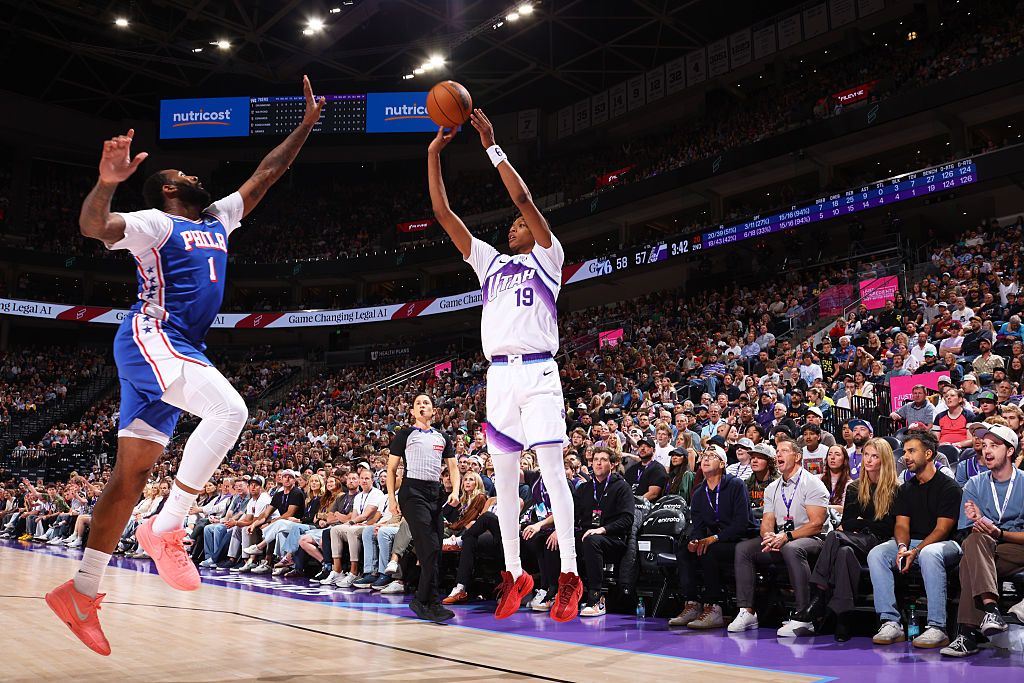
Utah has also been testing out less-heralded players to fill out its bench around its core pieces once Kessler and Jackson return next season. That includes giving major opportunities to 10-day players like former Ivy League Defensive Player of the Year Bez Mbeng, who’s averaged 1.5 steals per game across the last six games despite providing nothing on offense. The Jazz have also given free reign to fifth overall pick Ace Bailey, who’s had at least 25 points in each of his last three games. Bailey and Kennedy Chandler, who was signed to a 10-day contract earlier this week, should be Utah’s top scoring options.
Wizards at Jazz pick, best bet
With so much roster turnover, it’s hardly a surprise that both of these teams have been awful as of late. In the last 10 games, Washington has been out-scored by 15.6 points per 100 possessions despite having Young on the floor for five of them, losing each contest and infamously giving up 83 points to Bam Adebayo. The Jazz have been better across that span, in part because they waited to shut down George and in part because Bailey, who was the consensus No. 2 overall prospect in the 2024 high school class, has been on a tear. All in all, he’s averaged 19.4 points per game on 40.2% shooting from deep since the All-Star break, making a late run for All-Rookie First Team. The Wizards’ rookie revelation has been Will Riley, but he’s been both less productive and less efficient than Bailey across the same span while providing even less defensively.
Looking at each team’s lackluster interior defense, the fact that both have struggled recently is unsurprising. Utah has been gettable in the restricted area all season, and that’s been even more true since the start of March, as the Jazz have allowed a putrid 73.8% conversion rate on layups this month. Washington’s percentage (69.3%) is slightly lower, but it has allowed opponents to get to the rim at will, attempting 37.2 restricted-area tries per game (4.7 more than any other team). The Wizards might be able to get away with it slightly tonight against Utah, which struggles to penetrate inside, but they don’t drive or finish well enough to regain the overall advantage in paint play.
The Jazz should be able to extend their advantage on the glass, given that Washington has also been the league’s worst rebounding team this month, snagging just 44.5% of all available boards. While Utah hasn’t been good in that aspect this month, it hasn’t been historically awful, and it has been significantly better on the boards without Collier, Sensabaugh, and Filipowski. The young, athletic Jazz also rank near the top of the league in both points off of turnovers and fast-break points in this month, while the Wizards have struggled in that facet of the game, too. Utah also has a significant foul advantage, as Washington has been extremely indisciplined (the biggest reason Adebayo was able to record 83 points).
Shooting will be key for both teams, which should advantage the visitors; in March, the Jazz have allowed the second-most wide-open threes, and while the Wizards have managed to allow a below-average number, that’s in large part a result of their giving up so many layups. Both teams have gotten fairly unfortunate as of late, as Washington’s opponents have converted their triples at the third-highest rate and Utah’s at the seventh-highest. The Wizards have generated more wide-open looks than the Jazz this month and shot far better, and with all of Utah’s above-average shooters out, that could be somewhat sustainable, though Bailey’s sample of elite shooting is large and Washington will be without its best shooter, Johnson.
Picking the Jazz to win with the lineups that they’ve been trotting out lately feels risky, and it’s always possible that Washington could get hot from deep and take advantage of Utah’s porous perimeter defense, it’s just difficult to pick a team that has allowed 37.2 restricted-area shots per game in the last three and a half weeks. The Jazz have had a tendency to take leads early in games and end up losing — for instance, they did just that against the Philadelphia 76ers on Saturday — and it wouldn’t be a surprise to see them do that again tonight.