The Best Picture race always turns into a referendum on what the Oscars think movies are for. Some years that means solemn historical sweep. Some years it means a tasteful grief object in immaculate tailoring. And some years—like this one—it means a lineup so stylistically split, so full of monsters, misfits, hustlers, haunted families, political paranoiacs, and prestige machines running at radically different temperatures, that the category feels less like a consensus and more like an argument. This year’s field has room for Ryan Coogler turning a vampire movie into a full-blooded cultural event, Paul Thomas Anderson staging a big-canvas political scramble with establishment strength, Guillermo del Toro building a gothic lament out of inherited myth, and Joachim Trier once again making domestic wreckage feel like the most cinematic thing in the world. In other words, this is not a sleepy Best Picture slate. It is a weirdly live one. So before Oscar night locks one of these films into official history, it is worth looking at what each nominee is doing in the race, what kind of winner it would be, and which movie still feels best positioned to actually hear its name called at the end.
Find our predictions for other major 2026 Oscars categories here!
- Best Actor
- Best Actress
- Best Supporting Actor
- Best Supporting Actress
- Best Director
- Best Original Screenplay
- Best Adapted Screenplay
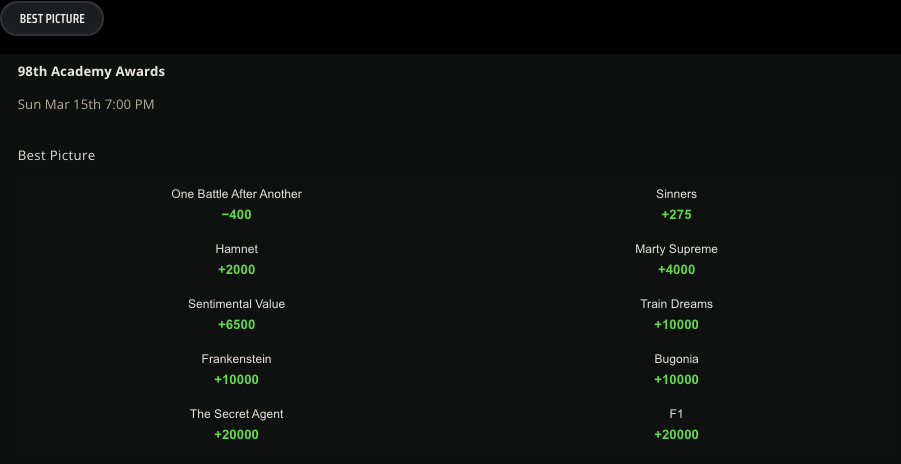
The 98th Academy Awards will air live from the Dolby Theatre on Sunday, March 15, at 7 p.m. ET on ABC. And the Best Picture field this year feels absolutely jubilant. For those of you interested in turning the event into some action, check out the below odds for the juice.
2026 Oscars Best Picture Nominees
Bugonia
Lanthimos is back on his favorite frequency: panic, absurdity, power, rot. Bugonia takes a deranged premise—two conspiracy-poisoned men kidnap a pharmaceutical CEO because they think she is an alien—and treats it less like a gag than a diagnosis. That’s the whole appeal. This is Emma Stone and Jesse Plemons in a movie that sounds engineered to make prestige audiences laugh, squirm, and briefly wonder whether modern life has simply become a corporate UFO cult. The Academy clearly liked it enough to put it in Best Picture and Best Actress and to recognize Will Tracy’s adapted screenplay, but the ceiling still feels obvious. Bugonia is the nominee people defend with zeal; the one the room settles on after dessert will be a different story. It has the aura of a cult object that snuck into the ballroom and refused to put on a tie. That rules. It is also usually how a movie finishes nominated, not crowned.
F1
Kosinski’s F1 is this year’s reminder that old-fashioned movie-movie craft still has a pulse. And that the Academy might enjoy a little fun. Brad Pitt’s Sonny Hayes—the greatest that never was, dragged back for one last lap beside Damson Idris’s Joshua Pearce—gives the film a classic comeback substructure, but that is almost beside the point. The sell here is movement: velocity, machinery, muscular editing, and the kind of premium-engineered spectacle the Academy likes to salute once it has convinced itself the blockbuster in question is serious enough. That nomination haul reflects exactly that: Best Picture, Editing, Sound, and Visual Effects. The issue is not whether F1 works. It plainly does. The issue is that Best Picture winners usually arrive with either auteurist myth, emotional devastation, or a larger cultural argument attached. F1 feels more like the nominee everyone is happy made the field—the handsome studio beast that proved big-screen craftsmanship still matters—than the one voters need to make history with.
Frankenstein
Del Toro finally making Frankenstein always had the air of destiny about it, didn’t it? Not an adaptation, exactly, but a homecoming for the man. Netflix’s setup is elemental—Victor, the Creature, monstrous ambition—but the film’s awards profile tells the fuller story. The Academy embraced it for Best Picture, production design, costumes, makeup, score, sound, and adapted screenplay, which is another way of saying voters responded to the world-building and the melancholy machinery of the thing. Oscar Isaac and Jacob Elordi were never going to play this material as mere gothic furniture; with del Toro, the whole point is that the creature is the wound, not the spectacle. Still, Frankenstein feels more like a below-the-line colossus and passion nominee than the consensus choice. Voters clearly respected the film’s handiwork and del Toro’s authorship. They just do not seem to be organizing around it as the defining statement of the year. It is too mournful, too handcrafted, too elegantly monstrous to be dismissed—and probably too singular and not quite good enough to actually win.
Hamnet
Chloé Zhao’s Hamnet has one of those premises that can go inert if handled too reverently: Shakespeare, grief, literary afterlife, all the usual awards-bait perfumes. Instead, the film seems to have landed as something rawer and stranger. Focus frames it as the love-and-loss story behind Hamlet, but the actual hook is Jessie Buckley, whose Agnes has become one of the season’s steadiest acting forces. The Academy backed the film across Best Picture, Best Director, Best Actress, Casting, Costume Design, Score, and Adapted Screenplay, which suggests voters saw it as more than tasteful sorrow in period cloth. Even so, Hamnet reads like the year’s grand heartbreak rather than its inevitable champion. It is the sort of movie people admire intensely, maybe even cherish, but Best Picture now tends to require some extra current—urgency, sweep, noise, the feeling that a win would say something public. Hamnet feels private in the best way. That may also be the thing that keeps it from the top prize.
Marty Supreme
Josh Safdie turned table tennis into an anxiety spiral and somehow got the Academy to nod along to the volley. Call it Timmy magic. That, by itself, is an achievement. A24’s synopsis is beautifully blunt: Marty Mauser goes to hell and back in pursuit of greatness. Which means Marty Supreme is operating in the classic Safdie lane—hustle as religion, self-invention as pathology, humiliation as propulsion—except now the vessel is Timothée Chalamet in full grease-slick American-dream mode. The nomination profile is telling: Best Picture, Directing, Original Screenplay, Cinematography, Editing, and Casting. In other words, voters responded to form as much as performance, to the jagged rhythm of the movie and not just its central mania. But that same mania is the limit. Marty Supreme feels like the film younger voters and true believers rank first because it actually leaves a bruise. Best Picture, though, is often won by the movie that survives compromise. This one feels designed to make compromise impossible, because its stakeholders and creators are so uncompromisingly maverick. That is part of its voltage, and probably why the nomination is the win.
One Battle after Another
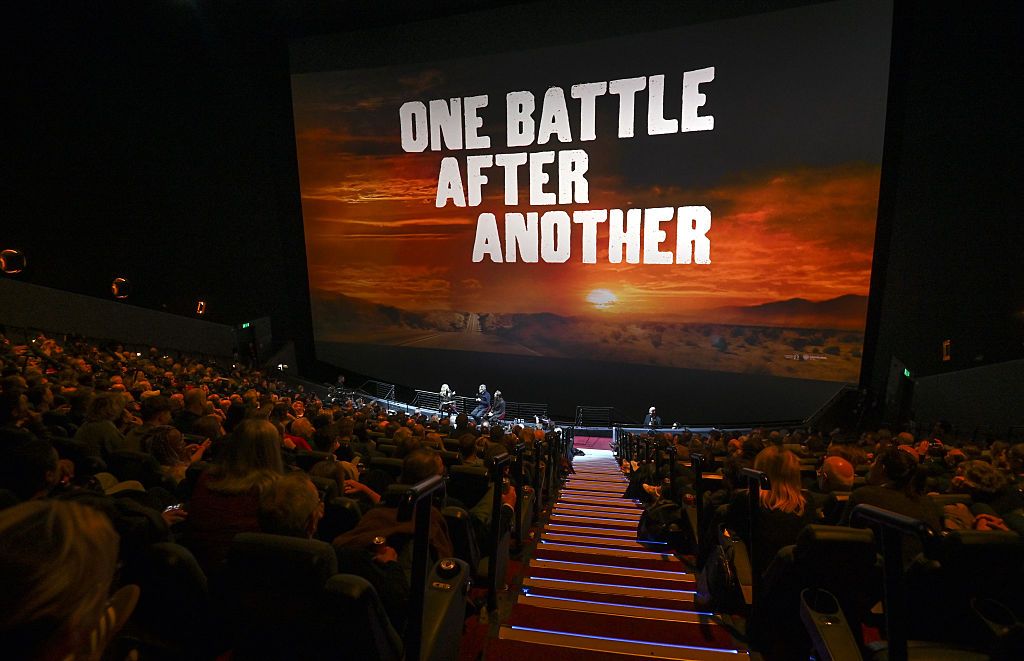
This is the nominee with the cleanest winner silhouette. Anderson’s film has the premise of a political pulp fever dream—ex-radicals, an old nemesis, a missing daughter, DiCaprio in stoned-paranoia mode—and the shape of a broad coalition movie: big, legible, auteur-stamped, funny, angry, kinetic. The official site sells it as Bob trying to outrun the consequences of his past when Sean Penn’s villain reappears and Chase Infiniti’s Willa vanishes; the awards season math sells it as the film the industry kept choosing when it mattered most. It won Critics Choice, BAFTA Best Film, the Producers Guild’s top prize, and the DGA feature award. That is not just momentum. That is institutional fluency. One Battle after Another is the rare contender that can be pitched as both major entertainment and major statement, the sort of movie voters can rank high without feeling they are sacrificing pleasure for importance or vice versa. It looks like the establishment pick because it became the establishment pick by doing almost everything excellently. True to form.
The Secret Agent
Kleber Mendonça Filho’s The Secret Agent is the sort of nominee that makes the category feel alive simply by being there. NEON’s synopsis gives it a clean spine—Brazil, 1977, Marcelo on the run, Recife during Carnival, danger where refuge was supposed to be—but the movie’s real calling card is atmosphere: history turned fever dream, politics refracted through place, and Wagner Moura carrying the whole thing with the kind of magnetic exhaustion critics adore. Cannes already told the story: Best Director, Best Actor, FIPRESCI. The Academy answered with Best Picture and International Feature, which is no small gesture for a film this specifically Brazilian and this tonally slippery. But it still reads as a cinephile passion candidate more than a genuine Best Picture closer. The nomination says the film broke containment; it is no longer just the international critics’ favorite in the corner. Winning Best Picture would require a much larger consensus leap. Its place in the lineup is already its own kind of victory.
Sentimental Value
Trier is back in the family-romance-autopsy business, which means Sentimental Value arrives already carrying a certain kind of devotion. The setup is gorgeous catnip: two sisters, an estranged father who is also a once-famous director, a comeback movie, a rejected role, and then an American actress dropped like a lit match into old domestic wreckage. NEON’s synopsis makes it sound elegantly combustible; the Academy response makes clear it hit hard. Best Picture, Best Actress for Renate Reinsve, two supporting actress nominations, Original Screenplay, Editing, and International Feature is an impressive spread for a film this intimate. But intimacy is also the barrier. Sentimental Value feels like the nominee that proves the Academy still has taste, that still knows how to honor a movie built on minute emotional humiliations rather than giant campaign slogans. It may even be the most purely loved movie in the lineup on a scene-by-scene basis. That is different from being the one voters anoint as the year’s emblem. It feels too inward, too beautifully bruised, to become the night’s consensus headline.
Sinners
Coogler’s Sinners is the movie that turned the entire race from orderly to dangerous. On paper, the pitch is already absurdly potent: twin brothers in 1932 Mississippi return home to start again and discover that something monstrous is waiting there. In practice, it became something bigger—a vampire picture, a blues picture, a Jim Crow ghost story, a Michael B. Jordan double-performance flex, and the most-nominated film in Oscar history with 16 nods. The Academy hit it everywhere: Picture, Director, Original Screenplay, Cinematography, Editing, Score, Song, Production Design, Sound, Makeup, Visual Effects. Then came the late-race surge: SAG-AFTRA’s Actor Awards gave it ensemble, and Jordan won lead actor there too. That is real heat. The only reason it is not my predicted winner is that the race’s other titan built an even sturdier precursor wall. But Sinners is the movie with the loudest pulse in the category—the one that feels least like a compromise and most like a takeover.
Train Dreams
Clint Bentley’s Train Dreams is the quiet one, which usually means one of two things in an Oscar lineup: either it is wallpaper, or it is the movie people will be writing love letters to in a decade. Netflix sells it simply—a logger moving through love, loss, and an America remaking itself in the early 20th century—and that simplicity is clearly the point. Denis Johnson adaptation, Joel Edgerton, a vanishing world, the dignity of ordinary life: this is prestige stripped of fuss. The Academy gave it Best Picture, Adapted Screenplay, Cinematography, and Original Song, which is a modest but meaningful package. No massive acting branch embrace, no directorial push, no impression of an insurgent coalition gathering around it. Train Dreams feels like the nominee voters were grateful to have seen, a hushed elegy admitted into a noisy room. That is valuable. It is not usually a winning formula. The film’s afterlife may wind up richer than its Oscar night.
Prediction: One Battle After Another (-400)
The upset case for Sinners is easy to make because it is the movie with the most obvious surge energy. It leads the nominations with a record 16, it won the SAG-AFTRA Actor Awards ensemble prize, Michael B. Jordan won there too, and it has the kind of cross-branch affection that can turn a ranked ballot into chaos. If the Academy wants to crown the movie that felt most culturally alive, most formally exuberant, and most impossible to ignore, that path is sitting right there.
But prediction is not the same thing as desire, and the underlying race map still points to One Battle after Another. Anderson’s film won Critics Choice for Best Picture, the PGA’s Darryl F. Zanuck award, BAFTA Best Film, and the DGA’s theatrical feature prize. That is the kind of precursor stack that usually stops being “momentum” and starts becoming a forecast. The Ringer’s final read on the race makes the same basic argument: Sinners is the live threat, but One Battle after Another still has the deeper résumé and broader institutional support. Prediction markets have also kept Anderson’s film out front, even with Sinners closing hard late. Finals voting ran from February 26 through March 5, which means the late Actor Awards shock absolutely mattered, but it landed against a season’s worth of evidence already pointing the other way.
So that is the call: Sinners is the movie most likely to turn the room electric, but One Battle after Another is still the movie most likely to survive every room in the building. That is usually how Best Picture gets won.
The spoiler is Ryan Coogler (Sinners), because Director is where the Academy can make a clean, forceful statement in a crowded Best Picture year. If Picture fractures, and voters want to honor the year’s loudest act of orchestration, Coogler’s the pivot. But if the ballot follows the “most complete film grammar” instinct, Anderson’s the closer.