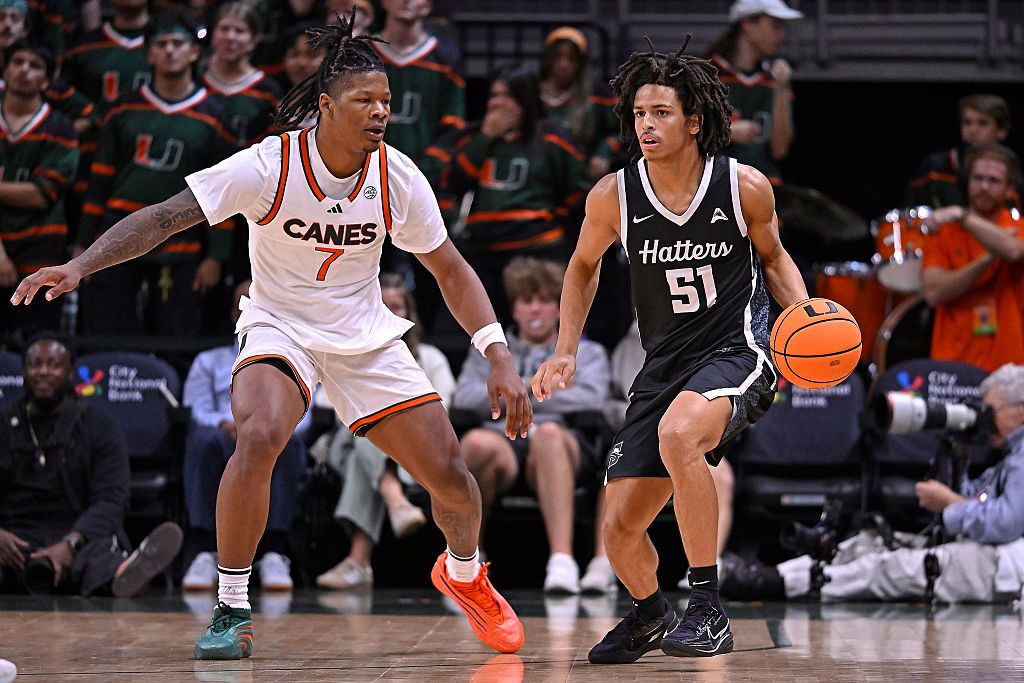
Austin Peay enters the ASUN quarterfinal carrying the profile of a true conference contender. The Governors finished the regular season 21-8 overall and 15-3 in league play, sharing the ASUN regular-season title and earning the No. 2 seed with a first-round bye in Jacksonville. Stetson arrives from the opposite end of the bracket. The Hatters closed the regular season 12-20 overall and 7-11 in conference, good for the No. 10 seed, but they kept their season alive by knocking off Eastern Kentucky 92-76 in the opening round to reach this matchup. Below is my preview, prediction, and pick for tonight’s college basketball game between the Austin Peay Governors and the Stetson Hatters.
Here’s how I’ll play it. I’ll be pumping out these predictions for individual games all season, with plenty of coverage here on DraftKings Network. Follow my handle @dansby_edits for more betting plays.
Austin Peay vs. Stetson prediction, preview
The Governors’ offense runs through a balanced three-player core that keeps their efficiency floor high every night. Collin Parker leads the team with 18.0 points per game, while Rashaud Marshall averages 6.2 rebounds and point guard Zyree Collins adds 4.2 assists and 2.1 steals per game, giving Austin Peay scoring balance, interior efficiency, and ball security. The offense as a whole produces 81.7 points per game on 46.6% shooting and 36.1% from three, while converting 74.4% of free throws, translating to a 115.5 offensive rating and a top-75 offense nationally. The possession mechanics are just as strong: the Governors average 16 assists against only 10.9 turnovers, generating a 1.5 assist-to-turnover ratio, while also producing nearly 19 points per game off turnovers thanks to an aggressive perimeter defense. Stetson’s offense is built very differently. The Hatters rely heavily on perimeter creation and high-volume shooting, launching 669 three-point attempts and making 230 (34.4%), which averages 8.8 made threes per game. That shot distribution creates far more volatility: when the perimeter connects the scoring ceiling jumps well above their season average of roughly 72–73 points per game, but the offense also carries drought risk.
The head-to-head results show how those styles interact statistically. Austin Peay swept the season series 81-69 and 73-65, margins of 12 and eight points, almost perfectly matching the current spread band. In the January matchup in DeLand, Parker scored 27 points while Austin Peay built its edge through possession control rather than pace. The box score highlights the structural difference: Austin Peay shot 48% from the field, forced 14 Stetson turnovers, and converted those mistakes into 15 points off turnovers and 15 fast-break points. Those categories represent the Governors’ true separation engines. On the season Austin Peay averages 35.8 rebounds per game, slightly above Stetson’s 33.3, and generates far more transition opportunities because of its defensive pressure. When those possession advantages appear, Austin Peay gradually builds scoring margins—but the important detail is that neither meeting produced a runaway result. Both games landed inside the single-digit-to-low-double-digit range, exactly where the current number sits.
Over the last 10 games, Austin Peay’s offense has remained remarkably stable while the defense has loosened slightly. The Governors are still producing roughly 81–83 points per game on about 46–47% shooting, almost identical to their season baseline of 81.7 PPG on 46.6% from the field and 36.1% from three. The possession engine that drives that efficiency hasn’t changed: Austin Peay averages 16 assists against only 10.9 turnovers, a 1.5 assist-to-turnover ratio, while generating 19.3 points per game off turnovers thanks to aggressive perimeter defense. What has changed is the defensive trend. The Governors’ season average sits at 71.2 points allowed, but recent games have pushed opponents closer to the mid-70s scoring range, reflecting slightly weaker defensive efficiency and more open perimeter looks.
Stetson’s trajectory has moved in the opposite direction offensively. The Hatters average 72.6 points per game on 44.3% shooting, but their last-10 scoring average has climbed into the upper-70s, driven almost entirely by perimeter efficiency. Stetson’s offense is structurally built on three-point volume—230 made threes on 669 attempts (34.4%), which averages as 8.8 made threes per game and more than 21 attempts per night. Because such a large share of their scoring distribution comes from beyond the arc, small swings in shooting efficiency create large scoring swings. That volatility was visible in the ASUN tournament opener, when Stetson exploded for 92 points in a 92–76 win over Eastern Kentucky, fueled by hot perimeter shooting and clean possessions.
Stetson vs. Austin Peay pick, best bet
Over the last five games, Stetson has produced multiple high-efficiency offensive nights, including the 92-point outburst, a performance built on 50%+ overall shooting, double-digit made threes, and very low turnovers, the exact statistical formula that allows their offense to spike far above its season average. The possession indicators reinforce the trend: Stetson’s perimeter-heavy attack means nearly one-third of their field-goal attempts come from three, so when the Hatters convert at even 36–38% instead of their 34% baseline, the scoring margin compresses quickly.
The interior and possession math still favors Austin Peay. The Governors average 35.8 rebounds per game compared with Stetson’s 33.3, giving them a modest but important edge in second-chance opportunities, while their transition pressure produces nearly 20 points off turnovers per game. In the earlier head-to-head meeting—an 81–69 Austin Peay win—those structural edges showed up clearly as the Governors forced 14 turnovers and turned those mistakes into transition scoring while controlling the rebounding battle. That is the stable separation engine in this matchup.
Stack those statistical layers together and the projection band tightens. Austin Peay’s structural advantages—rebounding, turnover margin, and free-throw efficiency—still make them the likely winner, but Stetson’s perimeter volume widens the variance window. The head-to-head margins (12 and eight points), the recent scoring trends, and the three-point distribution all point toward a game that clusters in the Austin Peay by 8–10 range. That leaves the number sitting directly in the danger zone for favorites laying double digits.
Best bet: Stetson +11.5. Final score somewhere in the ballpark of Austin Peay 84, Stetson 76.
Best bet: Stetson +11.5 (-115) vs. Austin Peay
Tail it with me in the DKN Betting Group here!