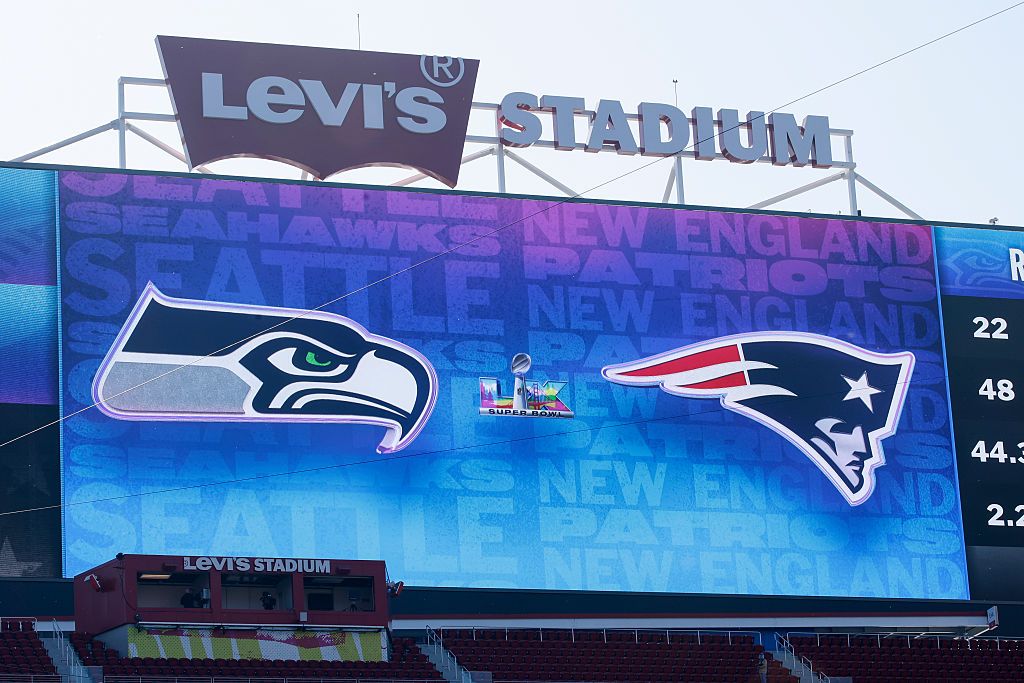
Sunday night at Levi’s Stadium, Super Bowl LX isn’t going to be decided by one highlight. It’s going to be decided by whose structure stays intact the longest. The Seattle Seahawks want the game compressed—heavy groupings, condensed splits, two-high patience, no cheap explosives. And, on the other side, the New England Patriots want mass and momentum—jumbo bodies, downhill carries, then play-action that turns one false step into seven points. The board says Seahawks -4.5 with 45.5, but that’s just the wrapper. The real story is which side wins the boring downs that stack into panic.
So this is the cleanest way to read it: five collisions that keep showing up in every serious breakdown, because they touch every possession. Christian Gonzalez versus Jaxon Smith-Njigba is the headline, but the geometry matters more than the nameplates. Seattle lived in condensed formations on 54.2% of snaps, because free releases are the whole point. The Patriots’ late-season jumbo surge is real, and Seattle’s answer is staying in nickel anyway, because that’s their identity. Drake Maye has the league’s best QBR, but he also took 47 sacks, so patience has to come with survival. Will Campbell dealing with DeMarcus Lawrence decides whether the Patriots can even call the full pass menu. And if Nick Emmanwori wins his box-and-slot snaps, Seattle gets to play fast without conceding the run.
Five matchups I’m watching (and betting) in Super Bowl 60
Everyone’s going to frame Super Bowl LX like it’s pure mythology. They’ll yap about the rematch ghosts, the legacy baggage, and whether Sam Darnold is exorcising his old narratives on the biggest stage. They’ll hammer the media-week theater—Opening Night quotes, body language, who won the podium, and the human-interest headlines, like Christian Gonzalez making history as the first player of Colombian heritage to appear in the game. And with a record $1.76 billion expected to be wagered, the loudest conversation will be about props, not football. That’s all fine for the cameras. It’s just not where the edges hide.
The edges live in the numbers that don’t trend on Sunday morning. One offense lived in condensed formations on 54.2% of snaps because free releases and traffic are the whole point. The other offense turned heavy personnel into a late-season identity, leaning on six-lineman looks to change the math before throwing over it. The rookie quarterback has the accuracy profile everyone celebrates—plus-9% CPOE and 8.7 air yards per attempt—yet he also carried a sack and ball-security tax that can flip a title game in four plays. And the defense on the other side has made a living staying in sub packages, changing pictures late, and forcing patience to coexist with survival. That’s the real movie: leverage, protection, and disguise—snap after snap—until somebody’s safe plan isn’t so safe anymore.
Ranked in order.
5. Klint Kubiak’s 12-personnel/condensed game vs. Patriots’ base front
All week, the loudest Super Bowl LX talk has been the easy stuff: contract clocks, legacy loops, who wants it more, and the rematch romance at Levi’s Stadium. Sam Darnold’s roster-bonus decision has turned into content bait, and the coaching-carousel chatter around Klint Kubiak is its own little soap opera. Mike Vrabel’s toughness aura gets repackaged every segment, and Josh McDaniels gets framed like he’s calling plays from a leather-bound spellbook. That stuff is fun, and it fills time. It’s also not where the game actually tilts.
The real edge is personnel physics, and it’s been hiding in plain sight for months. The Seattle Seahawks built an offense to force base defense, then punish it, and the New England Patriots answered with their own bigger counterpunch. Seattle ran condensed formations on 54.2% of snaps and lived in heavy subpackages on 54.2%, with the league’s lowest pass rate at 51.3%. In 12 personnel, they led the league at 7.5 yards per play, and that’s fifth-best by any team in the last decade. New England didn’t just dabble; it turned jumbo into a midseason identity shift, jumping to 87 jumbo snaps from Weeks 10-18 after six in the first nine games. That flip coincided with Patriots backs going from 3.8 yards per carry to 5.5 after Week 10, then a ridiculous 7.9 per carry with an extra lineman over the final eight regular-season games.
This is why the most boring matchup matters: the Patriots’ interior violence versus Seattle’s interior protection plan. Milton Williams can wreck a Super Bowl without anyone noticing until the punt count spikes, and his running mate Christian Barmore makes it worse because they win in the same space. Seattle’s soft spot is Anthony Bradford, and it’s not theoretical; he allowed a 15.3% pressure rate across two postseason games. Seattle’s entire pass architecture is built to avoid sit there and block it reps: only 62% of Darnold’s dropbacks are straight shotgun with no play-action, they’re under center 32% of the time, and he’s rolling out on 13% of dropbacks. That’s not aesthetic. That’s survival. The chess match inside the chess match is whether Seattle can keep those tackles running sideways and tired, or whether New England forces third-and-long and turns the game into a guard’s nightmare. See the image courtesy of PFF below.
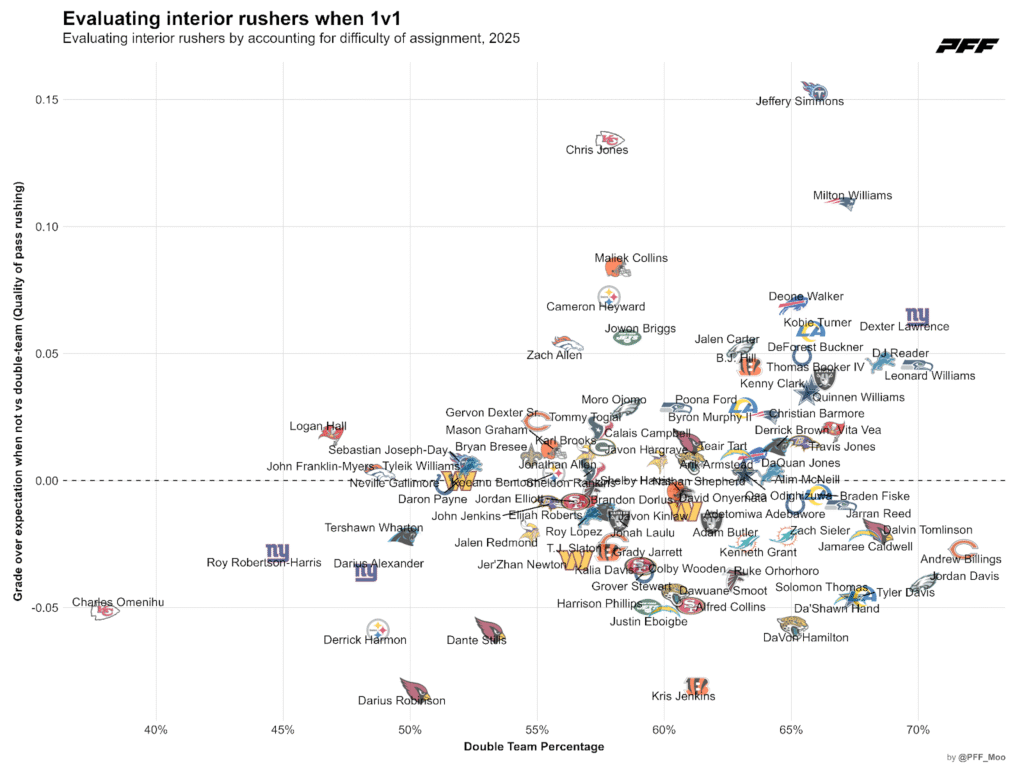
And here’s the part that makes this feel so Super Bowl-ish: one strip-sack changes everything, and the data says that door is real. Seattle ended 14.1% of drives with a turnover in the regular season, and Darnold’s turnover-worthy play rate under pressure was 7.2%, worst among starting quarterbacks. He’s sitting on six interceptions and five lost fumbles, so the just-take-the-sack sermon is not coach-speak; it’s math. If New England gets quick A-gap stress, Seattle’s cleanest response is to turn the run game into short passes and keep the sticks manageable, because every team eventually faces third-and-long. That’s where interior rushers stop being names and become a scoreboard.
If this matchup is the least sexy of the five, fine. It still decides how often the sexy stuff can even happen. When the interior collapses, coordinators stop being artists and start being firefighters. That’s why I’m betting the trenches to show up on the stat sheet—quietly, violently, and right on time.
Best bet: Sam Darnold 1+ interceptions thrown (-110)
Seattle ended 14.1% of drives with a turnover, Darnold’s turnover-worthy rate under pressure was 7.2%, and Anthony Bradford already allowed a 15.3% pressure rate this postseason. Tail this bet with me in the DKN betting group here!
4. Patriots’ jumbo/heavy run package vs Seattle’s nickel/dime answers
This matchup is the Patriots’ clearest attempt to drag the game into their preferred temperature: big bodies, downhill tracks, and “are you sure you want to tackle this again?” football. Super Bowl LX won’t be decided by one cute formation; it’ll get decided by whether New England Patriots can keep earning second-and-six without letting Seattle Seahawks turn drives into third-and-nine. The hard evidence is that New England didn’t just dabble in jumbo late—they lived there. They went from six total “six-lineman” snaps in the first nine weeks to 87 of them from Weeks 10 through 18, often with Khyiris Tonga moonlighting as an extra blocker. That shift yanked their run game out of the mud: RBs were at 3.8 yards per carry early, then 5.5 yards per carry from Week 10 on, and the jumbo-specific lane got cartoonish—7.9 yards per carry and ten touchdowns with the extra lineman body on the field. That’s not a tendency. That’s an identity they chose when the games got sharp.
Seattle’s counter is why this becomes a chess match instead of a bully session. Mike Macdonald basically dares teams to run (see image courtesy of PFF below) and then meets them with a defense built to win the exact thing it invites. The Seahawks have the confidence to stay in nickel against offensive sub-packages on 77.8% of snaps—no other defense even cleared 60.5%—and they still sit at 4.5 yards per play allowed in those looks. The reason that isn’t fragile is Nick Emmanwori, a DROY finalist, who’s a full-go for the game in that he’s off the injury report; he may be a bit slowed. If you were unfamiliar with Emmanwori before the NFC Championship game, his outstanding performance as broadcast by FOX’s Kevin Burkhardt and non-Patriots-rooting Tom Brady probably gave you a solid introduction.
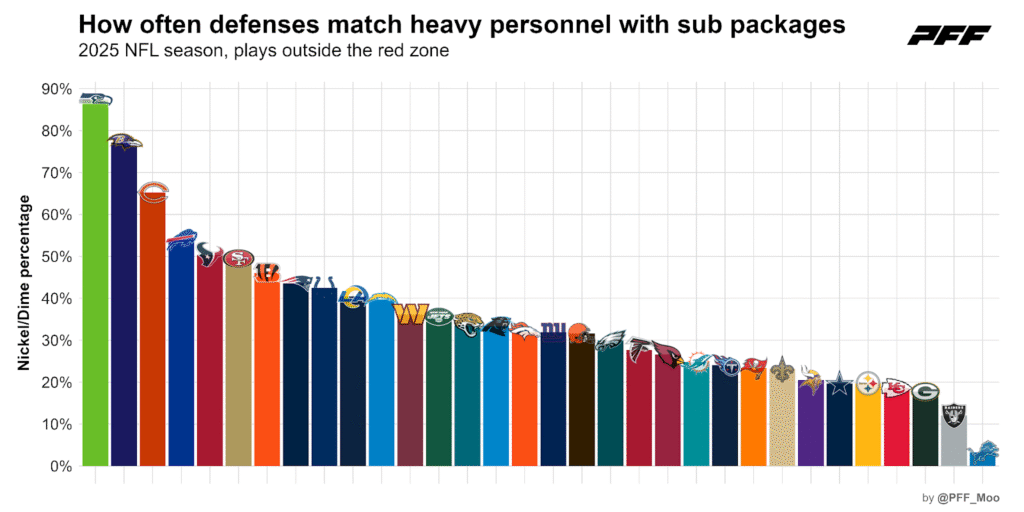
Emmanwori’s a 6-foot-3, 220-pounder who lets five DBs hit like base and move like nickel, and Seattle leans on that versatility because it keeps the disguise menu open. He’s not a garnish either; he’s lived in the box on 51% of his alignments, and he has produced like a front-seven player: 2.5 sacks, 11 passes defensed, and nine tackles for loss. The only sweat is health—he was limited Wednesday and didn’t practice Thursday with an ankle issue, and this is exactly the kind of matchup where one compromised plant foot matters.
Now fold the Patriots’ actual dudes into it, because this isn’t scheme vs scheme in the abstract. Rhamondre Stevenson is the tone-setter here; he led the league at 2.8 yards after contact per rush, which is basically a weekly argument with physics. TreVeyon Henderson is the counterpunch; he’s the perimeter juice, and he popped 18 runs of ten-plus yards this season. That pairing is why jumbo isn’t automatically a tell. New England can mash inside with Stevenson, then steal the edge with Henderson, then hit the same picture again and leak a back underneath when Seattle rotates late. ESPN even spelled out the pass-game angle: Seattle’s zone tendencies create outlet space for both backs. And the funniest part is that Seattle’s profile quietly agrees. They were stingy on pure rushing efficiency—just 3.5 yards per carry allowed in the regular season—but they still gave up the second-most RB catches (98) and a league-high 128 running back targets. So if the Seahawks win early downs with leverage and penetration, the Patriots’ answer isn’t panic throws; it’s backs as the extension of the run game.
This is also where Seattle’s pass-rush depth sneaks into a run matchup and starts tilting the drive math. If the Patriots go jumbo, the formation screams protection and angles, but it also dares Seattle to ruin the down with one loss. The Seahawks can rotate legit pressure bodies all night—New England’s own breakdown noted seven Seattle defensive linemen with 20-plus pressures this season: Leonard Williams, DeMarcus Lawrence, Byron Murphy II, Uchenna Nwosu, Derick Hall, Boye Mafe, and Jarran Reed. One negative run, one stunt win, one tackle-for-loss, and suddenly the Patriots are behind schedule against a defense that lives for that feeling. That’s why this battle isn’t just about yards; it’s about whether New England can keep the chains clean enough to stay patient and keep calling the heavy stuff.
Best bet: Rhamondre Stevenson 4+ receptions (+125)
Seattle gave up 98 RB catches and 128 RB targets. I believe it’s all setting up for a Stevenson legacy game. He led running backs players in yards-over-expectation. Maye wants to get him the ball. Tail this bet with me in the DKN betting group here!
3. Will Campbell vs Demarcus Lawrence
It’s important to meet folks where they are at social gatherings, so even the most meticulously-and-eclectically-curated archives of ball knowledge are going to find themselves at parties, talking about the two quarterbacks like they’re the whole movie. We know, though the real movie is whether New England’s offense gets to stay in rhythm, or has to live in emergency mode. This line has talent, but it’s young in the spots that matter most. Jared Wilson is a rookie inside, and the whole unit has shown the seam in January. Over three playoff games, New England has allowed a 38.3% pressure rate and an 8.7% sack rate, and the sack count has ballooned to fifteen. The tax isn’t only protection either. Maye’s pressure-to-sack rate has sat around 23% this season, and league average is closer to 17%. That one split is the difference between third-and-five and third-and-a-billion. It’s also how a game that feels fine on early downs turns into a punt festival by the second quarter.
Campbell’s problem isn’t effort or toughness. It’s physical geometry, and it’s no fun to talk about. But perhaps the only knock on Will Campbell in my scouting process—and I noted this in my draft pick grade for the Patriots at six-overall; I gave it a like-not-love B- —was his short reach/extension, and concerns about how some more of the NFL’s physically-imposing edge rushers would be at automatic advantages.
In the playoffs, his pressure rates allowed have been 17.2%, 12.1%, and 15.0% (see image courtesy of PFF below), and the deeper cut, again, is when the reach comes into play. Per NFL Next Gen Stats, his pressure rate allowed jumps from 11.0% to 14.0% when the rusher has 33.5-inch arms or longer, and 8.5 of his 11 sacks allowed came against that long-arm threshold. That’s a pattern. Lawrence lives in that type at 33.75-inch arms, and when Seattle rotates into late-and-long juice, the escape hatch still has teeth because Derick Hall has 34-inch arms. Lawrence doesn’t need to win in two seconds to ruin the down. His time-to-pressure has lived around 3.05 seconds, which is perfect for collapsing the platform right when Maye wants to hitch and rip. Even a non-sack rep can still be a kill shot if it forces a late throw into a split-safety picture.
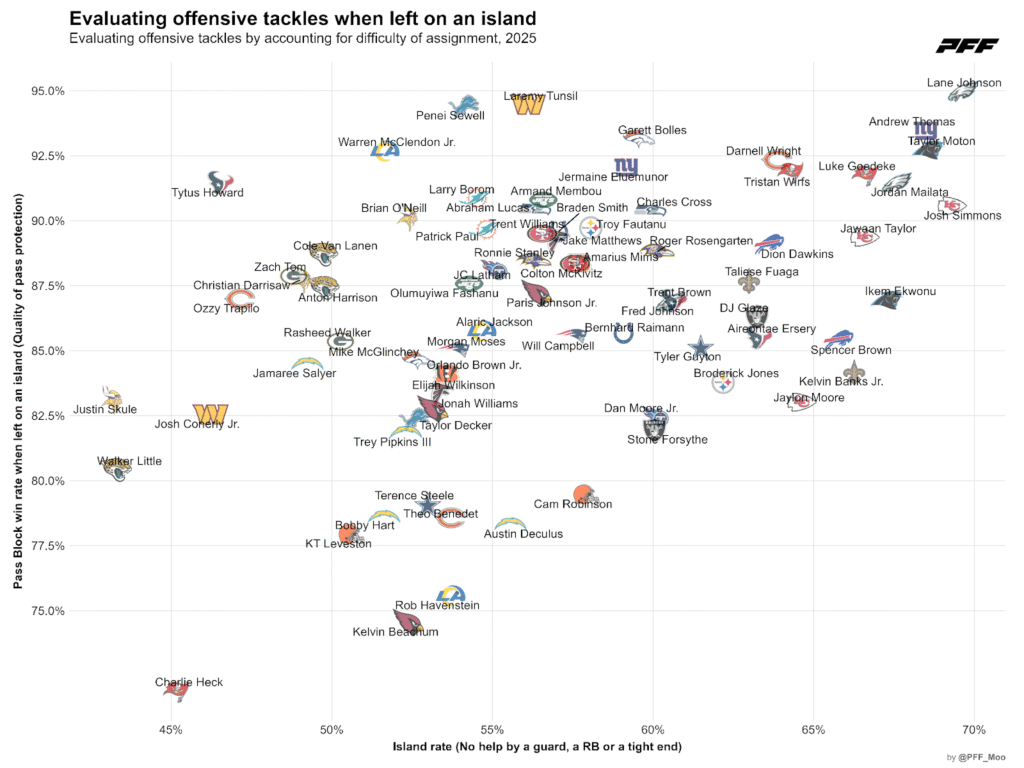
The coolest part of Seattle’s plan is that it doesn’t need Lawrence to win like a slot machine. It can win like a metronome. Lawrence aligns on the left edge nearly half the time, and Seattle can layer stunts and inside games to stress communication, not just one-on-one talent. If New England starts sliding help, that help has a cost. Keep Hunter Henry in to chip and the route tree thins. Ask Rhamondre Stevenson to scan and the checkdown becomes the only honest outlet. That’s how one edge matchup quietly dictates where Stefon Diggs gets targeted and how quickly the ball has to leave. And that’s the trap. Seattle can rush four, keep the roof intact, and still make the Patriots spend bodies on protection. Every extra protector is one fewer route stressing coverage rules. That’s how “helping the tackle” quietly makes third down harder.
Seattle also isn’t just a Lawrence-and-vibes front. The wave crashes at the point, too. Leonard Williams can collapse pockets from depth, Byron Murphy II can win the interior shoulder, and Uchenna Nwosu is a clean changeup when protections start cheating toward Lawrence. When Maye extends, the rush gets extra time to turn pressure into drive-killers, and Lawrence himself has said that’s the stress point Seattle wants to exploit. This is where the Super Bowl gets cruel. One scramble drill that turns into a sack is a punt. One scramble drill that turns into a strip is points. And once New England feels that squeeze, the playbook starts shrinking toward quick game, screens, and survival throws that keep the chains moving but cap the ceiling.
Best bet: Demarcus Lawrence 1+ sack(s) (+125)
New England has been hemorrhaging pressure (38.3% rate, fifteen sacks allowed), Campbell’s long-arm leak meets Lawrence’s 33.75-inch reach, and Maye’s 23% pressure-to-sack tendency turns one clean win into a drive-killer. Tail this bet with me in the DKN betting group here!
2. Drake Maye vs the Dark Side
(More specifically, the Dark Side’s split-safety/four-man looks)
Maye went 354-for-492 for 4,394 yards with a 72.0% completion rate, 8.9 yards per attempt, 31 touchdowns, eight picks, a 113.5 passer rating, and a league-best 77.1 QBR. He also took forty-seven sacks and still dragged New England to 14–3, which tells the whole story: the ceiling is sky-high, but the floor lives in protection moments.
Now look at what the playoffs did to that shape. The Patriots’ offense dropped from 2.59 points per drive in the regular season to 1.24 in three postseason games, and Maye has completed under 60% in all three, with fifteen sacks, a 6.9 yards-per-attempt clip, and five turnover-worthy plays. That’s not “quarterback struggles,” that’s what happens when early-down structure cracks and every third down feels like an escape room.
Seattle’s whole identity is designed to keep that crack open without ever giving you the easy answer. Mike Macdonald lives in two-deep looks early; Seattle played two-deep coverages on nearly 57% of early downs, showed eight-man boxes just 7.7% of the time, and still ranked top-five in early-down run defense by EPA. The point is simple: keep explosives rare, force patience, then let the pass rush arrive on schedule.
And the rush does arrive, even when it doesn’t look like it should. Seattle posted a 35.2% pressure rate despite blitzing at the sixth-lowest rate, which is exactly the kind of math that makes quarterbacks hold the ball one extra beat and regret it. That pressure isn’t a one-man act either. Leonard Williams and Byron Murphy II both had six sacks, Uchenna Nwosu had 5.5, and DeMarcus Lawrence had four, with pressure coming in waves rather than one headline.
That’s why this matchup is more psychological than schematic. Maye’s best version loves the in-between time—Barnwell notes he led the league with seventy-seven explosive pass completions when the ball came out between 2.5 and 5.0 seconds after the snap. But Seattle’s entire mission is to make that window feel expensive. If the first read isn’t clean, the clock gets loud, and that’s when sacks and fumbles start creeping into the frame.
The counter is obvious, and it’s why this is Super Bowl football. If Seattle refuses to blitz, Maye can turn into a runner and punish spacing. He scrambled nine times for 125 yards this postseason, picked up six first downs, and forced five missed tackles—he can absolutely flip a drive with his legs when coverage stays disciplined downfield. That’s also where the supporting cast matters. If Stefon Diggs can win fast underneath and Hunter Henry can become the steady outlet, New England can stay out of hero ball and make this a chain-moving game instead of a fireworks contest. And there’s a real structural reason to believe the tight ends can matter: Seattle allowed 115 tight end receptions for 1,214 yards at 7.73 yards per target across nineteen games.
Best bet: Hunter Henry o39.5 receiving yards (-115)
Maye’s playoff: 15 sacks and 6.9 YPA. He’ll need to get it out quick. Seattle also allowed 115 TE catches and 1,214 TE yards this season, so the middle is a real lane. Tail this bet with me in the DKN betting group here!
1. Christian Gonzalez vs Jaxon Smith-Njigba
The cleanest Super Bowl question is also the cruelest. What happens when Christian Gonzalez and freshly-crowned 2025-26 OPOY Jaxon Smith-Njigba get the same stage, the same snap count, and a play caller who refuses to stop feeding his best problem. Seattle’s season has been a weekly argument that JSN can’t be handled, only managed. He finished with 119 catches, 1,793 yards, and ten touchdowns, then walked into the NFC title game and went for ten catches and 153 yards anyway. The league has spent two months calling him unstoppable in different fonts. The Patriots have spent two months building a defense that lives on leverage and totally avoids reactionary play.
JSN’s case starts with volume and consistency, but the deeper cut is versatility. He has only two games all season with fewer than 70 yards, including the playoffs. And he’s not living in the slot as a pure get open fast receiver anymore. Across the regular season and playoffs, only 24% of his routes and 20% of his targets have come from slot alignments. That’s the part that matters for Sunday. It means Seattle can move him without telegraphing it, and it means New England can’t solve him with one alignment rule.
The explosive layer is real too, and it’s what makes the matchup feel like a title fight. Per Pro Football Focus, Smith-Njigba has accounted for 17 of Sam Darnold’s 33 deep completions, and his 656 receiving yards on deep completions leads the league. That’s not slot stuff. That’s tilt the safeties or die stuff. PFF also has his season-plus-playoffs line at 1,965 receiving yards on 550 routes with a 3.573 yards-per-route-run pace and 12 touchdowns. That efficiency is why Seattle can play patient football and still score fast.
Gonzalez’s counterpunch is that he doesn’t need chaos to win. He’s been a calm corner all year, and the public has finally caught up. Reuters framed the week around his story too: the first player of Colombian heritage to play in the Super Bowl, and the guy who sealed the AFC title with a late interception in a blizzard against Denver Broncos. That’s the psychological profile New England wants in this spot. No flinching, no hunting, just disciplined reps.
The best tell in this matchup might be deployment, not talent. The Patriots have not been a pure travel defense all season. Gonzalez has lined up as the right corner on 72% of snaps, and New England has leaned more zone than in prior seasons. The wrinkle is that they still have the travel card when it’s worth the tax. Carlton Davis III lets them do that. ESPN’s film note is clear: they’ve traveled Gonzalez at times, and the Patriots can also play the single-high/safety on top game and trust Davis to be physical at the line. But you don’t necessarily want to be the first in the chess match to move your safeties up. It’s not a winning strategy.
All that matters because Seattle’s first move is almost always motion. If Gonzalez shadows, Seattle will motion JSN into the slot to force Marcus Jones into the one-on-one. That’s not disrespect to Jones. It’s just math. JSN is the kind of separator who turns clean leverage into a first down, and he’s already shown he can win from the backfield, too. PFF noted his NFC title touchdown came on a corner route out of the backfield, a call he has run fewer than five times all season. That’s Seattle’s whole thesis. Make the defense declare, then hit the stress point it didn’t want to name.
New England’s best version of this plan is layered. Gonzalez can’t erase a player like JSN for a full game, but he can control the launch points. If Gonzalez plays off without help, or presses without a safety shaded, he’s going to lose more reps than the Patriots can afford. The Patriots have to decide where they’re willing to concede. Concede yards underneath and tackle, or concede bracket attention and expose the rest of the coverage. That’s Super Bowl defense.
There’s also a very real Gonzo-heater statistical argument. PFF lists Gonzalez with a 64.4 passer rating allowed this season. PFF’s Super Bowl coverage also notes he has played at an 86.8 overall grade over his past four games, and he’s allowed only 4.7 receiving yards per catch on targets into his coverage, second-best among 86 qualifying corners. ESPN also gave a clean example of how he wins without grabbing. Against Drake London, Gonzalez traveled and allowed three catches on seven targets with two pass breakups. That’s the style that can survive in a game where the refs might let contact exist.
So where’s the edge? The edge is that Seattle can win even if JSN doesn’t post a gaudy yardage number. If New England plays the Vikings tape and keeps a safety atop him, Seattle can turn JSN into a chain-mover and use motion to pick the best corner matchup on each down. If New England instead commits Gonzalez to travel with minimal help, Seattle can keep attacking him with pace, spacing, and layered breaks until one rep breaks late. Either way, JSN’s mere presence has the power to bend the entire structure.
Best bet: Jaxon Smith-Njigba 100+ receiving yards (+110)
My whole point is whole point is that Seattle can move him without telling the defense what’s coming. He led the league with 1,793 yards, and Seattle Seahawks still has the deep gear: he accounted for 17 of 33 Sam Darnold deep completions and 656 deep receiving yards. Tail this bet with me in the DKN betting group here!