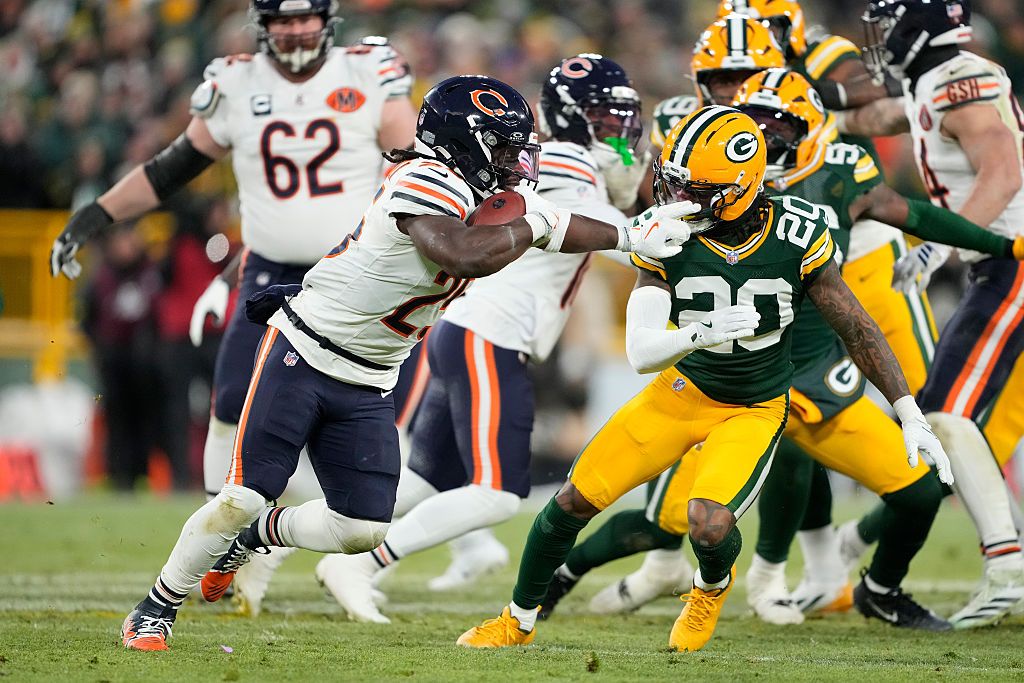
Saturday night in Chicago isn’t entertainment, it’s an audit. The Bears and Packers drag the same division argument back into the room, only louder. Last week’s result lives in both staffs’ heads, but it cannot write the sequel. Late-season whistle chatter hangs over every tight fourth quarter, and both teams know it. Chicago also comes in shorthanded at receiver, so the plan has to travel, not just the emotion. Below is my prediction for NFL Week 15’s game between the Chicago Bears and the Green Bay Packers on Saturday Night Football.
Here’s how I’ll play it. I’ll be pumping out these predictions for individual games all season, with plenty of coverage here on DraftKings Network. Follow my handle @dansby_edits for more betting plays.
Bears vs. Packers prediction, preview
Green Bay sits at 0.128 EPA per play and 0.246 pass EPA per play, so this offense can score without perfect run lanes. Chicago’s defense has been sturdy, allowing -0.021 EPA per play and -0.030 pass EPA per play, so Love (QB) has to win with timing. He’s played like a quarterback who can do that, completing 66.4% with 7.8 yards per attempt and a 23-to-six TD-to-INT line. Chicago’s offense grades 0.059 EPA per play, and it gets its cleanest work on the ground at 0.060 rush EPA. That identity is real, because D’Andre Swift (RB) is at 4.9 per carry and Kyle Monangai (RB) is at 4.7 per carry. That’s the collision point, because Green Bay’s rush defense allows -0.074 rush EPA and forces tough early downs.
If the Bears cannot stay ahead of the sticks, Williams (QB) is solving a heavy-zone menu, with Green Bay living in zone 79.7% of snaps. And his season line tells you why Chicago wants to avoid long-yardage living, with 58.0% completions and 6.9 yards per attempt. Chicago’s pressure comes with intent, blitzing 28.6% and playing 30.3% man, but Green Bay still generates a 39.9% pressure rate with a low blitz rate. That’s the fulcrum snap-to-snap: can Chicago speed Love up without turning it into free yards after the catch.
The Bears case is simple and serious. They can run with Swift (RB) and Monangai (RB), control the tempo, and force Green Bay into long fields. Swift also gives them a steady outlet profile with 29 catches, which matters if the perimeter is thin. They can also heat up the pocket with those blitz rates and steal a short field. That case gets shakier when you remove Rome Odunze (WR) and Luther Burden III (WR), because third downs become narrower and the red-zone menu gets smaller. Odunze’s 661 yards and six touchdowns aren’t just production, they’re the bailout throws when the picture muddies. Green Bay finishes drives at a 64.7% red-zone TD rate, and Chicago sits at 58.0%, so the touchdown gap matters in a one-score game.
Josh Jacobs (RB) is the drive-ender in that space with thirteen rushing touchdowns, plus enough receiving usage to punish light boxes. If Chicago leans even heavier into the run in scoring range, Green Bay’s run front has a clear answer. Love also has the easier baseline throws against zone, especially if Chicago’s pressure forces single coverage behind it. And when Green Bay does get into scoring territory, that 64.7% touchdown conversion is the difference between close and covers.
Packers vs. Bears pick, best bet
The Bears case is simple and serious. They can run with Swift (RB) and Monangai (RB), control the tempo, and force Green Bay into long fields. They can also heat up the pocket with those blitz rates and steal a short field. That case gets shakier when you remove Rome Odunze (WR) and Luther Burden III (WR), because third downs become narrower and the red-zone menu gets smaller. Green Bay finishes drives at a 64.7% red-zone TD rate, and Chicago sits at 58.0%, so the touchdown gap matters in a one-score game. If Chicago leans even heavier into the run in scoring range, Green Bay’s run front has a clear answer. Love also has the easier baseline throws against zone, especially if Chicago’s pressure forces single coverage behind it.
Green Bay should live in eleven personnel because Chicago blitzes 28.6% and plays 30.3% man, and spacing bakes hot answers into every snap. That alignment lets Love keep rhythm throws on schedule, layer crossers behind pressure, and use the back as an outlet when blitz lanes widen. Chicago should counter with heavier sets and a run-first posture because Odunze and Burden are out, and the receiver tree needs structure on money downs. Those bodies help the Bears protect Williams from long-yardage living, keep Swift and Monangai as the engine, and steal explosives off play-action when safeties step down. The Bears’ best version is field position, patience, and red-zone carries, not a dropback duel. The Packers’ best version is steady passing success and touchdowns instead of field goals. If this stays tight late, Green Bay’s 64.7% red-zone TD rate and cleaner passing baseline should decide the final possession. With Parsons out, Green Bay has fewer clean ways to steal downs, and that’s why I’m laying the point.
His absence flips leans. It changes the game tree. DraftKings has Bears -1.5 at -112, Packers +1.5 at -108, and 46.5 at -110 both ways. I’m taking Bears -1.5 (-112) because Parsons out strips Green Bay of the drive-wrecking snaps that keep underdogs alive. Green Bay can still score, but Chicago should finish more possessions and avoid the backbreaking negative plays.
Bears 24, Packers 20.
Best bet: Bears -1.5 (-110) vs. Packers
Tail it with me in the DKN Betting Group here!
For a prop lean, I’m taking D’Andre Swift (RB) three-plus receptions at +150 because this matchup is screaming for condensed, underneath volume. Odunze and Burden are out, so Chicago’s perimeter answers thin out fast, especially on money downs. Green Bay lives in zone 79.7% of the time, which keeps checkdowns and flare routes alive even when the first read is capped. Chicago’s offense is 0.059 EPA per play and Williams (QB) sits at 6.9 yards per attempt, so the path of least resistance is short completions that keep the chains moving. Green Bay’s rush defense is excellent at -0.074 rush EPA allowed, which can force Chicago into quick outlet throws when early-down runs get stuffed. Swift already owns a meaningful receiving role with 29 catches, and this game script should keep him on the field for pass protection, screens, and hot answers versus pressure. At +150, you’re buying a realistic floor outcome that fits the injury story and the coverage math.
Best prop lean: D’Andre Swift 3+ receptions (+150)
Tail it with me in the DKN Betting Group here!