It’s way too early to talk about any team either breaking the Golden State Warriors’ 73-9 record or the Philadelphia 76ers’ 9-73 mark. Only one undefeated team and two winless teams remain through the first two weeks of the NBA season, but all of them look either historically good (in the case of the Oklahoma City Thunder) or historically awful (in the cases of the New Orleans Pelicans and Brooklyn Nets).
Brooklyn faces a tough test tonight in its quest for its first win of the season, as the two-time Western Conference finalist Minnesota Timberwolves will travel to Barclays Center for a 7 p.m. ET clash. Minnesota will still be without Anthony Edwards, who was cleared to return to contact activities this morning.
The Timberwolves are 8.5-point favorites at DraftKings Sportsbook (-375 on the Moneyline), and the point total is set to 227.5. The Nets, meanwhile, are +295 on the Moneyline. Below, I’ll break down tonight’s inter-conference matchup and offer a prediction.
Minnesota Timberwolves at Brooklyn Nets preview, prediction
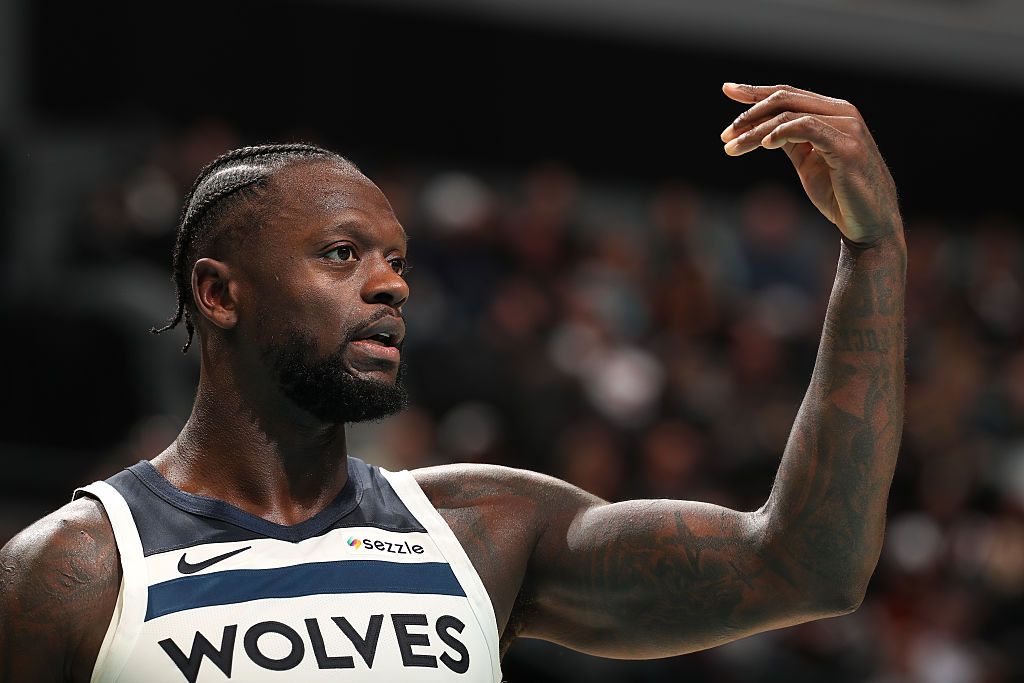
Minnesota had gotten off to a 1-1 start with Edwards in the lineup and has picked up two wins and two defeats in fairly competitive contests since. Julius Randle is coming off of the best playoff run of his career and has taken on most of the team’s scoring slack with Edwards sidelined, performing well in his larger role. However, Rudy Gobert and Mike Conley have both struggled to open the season, and youngsters Rob Dillingham and Terrence Shannon Jr. haven’t performed well enough to fill the void, so they’ll have to start stepping up if the Timberwolves want to be competitive this season.
Brooklyn, meanwhile, lost by 24 points to a Joel Embiid-less Philadelphia 76ers team last night, and only two of its games have been decided by fewer than 10 points. In one of those two, Trae Young suffered a knee injury just seven minutes into the game, forcing the Atlanta Hawks to reshuffle without their leading ball-handler on the fly. The Nets have two of the league’s better isolation scorers, Cam Thomas and Michael Porter Jr., but their shots are very rarely falling at the same time, and the rest of their rotation largely consists of young, untested pros.
Timberwolves at Nets pick, best bet
As might be expected for a team whose two best players are both offense-first and ball-dominant, Brooklyn ranks just 25th in assists per game and isolates at the 10th-highest rate. The Nets’ playmaking burden is spread pretty evenly: six different players are averaging between 2.7 and 3.2 assists per game, with 26th overall pick Ben Saraf leading the way. The isolation-heavy approach can be ugly: last night, Porter shot seven-for-23 from the field and one-for-12 from beyond the arc. Brooklyn has more rotation players shooting less than 40% from the field as it does shooting 50% or better, with Saraf all the way down at 21.7%. All in all, the Nets rank 12th-to-last in field goal percentage, seventh-to-last in three-point percentage, and third-to-last in rebounds while being the eighth-worst offense and easily the worst defense.
Some of that poor defensive performance can be chalked up to shooting luck — opponents have shot a league-best 52.5% on wide open threes, a completely unsustainable number — but the Nets have also served up the 11th-most wide open attempts. They’ve also conceded the fourth-most restricted area tries and the 14th-highest percentage on such attempts, as well as the fifth-highest mark from the non-restricted paint. The Timberwolves’ shooting could also regress, given that they’ve hit 44.2% of their wide open threes after canning them at a 40.0% clip last season, but they’ve attempted the ninth-most shots at the rim since Edwards’ injury and converted at a league-average clip, so they should continue to be dominant inside as long as their rebounding improves.
Without Edwards, Minnesota, too, has been isolation-heavy, operating in one-on-one at the fifth-highest rate for the season as a whole. The difference is, unlike either Thomas or Porter, Randle has the size and isolation ability to draw in the defense and generate open threes for his teammates. This season, Randle has been the league’s second-most efficient isolation scorer, and while that can be attributed to a small sample size, he averaged nearly a point per possession in isolation during his breakout playoff run, so it’s not completely out of the blue for him. While Edwards has been out, he’s averaged 29.5 points and 4.8 assists per game, and the team as a whole is shooting 39.7% from deep, in large part because of the opportunities Randle’s size and capable playmaking create.
The Timberwolves have also been solid enough on defense, even without Edwards. Despite an overall down season from Gobert — the four-time Defensive Player of the Year has had a 0.0 defensive box plus-minus this season — Minnesota has allowed the second-lowest percentage on restricted area tries since Edwards’ injury. Gobert’s presence could be a problem for a team that struggles to get downhill as is, and the Nets have struggled to convert from the corner, where Gobert-led defenses have historically been exploitable. His career-low rebounding percentage can largely be chalked up to luck: though the Timberwolves have hauled in 58.8% of their rebound chances, they’ve averaged the fewest rebound chances per game. Minnesota should be able to control the glass more against a team that has also had relatively few rebound chances and actually come down with the ball at the second-lowest rate.
With the Timberwolves’ ability to get downhill and Brooklyn’s inability to stop opponents from getting inside, Minnesota isn’t a good matchup for the Nets. Brooklyn doesn’t have the personnel to take advantage of the Timberwolves’ few weaknesses, and it hasn’t gotten significantly less lucky than Minnesota has. Most recently, the Timberwolves picked up a 17-point win over the Charlotte Hornets — a team that beat the Nets by 19 points on opening night.