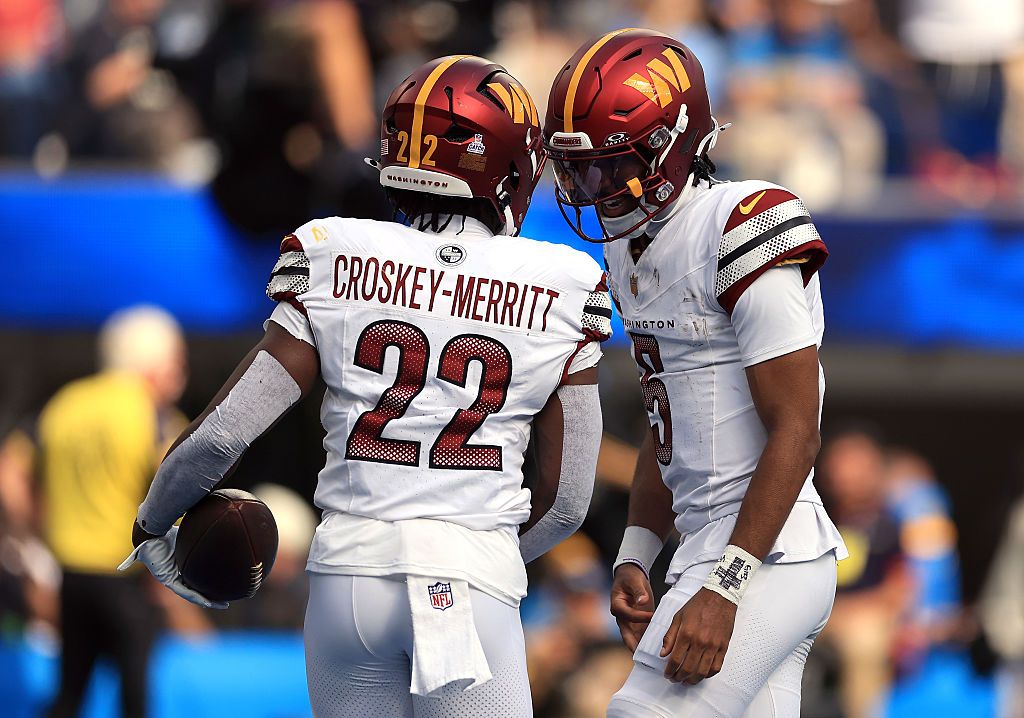
Northwest Stadium crackles Monday night, a rematch soaked in memory and impatience; no one wants to deal with the Hail Mary anymore. Washington leans into balance under Dan Quinn, with Jayden Daniels steadying the huddle. With Terry McLaurin and Noah Brown out and Deebo Samuel limited, Jacory Croskey-Merritt becomes the handle of the plan. Chicago arrives with Ben Johnson’s edge, Caleb Williams steering tempo and Rome Odunze hunting the big moments. Last year’s heave still needles the visitors and stokes the hosts, and every third down will test nerve. Below is my prediction for NFL Week 6’s Monday Night Football game between the Washington Commanders and the Chicago Bears.
Here’s how I’ll play it. I’ll be pumping out these predictions for individual games all season, with plenty of coverage here on DraftKings Network. Follow my handle @dansby_edits for more betting plays.
Commanders vs. Bears prediction, preview
Washington’s bones are efficient. The Commanders average 34.8 yards per possession, which places them eighth. Their ground game lands first punches, carrying a league-best 51.1% rushing success rate. They still flash with a 5.4% explosive-run rate that keeps boxes honest. The defense compresses space, allowing 310.3 yards per game, the third-fewest. They allow only 147.0 passing yards per game, which sits second. The front hurries at a 40% pressure rate and changes the math. With heat, opponents complete 48.1% at 7.0 yards per attempt. Without it, opponents surge to 72.5% at 9.5 yards per attempt. Washington also averages 349.0 yards and 26.8 points per game, which rank 13th and 8th. They wobble only in the red zone, allowing touchdowns on 80% of trips, which ranks 31st. That balance—field control, pass suppression, and situational strain—projects a tempo edge and a squeezebox game script.
Jayden Daniels returned with poise. He delivered 15 completions on 26 attempts for 231 yards and a touchdown. He added eight rushes for 39 yards and kept his sheet clean. Recent fantasy lines of 20.1, 19.7, and 17.1 echo steady growth. Washington funnels throws to backs on 27.9% of attempts, which ranks fourth. They keep wideout volume modest at 40.5%, which ranks thirty-first. That distribution forces linebackers to turn and chase, and it sustains rhythm. Daniels’ season sits at 4 touchdowns, 0 interceptions, and 59.2% completions, which preserves drive health. Washington also averages 156.4 rushing yards per game, which lightens his dropback load and sharpens play-action. That geometry tilts defenders into conflict and keeps the chains purring on schedule.
Chicago counters with selective fireworks. The Bears posted 34 points last week on 7.0 yards per play and 9.7 yards per pass attempt. The broader ledger shows staggered steps. Chicago averages 26.2 yards per drive, ranking twenty-seventh. They score on 36.1% of possessions, which sits in the middle. Their red-zone finish rate shows 6 touchdowns on 11 trips, a 54.5% clip. The defense lives in contradictions. They allow a worst-in-league 52.3% rushing success and 6.1 yards per carry to running backs. They also concede 18.6 rushing fantasy points per game to backfields and 12.3 receiving points per game to backs. Yet they permit only 29.3% third-down conversions, which leads the league. Only 27.3% of opponent drives reach the red zone, which ranks sixth. Early downs betray them, giving up 7.4 yards per play. Deep shots have pierced them, with 57.1% completions on targets of twenty or more air yards. Chicago’s offense has still produced 25.3 points per game with 225.8 passing and 102.3 rushing yards. That push-pull breeds volatility—chunk leaks early, stands on third down, and coin-flip deep shots shaping momentum.
Caleb Williams must live through the rush. His season rides volatility, with pressure revealing edges. Under heat he completes 48.6% at 4.3 yards per attempt. On third down, he throws 66.7% of passes short of the sticks. That tendency invites rally and tackle when Washington’s rush arrives on schedule. It can also suffocate drives when early-down gains stall. The profile still flashes: eight touchdowns, two interceptions, and 62.3% completions through four games. He ranks 29th in time-to-throw, which collides directly with Washington’s 40% pressure pulse. If the pocket frays, Chicago’s short-game bias tightens into punts; if it holds, shot plays reopen.
Trenches will dictate the soundtrack. Washington’s line grades twelfth, with twenty-six total pressures and three sacks allowed. Their pass-blocking efficiency sits at 88.2. Chicago ranks twenty-third, with forty-four pressures and four sacks allowed on 155 pass plays. Their efficiency rests at 84.5. Those four points of protection often become fourteen on the scoreboard. Washington’s front has produced 15 sacks this season, which matches the protection gap with tangible bite. That pairing—cleaner pockets for Washington, shakier ones for Chicago—points the flow toward the home sideline.
Routes will match coverage shadows. Luke McCaffrey should see volume expand with injuries shaping the tree. Zach Ertz ran a route on 71% last week and found space even without catches. Chicago allows 7.3 tight end receptions per game, which ranks thirty-first. They concede only 6.3 yards per target and a 3% touchdown rate to the position, but volume can still strain hooks and curls. Deep answers exist if safeties creep: opponents complete 57.1% on 20+ air-yard throws. Deebo Samuel posted 8 catches for 96 yards and a score last week, which sharpens the play-action crossers that punish those voids. If Chicago clamps the underneath, Washington’s deep timing can lift the lid and tilt possession count.
Bears vs. Commanders pick, best bet
Chicago can throttle pace with that league-best third-down defense. Only 27.3% of opponent drives even touch the red zone. The Bears can stiffen, force field goals, and tilt variance. They also land deep when protection holds, with that 57.1% on twenty-plus air yards lurking. They start fast at 7.8 first-quarter points per game (1st), and they score on 36.1% of possessions, which supports a script they can steer. Washington has allowed touchdowns on 80% of red-zone trips (31st), a seam Chicago can pry if it reaches the fringe. If Chicago constricts third downs and sprinkles in selective shots, the game shrinks to their preferred tempo.
The refutation flows through Washington’s resourcefulness. The Commanders run at a 51.1% success rate into a defense that bleeds 6.1 yards per carry to backs. They can keep the call sheet light and the clock stubborn. Their pressure flips Chicago’s passing math, dragging those 48.6% under-pressure completions into more third-and-long. Washington’s defense can live with fewer deep chances if the pocket never stabilizes. They just stamped Los Angeles with 163 rushing yards at 5.8 per carry and 7.2 yards per play, proof their plan travels. Washington’s front generates heat at a 40% rate; when it lands, opponents fall to 48.1% completions at 7.0 yards per attempt, which strangles shot volume. Chicago’s protection has surrendered 44 pressures with an 84.5 pass-blocking efficiency (23rd), a mismatch that compounds across quarters. If that equation holds, Washington trades explosives for attrition and still wins the math.
Washington’s structural edges live in sustainable places. Their offense owns that eighth-place yards-per-possession mark. Chicago’s defense surrenders early-down chunk gains at 7.4 yards per play. Washington’s pressure rate hits 40% against a line ranked twenty-third in pass protection. The Bears’ red-zone throttle is real, but Washington’s play-to-play leverage overwhelms it. Washington also averages 26.8 points per game and finished the Chargers win with 389 total yards, which aligns with a steady scoring cadence rather than a spike. Chicago’s front has allowed a league-worst 52.3% rushing success and 12.3 receiving fantasy points per game to backfields, inviting balance over volatility. Those layers point to sustained drive quality more than a coin-flip finish.
I’m laying the points on the home team. The Commanders control pace, win early downs, and turn pressure into field position. Their run game translates on any script, and their defense punishes hesitation. Washington’s defense has allowed 310.3 yards per game and only 147.0 through the air, which compresses comeback space once they lead. Against the worst yards-per-carry figure allowed to running backs, the late-game edge stays on the ground.
Commanders 27, Bears 20.
Best bet: Commanders -5.5 (-110) vs. Bears
Tail it with me in the DKN Betting Group here!
For a prop lean, I’m parlaying Bill’s rushing yards and anytime touchdown. This sets up a mismatch: Washington’s 51.1% rushing success meets Chicago’s 52.3% allowed and 6.1 yards per carry. Washington pounds for 156.4 rushing yards a game at 5.9 per carry behind a twelfth-ranked line and 88.2 efficiency. Jacory Croskey-Merritt ripped 111 on 14 carries with two scores, while the team posted 163 rushing yards at 5.8. Chicago allows 164.5 rushing yards a game and 7.4 yards per play on early downs, third-most generous to backs schedule-adjusted. Add 12.3 receiving fantasy points allowed to backfields, and his role stacks touches with plus efficiency and conversion equity. I’ll play 80+ rushing yards at +130 and pair it with an anytime touchdown at -160, aligned with Washington’s edge.
Best prop parlay lean: Jacory Croskey Merritt 80+ rushing yards + anytime touchdown (+205)
Tail it with me in the DKN Betting Group here!