The hinge weeks always feel different. By Week 6, the mirages fade—the dead-zone draft picks, the ghost targets, the fragile backfields that looked whole in August. Injuries have started to redraw the fantasy map: Alvin Kamara’s ankle turned Wednesday’s practice report into a full-blown referendum on the Saints’ offense; Omarion Hampton’s injury ripped open a Panthers committee no one trusts; and Tee Higgins, once a top-20 lock, now floats in the purgatory of 13% target shares and empty air yards. But might Ja’Marr Chase miss Week 6? The stalwarts we believed in are real—Kyren Williams clawing back a 90% workload, Courtland Sutton commanding double the league-average first-read rate, Quinshon Judkins turning gap runs into gospel—but the disappointments linger louder. It’s the moment the season sharpens: rosters tilt toward desperation, waiver wires shrink, and the smart players stop chasing names and start chasing usage. This is where volume meets nerve, where we find out who’s really locked in. Let’s get right to my Five Lists of Five: Week 6 edition, here, and forage ourselves some stashes, dart throws, breakouts, and, probably most importantly, as always, running back sleepers for fantasy football Week 6.
The refrain remains the same—All I want is for you to be better than your friends. You’re going to be surrounded by them on Sunday, probably. How sweet would it be if you could be sure you’ve checked every box possible that might guarantee you a resounding victory this week? Some kick-your-feet-up insights? I’ve got some. And I know my audience. The smoke-break audience. The quick-scan-of-the-phone-on-the-way-to-the-fridge audience. The I-ain’t-reading-all-that-but-good-luck folk. I’m a man of the people.
And so: the Five Lists of Five series. Think of these as byte-sized, two-minutes-to-yourself lists to scan during your weekend as you foam at the mouth for any competitive fantasy edge. As much relevant analysis as I can fit into, like, ~250 words per player.
Below: Top five buy-low players for Week 6 of 2025 fantasy football. A new list this season, and one to which we’ll return quite on-and-off until the fantasy football trade deadline. Simple enough, here: these are players whose performances have been underwhelming given their name value and/or draft capitol, but whose opportunity metrics and intangibles signal an uptick on the rise.
Here are the other offerings from my 2025 Fantasy Football Five Lists of Five: Week 6 edition:
- Top five breakout wide receivers for 2025 fantasy football Week 6
- Top five breakout running backs for Week 6 of 2025 fantasy football
- Top five WR/CB matchups to target for Week 6 fantasy football
- Top five must-start players for Week 6 of 2025 fantasy football
Follow my handle @dansby_edits for all preseason and fantasy draft kit content—as well as plenty of NFL betting goodies—all summer long. All my other fantasy football draft kit content is at the bottom of this list!
Top five buy-low players for Week 6 of 2025 fantasy football
Jameson Williams, WR, Detroit Lions
Detroit’s offense is a breathing organism, and Jameson Williams is the vertical airflow: the stretch that makes everything else easy. The surface stats spook managers (11 catches, 223 yards, and just a single TD through five games), but they hide the trait that fixes fantasy weeks in a blink—true, repeated downfield opportunity. Williams’ average depth of target sits in the stratosphere (about 20.8 yards), with per-catch damage to match (20.3 yards per reception). That profile is screams “hold your nerve” to me.
Detroit hasn’t needed volume to score—they’re top-tier in points and efficiency—so his box scores have whipsawed, but the usage skeleton is intact: heavy route participation and legit vertical isolation while defenses crowd Amon-Ra St. Brown and Sam LaPorta. Even local beat and team channels have hammered how he’s impacting games beyond the stat line—clearing, blocking, dictating safety depth. That stuff precedes the spike. If you’re hunting a discount, target profiles like this: elite aDOT, depressed raw targets, and a quarterback who will take shot plays when coverage tilts.
The correction doesn’t dribble in; it arrives in chunks—two connections and your week flips. Layer in the schedule dynamics (defenses selling out to cap Detroit’s quick-game rhythm) and you get the exact leverage spots where Williams’ speed becomes the answer. The market wants steady; you want asymmetric. Put simply: buy the downfield oxygen in the league’s most balanced offense and wait for variance to land on your side. The moment Goff hits two of those moon-balls in a game, the window slams shut.
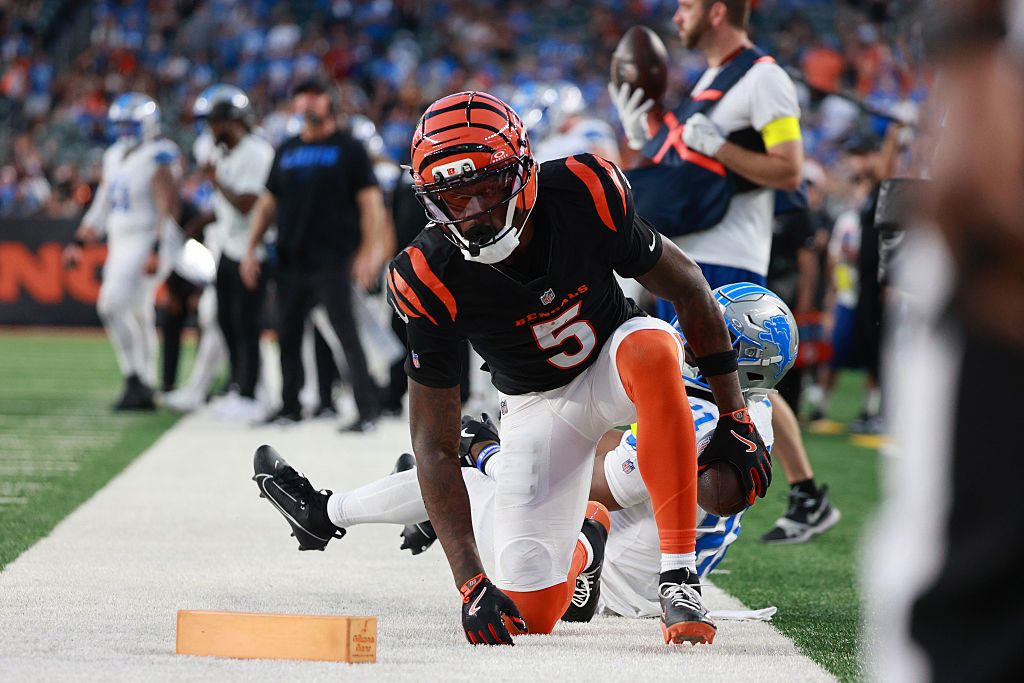
Tee Higgins, WR, Cincinnati Bengals
Every signal that matters says underpriced for Tee. The frustration is real—13 catches for 158 yards and two scores, a modest 16.9% target share and 0.99 yards per route run—but the ecosystem explains it: quarterback upheaval, negative flows, and a team playing from behind the sticks. The buy case isn’t blind faith; it’s role plus historical ceiling. Higgins still owns a first-read share north of 24% and four red-zone looks over his last four—usage that normally comes attached to weekly WR2 outcomes. Cincinnati’s perimeter schedule will lighten, and any stabilization at QB—reports have the team turning to a veteran presence—restores baseline accuracy and volume to the boundary game where Higgins wins.
The Packers are a rough immediate draw, but that only sweetens the trade price; you’re not buying Sunday, you’re buying November. Mechanically, Higgins’ slump has been about catchable volume, not separation death—his routes and snaps have stayed sturdy (mid-90s route participation), and the team’s heavy one-on-one outside looks haven’t disappeared; they just haven’t connected. When that needle ticks from almost to on-frame, the stat line will balloon fast because his targets skew high-value (end zone, intermediate sideline, play-action shots).
Acquire before the dreaded “Ja’Marr Chase is questionable” headline actually amounts to missed time—which it shouldn’t for Week 6—or a single multi-TD Sunday resets expectations. The path back is obvious: steady first-read share, red-zone equity, and a long track record of boundary wins that hasn’t changed one bit.
Jakobi Meyers, WR, Las Vegas Raiders
If you want the cleanest gap between usage and results, circle Meyers. Through five weeks he’s sitting on 25 catches for 290 yards…and zero touchdowns. That goose egg isn’t about failing as a separator; it’s about a red-zone offense stuck in sand. The Raiders enter Week 6 converting just 35.7% of red-zone trips into TDs—31st in the league—and their pass game has cratered there (42.9% completions, 70 rating). That’s a team problem, not a Jakobi problem.
Meanwhile, the macro volume screams “bankable”: team target leadership early, double-digit looks in spots, and a role that naturally commands first-read throws (chains, digs, choice routes). Even after a messy Monday, he’s pacing the receiver room in receptions and yardage, which tells you where progressions start. The beauty of this buy is how touchdowns normalize. Red-zone efficiency is one of the noisiest team stats week-to-week, and coaching staff tweaks—or even a simple regression to league-average—unlock payoffs for the most dependable underneath winner on the roster. You’re purchasing TD exposure at a fraction of the usual cost.
Add the trade-rumor halo about which everyone’s forgotten, and you get extra discount without losing near-term volume; if anything, a midseason shakeup could sharpen his role. If you believe in process over panic, this is the archetype: a high-usage veteran on a low-conversion offense. Buy now, let the touchdowns find him when the play-calling and luck stop fighting each other. The first 7-for-85-and-1 is coming, and the price will not be this soft when it does.
Marvin Harrison, WR, Arizona Cardinals
Year two, and the usage screams alpha waiting to detonate” Through five games Harrison owns about 20 percent of Arizona’s targets and about 40 percent of the team’s air yards, with roughly 61.2 receiving yards per game and around 1.7–1.8 yards per route run—sturdy scaffolding for spike weeks that haven’t fully arrived. He’s already stacked five deep targets and four red-zone looks, the exact high-leverage diet you buy when the market is fixated on week-to-week noise. The deployment is even louder than the box score: roughly 99 percent route participation with only about 20 percent of snaps in the slot, i.e., a true every-down perimeter X who never leaves the grass. His first-read involvement is real (about 4.4 first-read targets per game), and the efficiency under the hood is healthy—around 1.73 YPRR, 15.3 yards per catch, plus a sticky-hands 85.7 percent contested-catch rate on early chances.
Zoom in on how he wins and you see why the ceiling is imminent. The Cardinals are giving him isolation throws off play-action and condensed splits to create free access at the line—exactly where his pacing and late hands convert tight windows. Catchable volume has been merely decent (about a 72 percent catchable-target rate), which explains the “quiet” weeks more than anything about separation or command; when that needle ticks up even modestly, the numbers will lurch forward because his targets skew downfield and in the paint. Arizona’s pass tree also concentrates on two mouths (Harrison and Trey McBride), so consolidation doesn’t require a philosophical overhaul—just routine regression on red-zone sequencing and a couple more on-frame verticals.
The buy is simple: alpha usage plus perimeter routes plus a high-leverage target mix with underlying metrics that say healthy, not hot. Price him like the WR2 his current production suggests, and you’re effectively buying discounted WR1 outcomes the moment accuracy normalizes and one or two moon-balls land in stride. The role is already banked—every route, boundary leverage, first-read equity. The touchdowns and 100-yard lines lag usage… until they don’t. This is the edge: pay before the finishing catches up to the volume.
Ladd McConkey, WR, Los Angeles Chargers
McConkey is the receiver who gains value precisely when an offense shrinks to the quick game—option/choice, speed-outs, glance, and manufactured touches that behave like handoffs. The role already fits: 21 receptions on 34 targets for 213 yards and a score, with two top-24 weekly finishes; season shares around an 18.7% target rate and 22–23% first-read share are sturdy for a second-year gadget receiver living inside. Now layer in Week 6 context. Quentin Johnston is questionable for Sunday, which threatens perimeter depth and funnels even more first-read volume toward the slot. With Omarion Hampton banged up, the Chargers’ “run game by other means” becomes more pronounced—expect screens and bubbles to McConkey as literal extensions of outside zone and duo, especially early. The offensive line situation all but mandates it: both starting tackles (Joe Alt, Trey Pipkins) are out, pushing Los Angeles to its fourth and fifth options. That’s quick-rhythm football by necessity—catch, plant, out—where McConkey’s precision turns hot throws into layups.
The matchup cooperates. Miami is among the league leaders in two-high usage (about 60%), and against two-high McConkey ranks second on the Chargers with a 20% target share and owns a 27.3% first-read slice—when the safeties split, Herbert’s eyes go to Ladd. Add in how the Dolphins’ defense is performing right now—29.0 points per game allowed, 386.6 yards per game, 74.5% completion rate, 117.6 passer rating—and you get an environment that rewards immediate separators and YAC over brute-force verticals.
Put it together: a high-precision slot with >60% of routes inside, a quarterback forced to play on-time by protection, a potentially shorthanded perimeter, and a backfield minus its primary early-down hammer. That’s the recipe for 7–10 manufactured touches—screens, bubbles, speed-outs—plus the usual third-down option work. Buy the role, not the nameplate: first-read equity versus two-high, run-game supplements in space, and a defense that’s inviting high-percentage volume underneath.