The hinge weeks always feel different. By Week 6, the mirages fade—the dead-zone draft picks, the ghost targets, the fragile backfields that looked whole in August. Injuries have started to redraw the fantasy map: Alvin Kamara’s ankle turned Wednesday’s practice report into a full-blown referendum on the Saints’ offense; Omarion Hampton’s injury ripped open a Panthers committee no one trusts; and Tee Higgins, once a top-20 lock, now floats in the purgatory of 13% target shares and empty air yards. But might Ja’Marr Chase miss Week 6? The stalwarts we believed in are real—Kyren Williams clawing back a 90% workload, Courtland Sutton commanding double the league-average first-read rate, Quinshon Judkins turning gap runs into gospel—but the disappointments linger louder. It’s the moment the season sharpens: rosters tilt toward desperation, waiver wires shrink, and the smart players stop chasing names and start chasing usage. This is where volume meets nerve, where we find out who’s really locked in. Let’s get right to my Five Lists of Five: Week 6 edition, here, and forage ourselves some stashes, dart throws, breakouts, and, probably most importantly, as always, running back sleepers for fantasy football Week 6.
The refrain remains the same—All I want is for you to be better than your friends. You’re going to be surrounded by them on Sunday, probably. How sweet would it be if you could be sure you’ve checked every box possible that might guarantee you a resounding victory this week? Some kick-your-feet-up insights? I’ve got some. And I know my audience. The smoke-break audience. The quick-scan-of-the-phone-on-the-way-to-the-fridge audience. The I-ain’t-reading-all-that-but-good-luck folk. I’m a man of the people.
And so: the Five Lists of Five series. Think of these as byte-sized, two-minutes-to-yourself lists to scan during your weekend as you foam at the mouth for any competitive fantasy edge. As much relevant analysis as I can fit into, like, ~250 words per player.
Below: Top five breakout running backs for Week 6. These are guys that FantasyPros ECR has ranked in the mid-to-late RB2-or-worse range whose matchups I think warrant fringe RB1 consideration. Sometimes they’ll indeed be running backs who aren’t just breaking out of the prison of their rankings, but are indeed breaking onto the scene. But not always. There are only so many names that have scaleable and sustainable relevance in fantasy football!
Here are the other offerings from my 2025 Fantasy Football Five Lists of Five: Week 6 edition:
- Top five must-start players for Week 6 of 2025 fantasy football
- Top five breakout wide receivers for 2025 fantasy football Week 6
- Top five WR/CB matchups to target for Week 6 fantasy football
- Top five buy-low players for Week 6 of 2025 fantasy football
Follow my handle @dansby_edits for all of my fantasy football content—as well as plenty of NFL and College Football betting goodies—all season long.
Top five breakout RBs to target for Week 6 of 2025 fantasy football
Kendre Miller, New Orleans Saints
The breakout is coming eventually, and with a banged-up Alvin Kamara—efficient and impressive though he remains—this feels like Kendre Miller’s week.
The dimmer has been turning up one click at a time, and the staircase is clean: 13% → 16% → 27% → 32% → 39% snap shares. That’s not noise; that’s intent. The short-area distribution around him is loosening too. Alvin Kamara’s target shares opened at 26.8% and 26.5%, then slid to 19.5%, 12.5%, 13.3% across the last three. Simultaneously, Juwan Johnson logged an 85% route participation even with Foster Moreau and Taysom Hill back—proof the middle-of-the-field tree is diversifying, not bottlenecking. The lane for Miller is obvious: one more series, one more duo carry, one more angle route, one more red-zone rep where pad level turns a thicket into six. His style fits the plan—accelerate through the second step, keep runs on schedule, deny losses, finish forward. The appeal isn’t a single lever; it’s accumulation. Each incremental snap brings a fresh chance at a check-down, a backside cut, a short-yardage conversion.
Even a modest continuation—say 40%+ snaps with a tick more routes—turns into 15–18 touches without distorting the offense. No injury cave-in required; the numbers already chart the climb and the softening of monopoly targets underneath. That is the blueprint of a quiet takeover. When New Orleans leans into rhythm between the hashes, Miller becomes the clause that completes the sentence: early-down ballast, two-minute relief, and the carry that ends the drive clean. The trend line is the bet. Keep the staircase rising and the headline arrives—steady volume becoming points.
Michael Carter, Arizona Cardinals
Backfields love to lie; Week 5 told the truth in block letters. And in the form of a sideline video of Cardinals HC Gannon absolutely berating then-starting RB Emari Demercado after Demercado fumbled the ball away into the back of the end zone for a touchback on a breakaway touchdown. After that, Michael Carter handled 72% of the Cardinals’ running-back rushes, stacked a 16.7% target share, and played 20 more snaps than Emari Demercado. That’s a deliberate three-down plan, not a hot-hand blur. The distribution is perfect for a breakout: base carries are his, two-minute tempo is his, and the pass-pro looks that keep you through progression are his.
That’s how a box score inflates without lottery splash plays: 16–18 carries stabilize the floor, 4–6 targets unlock the ceiling, and the red-zone call sheet favors the back who’s already solved protection. The skill set has always been there—lateral patience, soft hands on screens and checkdowns, decisive trigger through interior creases—now the opportunity curve finally matches it. I care about indicators and whispers in the wind: ≥70% rush share plus a mid-teens target slice is the quickest path to 90–110 total yards on volume alone, with touchdown access if a screen splits or a safety fits late.
The substitution tells after the Demercado fumble seal it. End-of-half tempo? Carter. Long-down protection? Carter. Clock-control possessions? Carter. Those are sticky decisions, not gusts. Keep the same snap hierarchy and receiving seat, and you don’t need anything heroic—just another Sunday where the ball keeps finding the back already on the field. That’s the kind of breakout I buy every time: Carter’s is not thunder, but tide.
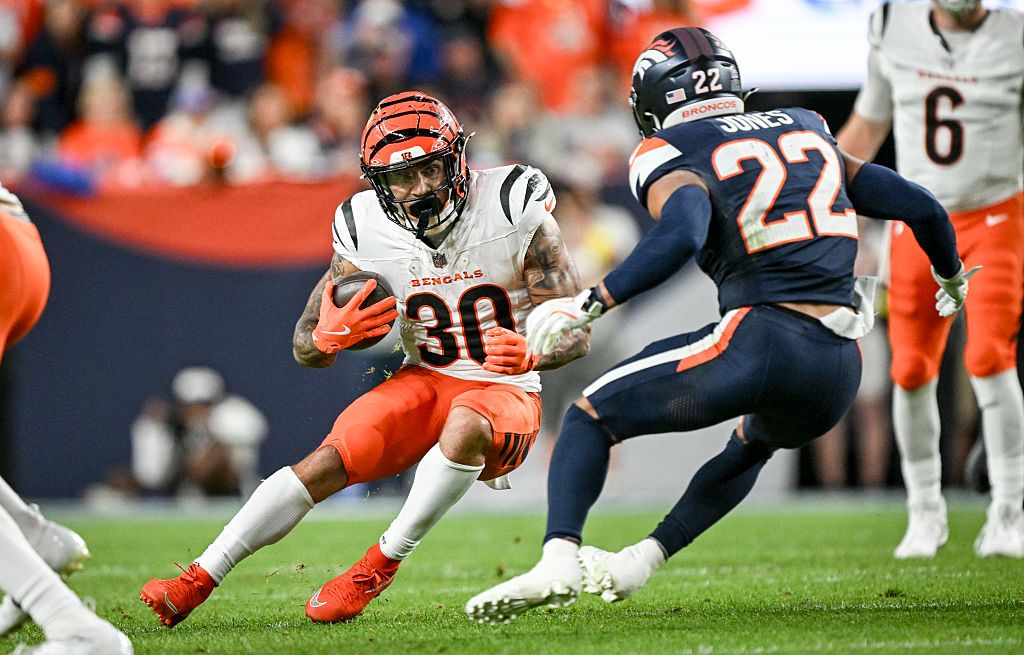
Chase Brown, Cincinnati Bengals
A borderline-first-round fantasy draft pick has fallen all the way to desperate hopes for a breakout. Nothing, really, has gone right for Cincinnati. And, as with all backfields, the quality of Cincinnati’s rushing opportunities has absolutely cratered since Jake Browning took over at quarterback. Having said that, Joe Flacco steps in as the starting QB against the Packers this week. There’s hope for some sort of balancing for Brown’s workload.
Start with the pass-game equity and let the rest tilt your way. Against Detroit, Chase Brown posted a 20% target share while running the same number of routes as Samaje Perine, despite playing only four more snaps. That’s two-minute trust at cost. Now he walks into Green Bay, a game environment that points toward negative script (Packers −14.5, 29.5 implied) and therefore more two-minute and outlet work—exactly where Brown already cashes. Lay that atop a carry pie that moves in big bites—53% → 91% → 67% the last three after opening at 100% in Weeks 1–2—and you get volatility where it should live: early-down share that can tilt in-game, layered onto a receiving role that travels with any script. Deployment is the giveaway—angle routes to isolate linebackers, gun runs that find daylight before contact, late-quarter screens that become free yards when pursuit is gassed.
All Brown needs the right 14–17 touches, and his portfolio already points to exactly those 14–17: routes, checkdowns, crease work, and a live chance to finish a drive. If the early series lean pass, he’s on the grass. If the game flips to protect-the-lead, he’s earned crease carries. And when the field compresses, equal routes say the quarterback can stay on schedule with him in progression. Backs who check routes, receiving share, and a swinging rush share don’t stay quiet long. The numbers are there; the negative-script accelerator adds the rest. The next step is the headline—this time against Green Bay.
Kimani Vidal, Los Angeles Chargers
Opportunity often arrives in plain clothes. Omarion Hampton exited, Hassan Haskins stepped in, and the rotation snapped to parity—Haskins and Kimani Vidal finished with the same number of snaps. That’s a first-trust tie the instant the depth chart bent. Now fold in the role handoff that matters: Hampton had been soaking up passing-down work, and Vidal is the cleaner heir to that slice than Haskins. The Chargers’ recent sequencing practically begs for it—neutral dropback rate 56.8% (weekly low), −6% vs expectation, −19% on first downs, with a compressed 3.8 air yards per attempt. That’s Justin Herbert living in the quick game, and Vidal is the back whose one-cut burst and soft hands convert protection slides into outlet yards; Haskins profiles as the goal-line/short-yardage hammer.
The opponent profile cooperates, too: teams run 51.3% against Miami, and the Dolphins have bled 40.9 yards/drive and 3.07 points/drive—long, possession-rich scripts where checkdowns stack and early-down touches repeat. Vidal’s path is clean: early-down efficiency when the offense is on schedule, plus the Hampton-style passing role that funnels Herbert-buoyed fantasy production through the air—flats, screens, angle routes against leveraged linebackers.Keep the snap foothold and add two series, and his lane becomes 12–15 opportunities without straining design: between-the-tackles rhythm, two or three schemed outlets, and the short-field sequence that ends six. No fireworks required—just steady accrual until the box score tilts.
With Haskins absorbing the bang-bang goal-line reps and Vidal inheriting the higher-probability reception work, the division of labor actually clarifies the ceiling: the back tied to Herbert’s quick-game volume is the back who sneaks into 5–7 catches before halftime. The role is live, the arithmetic is gentle, and against Miami, the door is wide open.
Tyjae Spears, Tennessee Titans
This is how a secondary back sneaks into the spotlight: the staff shows they want you on the field, the blocking rises, and the opponent can’t squeeze the quick game. Tyjae Spears’ Week 5 return spelled out the hierarchy—Tony Pollard 49 snaps to Spears’ 17, with Pollard running nearly three times as many routes—but it also flashed intention (a Wildcat touch early) and a path to utility when the game speeds up. The Titans’ front finally lifted, posting season-best grades across the board (74.0 offense, 81.3 pass-blocking, 69.5 run-blocking) alongside a much-improved −0.084 EPA/play. That’s the kind of footing that turns outlet designs into yards and draw looks into chain-movers.
Now comes Las Vegas, a defense sitting bottom-10 in EPA allowed per play and bottom-10 in pressure rate, which means clean checkpoints for backs in routes and fewer blown-up screens before they breathe. Pollard still holds the lead role, but that’s exactly why Spears’ profile is dangerous here: he inherits the tempo downs, the misdirection touches, the angle routes that punish linebackers when the rush stalls.
Give him 10–12 touches with 4–6 targets, and the math starts writing itself—especially if the two-minute drill stretches, because he’s already trusted there. The film matches the numbers: sudden feet to the landmark, balanced entry through the crease, and acceleration that turns late-quarter screens into 20 quiet yards. Breakouts don’t always arrive as 20 carries; sometimes they arrive as five catches, a red-zone misdirection, and a fourth-quarter drive where the defense is chasing shadows. With the line trending up and the Raiders offering soft tissue in space, Spears’ “No. 2” label can still produce a “No. 1” box score.