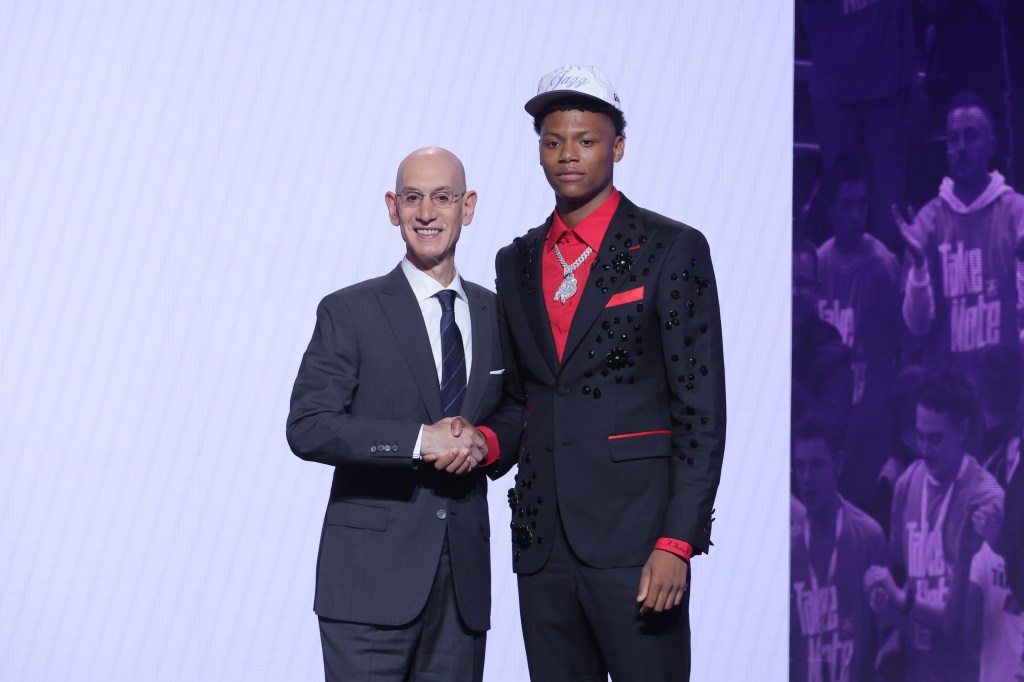
Between their move to Salt Lake City in 1979 and the 2024-25 season, the Utah Jazz had never lost more than 60 games in a season, the only team in the NBA to accomplish such a feat. They are also one of just six NBA teams never to have picked first overall.
Their reward for finishing with a league-worst 17-65 record? A slide all the way to the fifth pick, where they selected Ace Bailey, whose length and scoring ability tantalized evaluators despite effort and defensive questions. Oddsmakers aren’t high on the Jazz this season; at DraftKings Sportsbook, they have an over-under of just 18.5 wins, the lowest mark in the league. The 2026 draft class projects to be strong, headlined by a somewhat local product, AJ Dybantsa, who will play for Brigham Young University in Provo next season.
If you’re interested in seeing any of the other NBA teams’ projected win totals, check out DKN‘s master list of the full 2025-2026 NBA projected win totals.
Utah Jazz 2025-2026 projected win total

Analysis
After exhibiting some blatant tanking tactics towards the end of the 2024-25 season, Utah likely got worse in the offseason. Jordan Clarkson, who averaged a somewhat inefficient 16.2 points per game in his 37 games last season, secured a contract buyout and signed for the minimum with the New York Knicks. Collin Sexton averaged 18.4 points per game and was shipped to the Charlotte Hornets, along with a second-round pick, for Jusuf Nurkić, and John Collins, who averaged 19.0 points per game in an injury-riddled season, went to the LA Clippers in exchange for Kevin Love, Kyle Anderson, and a Clippers second. Walker Kessler and Lauri Markkanen could still be moved. The Jazz have a $26.6 million trade exception to use now that they’ve gutted their roster.
2025-26 won’t be about winning for Utah; after probably spending all season creating mockups of fake Cooper Flagg jerseys, Jazz fans are surely ready to press “purchase” on a Dybantsa purple kit. The priority for Utah this season will be growth, mostly for Bailey but also Isaiah Collier — who led all rookies last season with 6.3 assists per game but was among the least efficient jump shooters in the league — Kyle Filipowski, who averaged 14.3 points and 8.1 rebounds per game after the All-Star break, and Cody Williams.
The Jazz might benefit somewhat from better health: in addition to Clarkson’s and Collins’ lack of availability last season, Markkanen played only 47 games and 2023 lottery pick Taylor Hendricks suited up just thrice before suffering a gruesome leg injury. Bailey has been durable through his high school and college careers, Hendricks’ injury was a freak accident, and Markkanen’s total was a career low. Head coach Will Hardy has proven to be one of the league’s better sideline patrollers despite his poor record, and he’s locked in through 2031. That’s precisely why I expect Utah to lose a lot: Hardy is too good of a coach to win games when it wouldn’t benefit his team.
Utah Jazz projected win total: Best bets, predictions
Utah Jazz Under 18.5 (+100)
Prior to the draft, Bailey refused to work out for the Jazz in an agent-coordinated effort to steer his client’s way to a preferred destination. Utah took a chance anyway, and for his part, Bailey has seemed to buy in so far. I’m not concerned about Bailey’s effort; he’s an 18-year-old who still needs to prove himself at the highest level. Quality of life in Salt Lake City is high — among cities with more than 500,000 people, AARP ranks it the 17th-most livable, seventh among NBA markets — and Jazz fans are desperate for a star and will embrace Bailey at the outset. It might be ugly, though; the track record of high-usage, score-first players in their rookie season is poor. Even the 2007-08 Seattle SuperSonics, led by Rookie of the Year-winning Kevin Durant, went just 20-62, and despite some physical and stylistic similarities, Bailey is no Durant.