The Los Angeles Lakers’ season-ending 103-96 loss to the Minnesota Timberwolves in Game 5 of their first-round Western Conference playoff series made one thing crystal clear: Los Angeles cannot roll this team back. Ultimately, for all the fretting about LeBron James’ age or Luka Dončić’s defense, and for all the hype — from me as well — about the talent on the revamped roster, this Lakers team just didn’t have a championship-caliber roster.
The free agent market is relatively weak, especially at center, Los Angeles’ biggest position of need. None of the three free agent centers who the Lakers can afford to sign — Clint Capela, Steven Adams, and Kevon Looney — are starting-quality bigs, and the only one who is (Myles Turner) is both out of Los Angeles’ price range and very likely to re-sign with the Indiana Pacers, who enter their second-round series with the Cleveland Cavaliers with a puncher’s chance of making their second consecutive Eastern Conference Finals appearance.
Thus, it’s likely that the Lakers will have to turn to the trade market for their big man of the future. They almost nabbed a starting-quality center at the trade deadline, when they agreed in principle to deal Dalton Knecht, Cam Reddish, a 2031 first-round pick, and a 2030 pick swap to the Charlotte Hornets in exchange for Mark Williams, but ultimately rescinded the deal when Williams failed his physical.
Williams likely won’t be an option this time around, but even if he is, Los Angeles will have to give up more than just Knecht, whose value tanked after he fell out of JJ Redick’s rotation in the second half of the season. Other possible options include the Brooklyn Nets’ Nicolas Claxton, the Utah Jazz’s Walker Kessler, the Orlando Magic’s Wendell Carter Jr. or Moritz Wagner, and a sign-and-trade for Turner.
Assuming both James and Dorian Finney-Smith either take their player options or re-sign for a similar salary, and that the team picks up Jordan Goodwin’s $2.3 million option, the Lakers will have 12 players under contract for next season. James, his son, Bronny — probably — and Luka Dončić are untouchable, while nobody would claim that Gabe Vincent, Maxi Kleber, Shake Milton, Jarred Vanderbilt, and Goodwin are. That leaves four players who could possibly be shopped: Austin Reaves, Rui Hachimura, Finney-Smith, and Knecht. In this article, I’ll run through each of the four and discuss how much Los Angeles should value them on the open market.
Austin Reaves
Besides James and Dončić, Reaves probably has the most value on the roster. He received Most Improved Player votes in 2022-23 and again this season, increasing his scoring average from 15.9 points per game to 20.2 this season while also dishing out 5.8 assists per game and making 37.7% of his three-point attempts. In a 131-126 loss to the Denver Nuggets on March 14, with neither James nor Dončić playing, Reaves scored an efficient 37 points, grabbed eight rebounds, recorded 13 assists, and nabbed four steals, demonstrating the flashes of star potential that make his four-year, $56 million contract an absolute steal.
The issue is that Reaves underperformed in the postseason, averaging just 16.2 points per game, making just 31.9% of his threes, with a nearly one-to-one assist-to-turnover ratio. His raw defensive numbers were fine — none of Anthony Edwards, Donte DiVincenzo, and Julius Randle shot particularly well when guarded by Reaves, although Jaden McDaniels did — but the advanced numbers weren’t so kind, as he finished with a negative-2.0 defensive box plus-minus figure and a 120 defensive rating. Perhaps most damningly, the Lakers were 13.7 points per 100 possessions better with him on the bench, although James’ was worse.
The fit alongside James and Dončić is clunky, although it mostly worked over the second half of the season. James isn’t an elite defender anymore, although he had some flashes in the postseason, and Dončić’s woes on that side of the ball are the primary reason he wears the purple and gold at all. Los Angeles would love to have an efficient 20 points per game in the lineup alongside its two stars, but there are valid reasons to believe other teams would value Reaves more. Brooklyn could use an upgrade over D’Angelo Russell at point guard and Utah will be looking to move on from one or both of its veteran guards, Collin Sexton and Jordan Clarkson.
Rui Hachimura
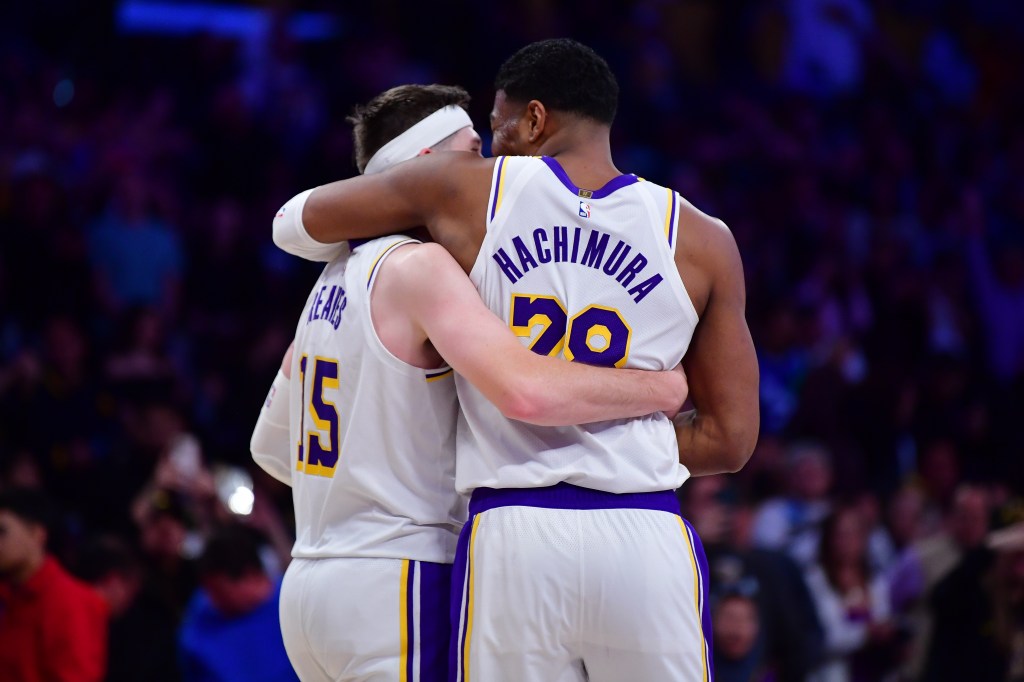
As a fit alongside Dončić and James next season — and alongside just Dončić after James retires — the Lakers would benefit more from keeping Hachimura than Reaves. The 27-year-old former lottery pick took a major step forward as a shooter this season, draining 41.3% of his triples, and while his overall stats — 13.1 points, 5.0 rebounds, and 1.4 assists per game — aren’t as gaudy as Reaves’, he makes more sense alongside both jumbo playmakers as a reliable three-and-D wing. Making Hachimura play 84% of his minutes at center during the first round wasn’t ideal, and Los Angeles was outscored by 14.8 points per 100 possessions with him on the floor, but he played capable defense against all three of Randle, Edwards and Rudy Gobert while finishing with two straight 23-point performances.
Because Hachimura makes $5 million more per season than Reaves, his salary is easier to include in either a hypothetical Claxton deal or a sign-and-trade involving Turner. But the Nets already have a better three-and-D wing than Hachimura on their roster in Cameron Johnson, the Pacers would likely rather flip him to a third team in order to facilitate finding a replacement for Turner, and the Jazz might find it less palatable to absorb his contract, given that Kessler is set to make only $4.9 million next season. Brooklyn might also ask for more additional assets in a Claxton deal centered around Hachimura than one centered around Reaves, given that Reaves is likely more valuable to the rebuilding franchise than Hachimura.
Dorian Finney-Smith
Could Los Angeles really deal Finney-Smith straight back to Brooklyn after just 48 games with the team? It didn’t give up too many assets to acquire his services — just Russell, Maxwell Lewis, and a few second-round picks. Russell was quite the disappointment in his 29 games — shooting just 29.7% from beyond the arc — and Lewis broke his leg in his first game with the team, returning six weeks later and eventually finding his groove for an injury-crushed roster. Finney-Smith was solid as a Laker in the regular season, making 39.8% of his three-point attempts, but he was fairly disappointing in the playoffs. His defense is somewhat better than Hachimura’s, but he offers less offensive versatility and is nearly five years older.
Finney-Smith is a more seamless fit into any team’s roster than Hachimura is because his 13.0% career usage rate is 5.5 percentage points lower than Hachimura’s. Hachimura drove nearly once more per game than Finney-Smith, got slightly more touches, and averaged slightly more dribbles per touch in 2024-25. Finney-Smith, on the other hand, is happy to just stand in the corner and play physical defense; three-pointers accounted for 74.6% of his shots with Los Angeles, and every single one of his made triples was assisted. A contending team like Indiana might prefer to have Finney-Smith on its roster than Hachimura, although the Lakers would have to give up more additional assets alongside him in a potential Turner deal — possibly both Vincent and Knecht. The Nets would likely rather have Hachimura.
Ultimately, Finney-Smith is probably not going anywhere, and not just because he’d net less in return than either Hachimura or Reaves. He also played with Dončić for four and a half seasons with the Dallas Mavericks. Dončić has shared more minutes on the court between his Dallas and Los Angeles stints with Finney-Smith than with any other player and considers the veteran to be one of his best friends. Given his value to the team as a friend and mentor to Dončić, the Lakers will likely prioritize bringing him back.
Dalton Knecht
I’m concerned that Knecht will turn into another Talen Horton-Tucker, who Los Angeles reportedly refused to give up in a possible deal for future Hall of Famer Kyle Lowry, who was still a high-quality player at that time. Then, the Lakers re-signed Horton-Tucker instead and let Alex Caruso walk before dealing him for Patrick Beverly when, reportedly, a Toronto Raptors first-round pick was on the table. It’s unclear whether Rob Pelinka didn’t pull the trigger on the Williams deal because of the 2031 unprotected first-round pick or because of Knecht, but regardless, it wasn’t a great decision.
Across the first half of the season, Knecht averaged a solid 20.7 minutes per game as a vital part of the rotation. And though he drained 40.8% of his threes after the deal, his minutes dipped precipitously as he usually didn’t see the floor much outside of garbage time unless one of Los Angeles’ stars was missing. He still demonstrated his potential when he got starter-level minutes, dropping 32 points in that March 14 loss to Denver and 27 in the final game of the season, but he played just four total minutes in the playoffs. His four 25-plus-point games tied for third behind only Rookie of the Year Stephon Castle and first overall pick Zaccharie Risacher, who had five each, but he ranked as the league’s 10th-worst defender by defensive box plus-minus.
Knecht’s $4.01 million salary is easily tradable in a deal for Kessler and Pelinka’s initial offer will surely be centered around him, but the Jazz might want more than a 24-year-old sharpshooter who might not be able to shoot in return for their big man, who is younger than Knecht and led the league in offensive boards this season. The Lakers could add the 2031 pick, but that in itself isn’t a particularly appealing package given that a core of Dončić and Kessler should compete for years to come. They could package Hachimura with Knecht to get Kessler and Sexton and deal Reaves for a Hachimura replacement.