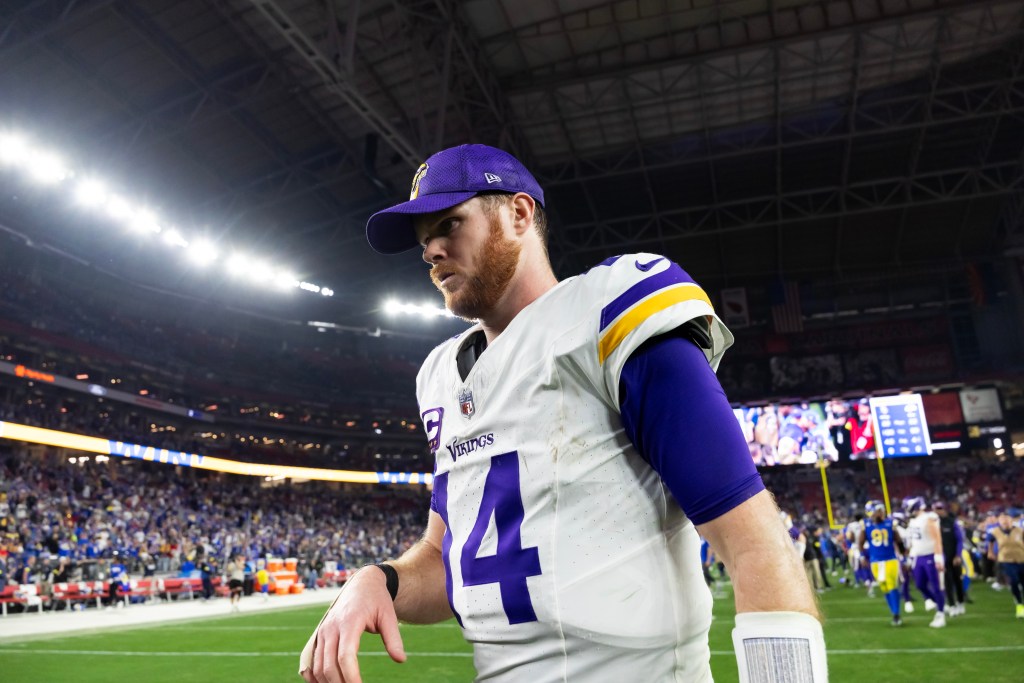
Sam Darnold entered the 2024 season as a bridge quarterback to first-round pick JJ McCarthy, but when McCarthy suffered a torn ACL during the preseason, the seven-year veteran took advantage. He posted by far the finest season of his career, setting the stage for the Vikings to bring him back in a longer-term role. But then he struggled in a winner-takes-the-first-seed game against the Detroit Lions in Week 18 and in the Wild Card Round loss to the Los Angeles Rams, muddying his perceived future with the team.
Whether or not Minnesota eventually brings him back, it won’t be via the franchise tag, according to ESPN’s Adam Schefter.

Under the NFL’s rules, a franchise tag effectively binds a player to his team on a one-year contract. While there are three types of franchise tags, the most common is the non-exclusive tag, which allows a team to match a player’s offer sheet from another team or receive two first round picks in compensation and pays the player the average of the top five salaries at his position over the last five years or 120% of his current salary, whichever is greater. In Darnold’s case, the tag would’ve been a one-year, $41.325-million pact, since his 2024 salary was just $10 million.
Clearly, the Vikings weren’t comfortable enough with Darnold to go all-in for a season around him. According to Schefter, Minnesota would still like to bring him back, likely on a longer-term, possibly incentive-laden deal. The Vikings are projected to have $60.5 million of effective cap space, the fourth-most in the league. But Minnesota has several impending free agents — including three others who appeared in more than 90% of the team’s snaps in 2024 — so it’ll have to be careful in its negotiations with Darnold.
There are also four other quarterback-needy teams with enough cap space to sign Darnold to a contract with higher AAV than the franchise tag: the Las Vegas Raiders, Pittsburgh Steelers, New York Jets, and Tennessee Titans.
Let’s take a look at three possible Darnold landing spots, starting with his current team:
Minnesota Vikings
Darnold’s most likely option is returning to the team with which he resuscitated his career. The Vikings probably wouldn’t anoint him the starter, given that McCarthy has done nothing to disprove the notion that he’s the quarterback of the future after the team traded up to get him. With Minnesota, Darnold likely wouldn’t make more than $15 million per season as McCarthy’s backup, so it all depends on whether or not there’s a team that sees him as a viable starter. With Matthew Stafford returning to the Los Angeles Rams, it’s not a particularly deep quarterback class, and the incoming rookies don’t grade out highly, either.
Currently, the Vikings have +4000 odds to win Super Bowl LX, the 15th-shortest in the league, and those odds would almost certainly be shorter with Darnold on the roster, given that McCarthy wasn’t projected as a Day One starter and will be hard-pressed to reproduce Darnold’s 2024 production. Darnold already has chemistry with several of Minnesota’s core pieces, especially wide receivers Justin Jefferson and Jordan Addison. Unless the Vikings bring in several good free agents with the cap space they’d save, their short-term ceiling is likely to be higher with Darnold than without him, but Minnesota isn’t an inner-circle contender either way, so maybe it shouldn’t care about the 2025 season.
The 2024 season may not have ended how either player or team wanted, but it was remarkable nonetheless, and the Vikings’ front office shouldn’t overlook that as it assesses its options. Darnold was bad during the playoff game, as several of the playoff-record nine sacks he took where his fault, but his offensive line bears partial blame for the collapse as well.
Pittsburgh Steelers
If there’s ever a team that strives to be good, even when a rebuild might be beneficial, it’s Pittsburgh. The Steelers have finished with a record of .500 or better every season since 2004, and head coach Mike Tomlin has recorded an NFL-record 18 consecutive non-losing seasons to begin his career. It’s a remarkable run of consistency that looks to be in jeopardy this season, given Pittsburgh’s four consecutive losses to end the 2024 season and feeble showing in the playoffs.
Overall, the Steelers have a solid roster. Wide receiver George Pickens, when healthy, is more than capable, and while running back Najee Harris had a sluggish end to his season, he’s still a 27-year-old who has opened his NFL career with four consecutive 1,000-yard seasons. There were several defensive bright spots, as well, given that Pittsburgh gave up the sixth-fewest rushing yards in the league despite playing in the same division as Lamar Jackson and Derrick Henry. The quarterback play was the main issue; Russell Wilson and Justin Fields — both free agents — combined to complete 64.3% of their passes for 3,264 yards, the sixth-lowest total in the league. If he plays anywhere near the level he did in 2024, Darnold would be an immediate upgrade over either.
The Steelers are stuck in the dreaded middle, with just +7000 odds to win the Super Bowl in 2026, the 12th-longest in football and second-longest in their own division. With Darnold, Pittsburgh likely would finish with somewhere between nine and 11 wins and lose in the Wild Card Round. If the Steelers are resigned to mere competence, Darnold is their guy, but otherwise, Pittsburgh should look elsewhere.
Tennessee Titans
Of all the quarterback-needy teams with sufficient cap space, the Titans are probably Darnold’s least likely destination, given that they’re almost certainly going to draft former Miami quarterback Cam Ward with the first-overall pick. 2023 second-round pick Will Levis, despite showing occasional flashes, is not an NFL-caliber starting quarterback and shouldn’t factor into the team’s plans.
Still, with the longest Super Bowl odds at DraftKings Sportsbook, Tennessee needs talent all over and could select the best player available, whether that’s Penn State edge rusher Abdul Carter or Colorado defensive back/wide receiver Travis Hunter. As a prospect, Ward has plenty of flaws, while both Carter and Hunter project to be productive starters from their very first snap. There are complicating factors — Carter is coming off a stress fracture in his foot and Hunter can’t play both sides of the ball full-time in the NFL — but both players are better at their respective positions than Ward. What if the Titans prefer the 2026 quarterback class, headlined by Arch Manning, Nico Iamaleva, and Drew Allar?
In the (unlikely) scenario that the team opts for Carter or Hunter over Ward, Tennessee’s roster is probably bad enough from top to bottom that even with Darnold and their rookie, the Titans will still land a top-five pick in the 2026 Draft. Tennessee could give Darnold a one-year deal before moving on next summer, and if he happens to impress, he’s still only 27 years old and conceivably fits the timeline of a rebuilding franchise.