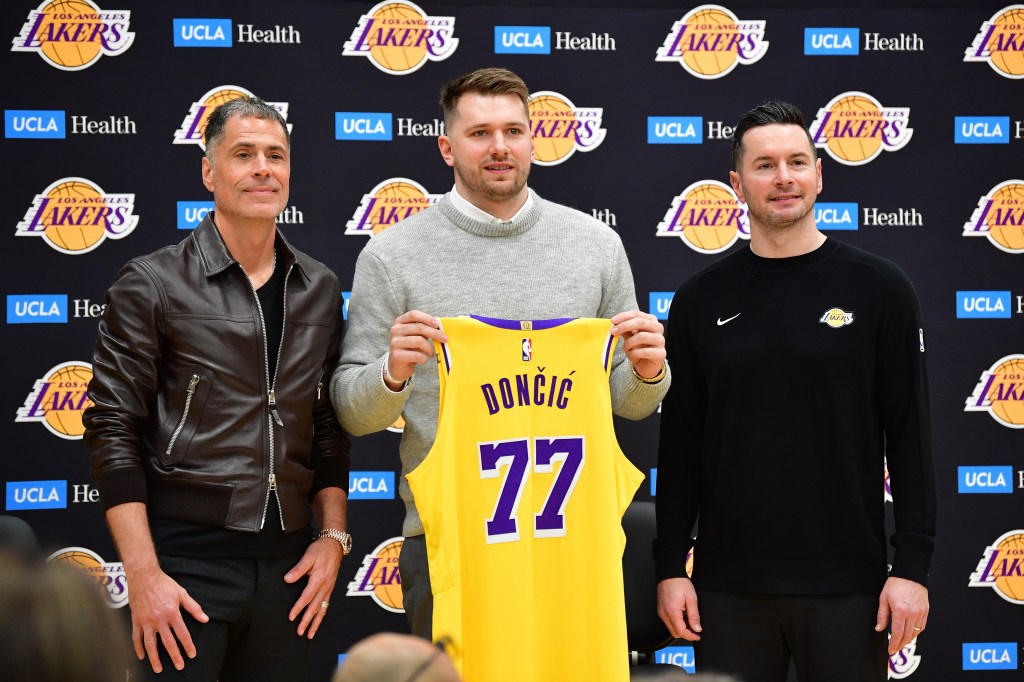
Arguably the most shocking trade deadline in NBA history has come and gone, and after a few years of mostly dull deadlines, basketball is the talk of the sports world, even though there are only three days left until the Super Bowl.
Jimmy Butler and De’Aaron Fox were the two most obvious big names that changed teams, with Butler landing on the Golden State Warriors and Fox reaching his preferred destination, becoming Victor Wembanyama’s sidekick on Jupite—San Antonio. But the Dallas Mavericks’ decision to trade Luka Dončić to the Los Angeles Lakers for Anthony Davis was so unfathomable that it was widely assumed ESPN’s Shams Charania got hacked.
As the dust settles on the wildest few days in NBA history, DraftKings Network is taking a look back at the deadline and picking a few winners and losers. In this column, I’ll take you through three of each, and my colleague Bill Yin will grade the deadline’s biggest moves.
Winner: Los Angeles Lakers
When Mavericks general manager Nico Harrison called his Lakers counterpart, Rob Pelinka, to propose trading Dončić, Pelinka initially thought he was joking. Even Dallas controlling owner Patrick Dumont laughed at at the mere idea. Harrison didn’t even offer Dončić to a different team; he wanted a defensive-oriented big man, but he seemingly didn’t bother to call the Milwaukee Bucks about Giannis Antetokounmpo or the San Antonio Spurs about Victor Wembanyama, although the latter certainly wouldn’t have been available.
Pelinka not only got the deal over the line, he reportedly managed to convince Harrison that Dončić wasn’t even worth Dalton Knecht and an additional first round pick, both of which were in the original package. Los Angeles then flipped Knecht and that pick, along with Cam Reddish, to the Charlotte Hornets, for Mark Williams, a rim-running, hyper-athletic center who’s averaged 18.3 points and 11.5 rebounds per game since the calendar flipped to 2025 and is only 23 years old, younger than Knecht. Williams has injury and attitude concerns, but he fits Dončić’s timeline and is a perfect fit with his skill set.
Los Angeles looked to be stuck in neutral, with no clear succession plan upon LeBron James’ eventual retirement and an injury-prone, even if excellent, center who will turn 32 in just over a month. Sure, the Lakers had won nine of their past 11 games and were creeping up on the Denver Nuggets for the fourth seed in the West, but even the most optimistic fans thought the ceiling was a second-round exit and the floor a first-round exit. The floor is still a first-round exit — Williams still isn’t a good enough defender to contain Jokić — but the ceiling is definitely raised by bringing in a player who just led Dallas to the NBA Finals last June. Los Angeles might not be the title favorite this year, but with Dončić on the roster, its future is as bright as any.
Loser: All 8.1 million people in the Dallas-Fort Worth-Arlington Metropolitan Statistical Area
It’s been five days, and I still don’t understand the trade from the Mavericks’ perspective, unless new owner Miriam Adelson really wants to get under the luxury tax. Literally any other team in the league would’ve given Dončić the five-year, $345-million supermax extension that he was eligible for, and he clarified in his introductory press conference with the Lakers that he never told Dallas he wouldn’t sign it. If Harrison had really wanted to deal Dončić and maximize his return, he could have asked around the league and every team would have given up more than the package he ultimately received from Los Angeles.
This is no knock on Davis, who’s a fantastic player in his own right. Davis has been the best player on the Lakers, even though James is by far the best 40-year-old in league history. The uproar in North Texas over the trade has overshadowed how good Davis has been, averaging 25.7 points, 11.9 rebounds, 1.3 steals, and 2.1 blocks per game. He should fit nicely with Kyrie Irving and Klay Thompson, the two other veteran pieces on the Mavericks’ roster, and he’ll get to play his preferred power forward position. Dallas’ other pickup, Max Christie — a 21-year-old three-and-D wing who had 15 points, nine rebounds, and three steals in his Mavericks debut on Tuesday — is a great role player and should develop into an above-average starter.
But Dončić is a generational talent who is one of three players in NBA history to average 25 points, seven rebounds, and seven assists for his career, along with James and Oscar Robertson. He has been named to the All-NBA First Team in five of his first six seasons in the NBA and would have likely gotten there this season if not for a series of injuries that has cost him 28 games so far. He won an MVP in the second-best league in the world as a 19-year-old, earned the NBA’s Rookie of the Year award the next season, and has been an MVP candidate ever since. Dončić has the second-highest playoff scoring average in NBA history, behind only Michael Jordan.
Dallas fans have canceled their season tickets in droves after the trade, and the team is reportedly offering refunds to those fans. The trade was so egregious that fans held a funeral in front of American Airlines Arena the day after the trade. The Mavericks also lost some 700,000 Instagram followers, including Dončić himself.
Winner: Victor Wembanyama
Wembanyama is already a Top-10 player in basketball, just a month after his 21st birthday, and the San Antonio Spurs are already starting to reap the benefits of having him on the roster. Other stars want to come play with him. The first domino fell when De’Aaron Fox, a Houston native and one-time All-NBA honoree with the Sacramento Kings, indicated that he’d like to play with Wembanyama. Just a few weeks later, he did, scoring 24 points and adding 13 assists in his Spurs debut yesterday.
San Antonio gave up nothing of value in order to get Fox on the roster, offering up backup center Zach Collins, second-year guard Sidy Cissoko, backup point guard Tre Jones, and three relatively weak first-round picks for his services. The Spurs were able to keep guard Stephon Castle, one of the favorites to win Rookie of the Year, along with Jeremy Sochan and Keldon Johnson. They even held onto veteran point guard Chris Paul, who has played tremendous basketball in his 20th season and has been a valuable mentor to both Wembanyama and Castle. They’ll have some decisions to make — Sochan will become extension-eligible after this season and Johnson is a pending free agent — but they’ll have 18 months to see how well the core fits together before Fox reaches unrestricted free agency.
On paper, the fit of Fox and Wembanyama is perfect. Fox is one of the league’s best slashers, and Wembanyama one of its best floor-spacers, both horizontally and vertically. Wembanyama is the league’s premier lob threat, shooting 82.3% within three feet of the basket, and he’s also a league-average three-point shooter on 8.9 attempts per night. With his rim-running ability, pick-and-rolls with Wembanyama as the screener and Fox as the ball-handler should be more or less unstoppable. San Antonio ran precisely that play with a chance to beat the Atlanta Hawks in Fox’s debut, and although Wembanyama was fouled on the play, he hit the game-winning free throw to get the Fox-Wemby era off to a perfect start.
Loser: Golden State Warriors
I understand why the Warriors traded for Jimmy Butler. Butler is a proven playoff performer and might still be an elite perimeter defender, even at 35 years old, and if Stephen Curry ever wants to catch Magic Johnson as the greatest point guard in NBA history, another title certainly wouldn’t hurt his resume. Golden State was not in contention for a championship prior to the trade, and it looked destined for a Play-In Tournament exit — at best.
Butler’s 17.0 points per game are his fewest since his third season and his plus-0.5 defensive box plus-minus is his worst since his rookie season. The Heat have outscored their opponents by 3.1 points per 100 possessions with him on the court, so it’s not all bad, but barring some absolute postseason miracle, the Warriors still don’t have a championship season. Age is finally starting to catch up to the 36-year-old Curry, whose 59.6% true shooting percentage is the worst he’s posted in a full season in more than a decade and whose plus-3.5 on-off figure is one of the lowest in his career. Curry is still a borderline All-NBA player, and Butler’s isolation scoring — his 1.00 points per possession on isos this year ranks 44th among 196 qualifying players — should alleviate some of his immense offensive burden, but an aging Curry, Butler, and Draymond Green aren’t enough. Kyle Anderson and Dennis Schröder were dispensable, but Andrew Wiggins had begun to reclaim some of the form that earned him his first All-Star nod in 2021-22 and will be missed.
Then there’s the two-year, $121-million extension that Butler committed to sign immediately after joining the team. He hasn’t played 65 games since the 2018-19 season, and his body isn’t likely to start treating him better as he ages. The Warriors don’t have a ton of draft capital, either, after giving up a lightly-protected first-round pick to the Heat in this deal. Green is far from a threat on offense now and will turn 35 in less than a month. Butler’s presence on the roster won’t help the development of Moses Moody, Brandin Podziemski, or Jonathan Kuminga. Golden State doesn’t have a succession plan once Curry retires, and it doesn’t have enough to win him another title either.
The Warriors might have been able to emerge a winner if they’d manage to coax a reunion out of Kevin Durant, who, unlike Curry, Butler, and Green, has shown virtually zero signs of his age. But the two-time former Finals MVP was uninterested in rejoining the team and is reportedly unhappy with Phoenix’s front office for fielding offers.
Winner: Cleveland Cavaliers
After largely sitting tight in the offseason while the Philadelphia 76ers and New York Knicks made splashy, win-now moves, Cleveland has firm control over the Eastern Conference 51 games through the 2024-25 season, with a 41-10 record and a five-game lead over the reigning champion Boston Celtics for the top overall seed in the conference. Point guard Darius Garland, shooting guard Donovan Mitchell, and power forward Evan Mobley all earned All-Star nods, and center Jarrett Allen is no slouch either, averaging 13.6 points and 10.3 per game this season.
But the Cavaliers have struggled somewhat with production from the small forward position. Their starter in the last few seasons, defensive specialist Isaac Okoro, has missed significant time with a shoulder injury, and sharpshooter Max Strus has missed significant time as well. By picking up former Atlanta Hawks wing De’Andre Hunter, Cleveland has shored up its one weakness without giving up significant assets. The only pieces the Cavaliers gave up were Caris LeVert, who has averaged 10.3 points in just 23.8 minutes per game this season while playing above-average defense, and Georges Niang, a three-point specialist, as well as a few second-round picks and swaps. Cleveland still rosters backup point guard Ty Jerome, who has enjoyed a tremendous return from an ankle injury that cost him nearly all of the 2023-24 season, as well as promising rookie Jaylon Tyson, sharpshooter Sam Merrill, and Okoro.
This season, Hunter has been one of two Hawks forwards to break out, the other being Jalen Johnson, who is now done for the season after undergoing shoulder surgery. Although he has come off the bench in all but four games — he usually enters in relief of first overall pick Zaccharie Risacher — he has become an indispensable piece for Atlanta, averaging a career-high 19.0 points while shooting 39.3% from beyond the arc. He’s only an average-to-below-average defender, but the Cavaliers should still be fine on that end of the floor. This season, Cleveland’s 122.2 offensive rating is the second-best mark in NBA history, and Hunter should make that even better.
Loser: Toronto Raptors
I don’t understand what the Raptors’ strategy was by trading for former New Orleans Pelicans wing Brandon Ingram. Ingram, a former All-Star, has seen his value diminish in recent years because of his injury concerns. At 27 years old, he’s still good enough and young enough to win games for Toronto but not good enough to be a top-two player on a championship team. The Raptors can still bottom out this year and tank for Cooper Flagg, since Ingram has been out with an ankle injury since December 7 and there is no timeline for his return.
Still, if Ingram returns next year to form a partnership with RJ Barrett and Scottie Barnes, even with a 2025 lottery pick in tow, is that really good enough to win even a playoff series? Barnes earned his sole All-Star appearance last season, and Toronto had no choice but to extend him, even if the price was a little steep for a player that has shot just 30.2% from beyond the arc in his four-year career. Barring improvement, though, I’m not sold that Barnes is capable of being a top-two player on a championship team.
Since losing Kawhi Leonard in the 2019 offseason, the Raptors have kind of been stuck in the dreaded middle, being too good to truly land a top prospect and too bad to compete for a championship. They took some steps towards the bottom last season, trading Pascal Siakam to the Indiana Pacers, OG Anunoby to the New York Knicks, and Kyle Lowry to the Miami Heat, and that decision has paid off so far this season, as Toronto is just 16-25, good for the fifth-worst record in the league. That’s why the Ingram trade makes no sense — why bite on a guy who raises the ceiling to a play-in team?
Maybe the Raptors will win the lottery, draft Flagg, and go on to win a title with Ingram as a valuable role piece, but for now, things are going south in the North.